
On two wheels this is a preference. On three it is a structural decision. A trike carries two wheels on one axle, so where the motor sits decides whether a differential will fit, whether the vehicle can reverse under power, and which wheel breaks traction first. Most published comparisons answer the bicycle question. This is the trike version, for people writing a specification.
Why the bicycle answer does not transfer
Two things change the moment you add a third wheel, and both are geometric rather than electrical.
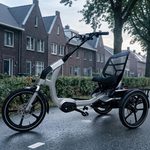
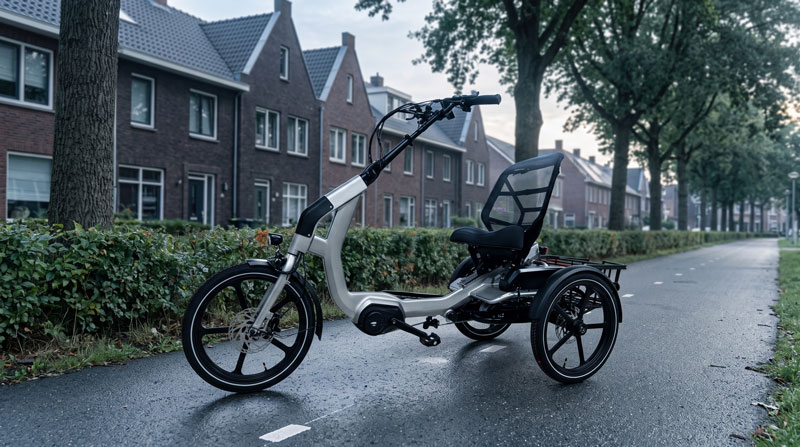
The first is layout. The industry splits trikes into delta — one wheel at the front, two at the rear — and kijanka, two at the front and one at the rear. As the standard description of tricycle drive arrangements sets out, delta trikes sit higher and turn tighter, while tadpoles usually borrow a bicycle’s rear-wheel drive and are therefore lighter and cheaper to repair. Almost every senior and comfort trike sold in Europe is a delta, which means almost every drive decision in that segment is a decision about a two-wheel rear axle.
The second is naming. A bicycle mid-drive sits between the wheels. On a recumbent or semi-recumbent trike the pedals are out on a front boom, so the so-called mid-drive physically sits at the front of the vehicle — specialist recumbent retailers point out that “front drive motor” would describe it more honestly. The term survives because the motor still drives through the gears, which is the property that matters. Keep that distinction when you read a spec sheet: mid-drive describes a torque path, not a position.
So the real question in hub motor vs mid drive trike sourcing is not which motor is stronger. It is which torque path suits an axle that has two wheels on it.
Front hub vs rear hub motor: structural, not a matter of feel
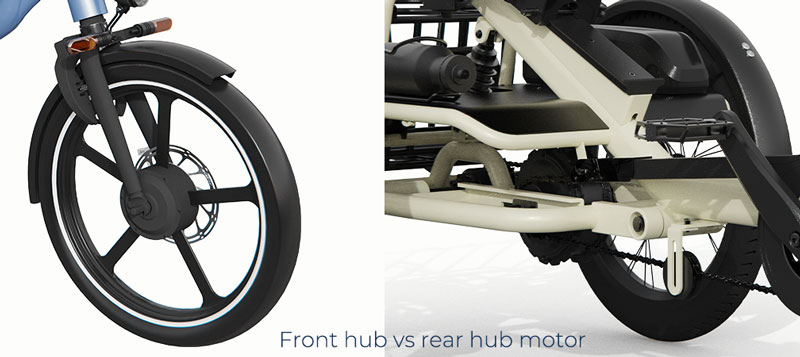
Most hub motor vs mid drive trike comparisons treat hub placement as a ride-feel preference — a rear hub pushes, a front hub pulls. True, but it buries the engineering.
A front hub on a delta trike sits on a single, undriven, steered wheel. That wheel is free real estate: nothing else is competing for it, installation is simple, and the chain is untouched. The cost is traction. On a delta trike the rider’s mass sits rearward, so the front wheel is the lightly loaded end. Under hard forward drive on a wet surface or a gradient, that is the wheel that slips first — which is why a front hub is a poor choice as a trike’s primary forward drive, whatever its torque rating.
A rear hub has to cope with the fact that there are two rear wheels. You get two options, and they are genuinely different products:
- Drive one rear wheel only. Simple and cheap, and the usual arrangement on inexpensive delta trikes. Under load the vehicle pulls toward the driven side, and in a corner the driven wheel fights the undriven one.
- Drive both through a differential. An electric trike differential lets the outer wheel travel further than the inner one through a turn while both still receive drive. It costs weight, cost and complexity, and it is the difference between a trike that tracks straight under power and one that does not.
This is also where front hub vs rear hub motor decisions collide with the gearbox. The reference account of trike drivetrains notes that trikes with a differential often use an internally geared hub as the gearbox in a mid-drive system — which is exactly why UnitedMobility’s delta platforms pair an Ananda mid-drive with a Shimano 8-speed internal hub and a rear differential rather than a rear hub motor. Once you commit to a differential on the rear axle, the rear wheels are no longer available for a hub motor, and the drive has to arrive at the axle through a chain. The differential chooses the motor, not the other way round.
Reverse assist is often the requirement that settles it
This is the deciding factor more often than any performance number, and it is almost absent from published comparisons.
A mid-drive delivers power through a chain and a freewheel. A freewheel, by construction, will not drive the wheel backwards. So a mid-drive trike cannot reverse under power without additional hardware — and a 55 kg trike with a seated rider cannot be shoved backwards out of a lift, a hallway or a parking bay by its rider, particularly the older rider this category is sold to.
A hub motor reverses in firmware. Nothing mechanical has to change.
That asymmetry is visible across UnitedMobility’s own range: the models that list a reverse function run hub motors somewhere in the driveline, and the pure mid-drive models do not. If your market stores vehicles indoors or your dealers demo in tight showrooms, electric trike reverse assist belongs in the specification before torque does, because it eliminates configurations rather than ranking them.
Dual motor electric trike: what actually exists, and what does not
“Dual motor” is used loosely enough in this category that it is worth separating three different things.
Dual battery is not dual motor. Several trikes marketed with “dual” in the product name carry two battery packs and one motor. Read the motor line, not the title.
Simultaneous dual hub drive does exist. In the US fat-tyre segment, trikes in the 750 W class are sold with front I rear hub motors and advertised all-wheel-drive modes, with combined torque claims around 180 N·m and peak power figures above 2 kW. This works because both motors are direct drive at their own wheel: same effective ratio, no gearbox between them, so a controller can simply split current between the two without arbitrating anything.
Simultaneous mid-drive plus hub drive is a different problem, and production trikes do not do it. The mid-drive’s output passes through a variable gear ratio; the hub is locked to wheel speed. At any given moment the two want different wheel speeds, so blending them smoothly requires real-time torque arbitration between two unlike actuators — and getting it wrong produces one motor dragging the other, heat, and a surge the rider feels through the seat. The cost and calibration burden are hard to justify on a 25 km/h vehicle.
The workable answer is to stop trying to blend them and split them by function instead. On the UM Apta, a 120 N·m Ananda M100 mid-drive handles all forward propulsion through the internally geared hub, and a dedicated front hub motor handles reverse on a button. The two never run together, which is precisely why the system needs no arbitration — each motor owns a job the other cannot do. The rear differential stays where it belongs, and reverse stops being a feature that a mid-drive platform has to go without.
That design is a deliberate answer to the dual-motor coordination problem rather than a marketing use of the phrase. A dual motor electric trike built this way should be specified and sold as split-function, not as all-wheel drive — a distinction worth getting right in dealer training, because a buyer who expects both motors to push will report the product as faulty.
How to brief a hub motor vs mid drive trike spec
| If your market needs… | Specify |
|---|---|
| Sustained climbs, loaded hill starts | Mid-drive through an internally geared hub |
| Straight tracking under power, both rear wheels driven | Mid-drive plus rear differential |
| Reverse under power | A hub motor in the driveline — or split-function dual motor |
| Lowest cost, flat terrain, simple service | Single rear hub motor, one driven wheel |
| Service by non-specialist workshops | Hub motor — sealed, swappable, no parts account |
| Throttle operation (US and similar) | Hub motor; mid-drives rarely offer a throttle |
Two cautions before you sign anything on a hub motor vs mid drive trike build. First, compare gradeability at your target gross weight from a standing start, not headline torque: 120 N·m at the crank through a low gear and 60 N·m at the wheel are different currencies, which is why these figures are calculated per configuration at quotation. Second, a drive system’s character comes from calibration more than components — the assist map and the taper band near the 250 W, 25 km/h envelope set by EN 15194 decide the ride, and that work is covered in jak kalibrujemy układ napędowy trójkołowego roweru elektrycznego.
UnitedMobility builds both torque paths on shared delta platforms — mid-drive, rear hub, or split-function dual motor, with torque or cadence sensing and EU or throttle-equipped settings — so a market read can be tested in a small batch rather than committed to at platform level. The wider framework for that decision sits in our pillar on electric trike drive systems, the stability consequences of moving mass and drive around are in inżynieria stabilności trójkołowca elektrycznego, and the equivalent question for two-wheeled cargo platforms is covered separately in mid-drive motors in cargo e-bikes. If you want a configuration priced against your own terrain and channel, that starts on our Usługa ODM strona.
Często zadawane pytania
Is a mid-drive better than a hub motor on a trike?
For climbing and loaded hill starts, yes, because it multiplies torque through the gears. For cost, serviceability, throttle operation and reverse, the hub motor wins. On a delta trike the decision is usually made by the rear axle: committing to a differential commits you to a mid-drive.
Why do trike mid-drives sit at the front?
Because on a recumbent or semi-recumbent trike the pedals are on a front boom, so the crank-mounted motor ends up ahead of the rider. It is still a mid-drive in the sense that matters — it drives through the gears.
Can two motors on a trike work at the same time?
Two hub motors can, and some US-market trikes are sold that way, because both are direct drive at the same effective ratio. A mid-drive and a hub motor cannot be blended smoothly without real-time torque arbitration, so production designs split them by function instead: mid-drive forward, hub for reverse.
Do I need a differential?
If both rear wheels are driven, yes — without it the wheels fight each other in corners. If only one rear wheel is driven, no, but accept that the trike pulls toward the driven side under load.
Can a mid-drive trike reverse?
Not without extra hardware. The freewheel in the chain drive will not turn the wheel backwards. Reverse requires a hub motor in the driveline, which is the practical reason split-function dual-motor layouts exist.
 Polish
 English
 German
 Dutch
 Danish
 French
 Portuguese
 Spanish