

An electric trike with reverse is not a convenience feature. It is the line that removes a buyer’s pre-purchase fear — the moment they imagine a dead end, a lift, or a parking bay and realise they cannot shove 55 kg backwards by hand. Reverse costs little, is limited to walking pace, and is only possible with a hub motor in the driveline. Specify it before you specify colours.
First, a disambiguation: reverse function, not reverse layout
In English the phrase “reverse trike” usually means a layout — two wheels at the front, one at the back, what the industry calls a tadpole. This article is about none of that. An electric trike with reverse means a vehicle that can drive itself backwards under motor power, and the layout it most often appears on is the opposite one: a delta, with one wheel at the front and two at the rear. If you are comparing wheel arrangements rather than drive functions, the layout question belongs with sistemas de acionamento de triciclos elétricos em vez de.
Why reverse decides the sale
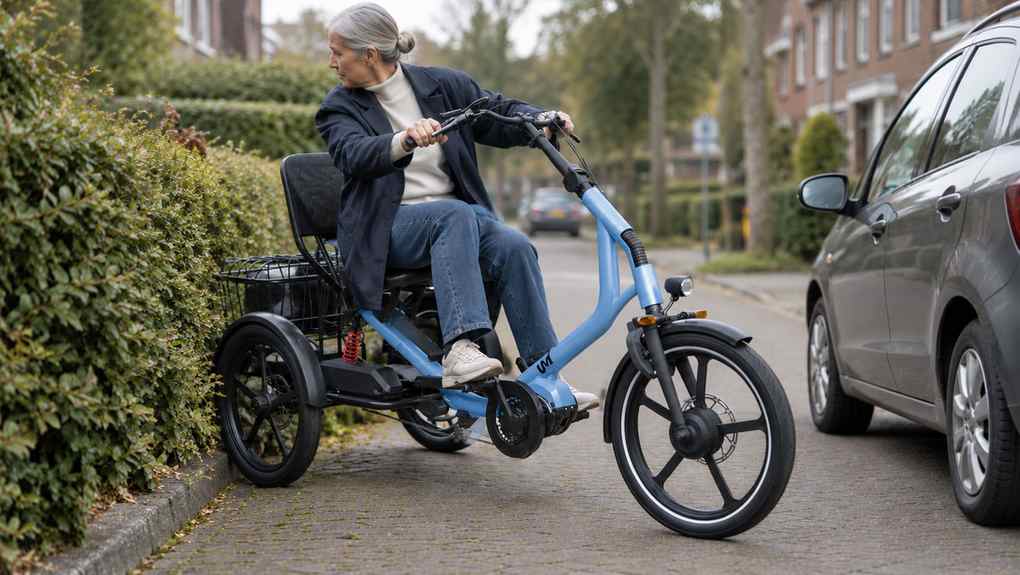
Ask a dealer where trike demonstrations fail and you will not hear about torque figures. You will hear about the first two metres and the last two.
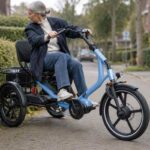
A seated rider on a semi-recumbent trike cannot paddle backwards with their feet the way they can on an upright bicycle — the seat is too low and too far back, and there is a frame between the rider and the ground. A standing rider cannot drag the vehicle either: a mid-size delta trike is around 55 kg before any cargo. So when a prospective buyer pictures the lift in their building, the hallway outside their flat, or the dead-end of a supermarket aisle, the honest answer without reverse is you will have to find someone to help you. That is the sentence that loses the order.
What an electric trike with reverse sells, therefore, is not convenience. It is confidence, and it is felt before purchase rather than after. The customer with no cycling background arrives already worried about getting stuck; “ride it in, press the button, back it out” answers the worry in one sentence. Dealers consistently report this as the single most persuasive demonstration they can run, and it costs them nothing to run it.
UnitedMobility has had customers specify powered reverse unprompted on semi-recumbent trike projects — not as a wish-list item late in the brief, but as a requirement stated at the first enquiry. When a feature arrives that early in a conversation, it is not a feature. It is a gate.
Who needs it: weight, rider capability, narrow space manoeuvring
Three variables decide whether reverse moves from nice-to-have to mandatory.
Kerb weight. The heavier the vehicle, the less realistic human muscle becomes as the reverse mechanism. The European Commission’s road safety observatory makes the same point from the crash side: in its thematic report on cyclists, pedelecs “are heavier, which affects balance, especially when mounting and at low speeds.” A trike removes the balance problem and keeps the mass problem. Reverse is how you remove the mass problem.
Rider capability. The same report records that in 2020, 47% of cyclist fatalities in its scope were aged 65 or over, against a 21% share of the population, and that one of the three main crash types for Dutch cyclists aged 50 and over is colliding with another road user or an object at low speed. Low speed is precisely where manual manoeuvring happens. For an triciclo elétrico para idosos, a powered reverse is not a comfort item in the same category as a padded saddle; it addresses the specific situation in which this rider group gets hurt.
Route and storage. Narrow space manoeuvring is a property of the route, not of the rider. Lifts, bicycle stores, shared hallways, kerbside bays between parked cars, and the turning circle available at the end of a cycle path all decide how often the vehicle has to be reversed. Ask the buyer where the vehicle sleeps, not just where it rides. Our note on electric trike positioning works through how those storage realities differ by channel and market.
Put plainly: a 25 kg upright trike ridden by an active 55-year-old on open suburban roads may never need reverse. A 55 kg semi-recumbent trike stored in a Dutch apartment block and ridden by a 78-year-old needs it on day one.
Hub motor reverse works, a mid-drive alone cannot
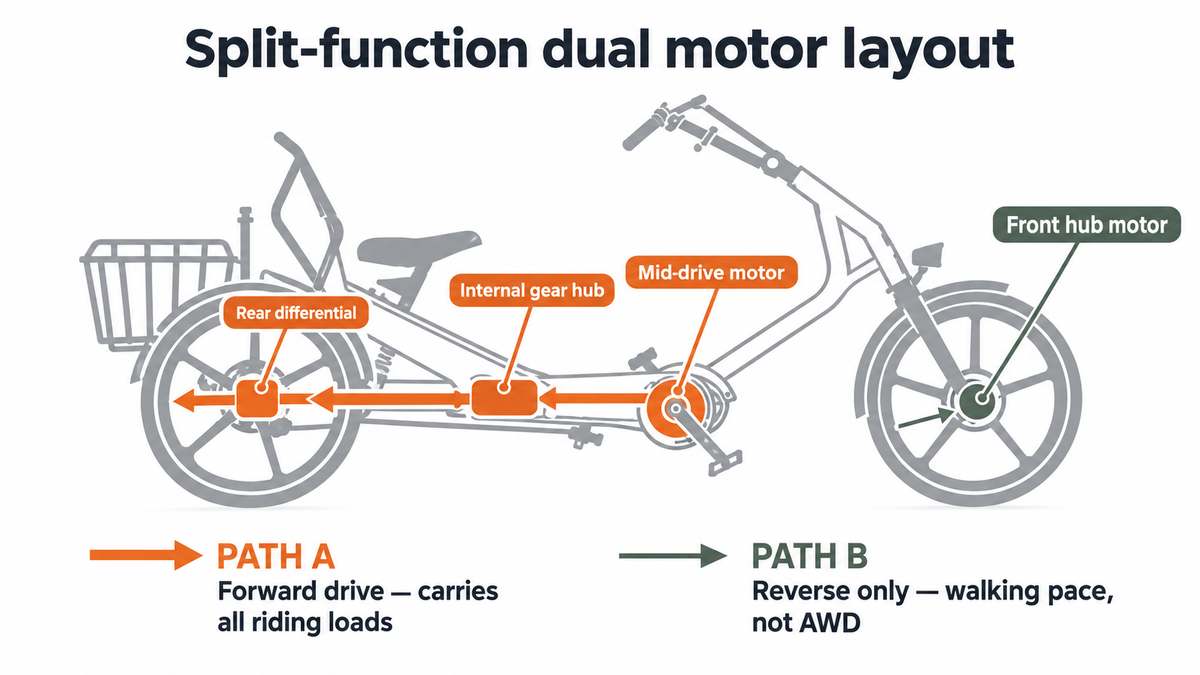
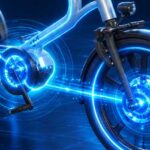
This is a hardware fact, not a configuration preference. A hub motor reverse is simply the controller running the motor the other way, which is why both a front hub and a rear hub can provide it. A mid-drive cannot, because the one-way clutch between the motor and the chainring transmits torque in the drive direction only — we work through that mechanism in motor de cubo versus triciclo com motor central and will not repeat it here. The consequence is what matters for your bill of materials: if the specification says reverse, there is a hub motor somewhere in the driveline, whether or not there is also a mid-drive doing the forward work.
Two commercial points follow, and both run against the assumption buyers arrive with.
The first is cost. Hub motors are the cheaper motor architecture, so reverse is not a premium upcharge bolted onto an expensive drivetrain. In practice it tends to arrive on the more affordable builds and to be absent from the sportier mid-drive ones — the opposite of how buyers expect features to be distributed.
The second is that reverse constrains the rest of the driveline, which is why it belongs in the brief rather than in a change request. On a UM Apta, the split-function layout exists for exactly this reason: the mid-drive does the riding and a front hub motor exists to reverse, because no single motor architecture does both well.
What riders actually notice at 3–4 km/h
Customers hearing “motor-driven reverse” for the first time usually imagine a vehicle that lurches backwards. Say the number early. Reverse is limited to roughly 3–4 km/h — slow walking pace — and it is held there by the controller rather than by rider restraint, so it cannot run away from someone who is already nervous.
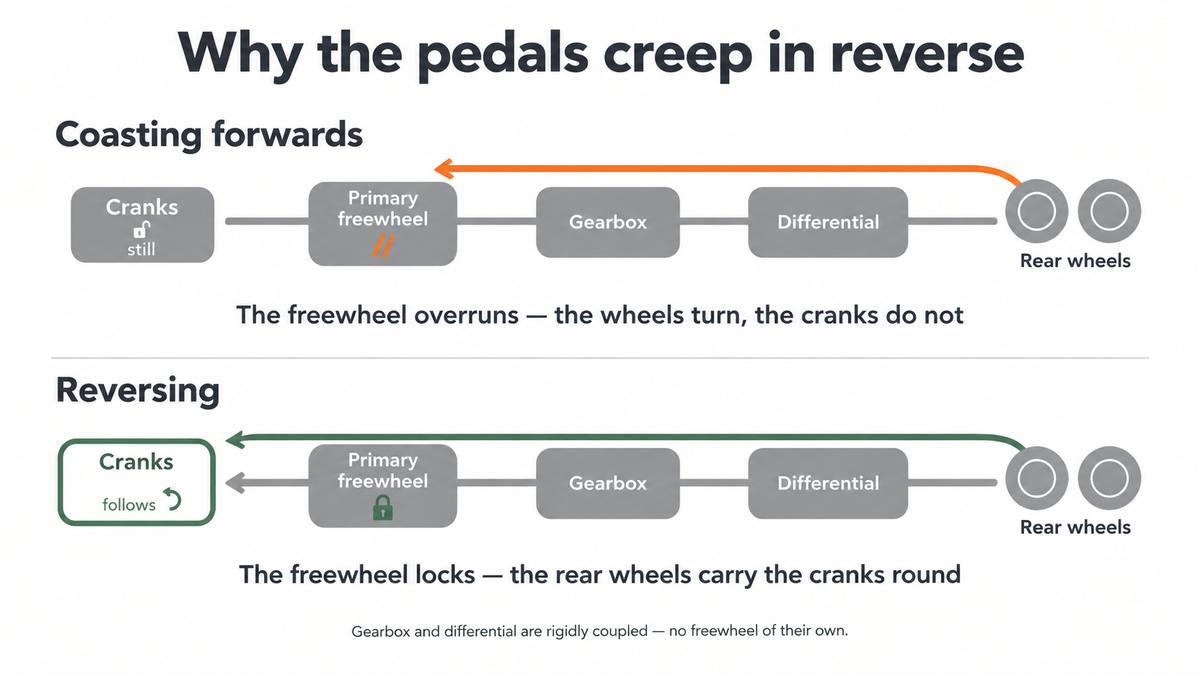
There is a second behaviour worth naming openly, because a dealer who hears about it from a customer will log it as a fault. While the trike reverses, the pedals creep round slowly. They do not do this when the vehicle coasts forwards.
The reason is a one-directional component, and it is worth a sentence because it reassures rather than alarms. The freewheel in the primary drive lets the wheels overrun the cranks in the forward direction, which is why forward coasting leaves the pedals still. In reverse, that freewheel locks instead of overrunning, and since the gearbox and differential behind it are rigidly coupled with no freewheel of their own, the rear wheels turning backwards carry the cranks with them. It happens whether the reverse comes from a front hub or a rear hub, because in both cases the rear wheels are rolling backwards. Over the two or three metres a reverse manoeuvre actually covers, the cranks move well under a full turn — riders describe it as the pedals following along, not spinning.
Brief your dealers on this before the first unit ships, with one instruction attached: keep both feet on the pedals or both feet off, and do not put a foot down mid-manoeuvre. That is a fifteen-second conversation at handover and a cancelled service visit later. UnitedMobility ships it as a handover note rather than burying it in the manual, because an unexplained normal behaviour costs more in support than an explained one.
Specifying an electric trike with reverse
Most briefs say “reverse function: yes”, which is not a specification. Four attributes make it testable at inspection:
| Attribute | What to state | Why it matters |
|---|---|---|
| Motor providing reverse | Front hub or rear hub, with position | Determines traction when reversing up a slope or over a kerb lip |
| Maximum reverse speed | e.g. 3–4 km/h, controller-limited | The limit must be in firmware, not in the handbook |
| Activation | Button, switch, or hold-to-run | Hold-to-run stops unintended engagement when parked |
| Behaviour at release | Immediate cut-off | Prevents creeping after the rider lets go |
One legal note that is routinely asserted without a source, so handle it carefully. Regulamento (UE) n.º 168/2013 excludes pedal cycles with pedal assistance of up to 250 W whose motor output “is cut off when the cyclist stops pedalling”, and separately excludes vehicles “with a maximum design speed not exceeding 6 km/h”. The words reverse, walk e start-up assistance do not appear anywhere in that regulation. The widely repeated industry position that a pedelec may be driven without pedalling below 6 km/h is a reading of those two exclusions together, reinforced by the pedelec convention that a push- or start-assist mode may be operated by a switch rather than by pedals — not an explicit clause you can point a customs officer at. Treat the walking-pace limit as a design constraint you must hold, and confirm the position in each destination market rather than assuming it transfers. If you want that check handled alongside the rest of the compliance package, it is part of what we cover in our Serviço ODM.
Perguntas frequentes
Can any electric trike be fitted with reverse later?
Only if a hub motor is already in the driveline. Retrofitting reverse to a pure mid-drive trike means adding a hub motor and its controller — a driveline change, not an accessory. Decide at the brief stage.
Is reverse legal on a pedal-assist trike in Europe?
The walking-pace reverse used in this category is designed to stay inside the same ≤6 km/h envelope the industry relies on for push assistance. Regulation (EU) No 168/2013 contains no explicit provision for it, so confirm the interpretation market by market before you commit to a launch.
How fast does reverse go?
Around 3–4 km/h, limited in firmware. It is deliberately slower than walking so that a rider who is nervous about the function cannot be surprised by it.
Why do the pedals turn when the trike reverses?
Because the primary freewheel only overruns in the forward direction. Going backwards it locks, and the rigidly coupled gearbox and differential carry the cranks round with the rear wheels. It is normal, it covers less than a full crank turn in a typical manoeuvre, and riders should keep their feet in one position while reversing.
Does a reverse assist electric trike cost significantly more?
No. Reverse rides on hub motor hardware, which is the cheaper motor architecture, so it is usually a small addition rather than a premium tier. The cost that matters is the one you pay for omitting it at the brief stage and adding it afterwards.
Figures current as of October 2026; verify regulations and certifications directly in each destination market.
 Portuguese
 English
 German
 Dutch
 Danish
 French
 Polish
 Spanish