


City ebike wholesale europe is a specification audit wearing the clothes of a price negotiation. The four numbers on a quotation — 250 W, 25 km/h, 80 km, IPX4 — are each defined somewhere, and each can be perfectly true on paper while the bike behaves differently in a Dutch February. This guide gives a European distributor seven checks to run before signing, what a durable answer looks like, and the reply that should end the conversation.
What 250 W continuous rated power actually means
The 250 W figure on a European city ebike is a declared continuous rating, not a measurement of what the motor can deliver on a hill. Regulation (EU) No 168/2013 keeps pedal cycles out of vehicle type approval on three conditions at once: the auxiliary motor’s maximum continuous rated power does not exceed 250 W, the assistance is progressively reduced and finally cut off before the vehicle reaches 25 km/h, and the motor cuts out when the rider stops pedalling. Miss any one of the three and the vehicle is no longer an EPAC — it has left EN 15194 and entered a different approval regime entirely.
That is why “is it 250 W?” is the wrong question. The right one has three parts, and each has a document behind it:
- The declared rating. Ask for the nameplate photograph and the page of the EN 15194 report that states the maximum continuous rated power. Peak output is a different number and is allowed to be three times higher; a listing that advertises 600 W while the nameplate says 250 W has told you both things, and only one of them is the legal one.
- The cut-off behaviour. Assistance must taper and stop by 25 km/h. Ask for the controller parameter sheet showing the set point, not a marketing line saying “25 km/h”.
- The stop-pedalling condition. A throttle that drives the bike without pedalling moves the product out of the EPAC definition, whatever the motor rating says.
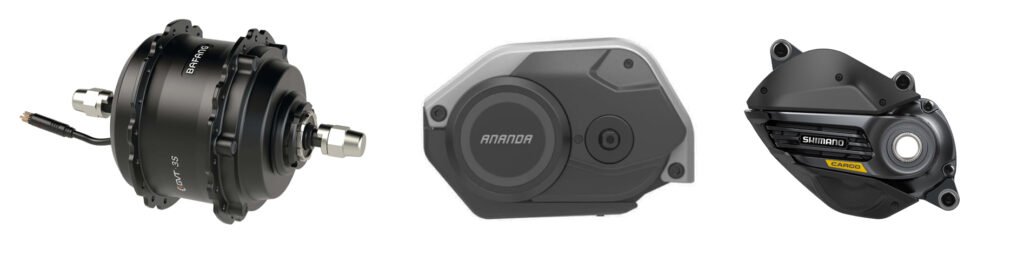
The check almost nobody runs is the one that catches real bikes. Assist cut-off is computed from wheel speed, and wheel speed is computed from a circumference value in the controller. If that parameter is set for a 28-inch wheel and the container ships with 27.5-inch wheels and 2.1-inch tyres, indicated speed reads low against GPS, and the true cut-off lands above 25 km/h. The bike is non-compliant on delivery while the parameter sheet looks perfect. Ask the factory to confirm the circumference value against the shipped tyre specification, and verify one production sample against GPS before you accept the batch. This is a two-minute test that has saved distributors an entire container. How the motor itself is characterised on a bench is the other half of that file — our note on testing an electric bike motor covers the load points worth asking for.
Range claims only become comparable in Wh per kilometre
No harmonised test protocol binds the range number on a European city ebike specification sheet, which is why the figures across suppliers are not comparable as written. Two disclosed numbers make them comparable: consumption in Wh/km, and usable energy in Wh.
Nominal energy is the easy one — volts times amp-hours. Usable energy is the honest one, and it is always lower. The battery management system stops discharge before the cells are empty, depth of discharge is capped to protect cycle life, and cold weather cuts delivered capacity further. A 36 V 14 Ah pack is 504 Wh nominal; at a 90 per cent depth-of-discharge limit that is roughly 450 Wh of usable energy before temperature is considered at all.
Amp-hour ratings carry their own trap. Capacity is normally measured at a low rate such as 0.2C at 25 °C. A pack described as 14 Ah at that rate delivers measurably less when drained continuously at 1C on a cargo-heavy commuter, so two packs that both read “14 Ah” are not the same product. Ask at what rate the figure was measured, and how the pack is specified beyond that one number — our battery specification guide lists the parameters that belong on the sheet.
Then apply it to city duty. Stop-start riding is dominated by acceleration mass rather than top speed, so a heavier build with an identical motor and pack returns a worse figure in town than on the flat loop used for the claim. Ask for consumption at a stated rider mass, assist level, ambient temperature and surface, then divide your usable Wh by it yourself. If you want the pack architecture behind that number, our cargo bike battery system strategy sets out how cell choice, BMS thresholds and pack format interact.
IP rating is measured per component, and the weakest one sets the ceiling
The IP code comes from IEC 60529 and has two digits: solids, then water. An X means that half of the test was not performed, so IPX4 says nothing whatsoever about dust. The scale is also not cumulative above the sixth digit — a component rated IPX7 has been immersion-tested and has not necessarily been jet-tested. Those two facts dismantle most of the water-resistance claims in the category.
| Code | What was actually tested | What it does not tell you |
|---|---|---|
| IPX4 | Splashing water from any direction, about ten minutes | Nothing about dust, jets or immersion |
| IPX5 | Water jets from a 6.3 mm nozzle at 12.5 l/min | Nothing about dust or immersion |
| IPX6 | Powerful jets from a 12.5 mm nozzle at 100 l/min | Not pressure-washer clearance, and not immersion |
| IPX7 | Immersion at 1 m for 30 minutes | Nothing about jets — the scale does not stack |
| IP65 | Dust-tight, plus jets | Applies only to the component that was tested |
| IP67 | Dust-tight, plus immersion | Still nothing about jets; an IP67 part need not pass IPX5 |
There is no such thing as a whole-bike IP rating. A bike is a system of separate enclosures, and the practical water resistance of the product is set by the weakest one. In city use the weak point is almost never the pack — it is the charge port behind a rubber flap that has been opened three hundred times, or the harness junction under the down tube where spray collects.
So ask for a code per component: pack, motor, display, controller, charger, and the main harness junction. Then ask two questions that separate engineering from marketing. Was the pack tested as a new unit, and what happens to that seal after two winters of vibration and heat cycles? And does the port have a drain path, or does water that gets past the flap sit on the contacts? For year-round commuting, a sensible target is IP65 on motor and pack with a defined answer for the port; IP67 is protection against an accidental dunking, not permission to ride through a flooded street.
Spare parts: what Article 11 changes for a European city ebike
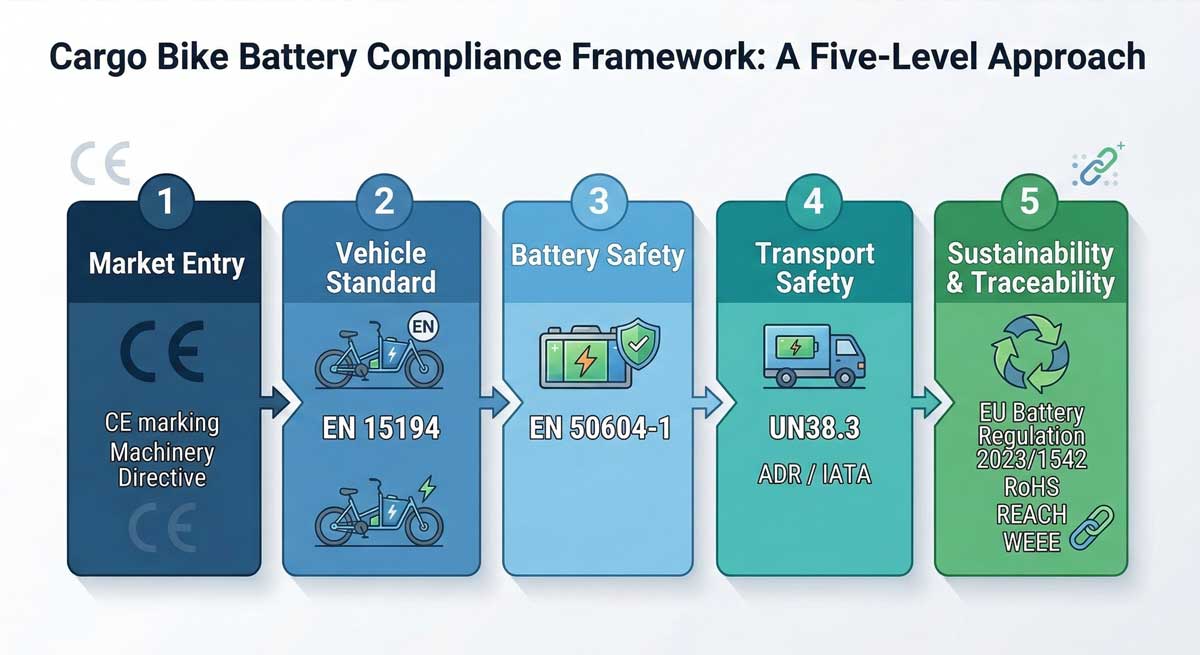
Battery replaceability stops being a customer-service preference and becomes a market-access condition on 18 February 2027. Article 11 of Regulation (EU) 2023/1542 requires that light-means-of-transport batteries, including the cells inside the pack, be readily removable and replaceable by independent professionals throughout the product’s life. The Commission’s application guidelines confirm the tool rules: commercially available tools at most, with no proprietary tooling, heat or solvents, and any special tool supplied free of charge.
Three further obligations sit alongside it, and all three are procurement questions today. The battery must remain available as a spare part for at least five years after the last unit of that model is placed on the market, at a reasonable and non-discriminatory price. Software must not be used to block a compatible replacement battery. And from the same date, an LMT battery needs a digital battery passport reachable by QR code — we come back to who carries that duty in the wholesale relationship below. If the passport itself is new to you, our breakdown of Regulation 2023/1542 for e-cargo batteries sets out what each article asks for.
The procurement translation is short. A potted pack on a proprietary mount with a BMS that requires factory pairing is a 2027 problem, and you will meet it in 2027 with stock you already own. Before you sign, ask for four artefacts: the mount interface drawing, the connector part number and its second source, whether the BMS needs pairing to a new pack, and the service-manual page that walks a workshop through replacement. If the fourth one does not exist, the first three do not help you.
Parts commonality is the other half of the same question, and it is where a portfolio decision beats a specification decision. It is also the part of city ebike wholesale europe that a single-model quotation never shows you. Our note on OEM versus ODM cost for European distributors works through how much of a programme’s cost sits in parts that are shared across a range rather than unique to one model.
Frame material and process: the question behind the question
Buyers ask aluminium or steel. That question does not survive contact with a quotation, because both materials span an enormous quality range. The question that predicts whether the frame lasts is what happened to it after welding.
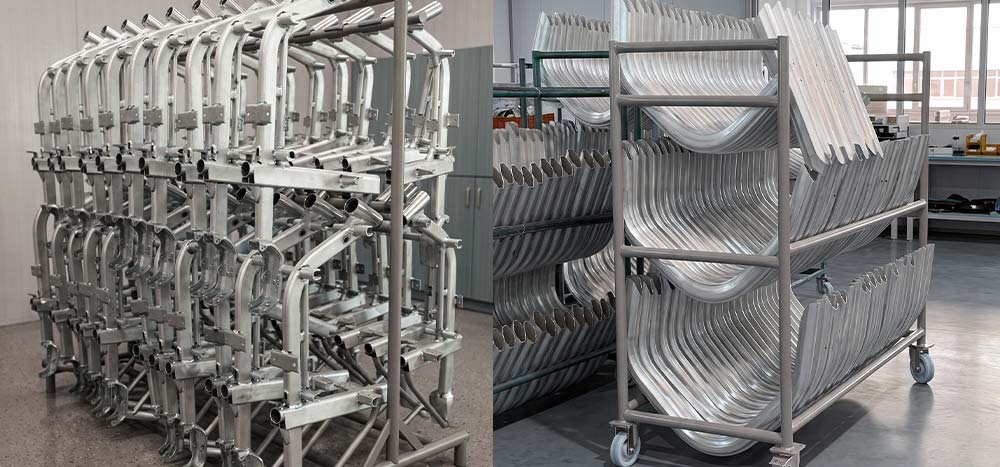
Take 6061 aluminium, the default for a European city ebike. It is supplied in the T6 condition, and welding destroys that condition in the heat-affected zone around every joint, dropping local strength back toward annealed. A frame welded from T6 tube and shipped without post-weld heat treatment has joints materially weaker than the tube it is made from. A frame that is solution-treated and artificially aged after welding restores most of that strength. The two frames look identical, weigh the same and pass different fatigue results. Ask directly whether the frame is heat-treated after welding, and ask for the fatigue report that names this frame rather than the platform family.
Step-through geometry raises the stakes. Without a top tube to triangulate the front and rear triangles, vertical load at the saddle becomes a cantilever bending moment on the seat tube and lower seat stays. That is ordinary engineering, not a defect, but it means weld quality and tube gauge carry more of the structure than on a diamond frame. The relevant protocol is the vertical fatigue test in ISO 4210-6, which applies cyclic load at the seat post in the order of a hundred thousand cycles at loads stepping up toward one and a half times the reference figure for the category. Ask what the frame was tested to, and how welds are inspected in series: visual only, or dye penetrant and radiographic sampling on a stated frequency.
If the frame is steel, the material split matters more than the word steel. Chromium-molybdenum tubing at sensible wall thickness rides well and resists fatigue; high-tensile tubing is heavier and rusts from the inside out where you cannot see it. Ask for internal anti-corrosion treatment and for drain holes at the bottom bracket and stays. Then ask about surface protection, because a city bike lives outdoors: an electrophoretic primer plus powder coat is a different proposition from powder coat alone, and the salt-spray hours in the test report will tell you which one you are buying. How those process choices are made on the line is covered in our cargo bike frame manufacturing note, and the material trade-offs themselves are set out in choosing a frame material.
The seven-question sheet, and what a supplier who can answer it looks like
Send these seven in one email before commercial terms for a city ebike wholesale europe programme are discussed. The pattern in the right-hand column is consistent: a factory that has shipped into Europe answers from a file, while a trading desk answers from a brochure.
| # | Send this | An answer that holds | A reply that should stop the order |
|---|---|---|---|
| 1 | Nameplate photo and the declared rating page of the test report | 250 W declared, consistent across nameplate, report and listing | Peak wattage advertised as the rating |
| 2 | Controller cut-off set point and wheel circumference value | Set for 25 km/h at the shipped tyre size, verified by GPS | “About 25 km/h” on the display only |
| 3 | Consumption in Wh/km with test conditions | Rider mass, assist level, temperature and surface stated | A single range figure with no conditions |
| 4 | Usable Wh, and the rate at which Ah was measured | Capacity at a stated C-rate, BMS cut-off and depth of discharge given | Nominal Wh and nothing else |
| 5 | IP code for each electrical component | A code per part, plus a stated answer for the charge port | One IP number attributed to the whole bike |
| 6 | Mount drawing, connector part number, BMS pairing rule | Standard connector, documented interface, no forced pairing | Potted pack on a proprietary mount |
| 7 | Fatigue report naming this frame, plus post-weld treatment | Heat treatment declared, report identifies the frame | A report for “the platform family” |
UnitedMobility answers this sheet from the Wuxi engineering file rather than by request, because the seven checks above are the same ones a European importer’s technical file has to contain. The wider compliance map around them — which standard applies to which vehicle — is in our guide to EN 15194 and EN 17860 and in the EPR duties that sit on the importer rather than the factory. The inspection regime that turns those documents into shippable units is described in our B2B quality engineering guide.
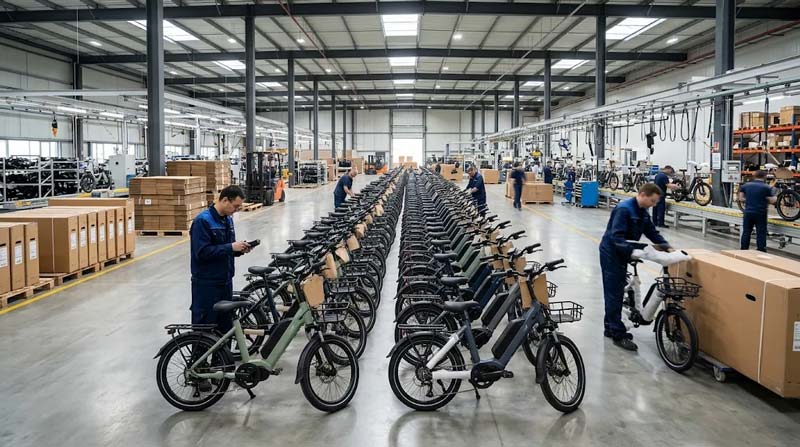
Where a city ebike wholesale europe programme goes beyond a single model, the answer to all seven questions stops being a document and becomes a supply arrangement. UnitedMobility builds city and commuter ebikes, longtail and long-john cargo bikes, and delta and tadpole trikes on the same engineering base, including the semi-recumbent format, and has been doing it since 2009 with more than fifty registered patents behind the platforms. What that means in practice for a distributor is a configuration ladder rather than a catalogue: entry, mid and premium builds off shared frames, mounts and harnesses, so a battery, a rack or a display specified for one tier does not force a new certification file for the next. The supply chain is deliberately broad enough to place a motor, a pack or a frame with the source that fits the volume, and flexible enough to run a first order at fifty units before a full container is committed. Assembly in Poland means a European buyer can be served from inside the customs union, and the documentation pack handed over covers what the file actually needs: test reports per applicable standard, UN 38.3 summaries for transport — the shipping rules are summarised here — and the battery passport data set, the Annex XIII fields, the unique identifier and the resolver arrangement, prepared in the importer’s name rather than promised for later.
FAQ
Is a 250 W motor legally allowed to peak above 250 W?
Yes. The regulation limits the maximum continuous rated power, which is a declared figure for sustained output, not the momentary peak a motor can deliver under load. What matters legally is the declared rating on the nameplate and in the test report, plus the cut-off behaviour.
Why do two city ebikes with the same battery read very different ranges?
Because the range figure has no binding test protocol behind it. Differences usually come from undisclosed consumption, from nominal versus usable energy, and from the rate at which capacity was measured. Compare Wh/km at stated conditions against usable Wh, not headline kilometres.
Does an IP67 battery make the whole bike waterproof?
No. IP codes apply to the enclosure that was tested, and a bike contains several. The scale is also not cumulative above the sixth digit, so an IP67 pack has not necessarily been jet-tested. Water normally enters at the charge port or a harness junction, neither of which the pack rating covers.
What changes for spare batteries in 2027?
From 18 February 2027, LMT batteries including their cells must be removable and replaceable by independent professionals, must stay available as spare parts for at least five years after the last unit of the model is placed on the market, and must not be blocked by software. A battery passport reachable by QR code is required from the same date.
Who is responsible for the battery passport, the factory or the importer?
The economic operator placing the battery on the EU market, which for goods made outside the EU is the importer. The factory’s job is to supply the underlying data set and the identifier arrangement. A distributor who assumes the factory “has a passport” is the one who discovers the gap at the border.
 English
 German
 Dutch
 Danish
 French
 Polish
 Portuguese
 Spanish