

| If you’re sourcing cargo bikes for the European market today, relying solely on EN 15194 certification could leave your inventory non-compliant — and your business exposed. With EN 17860 now the cargo-specific standard of record, B2B buyers face a pivotal decision: which standard applies, what your supplier must already hold, and how to avoid costly customs holds, platform delisting, or market-entry delays. This guide cuts through the complexity for distributors, fleet operators, and private label brands importing electric cargo bikes into EU markets. |
1. What EN 15194 Certification Covers — And What It Doesn’t — for Cargo Bikes
EN 15194 is the European harmonised standard for electrically power-assisted cycles (EPACs). It defines the technical requirements that make a pedelec legally placeable on the EU market as a bicycle rather than a motor vehicle — including the 250W continuous rated motor limit, 25 km/h assisted speed cutoff, pedal-assist (no throttle) operation, and a comprehensive suite of electrical safety and electromagnetic compatibility (EMC) tests.
For the majority of standard e-bikes, EN 15194 remains the primary compliance pathway. The standard covers:
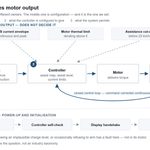
- Electrical system safety — motor controller output, wiring, connectors, short-circuit protection
- Battery requirements — referencing EN 50604-1 for lithium-ion traction batteries
- EMC compliance — emissions and immunity under EN 55014 and EN 61000 series
- Braking performance — minimum deceleration under load with the drive system active
- Environmental testing — IP ratings, temperature range, vibration resistance
Where EN 15194 falls short for cargo bikes: the standard was engineered around a rider + standard bicycle load scenario. It does not address the biomechanical and structural realities of a long-tail cargo bike carrying 150 kg of freight, a front-loader transporting two children, or a three-wheel electric cargo tricycle deployed in urban logistics fleets. Frame fatigue, dynamic stability under asymmetric loads, braking distances with maximum payload, and commercial-duty cycle endurance are all outside EN 15194’s testing scope.
| Key insight: EN 15194 is a necessary but no longer sufficient standard for cargo bikes entering the EU market. It certifies the electrical drive system — but not the cargo-specific structural and safety requirements that regulators, insurers, and fleet procurement teams now demand. |
2. Why Cargo Bikes Are Transitioning from EN 15194 to EN 17860 Standards
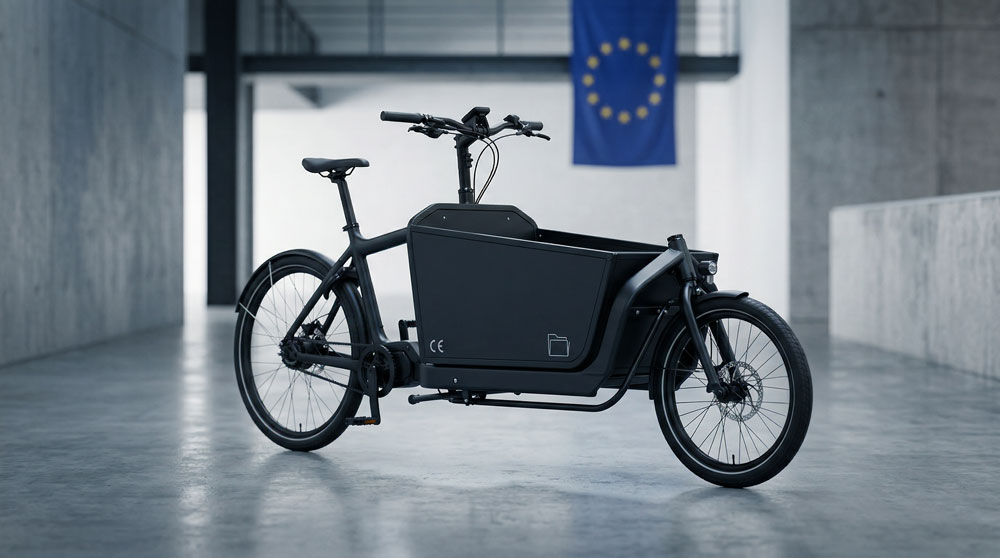
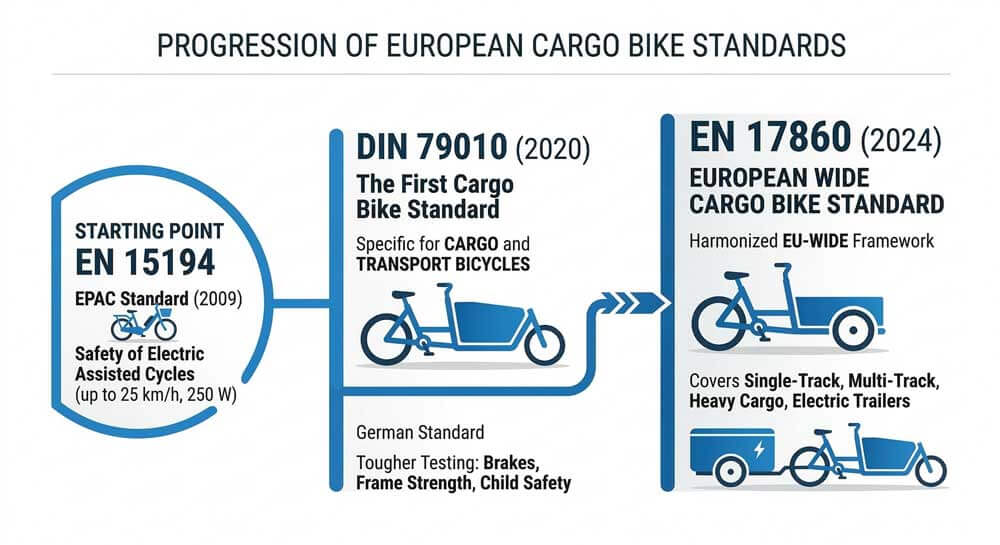
The growth of e-cargo bikes in urban logistics, last-mile delivery, and family transport has outpaced the regulatory framework that governed them. EN 15194 was published with standard e-bikes in mind; cargo bikes were an afterthought addressed primarily through supplementary standards like DIN 79010 (Germany) and EFBE’s Tri-Test protocol — neither of which provided a harmonised EU-wide compliance basis.
EN 17860 changes this. Published in 2023-2024 and progressively replacing EN 15194 as the primary standard for cargo bikes, EN 17860 is a multi-part standard series specifically developed for:
- Two-wheel cargo bikes (EN 17860-1)
- Three-wheel and multi-wheel cargo bikes (EN 17860-2)
- Electric cargo bikes with integrated drive systems (EN 17860-3)
From a regulatory standpoint, the transition has direct market-access implications. From 2025 onwards, EU notified bodies and market surveillance authorities are increasingly treating EN 17860 as the operative standard for cargo bike CE conformity. Buyers importing cargo bikes certified only to EN 15194 — without EN 17860 coverage — face growing risk of customs challenge, non-conformity notices, and platform delisting.
The 2024–2025 window is decisive. Distributors and fleet operators with existing inventory built to EN 15194 alone must assess whether their products require retesting or whether transition provisions apply. For new product sourcing, EN 17860 should be a non-negotiable supplier requirement — not a nice-to-have.
EN 15194 vs EN 17860: Side-by-Side for Cargo Applications
| Criteria | EN 15194 | EN 17860 |
| Scope | Standard e-bikes & pedelecs | Cargo bikes (incl. e-cargo) |
| Max payload addressed | No specific payload testing | Up to 300 kg GVW |
| Stability testing | Basic | Advanced dynamic + static |
| Frame fatigue testing | Standard bicycle loads | Elevated commercial loads |
| Battery standard ref. | EN 50604 (series 1) | EN 50604 + expanded requirements |
| Commercial use coverage | Not addressed | Specific commercial-use tier |
| Required for EU market (cargo) | Partial (e-bike components) | Mandatory from 2025 onwards |
Read the complete guide to cargo bike manufacturing standards and the EU regulatory framework.
3. Key Testing Requirements: EN 15194 vs EN 17860 for Cargo Applications
Understanding what each standard actually tests is essential for evaluating supplier claims and planning certification budgets.
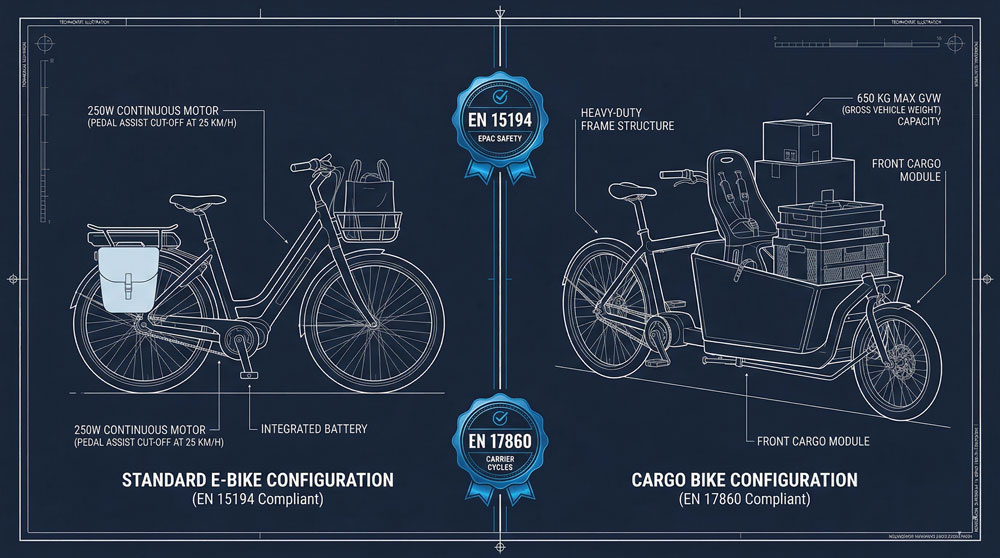
EN 15194 Core Testing Scope
- Electrical safety: insulation resistance, protection against electric shock, controller output verification
- Battery & charger: charging cycle safety, temperature management, short-circuit protection, cell-level safety per EN 50604
- EMC: radiated/conducted emissions, immunity to interference (critical for markets with strict EMC enforcement like Germany)
- Braking: deceleration test at 25 km/h with motor engaged, wet-weather braking
- Environmental: IP rating validation, temperature cycling, mechanical vibration
EN 17860 Additional Testing Scope (Cargo-Specific)
- Static and dynamic stability: tip-over testing under maximum payload, cornering stability simulation
- Frame and fork fatigue: elevated load cycles representing commercial duty — far exceeding EN ISO 4210 bicycle standards
- Payload capacity validation: structural testing up to declared maximum payload and GVW
- Child-carrying configurations: specific tests for front-loader child seats, restraint systems
- Braking under cargo load: stopping distance tests at full payload — critical given the extended braking distances of loaded cargo bikes
- Battery placement and protection: more stringent requirements for batteries positioned in cargo zones or under load-bearing structures
- Commercial-use durability: extended fatigue cycling for bikes intended for fleet/delivery use
| Budget reality: Full EN 17860 testing for a new cargo bike model at an accredited European lab (SGS, TÜV, EFBE) typically runs €15,000–€40,000 per model variant, with timelines of 12–20 weeks. Combined EN 15194 + EN 17860 certification for an electric cargo bike model can reach €35,000–€80,000 when including EMC testing, battery certification, and DoC preparation. This is not a one-time cost — variant changes (motor, battery, frame geometry) may trigger partial or full retesting. |
4. How to Verify EN 15194 Compliance When Sourcing from ODM Suppliers
The EU cargo bike market’s rapid growth has unfortunately created an ecosystem of certification fraud and documentation misrepresentation — particularly from suppliers unaware of or unconcerned with genuine compliance. Customs authorities across Germany, the Netherlands, Belgium, and France are now applying significantly stricter scrutiny to incoming cargo bike shipments.
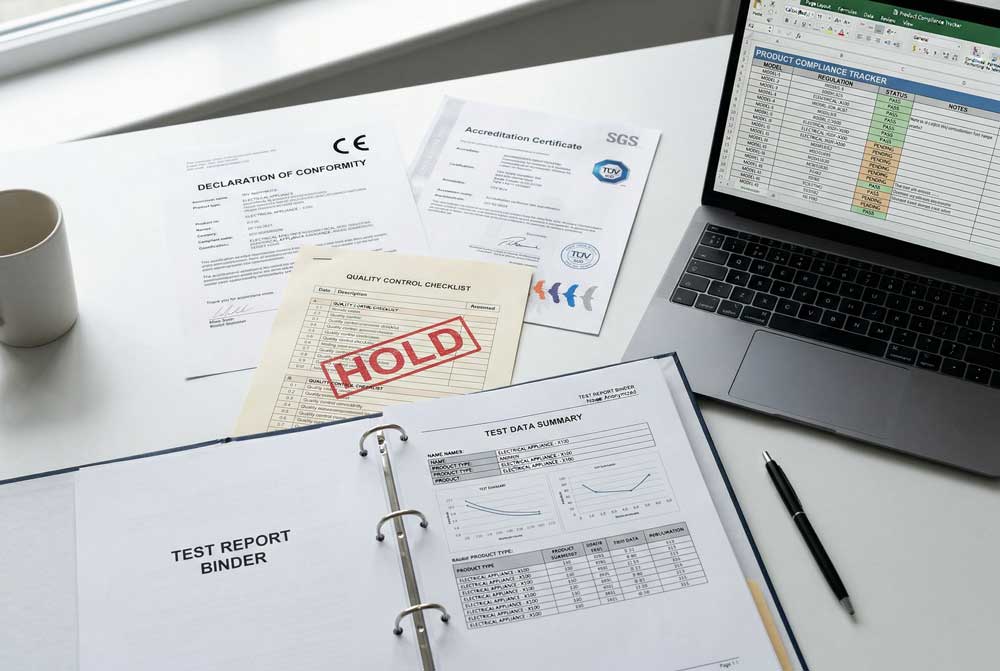
Common causes of shipment holds and platform delistings in 2024–2025 include:
- CE marking present but Declaration of Conformity (DoC) incomplete or missing EU Authorised Representative details
- EN 15194 test reports from non-accredited or unrecognised laboratories
- Battery UN 38.3 transport certification absent or not matching shipped battery configuration
- EMC reports missing — or covering a different motor/controller combination than the shipped product
- Shipping declarations inconsistent with actual product specifications
- EU Authorised Representative information falsified or representing a non-existent entity
Platform enforcement has intensified dramatically. Amazon, eBay, and OTTO now require full compliance documentation at onboarding, with review timelines 2–3x longer than 18 months ago. The era of ‘upload a CE mark and start selling’ is definitively over for cargo bikes in Europe.
Supplier Verification Checklist
Before placing any cargo bike order destined for EU markets, request and independently verify the following:
| Documentation | What to Request | Red Flag |
| CE Declaration of Conformity (DoC) | Full DoC with EU Authorised Rep details | Missing EU Rep, generic template |
| EN 15194 test report | Accredited lab report (TÜV/SGS/EFBE) | Self-issued or unaccredited lab |
| EN 17860 test report | Full series report if cargo > 50 kg | EN 15194 only, no cargo standard |
| Battery compliance | UN 38.3, IEC 62133 or EN 50604 cert | Missing cell-level cert |
| EMC compliance | EN 55014, EN 61000 test results | No EMC section in DoC |
| Factory audit | ISO 9001 or equivalent QMS cert | No QMS, self-declared only |
Critical verification step: always cross-reference the test report’s model numbers, motor specifications, and battery configuration against the actual product you’re ordering. Certification is model-specific — a test report for a 36V/10Ah variant does not cover a 48V/15Ah version of the same bike, even from the same factory.
Recommended Reading: Cargo Bike Compliance Guide for European Market Entry: EN 17860 & Multi-Country Certification Strategy
5. Certification Timeline and Cost Implications for Private Label Programs
For B2B buyers developing private label cargo bike programs, certification is not a line item to optimise away — it is a market-access investment with direct impact on launch timelines, SKU rationalisation, and landed cost.
Typical Certification Timeline for a New Cargo E-Bike Model
- Pre-certification sample preparation and documentation gathering: 4–6 weeks
- EN 15194 electrical + EMC testing at accredited lab: 6–10 weeks
- EN 17860 mechanical + stability testing: 8–14 weeks (can partially parallel EN 15194)
- Battery UN 38.3 + EN 50604 certification (if not already cell-certified): 4–8 weeks
- DoC preparation, EU Authorised Representative registration, technical file compilation: 2–4 weeks
- Total realistic timeline (new model, full dual certification): 4–6 months
The ODM supplier’s role is decisive here. A manufacturer with existing EN 15194 test reports, established relationships with accredited labs, and in-house technical documentation teams can compress this timeline significantly. A supplier who treats certification as an afterthought will extend it — often past your product launch window.
Recommended Reading:
Cost Planning for Private Label Certification
- EN 15194 certification (existing model, minor variant): €5,000–€15,000
- EN 17860 cargo-specific testing (new model): €15,000–€35,000
- Combined EN 15194 + EN 17860 + battery: €35,000–€80,000
- EU Authorised Representative (annual): €1,500–€5,000 depending on provider
- Technical file maintenance per product family (annual): €2,000–€8,000
| Strategic insight: For B2B buyers building multi-SKU cargo bike programs, working with an ODM partner who certifies at the platform level — covering multiple derivatives under a single technical file where permissible — significantly reduces per-SKU certification costs. This is a key differentiator when evaluating ODM partners: ask specifically how they structure certification across model families. |
6. The Market Opportunity in This Compliance Moment
Europe’s cargo bike market is undergoing an industry-level rationalisation. The suppliers and distributors who treated certification as optional are being forced out — by customs enforcement, platform delistings, and increasingly sophisticated B2B buyers who have learned to scrutinise documentation.
For buyers who get compliance right, the opportunity is substantial:
- Cleaner market with fewer low-quality competitors driving price erosion
- Access to premium distribution channels — European independent retailers, chain stores, shared mobility fleets — that require full EN 17860 compliance as a baseline
- Qualification for government subsidy programs and municipal procurement tenders, where compliance documentation is a hard eligibility requirement
- Stronger brand positioning: in a market where buyers are educating themselves on standards, being able to demonstrate dual EN 15194 + EN 17860 certification is a concrete differentiator
The companies that invest in compliance infrastructure now — through the right ODM partnerships, certified product lines, and rigorous documentation — are building the competitive moat that will define the European cargo bike market for the next decade.
Frequently Asked Questions
Is EN 15194 certification mandatory for cargo bikes in Europe?
EN 15194 remains the mandatory harmonised standard for the electrical drive system of any pedelec sold in the EU. However, for cargo bikes, it is increasingly considered insufficient on its own. EN 17860 now addresses cargo-specific structural and safety requirements and is becoming the operative standard for cargo bike CE conformity assessments from 2025 onwards.
What is the difference between EN 15194 and EN 17860 for cargo bikes?
EN 15194 covers the electrical and EMC requirements of the drive system. EN 17860 adds cargo-specific testing: payload-rated structural testing, dynamic stability, extended frame fatigue, and cargo-load braking performance. For electric cargo bikes, both standards are needed for comprehensive EU market compliance.
How much does EN 15194 certification cost for a cargo bike model?
EN 15194 alone for an existing model variant typically costs €5,000–€15,000. Combined EN 15194 + EN 17860 certification for a new electric cargo bike model at an accredited European laboratory runs €35,000–€80,000 including battery certification, with timelines of 4–6 months.
Can a cargo bike hold both EN 15194 and EN 17860 certification?
Yes — and for most electric cargo bikes, this dual certification is the correct approach. EN 15194 covers the drive system and electrical safety; EN 17860 covers the cargo-specific mechanical and stability requirements. Together they provide a comprehensive compliance basis for CE marking and EU market access.
How do I verify if a cargo bike supplier has genuine EN 15194 certification?
Request the full test report (not just a certificate) and verify the issuing laboratory’s accreditation status via the EA MLA database or the notified body’s own registry. Cross-check the model numbers and specifications on the test report against the product you’re ordering. Verify the EU Authorised Representative listed on the Declaration of Conformity is a real, registered entity. If the supplier cannot produce a complete technical file, treat this as a significant compliance risk.
United Mobility — Compliance-Forward Cargo Bike ODM. For sourcing enquiries, certification support, or private label program discussions, contact the UM B2B team.
 English
  German
  Dutch
Dutch  Danish
  French
  Polish
  Portuguese
  Spanish