




In What Actually Matters in a Cargo Bike Battery System, we examined battery architecture from a system perspective—how communication protocols, integration logic and lifecycle behaviour influence long-term cost and scalability.
This guide focuses specifically on cargo bike battery specs. It explains the technical parameters behind a lithium battery for cargo bike applications and clarifies how those parameters influence vehicle design, regulatory compliance and commercial durability.
No matter you’re developing a utility electric bike, an electric delivery bike, a longtail bike or a three-wheeled cargo bike, understanding specifications at engineering level is fundamental to building a reliable cargo bike frame platform.
What Are the Most Important Cargo Bike Battery Specs?
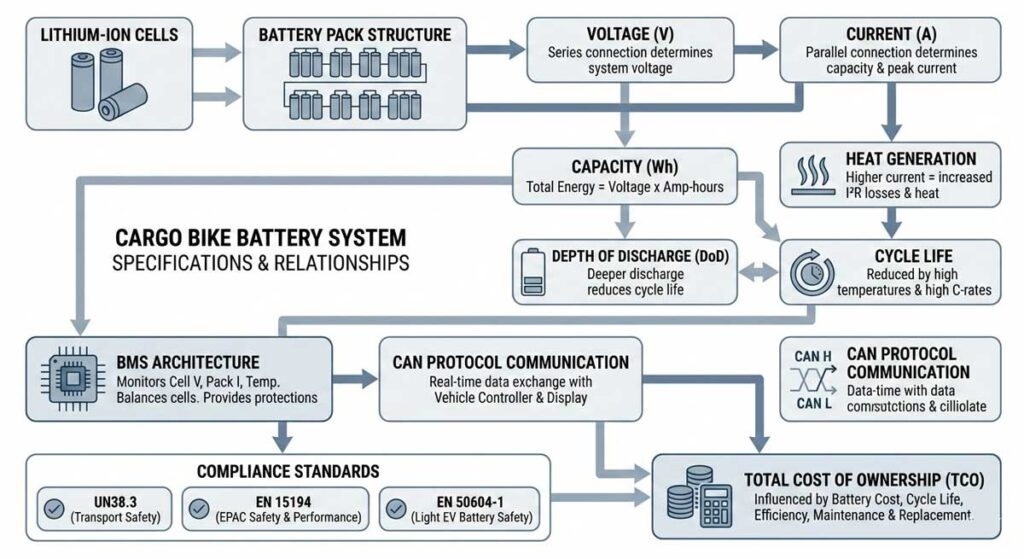
The most important cargo bike battery specs include cargo bike battery voltage, cargo bike battery capacity (Wh), continuous and peak discharge current, cycle life, battery management system architecture, thermal management, SOC and SOH monitoring, CAN protocol communication, ingress protection rating, and compliance standards such as UN38.3 and EN 15194 battery compliance.
These specifications collectively determine range, durability, safety, regulatory approval and total cost of ownership. Let’s explain each item one by one:
1. Lithium Battery for Cargo Bike Applications
Most cargo platforms use lithium-ion battery chemistry due to its energy density and power delivery characteristics. However, a lithium battery for cargo bike use is not identical to one used in a standard commuter eBike.
Cargo bikes operate at higher continuous loads, especially in commercial contexts such as electric delivery bike fleets. Cell selection, pack structure and current capability must reflect this duty cycle. The battery pack must sustain sustained torque demand rather than short bursts of assistance.
The chemistry remains lithium-ion, but the system design differs significantly.
2. Cargo Bike Battery Voltage
Cargo bike battery voltage typically falls into two system classes: 36V and 48V.
Higher voltage reduces current for the same power output. This lowers resistive heat losses and improves system efficiency under load. For heavier platforms such as a three-wheeled cargo bike or longjohn cargo bike, 48V systems are increasingly preferred.
Voltage selection affects:
- Motor compatibility
- Controller design
- Cable gauge
- Thermal load
It is therefore not only an electrical choice, but also a mechanical and integration decision within the cargo bike frame.
3. Cargo Bike Battery Capacity
Cargo bike battery capacity is expressed in watt-hours (Wh), calculated as:
Voltage × Amp-hours = Watt-hours.
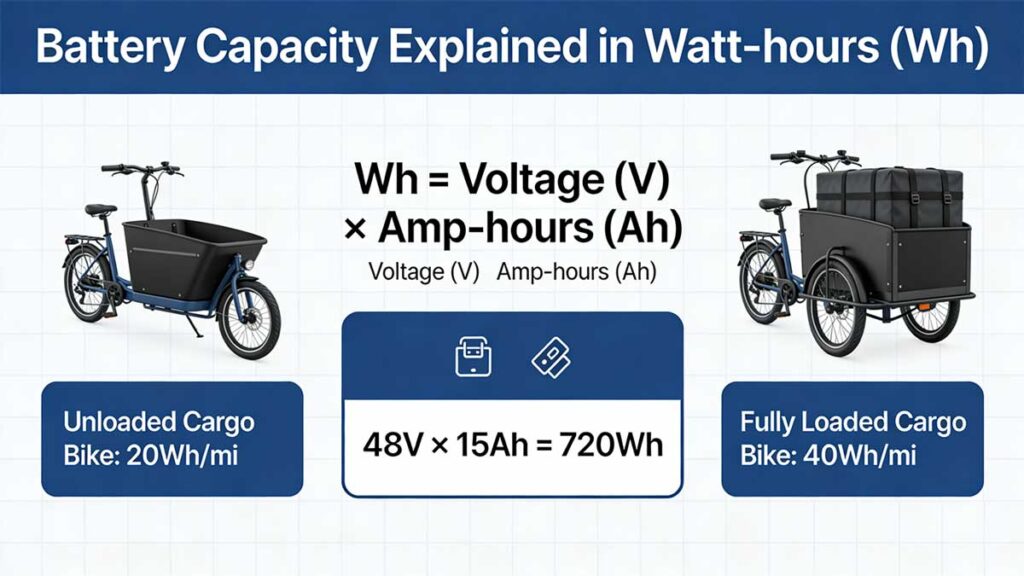
Capacity directly influences range, but in commercial use it also affects daily utilisation cycles. A high-capacity ebike battery reduces charging frequency, which can extend practical cycle life in fleet operations.
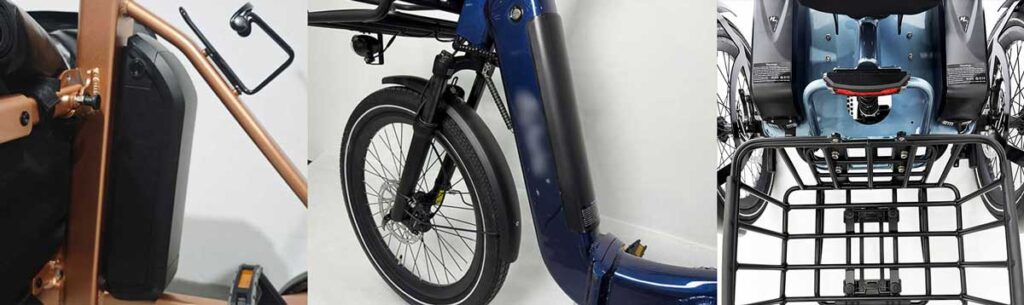
However, increasing capacity increases weight and affects frame integration. In a longtail bike, designers often integrate one battery inside the downtube and, in a dual battery cargo bike configuration, position a second battery externally near the seat tube. In a three-wheeled cargo bike, dual batteries may be integrated within the cargo box structure. Frame geometry and load distribution determine placement.
4. Current (Amps) and Discharge Rate
Current defines how much electrical flow the system can deliver at a given moment. In cargo applications, sustained current capability matters more than nominal rating.
High discharge rates generate heat. Excessive heat accelerates degradation and reduces cycle life. Therefore, discharge specifications must be evaluated together with thermal management and BMS control strategy.
For electric delivery bike platforms operating on gradients with full payload, underspecified discharge capacity quickly translates into warranty issues.
5. Maximum Discharge Current and Peak Power
Peak power supports acceleration under load. Maximum discharge current indicates how much current the battery can deliver safely for short periods.
This parameter must align with motor peak demand. If the motor controller requests more current than the battery safely supplies, protection mechanisms will trigger. That results in power cut-offs, which are unacceptable in commercial logistics use.
The relationship between peak power and continuous power must be clearly defined in cargo bike battery specs documentation.

6. Cycle Life and Long-Term Cost
Cycle life refers to the number of full charge cycles until capacity declines to typically 80% State of Health (SOH).
For private use, 500–700 cycles may suffice. For commercial fleet use, significantly higher cycle performance is expected.
Cycle life is influenced by:
- Depth of discharge
- Operating temperature
- Discharge rate
- Cell quality
It is not only a cell-level metric. It is a system-level outcome.
7. Battery Management System (BMS) for Cargo Bikes
The battery management system (BMS) for cargo bikes monitors voltage, temperature and current at cell level.
Two main architectures exist:
Hardware-based BMS operates with fixed protection thresholds and limited upgrade flexibility.
Software-based BMS integrates firmware logic, allowing calibration, remote diagnostics and adaptive protection strategies.
For scalable platforms, particularly where CAN protocol integration is required, software-based BMS solutions provide long-term flexibility.
The BMS is central to cargo bike battery safety.
8. SOC and SOH
- State of Charge (SOC) represents available energy at a given time.
- State of Health (SOH) represents remaining capacity relative to original specification.
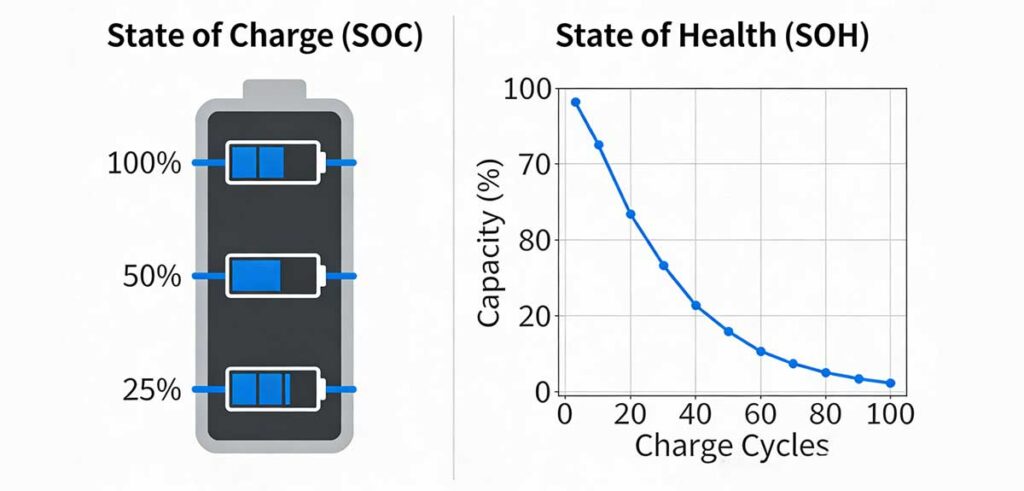
In commercial environments, SOH tracking is essential for fleet planning. Without accurate SOH data, operators cannot predict replacement cycles or calculate depreciation accurately.
Advanced systems communicate SOC and SOH data through CAN protocol to the display or fleet management systems.
9. CAN Protocol Integration
CAN protocol enables real-time communication between battery, motor controller and display.
In a cargo bike battery system, CAN improves diagnostic capability and system coordination. It reduces compatibility risks between components from different suppliers.
For OEMs developing multiple frame formats—longtail bike, longjohn cargo bike, cargo tricycle—CAN-based systems simplify cross-platform integration.
10. Dual Battery Cargo Bike Architecture
A dual battery cargo bike increases range without excessively increasing individual pack size.
Integration varies by vehicle type:
- Longtail bike: one internal downtube battery, one external seat-tube battery.
- Longjohn cargo bike: placement depends on front frame structure and load bay design.
- Three-wheeled cargo bike: batteries may be integrated within the cargo box or rear frame assembly.
Battery placement must preserve centre of gravity and structural integrity of the cargo bike frame.
11. Battery Thermal Management
Thermal management defines how heat is dissipated during discharge and charging.
Poor thermal control shortens cycle life and increases safety risk. High-load utility electric bike platforms require careful cell spacing, enclosure design and BMS temperature monitoring.
Thermal performance becomes critical in southern European climates where ambient temperature already stresses the operating window.
12. Operating Temperature Range
Operating temperature range specifies safe charging and discharging conditions.
Lithium-ion batteries typically perform optimally between approximately 0°C and 45°C. Below freezing, charging must be restricted to prevent lithium plating.
Fleet operators must consider seasonal impact, especially in Northern Europe.
13. Cargo Bike Battery Safety and Certification
Cargo bike battery safety is governed by transport and product standards.
UN38.3 certification covers transport testing for lithium batteries. It validates resistance to vibration, thermal stress and short circuit.
EN 15194 battery compliance applies to EPAC systems within the EU. For cargo platforms, EN 50604-1 addresses safety requirements for light electric vehicle battery packs.
CE certified ebike battery documentation confirms conformity with applicable EU directives.
Compliance is not optional. It is market access.
14. Ingress Protection Rating
Ingress Protection (IP rating) defines resistance to dust and water.
Commercial platforms often require IP65 or higher to ensure durability in year-round delivery operations.
15. Battery Pack Design
A battery pack integrates:
- Mounting system
- Cells
- BMS
- Structural enclosure
- Connectors
Mechanical robustness is especially important in a three-wheeled cargo bike where vibration loads differ from two-wheel platforms. Sealing standards must reflect commercial exposure.
The battery pack is the most expensive single component in many cargo systems. Design decisions here directly affect total cost of ownership.
Conclusion: Reading Cargo Bike Battery Specs as a System
Cargo bike battery specs are not isolated numbers. They describe an interconnected system that affects performance, compliance and lifecycle cost.
Voltage influences current.
Current influences heat.
Heat influences cycle life.
Cycle life influences warranty exposure.
When specifying a lithium battery for cargo bike use—whether for a utility electric bike, electric delivery bike or dual battery cargo bike platform—the correct interpretation of these parameters determines commercial viability.rategy.
Professional Cargo Bike ODM Support
At United Mobility, we bring nearly 20 years of industry experience in cargo bike ODM manufacturing. Battery specification is never treated as an isolated procurement decision. It is engineered in direct relation to vehicle architecture, intended payload, regulatory market and commercial operating profile.
Whether you require a high-capacity ebike battery solution for a dual battery cargo bike, or an optimised lithium battery for cargo bike integration within a longtail bike or three-wheeled cargo bike frame, our engineering team designs the battery-vehicle interface professionally to meet your performance and compliance requirements.
If you are developing a new platform or upgrading an existing electric delivery bike line, we can support specification, integration and certification alignment according to your market objectives. Contact us for a professional cargo bike odm quote.
 English
  German
  Dutch
Dutch  Danish
  French
  Polish
  Portuguese
  Spanish