


OEM and ODM differ less in unit price than in where the costs sit: tooling investment, minimum order quantity, design ownership and supply risk. This comparison puts numbers side by side and shows the order volume at which each model breaks even. For how the ODM route actually runs once chosen, see the ODM process timeline.
A Dutch distributor recently shared a case study that stopped a boardroom cold: they chose ODM to avoid €140,000 in tooling costs — then lost €280,000 in year two when their supplier’s chronic component delays collapsed three municipal fleet contracts. Across town, a German startup that committed €195,000 to OEM tooling broke even in 19 months by winning private-label tenders their ODM competitors structurally could not bid on.
The OEM vs ODM cargo bike decision is rarely what it appears at first glance. Both models carry hidden costs that surface only after launch. Both carry risks that manufacturers rarely discuss upfront. And for European distributors and fleet operators targeting the 800–2,000 unit annual segment, neither traditional model is cleanly optimal — which is exactly the gap that configurable ODM platforms now address.
This guide cuts through the positioning. It covers the real 3-year cargo bike fleet TCO differences, the European compliance costs competitors ignore, the operational failure modes of each model, and a decision framework built for transactional B2B buyers who need the right answer before signing a manufacturing partnership.
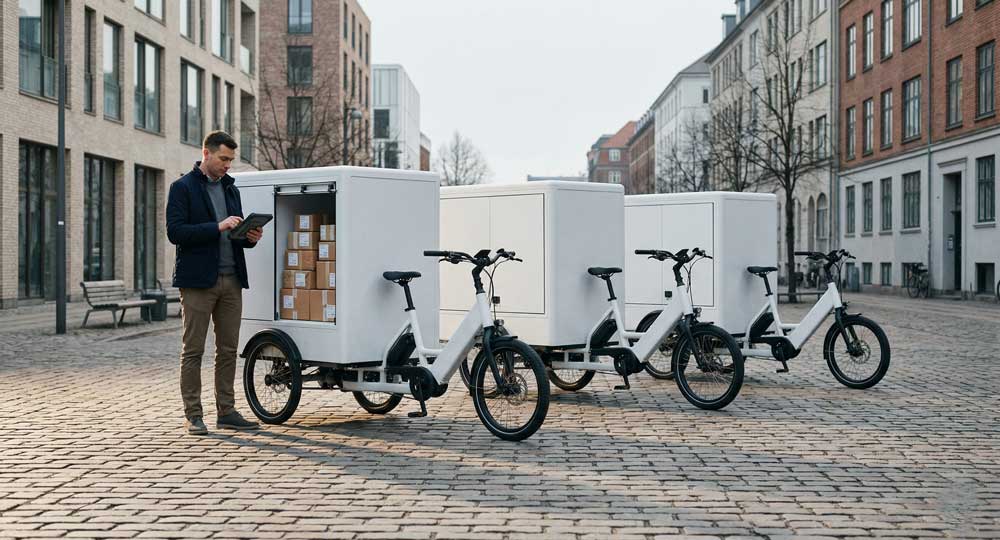
OEM vs ODM Cargo Bike Models: What B2B Buyers Actually Get
Before comparing costs, the definitions need to be precise — because the industry uses these terms loosely, and that ambiguity costs buyers money.
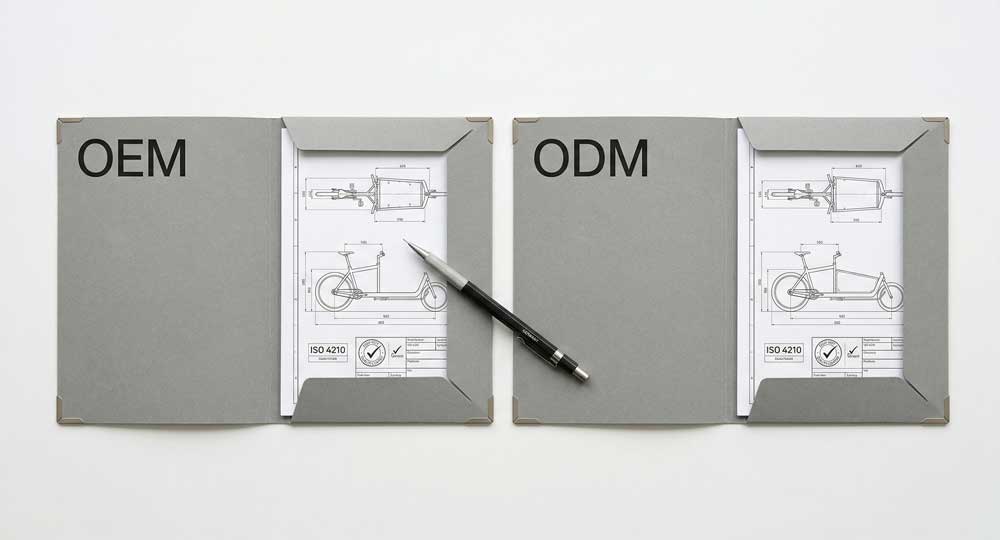
OEM (Original Equipment Manufacturer): You own the design. You provide engineering specifications, geometry, component selection, and brand identity. The manufacturer produces to your blueprint. All tooling, molds, and IP remain yours. You absorb 100% of development cost and lead time; in return, you have full exclusivity and zero dependency on the manufacturer’s platform decisions.
ODM (Original Design Manufacturer): The manufacturer owns the base platform. You select from pre-engineered frame architectures, configure components within defined parameters, apply your brand identity, and proceed to production on a compressed timeline. Tooling costs are amortized across multiple buyers; your per-unit cost is higher, but your entry investment is dramatically lower. (Recommended Reading: Cargo Bike ODM Process: How to Build a Market-Ready E-Cargo Bike in 12 Steps)
The practical difference for a European cargo bike brand or fleet operator is not philosophical — it is financial and operational. OEM gives you a defensible product architecture no competitor can copy directly. ODM gives you speed to market and a known-tested compliance baseline, but constrains differentiation and creates shared-platform exposure.
Neither is inherently superior. The correct choice depends entirely on your annual volume target, your internal design capability, your compliance budget, and how much supplier dependency you can absorb.
The Real Cost Breakdown: 3-Year TCO Comparison for 500–2,000 Unit European Partnerships
The upfront cost comparison is straightforward. The 3-year picture is not.
OEM scenario (1,000 units/year, European distributor):
- Frame tooling and mold development: €150,000–€220,000
- EN 15194 and EN 17860 certification on custom geometry: €18,000–€35,000
- Prototype and validation cycle (3–5 rounds): €25,000–€45,000
- Total Year 1 pre-revenue investment: €193,000–€300,000
- Per-unit manufacturing cost at 1,000 units: typically 12–18% lower than equivalent ODM
ODM scenario (1,000 units/year, same distributor):
- Platform access and branding configuration: €8,000–€20,000
- Certification delta costs (existing certs may not cover your configuration): €5,000–€15,000
- Sample and approval cycle: €3,000–€8,000
- Total Year 1 pre-revenue investment: €16,000–€43,000
- Per-unit manufacturing cost: higher by €180–€380/unit depending on component tier
At 1,000 units annually, the OEM cost premium of approximately €250 per unit means the tooling investment breaks even at roughly month 22–26, assuming no production disruptions. That math is clean and predictable — which is why it is also misleading. It ignores the year two and year three variables that determine actual profitability.
The 3-year TCO factors that destroy the simple comparison:
- Spare parts inventory obligation: OEM buyers must self-fund a rolling spare parts buffer — typically 8–12% of fleet value for active municipal or logistics contracts. ODM buyers whose supplier maintains a parts warehouse can offload this capital requirement, but only if the supplier contractually commits to minimum stock levels.
- Warranty claim processing: OEM warranty disputes require direct negotiation with your manufacturer on your custom geometry, which can extend resolution cycles to 60–90 days. ODM platforms with standardized components resolve most warranty claims against catalogued parts in 10–20 days.
- Component substitution exposure: When Bosch or Shimano components face 16+ week allocation delays — a recurring reality since 2022 — OEM contracts that permit defined component substitution protect your production schedule. ODM platforms that lock you to specific component tiers without substitution clauses leave you entirely dependent on your supplier’s allocation relationships.
When ODM Kills Your Margins: The Hidden Costs Manufacturers Don’t Advertise
ODM’s pitch is compelling: lower entry investment, faster time to market, pre-certified platforms. The pitch is also selectively honest.
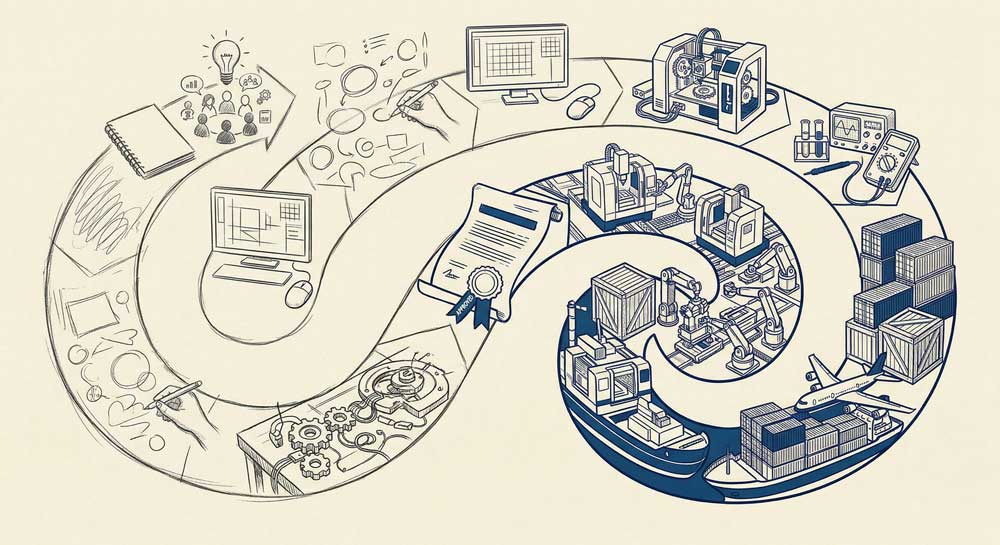
The differentiation ceiling: In a market where three European distributors source from the same ODM platform with minor component variations, price competition is inevitable. Without unique frame geometry or patented cargo systems, the product conversation quickly reduces to price per unit — a race that destroys margin for everyone except the manufacturer.
Restocking delay compounding: ODM suppliers serving multiple clients simultaneously face production queue conflicts that cargo bike OEM buyers with dedicated tooling do not. A 6–8 week restocking delay on a top-selling cargo bike model is commercially survivable for B2C retailers. For B2B fleet operators holding municipal contracts with defined replacement windows, the same delay triggers penalty clauses or contract non-renewal. The distributors who learned this in year two did not get that lesson included in their ODM pricing model.
IP ownership ambiguity: Without a carefully drafted exclusivity agreement, the ODM platform you launched your brand on can be licensed to a competitor in your territory within 12 months. Some ODM suppliers offer formal territory exclusivity; most do not by default. The contract language around exclusivity, territory, and minimum volume commitments must be negotiated before signature — not discovered during a competitive conflict.
Certification portability: An EN 15194 certificate issued to your ODM supplier does not automatically transfer to your brand’s regulatory documentation in all EU member states. Distributors entering France, Germany, and the Netherlands simultaneously often discover that municipal tender requirements demand brand-specific certification documents, not supplier certificates of conformity. The cost of correcting this post-launch runs €8,000–€22,000 per market.
When OEM Investment Pays Off: Volume Thresholds and Breakeven Timelines
OEM is not appropriate for every buyer — but it is definitively correct for specific situations.
The volume threshold argument: At 500 units annually, OEM’s higher per-unit cost and tooling amortization create a breakeven timeline beyond 36 months for most product categories. At 1,500 units annually, that timeline compresses to 14–20 months, and the per-unit cost advantage begins generating compounding margin improvement. The crossover point for most European cargo bike categories falls between 1,100 and 1,400 annual units, assuming standard EN 15194 compliance and single-market distribution.
Private-label revenue unlocked by OEM: Distributors with proprietary OEM geometry can white-label their product to subsidiary brands, resellers, or municipal procurement frameworks without sharing their cost structure. This revenue layer is structurally unavailable to ODM buyers whose product is available to any buyer of the same platform.
Tender qualification requirements: A significant share of European municipal fleet tenders — particularly in Germany, the Netherlands, and France — require bidders to demonstrate proprietary product specification capability. Submitting an ODM platform as your product specification in a German public procurement process carries meaningful disqualification risk. OEM buyers can document their proprietary architecture with precision.
Lead time predictability: Once tooling is complete and validated, OEM production scheduling is entirely within your manufacturing partnership agreement. ODM buyers share production windows with the supplier’s other clients, creating queue uncertainty during peak periods — typically Q1 and Q3 for European cargo bike demand cycles.
European Compliance Stacking: How Certification Costs Multiply Across EN 15194, NF, and DIN Standards
Competitors consistently understate this cost category. The actual compliance cost for a European cargo bike launch is rarely a single certification fee.
The baseline: EN 15194 (electric cycles) and EN 17860 (cargo cycles) form the mandatory technical foundation for European market access. A conformity assessment on a new OEM platform runs €18,000–€35,000 and requires 8–14 weeks of testing. An ODM platform with an existing valid certificate reduces this to a delta assessment of €5,000–€12,000, assuming your configuration remains within the certified parameters.
The multi-market stacking problem: A distributor entering France, Germany, and the Netherlands simultaneously faces compliance requirements that do not perfectly overlap:
- French municipal tenders increasingly reference AFNOR/NF specifications alongside CE marking, particularly for cargo bikes used in waste management or postal services
- German DIN 79010 compliance is required for municipal procurement in several Bundesländer, even though it operates alongside EN standards
- Dutch subsidy programs (MIA/Vamil for commercial fleet operators) require specific documentation packages that go beyond standard CE declarations
In an ODM scenario, adding a market-specific variant to an existing platform typically costs €8,000–€15,000 per variant in certification delta work, because the original certificate was issued against a specific configuration. In an OEM scenario where your proprietary platform is the certified basis, adding a variant configuration costs €12,000–€25,000 but the resulting certificate is fully yours to deploy across all sales documentation.
For a distributor entering three markets simultaneously, the multi-market compliance budget should be modeled at €28,000–€55,000 (ODM) versus €42,000–€85,000 (OEM) for a comparable product range — a difference that compresses significantly at scale.
External reference: EN 15194:2017+A1:2020 and EN 17860:2022 are published by the European Committee for Standardization (CEN). The full standard texts and current amendment status are available through national standards bodies including DIN (Germany), AFNOR (France), and NEN (Netherlands).
How Does Cargo Bike ODM Work? A Step-by-Step Process for B2B Buyers
For buyers encountering ODM for the first time, the process structure matters as much as the cost model. A well-run cargo bike ODM workflow follows a defined sequence that protects both parties.
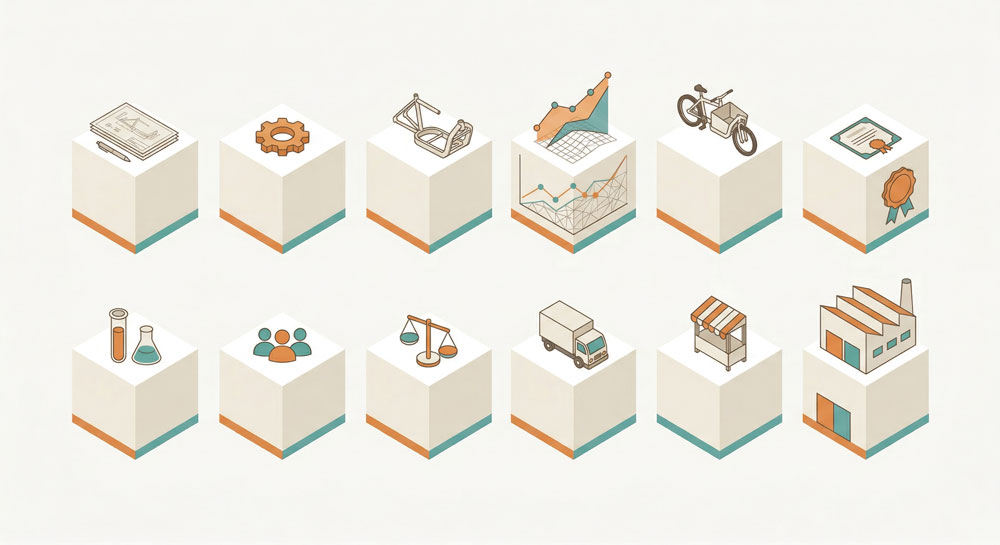
Step 1 — Requirements scoping: The buyer defines target market, intended application (last-mile logistics, family transport, municipal fleet, food delivery), payload requirements, and regional compliance needs. A capable ODM manufacturer maps these requirements against their existing platform library to identify the best fit.
Step 2 — Platform selection and configuration: The buyer selects from pre-engineered frame architectures and configures components within approved parameter ranges — motor system, battery capacity, cargo box format, braking system, lighting, color, and branding. Buyers can also initiate a fully customized design if no existing platform meets requirements, though this extends timelines significantly.
Step 3 — Sample production and validation: The manufacturer produces sample units for buyer evaluation. This stage covers design verification, performance testing, usability assessment, and compliance pre-screening. A professional ODM partner schedules this review with documented sign-off criteria rather than informal approval.
Step 4 — Commercial terms and production scheduling: MOQ, pricing tiers, delivery schedule, spare parts commitments, warranty terms, and exclusivity clauses are finalized. This is the stage where buyers without manufacturing partnership experience most frequently leave value on the table by not negotiating spare parts inventory obligations and component substitution rights.
Step 5 — Mass production and quality inspection: Production proceeds against the confirmed specification with defined in-process quality checkpoints. Pre-shipment inspection by a third-party quality assurance firm is strongly advisable for first production runs.
Typical ODM timeline: 8–12 weeks from confirmed specification to first production delivery, versus 5–8 weeks for repeat orders on an established platform configuration.
Hybrid Path: Starting ODM, Scaling to OEM Without Losing 18 Months
The most commercially rational strategy for buyers entering the 300–800 unit annual range is not a binary choice — it is a sequenced transition plan.
Phase 1 (Year 1–2, 300–800 units): Enter the market on an ODM platform with a pre-certified, battle-tested design. Validate market demand, build your dealer network, establish service infrastructure, and generate the sales data required to justify OEM tooling investment. Critically, negotiate an ODM contract that includes a right-to-transition clause — a contractual provision permitting you to develop competing OEM geometry after a defined volume threshold without triggering exclusivity penalties.
Phase 2 (Year 2–3, 800+ units): Commission OEM tooling for your highest-volume model, using field data from ODM sales to inform geometry decisions that pure market research cannot provide. The ODM platform continues serving your secondary and test market SKUs while OEM handles your flagship.
The IP protection imperative: Any ODM contract that leads to OEM development must explicitly address: (a) who owns design improvements made to the ODM platform during the partnership; (b) whether the ODM supplier can commercialize field performance data from your fleet; and (c) what component sourcing intelligence the supplier retains after the relationship ends. These clauses are negotiable before signature and non-negotiable after.
Buyers who execute this transition correctly typically reach a position by year three where 60–70% of unit volume runs on proprietary OEM architecture with OEM’s margin advantages, while the remaining 30–40% serves test markets or lower-volume SKUs on configurable ODM platforms.
Risk Factors Both Models Hide: Supply Chain, IP, and Supplier Lock-In
Supply chain concentration risk: Post-2022 component allocation volatility has exposed a structural vulnerability in both OEM and ODM cargo bike partnerships: if your motor and battery supply chain is concentrated in a single Tier 1 manufacturer without contractual substitution rights, a 16-week Bosch or Shimano allocation delay halts your production regardless of your OEM vs ODM model. OEM contracts that define pre-approved alternative component specifications — including Bafang, Aikema, or Panasonic substitutes at equivalent performance thresholds — provide protection that ODM contracts almost never include by default.
Geographic production dependency: Buyers sourcing exclusively from Asian manufacturers without EU-based assembly options face two specific risk exposures: tariff reclassification risk under evolving EU trade policy, and extended lead times that make reactive restocking structurally difficult. EU-based or EU-adjacent final assembly partnerships substantially reduce both exposures.
Supplier financial health: An ODM buyer whose supplier faces financial distress loses their platform, their certifications, and their production capacity simultaneously. OEM buyers with owned tooling can theoretically transfer production to an alternative manufacturer, though the practical difficulty of doing so should not be understated. In both cases, supplier financial due diligence before partnership commitment is a basic risk management requirement that a significant share of first-time buyers skip.
United Mobility’s Modular Platform
The commercial reality is that most European cargo bike distributors targeting 800–1,500 annual units are poorly served by either model in its traditional form. Pure OEM tooling investment is prohibitively expensive at these volumes. Pure ODM constrains differentiation to the point where brand-building becomes nearly impossible against competitors on the same platform.
United Mobility’s manufacturing approach directly addresses this segment through a modular platform architecture that functions as configurable ODM — delivering approximately 80% of pure ODM’s speed-to-market with approximately 60% of OEM’s customization depth.
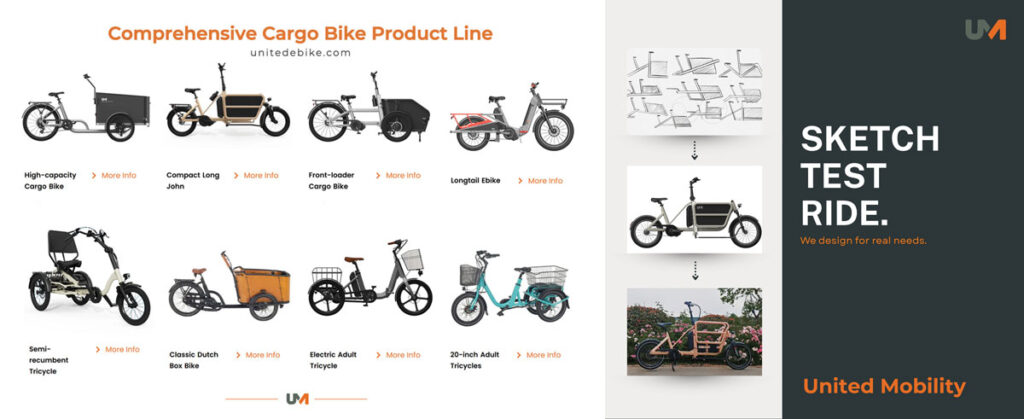
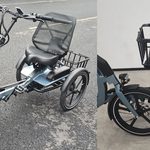
The platform range: United Mobility’s electric cargo bike lineup includes the UM Flow (urban logistics and last-mile delivery, 55N·m hub motor, low centre of gravity), the UM SE (high-capacity family and transport, 275L cabin, seating for up to five), the UM Starter (entry-level family cargo, 300kg GVW, four-child seating), and the UM ZIP (compact foldable long-john, 120N·m mid-drive motor, 250kg GVW). The electric trike range extends the portfolio to three-wheel configurations for stability-sensitive logistics applications.
Compliance baseline: All platforms are certified against EN 15194 and EN 17860 standards, with CE, TÜV, and E-MARK certification and ISO 9001:2008 manufacturing quality management. Battery systems comply with EN 50604-1. This pre-certified foundation reduces the buyer’s compliance cost exposure relative to a fully custom OEM development while providing documentation that supports brand-specific regulatory filings.
Customization depth: Frame configuration, cargo module format (box, flatbed, insulated food transport, postal configuration), component tier selection, battery capacity, color, branding, lighting systems, and controller parameters are all configurable within the platform architecture. Buyers with specific geometry requirements or proprietary cargo system needs can initiate an OEM development track from the same manufacturing relationship, eliminating the friction of transitioning between suppliers.
Production and delivery timelines: OEM projects deliver within 5–8 weeks post-specification confirmation. ODM projects, including design and prototype development, run 8–12 weeks. Standard production delivery runs 45–60 days depending on order volume and trade terms — FOB, CIF, and DDP all supported.
Warranty structure: Core components (motors and batteries) carry 2–8 year warranty coverage depending on configuration, with a 24/7 technical support commitment that matters significantly in fleet operator service level agreements.
For buyers evaluating a Cargo Bike Manufacturing partnership or an ODM Service configuration, the conversation starts with your annual volume target, target markets, and required compliance documentation — not with a binary OEM or ODM declaration.
Frequently Asked Questions
What is the minimum order quantity for ODM cargo bikes in Europe?
ODM MOQ varies significantly by manufacturer and platform complexity. Entry-level MOQs from reputable manufacturers run 50–100 units for standard configurations. Custom cargo box tooling or exclusive color programs typically require 200–500 units to amortize tooling costs. Buyers should negotiate tiered pricing across their 12-month forecast rather than committing to a single MOQ figure. (Recommended Reading: How Low Is the Real MOQ for Cargo Bike ODM Manufacturing?)
How much does EN 15194 certification cost for OEM vs ODM cargo bikes?
A full OEM conformity assessment against EN 15194 and EN 17860 costs approximately €18,000–€35,000 and takes 8–14 weeks. An ODM delta assessment on an existing certified platform costs €5,000–€12,000, assuming the buyer’s configuration stays within certified parameters. Multi-market certification stacking (France, Germany, Netherlands simultaneously) adds €8,000–€22,000 per market-specific requirement in either model.
Can you switch from ODM to OEM cargo bike manufacturing later?
Yes, and it is the recommended path for buyers in the 300–800 unit range. The critical requirement is negotiating a right-to-transition clause in the initial ODM contract, which permits development of competing OEM geometry after a defined volume threshold without exclusivity penalties. Without this clause, the ODM supplier may have contractual grounds to restrict competitive development.
What are the lead times for OEM cargo bike tooling and prototypes?
Frame tooling and mold development typically runs 8–16 weeks from design sign-off. Prototype production follows at 3–6 weeks, with 3–5 validation rounds common before production sign-off. Total OEM development timeline from initial brief to first production delivery: 26–40 weeks. ODM first delivery from specification confirmation: 8–12 weeks.
Do ODM cargo bike suppliers offer exclusive territory agreements?
Some do — but exclusivity is rarely the default. Territory exclusivity must be explicitly negotiated, and the terms should define: geographic scope, minimum annual volume obligations to maintain exclusivity, the enforcement mechanism if minimums are not met, and the notice period for either party to renegotiate. Buyers who skip this negotiation frequently discover a competitor on the same platform in their core market within 18 months.
What spare parts inventory do cargo bike distributors need to stock?
Fleet operators and distributors with active B2B contracts should budget for a rolling spare parts buffer of 8–12% of total fleet replacement value. Critical fast-moving parts include brake pads (hydraulic disc systems), inner tubes, cargo box latches and hinges, controller units, and battery connectors. Motor and battery warranty exchange units should be held in stock for fleet contracts above 50 units. ODM suppliers with a contractual spare parts programme can reduce this capital requirement substantially.
How do OEM and ODM cargo bike warranties differ for B2B fleet buyers?
OEM warranty terms are fully negotiable within your manufacturing agreement, including coverage duration, claim processing timelines, and replacement unit provisions. ODM warranties are issued against the manufacturer’s standard terms and applied to their platform. B2B fleet buyers should specifically negotiate: (a) maximum warranty claim response time, (b) whether replacement units are dispatched before or after fault diagnosis, and (c) whether the warranty covers consequential losses from fleet downtime — a clause almost never included by default but negotiable in volume partnerships.
Partner With United Mobility: Start With the Right Model for Your Volume
Whether your 2026 plan calls for rapid market entry on a pre-certified platform or a phased investment in proprietary OEM architecture, the manufacturing partner relationship determines how much of that plan actually executes.
United Mobility brings nearly two decades of cargo bike manufacturing experience, pre-certified platforms spanning family, logistics, and three-wheel configurations, and a structured OEM/ODM process that begins with your target market brief and ends with a production-ready solution.
Explore the Cargo Bike Manufacturing and ODM Service →
Browse the Electric Cargo Bike Platform Range →
View Electric Trike Configurations →
Contact the partnerships team with your annual volume target, target market, and compliance requirements. A tailored quote and process timeline will follow within 24 hours.
Standards references:
EN 15194:2017+A1:2020 (Cycles — Electrically power assisted cycles — EPAC Bicycles) and EN 17860:2022 (Cycles — Cargo cycles — Safety requirements and test methods) are published by the European Committee for Standardization (CEN). Current versions available through DIN, AFNOR, NEN, and other national standards bodies. European fleet subsidy programme eligibility requirements vary by member state and procurement framework; current programme terms should be verified directly with national programme administrators.
 English
  German
  Dutch
Dutch  Danish
  French
  Polish
  Portuguese
  Spanish