When evaluating cargo bike specifications for commercial deployment, the question of single versus dual battery rarely comes down to one factor alone. Range matters, but so does payload, charging infrastructure, frame design, and total cost of ownership over a three-to-five-year fleet cycle.
Dual battery configurations have moved from premium option to practical necessity for many European commercial operators—but not universally. This guide breaks down how dual battery systems actually work, when they justify the 30–40% cost premium, and what design and integration decisions will affect your procurement choices and private label scalability.
How Dual Battery Systems Actually Work: Two Architectures, Different Trade-offs
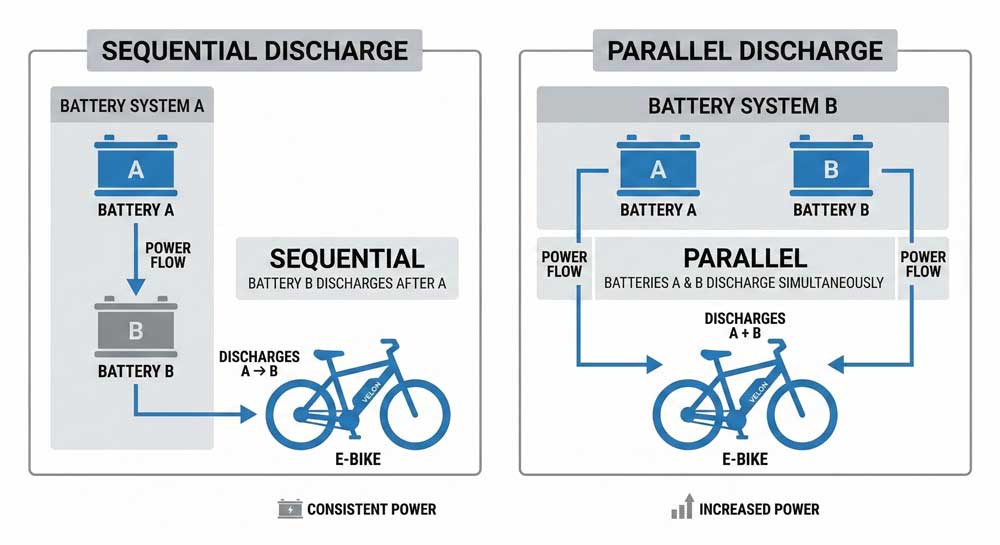
Before evaluating any dual battery cargo bike, you need to know which discharge architecture it uses. They are not the same, and the difference has direct operational implications.
Sequential Discharge (Series Logic)
In a sequential configuration, the bike draws from Battery A until it reaches a low-charge threshold, then automatically switches to Battery B. The rider essentially gets two full single-battery ranges back-to-back.
Advantages:
Simpler battery management system (BMS) logic
Easier to diagnose battery health individually
One battery can be swapped mid-route without interrupting the second
Disadvantages:
Power delivery may dip slightly at the handover point
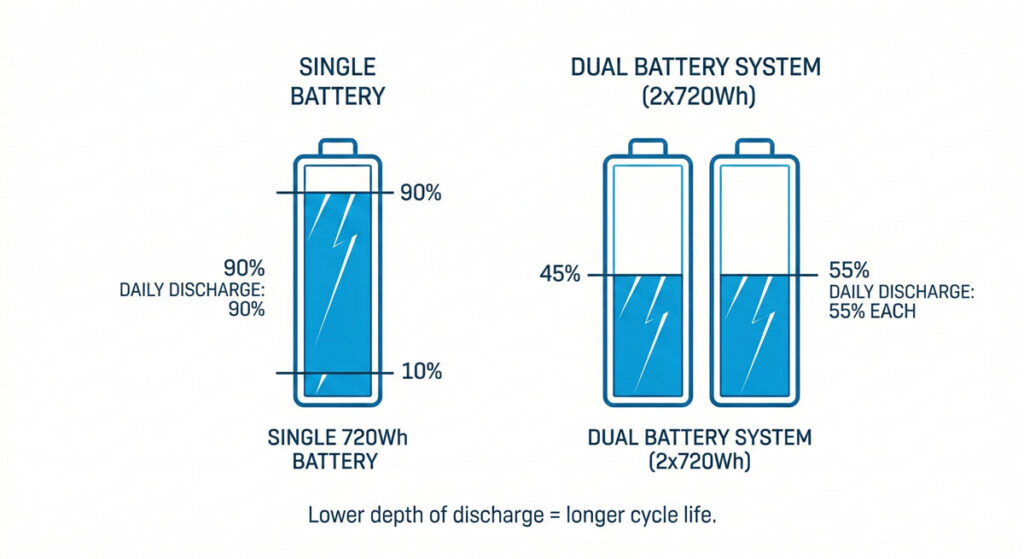
Uneven aging: the primary battery cycles more frequently than the secondary
Less efficient for sustained high-load operations (heavy cargo, hills)
Parallel Discharge (Simultaneous Draw)
In a parallel configuration, both batteries supply current simultaneously. The BMS balances the draw across both packs to maintain equal state-of-charge, or manages them by temperature and internal resistance. Bosch’s DualBattery system uses a variation of this—alternating discharge in balanced blocks rather than true simultaneous draw, which protects individual cell cycles while maintaining consistent power output.
Advantages:
More consistent power delivery under load
More even battery aging across both packs
Better thermal distribution across two smaller packs vs one large pack
Disadvantages:
Higher BMS complexity → higher component cost
Both batteries must be present and functional for full system performance
Replacement cost is effectively doubled when one pack degrades
How to evaluate: For urban last-mile delivery with frequent stops and moderate loads, sequential logic often suffices. For longer intercity routes or heavy cargo (bakfiets-style, 150+ kg payload), parallel draw provides more stable motor support across the full range. Ask your ODM partner which architecture their dual battery frame is designed around—it affects both the BMS specification and the battery enclosure layout.
Key takeaway: Sequential and parallel discharge are not interchangeable. The right architecture depends on route profile, payload, and how your service team will manage battery replacement over the fleet lifecycle.
When Does Dual Battery Make Sense? Matching System to Use Case
Cargo bikes inherited their battery architecture from the eBike world. In consumer eBike applications, a 500–750 Wh battery comfortably covers 60–100 km of assisted riding. For family cargo bikes operating similar short-trip patterns—school runs, grocery errands, weekend use—a single battery is typically sufficient and keeps the bike lighter and cheaper.
The calculation shifts significantly in commercial scenarios.
Use Case
Typical Route
Single Battery Viable?
Dual Battery Benefit
Urban last-mile delivery
30–60 km/day
✅ Yes
Marginal
Multi-stop courier routes
60–120 km/day
⚠️ Marginal
High—eliminates mid-day charging stop
Rural/intercity logistics
100–200 km/day
❌ No
Essential
Refrigerated cargo
Variable
⚠️ Depends
Auxiliary load from cooling unit reduces effective range
The most common commercial justification for dual battery is eliminating the mid-day charging stop. For a fleet operator running 8-hour delivery shifts, a single 625 Wh battery may require a 2-hour midday charge window. Dual battery extends operational range to cover a full shift without interruption—and the labor cost of downtime often exceeds the battery premium within the first year.
Key takeaway: Dual battery is not always the right answer. For routes under 80 km/day with access to depot charging, a single high-capacity battery (750 Wh+) often delivers better payload-to-cost ratio. Dual battery earns its cost premium primarily in full-shift commercial operations without reliable mid-route charging.
Design Integration: Why Cargo Bike Dual Battery Is Not Just “Double the Cells”
This is where cargo bike dual battery diverges sharply from eBike practice, and where many buyers underestimate the specification complexity.
Frame Type Determines Everything
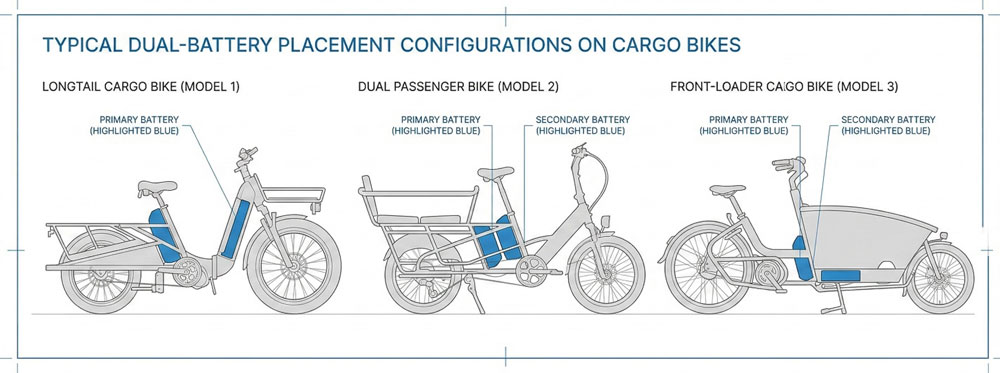
Different cargo bike architectures impose completely different constraints on battery placement:
Front-loader: The extended front box structure creates space for a primary battery in the downtube and a secondary unit integrated into the box base or a supplementary enclosure. When both batteries need to be concealed for aesthetic reasons—which is increasingly a requirement in premium European market segments—the enclosure must be custom-designed to match the frame geometry and tubing profile.
Longtail: Battery placement follows eBike logic more closely (downtube primary, rear rack secondary), but the rear battery must integrate with the rack system without compromising payload surface or creating an awkward visual break in the frame line. For private label models targeting lifestyle or premium logistics segments, this matters commercially. Check how dual battery designed in UM’s longtail ebike Stretch.
Compact urban cargo (boxy/upright style): Often the most constrained geometry. Dual battery requires careful BMS routing and thermal management design to avoid heat concentration in an enclosed frame area.
Aesthetics Are Now a Commercial Factor
Five years ago, cargo bike buyers prioritized function almost exclusively. Today—particularly in the German, Dutch, and Scandinavian markets—fleet buyers and private label distributors are evaluating frame aesthetics as part of their brand positioning. A visible battery bolted onto a rack as an afterthought signals low specification. A flush-integrated dual battery design signals premium.
For ODM projects, this means battery dimensions and enclosure profiles need to be defined at the frame design stage, not retrofitted afterward. Cell format (cylindrical 21700 vs prismatic), pack orientation, and connector placement all feed into whether a dual battery solution looks purpose-built or improvised.
Key takeaway: For cargo bikes, dual battery integration is a design decision, not just an electrical specification. Distributors building private label products should define battery placement and enclosure aesthetics during frame development—retrofitting dual battery compatibility adds cost and compromises appearance.
Range and Payload: The Real Trade-off Numbers
A typical dual battery pack adds 4–7 kg to the system weight depending on capacity. For a cargo bike with a 100 kg rated payload, that’s a 4–7% reduction in available carrying capacity—generally acceptable. For a heavy-duty commercial model targeting 250+ kg payload, the weight penalty is proportionally smaller and the range benefit more operationally significant.
Real-world range benchmarks for commercial dual battery cargo bikes in European logistics deployments (flat to moderate terrain, 60–80% assist, 80–120 kg cargo):
Dual 400 Wh (800 Wh total): 90–130 km
Dual 500 Wh (1,000 Wh total): 110–160 km
Dual 625 Wh (1,250 Wh total): 130–200 km
These figures degrade by 15–25% in winter conditions (below 5°C), and by 20–35% under maximum payload. Fleet planning should use the lower bound of the range for route mapping, not the marketing headline number.
For TCO calculations: a dual 625 Wh system at 150 km real-world range eliminates approximately 1.5 charging cycles per week versus a single 625 Wh system on a 100 km daily route. Over a 5-year fleet lifecycle with 50-vehicle scale, that difference in charging infrastructure and labor time frequently justifies the battery premium on its own.
Key takeaway: Plan fleet routes using 70–75% of the manufacturer’s stated range to account for real-world load, weather, and battery aging. At commercial scale, dual battery systems typically recoup their cost premium within 18–30 months through reduced charging infrastructure and operational downtime.
EU Battery Regulation: What Dual Systems Mean for Compliance
The EU Battery Regulation (2023/1542), which entered into force in August 2023 and is progressively replacing the older Battery Directive (2006/66/EC), introduces requirements that directly affect how dual battery cargo bikes are specified and sold in Europe.
Key provisions relevant to dual battery procurement:
Battery passport (from 2026 for LMT batteries): Each battery in a dual system will require individual traceability documentation—cell chemistry, carbon footprint, supply chain data. For dual battery configurations, this means two passports per bike, doubling the compliance documentation burden.
Capacity declaration: Batteries above 2 kWh (light means of transport category) require state-of-health reporting. A dual 625 Wh system at 1.25 kWh sits below this threshold; a dual 750 Wh system at 1.5 kWh also remains under it. But as capacity specifications increase toward dual 1,000 Wh configurations, compliance requirements escalate.
End-of-life and repairability: The regulation strengthens requirements for battery replaceability by end users. Dual battery systems that are designed with tool-free or simple-tool removal—increasingly common in fleet-oriented models—align well with this direction.
For distributors building private label products: confirm that your ODM partner can provide EU Battery Regulation-compliant documentation for both battery units in a dual configuration. This is not yet universally standardized across Asian manufacturers supplying the European market.
Key takeaway:EU Battery Regulation compliance for dual battery systems means double the documentation overhead. Factor this into ODM partner evaluation and ensure your supply agreement includes battery passport data delivery as a contractual deliverable.
What to Ask Your ODM Partner: A Dual Battery Specification Checklist
When sourcing a dual battery cargo bike platform for private label or fleet deployment, these are the questions that separate technically capable partners from those offering a single-battery frame with a rack-mounted add-on:
Architecture:
Is the dual battery design sequential or parallel discharge?
What BMS manages cross-battery balancing, and what is the thermal management architecture?
Is the dual battery configuration designed into the frame or retrofitted?
Integration:
What are the battery enclosure dimensions and mounting interface specs?
Can the secondary battery be removed independently for single-battery operation mode?
What is the IP rating for both battery enclosures?
Design:
Can battery enclosures be customized for our frame geometry and brand aesthetic?
For longjohn and longtail models: how are both batteries concealed or integrated into the frame profile?
Compliance:
Can you supply EU Battery Regulation documentation (including battery passport data) for each unit?
What is the warranty structure for each battery independently versus the combined system?
Service:
What is the replacement lead time for individual battery units?
Is the BMS firmware updateable in the field?
FAQs
What is the range of a dual battery cargo bike?
Under typical commercial conditions (60–80% assist, 80–120 kg cargo, moderate terrain), dual battery cargo bikes deliver 90–200 km depending on total capacity. A dual 500 Wh system (1,000 Wh total) typically covers 110–160 km in real-world European logistics conditions. Cold weather and maximum payload reduce this by 20–30%. For fleet planning, always calculate routes using 70–75% of the stated maximum range.
What is Bosch DualBattery technology?
Bosch DualBattery is Bosch eBike Systems’ proprietary dual battery architecture used widely in European premium cargo bikes. It uses alternating discharge logic—drawing from each battery in balanced intervals rather than simultaneously—which protects individual cell cycles and provides consistent power delivery. The system integrates via Bosch’s KIOX or Purion displays and requires both batteries to be Bosch-compatible units. For distributors, this means the system offers strong market recognition in Germany and Western Europe but locks the specification to Bosch’s component ecosystem and pricing.
Are cargo bikes suitable for business logistics?
Yes—with the right battery specification for the route. Single battery cargo bikes are commercially viable for urban routes under 80 km/day with depot charging. Dual battery systems extend commercial viability to full-shift operations of 100–180 km without mid-day charging, making them the standard specification for serious European logistics fleet deployments. The operational efficiency gain—eliminating 1–2 charging stops per shift per vehicle—frequently justifies the cost premium at fleet scale within 18–24 months.
How much weight can a commercial dual battery cargo bike carry?
Commercial dual battery cargo bikes typically carry 150–300 kg gross payload (including rider), depending on frame design. The dual battery system itself adds 4–7 kg to the bike weight, which reduces available cargo capacity by the same amount. For heavy-duty logistics applications (200+ kg cargo), this trade-off is generally acceptable given the range benefit. Confirm total system weight (bike + batteries + maximum cargo) against your legal road limits, which vary by market in Europe.
Ready to Spec a Dual Battery Cargo Bike for Your Market?
Choosing between sequential and parallel discharge, integrating two battery enclosures into your designated frame, and meeting EU Battery Regulation documentation requirements—these decisions happen at the design stage, not after the fact.
United Mobility works with distributors and fleet operators across Europe to develop dual battery cargo bike platforms built around your route requirements, brand aesthetics, and compliance obligations—from initial specification through private label production.




 English
  German
  Dutch
Dutch  Danish
  French
  Polish
  Portuguese
  Spanish