



Introduction: Why Battery Compliance Matters for Cargo Bike Businesses
For distributors, fleet operators, and cargo bike brands entering the European market, battery compliance is not just a technical requirement—it is a commercial risk control mechanism.
Cargo bikes operate under significantly higher loads than standard e-bikes. A delivery cargo bike may carry 120–200 kg of payload, operate continuously for 8–10 hours, and rely on high-capacity batteries that deliver sustained current. Under these conditions, battery reliability, safety certification, and regulatory compliance become critical factors for long-term business stability.
However, many buyers entering the cargo bike market struggle to understand the relationship between different compliance standards such as EN 15194, EN 50604-1, UN38.3, and CE certification. These certifications often appear together in supplier documentation, yet they serve very different purposes.
Before diving into regulations, it is also useful to understand the technical structure of a cargo bike battery system, including parameters such as voltage, capacity, discharge current, and battery health. These fundamentals are explained in detail in our earlier guides:
- What Actually Matters in a Cargo Bike Battery System?
- Comprehensive Cargo Bike Battery Specs Guide 2026
Together with this article, these resources form a complete framework that helps buyers evaluate battery performance, compliance requirements, and long-term operating costs.
Understanding EU Battery Regulations for Cargo Bikes
When people refer to EU battery compliance for cargo bikes, they are usually referring to a combination of regulations and safety standards rather than a single certification.
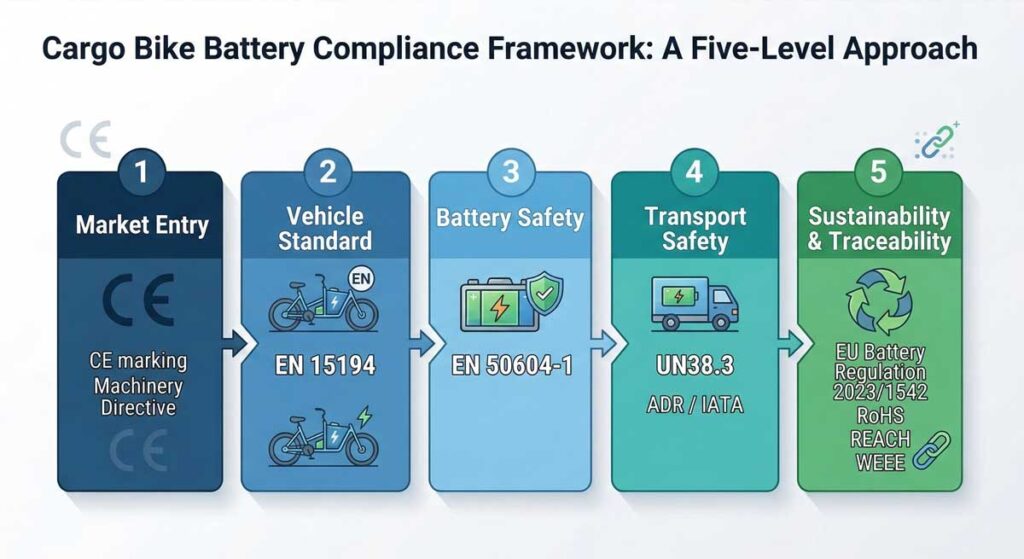
Three core frameworks define the compliance logic.
EN 15194 governs the safety requirements of electrically assisted bicycles sold in Europe. It defines the overall vehicle system requirements including motor assistance limits, electrical safety, and mechanical integrity.
EN 50604-1 focuses specifically on lithium-ion battery safety for light electric vehicles such as e-bikes and cargo bikes. It tests battery pack design, electrical protection, thermal stability, and abuse resistance.
UN38.3 is a global transportation safety standard. It ensures lithium batteries can be safely transported by air, sea, or road.
Finally, CE marking indicates that the complete product complies with applicable EU directives and harmonized standards.
The relationship between them can be summarized simply:
- EN 15194 → vehicle system safety
- EN 50604-1 → battery pack safety
- UN38.3 → transportation safety
- CE marking → legal market entry in the EU
When combined, they form the core of battery compliance for e-bikes and cargo bikes in Europe.
EN 15194 Battery Compliance Explained
EN 15194 is the primary European standard regulating EPACs (Electrically Power Assisted Cycles).
It defines key parameters including:
- Maximum motor assistance speed (25 km/h)
- Electrical system safety
- Mechanical durability
- EMC requirements
- Battery integration safety
While EN 15194 applies to both e-bikes and cargo bikes, the practical engineering requirements for cargo bikes are much higher.
Cargo bikes typically use:
- Larger battery capacities (700–1200Wh)
- Higher continuous discharge current
- More frequent charge cycles
- Longer daily operating hours
Because of these conditions, cargo bike battery design must focus heavily on thermal stability and long-term cycle durability.
A battery that technically passes EN 15194 for a standard commuter e-bike may still perform poorly in a commercial cargo bike fleet.
For example, a logistics company operating delivery cargo bikes in Amsterdam reported that some early-generation battery packs degraded to 70% capacity within 18 months due to continuous heavy load operation.
This highlights the gap between minimum compliance and real commercial durability.

EN 50604-1: The Core Safety Standard for Cargo Bike Batteries
If EN 15194 regulates the vehicle system, EN 50604-1 regulates the battery pack itself.
This standard evaluates how a lithium battery behaves under extreme conditions, including:
- overcharge and over-discharge
- external short circuit
- mechanical shock and vibration
- thermal runaway risk
- cell imbalance protection
For cargo bike manufacturers, compliance with EN 50604-1 is increasingly considered a baseline requirement by European distributors.
Many professional fleet buyers now request explicit documentation for EN 50604-1 battery certification before placing orders.
The reason is simple: cargo bike batteries are larger, heavier, and often mounted externally on the frame or rear rack. Any failure can cause serious operational and reputational damage.
A properly engineered Battery Management System (BMS) plays a central role here. It monitors voltage, temperature, and current flow to ensure the battery operates within safe limits.
The technical logic behind battery management is explained in more detail in our guide:
Comprehensive Cargo Bike Battery Specs Guide 2026
UN38.3 Cargo Bike Battery Requirements
Even if a battery performs well technically, it cannot be shipped internationally without passing UN38.3 testing.
UN38.3 certification verifies that lithium batteries can safely withstand transportation hazards.
The test includes:
- altitude simulation
- thermal cycling
- vibration testing
- shock testing
- external short circuit
- impact and crush testing
Without UN38.3 documentation, lithium batteries cannot legally be transported by air or sea freight.
This is one of the most common hidden risks for new cargo bike brands sourcing batteries from smaller suppliers.
A manufacturer might offer a lower price, but if the battery lacks proper UN38.3 test reports, the shipment may be blocked by logistics providers.
This often leads to delayed product launches and unexpected costs.
Regulation (EU) 2023/1542: The New Battery Framework for the European
Beyond technical standards such as EN 15194, EN 50604-1, and UN38.3, cargo bike batteries sold in Europe are increasingly governed by a broader regulatory framework introduced under Regulation (EU) 2023/1542, commonly referred to as the EU Battery Regulation.
This regulation represents a major shift in how batteries are managed across their entire lifecycle. While earlier standards primarily focused on safety and transport requirements, the new regulation expands compliance into areas such as traceability, sustainability, labeling, and recycling responsibilities.
For cargo bike batteries classified as Light Means of Transport (LMT) batteries, several requirements will gradually become mandatory across the EU market.
One of the most significant changes is the introduction of the Battery Passport, which will become mandatory in the coming years. Each battery must carry a digital record—typically accessible through a QR code—that contains key information such as battery chemistry, manufacturing origin, performance characteristics, and recycling data. This system aims to improve transparency across the battery supply chain and ensure long-term traceability.
From a procurement perspective, EU Battery Regulation 2023/1542 effectively shifts part of the compliance responsibility to brands and importers, not only the battery manufacturer. Distributors and cargo bike brands must ensure that the batteries integrated into their products meet the documentation, labeling, and lifecycle management requirements defined by the regulation.
A deeper explanation of how this regulation affects cargo bike businesses can be found in our dedicated analysis: E-Cargo Bike Batteries & EU 2023/1542: Key Moves for Your Business.
Additional EU Regulations Affecting Cargo Bike Batteries
In addition to the battery-specific standards and the new EU Battery Regulation, several other European regulatory frameworks also apply to cargo bike batteries because they are classified as electronic products containing chemical materials.
One of the most relevant is the RoHS Directive (2011/65/EU), which restricts the use of hazardous substances in electrical and electronic equipment. This directive limits materials such as lead, mercury, cadmium, and hexavalent chromium. Battery packs integrated into cargo bikes must comply with these restrictions to be legally sold within the European Economic Area.
Another important framework is the REACH Regulation (EC 1907/2006), which governs the registration and safe use of chemical substances within the European Union. For battery manufacturers and cargo bike brands, REACH compliance involves ensuring that materials used in battery cells, casing components, and electronic circuits do not contain restricted substances above regulatory thresholds. It also requires transparency regarding SVHC (Substances of Very High Concern) within the supply chain.
End-of-life management is addressed through the WEEE Directive (Waste Electrical and Electronic Equipment), which establishes extended producer responsibility for electrical products placed on the EU market. Cargo bike brands and distributors are often required to participate in national recycling systems to ensure that batteries and electronic components are properly collected and recycled at the end of their lifecycle.
Together with EN 15194, EN 50604-1, UN38.3, and Regulation (EU) 2023/1542, these frameworks form the broader compliance environment for cargo bike batteries sold in Europe. For manufacturers and B2B buyers, understanding how these standards interact is essential for avoiding regulatory risk and ensuring long-term market access.
CE Certified E-Bike Battery vs Cargo Bike Battery
Many suppliers advertise CE certified e-bike batteries, but buyers should understand what this actually means.
CE certification is not a single test. It represents compliance with multiple EU directives.
For e-bike batteries, CE compliance typically requires:
- EN 15194 conformity
- relevant EMC directives
- electrical safety compliance
- documentation and traceability
However, cargo bikes place additional operational demands on battery systems.
A delivery cargo bike may run 3–5 charge cycles per day, compared to a commuter e-bike that charges once every few days.
This difference significantly affects:
- battery lifespan
- thermal stability
- degradation rate
A battery that works well for a lightweight e-bike may not deliver sufficient durability for cargo bike fleets.
This is why many professional buyers now evaluate complete cargo bike battery system design, not just certifications.
Our Cargo Bike Battery System Strategy explains this broader system perspective.
Cargo Bike Battery Replacement Cost in the EU
Battery replacement cost is one of the most important operational factors for fleet operators.
A typical cargo bike battery replacement cost in the EU ranges from:
€500 to €900 depending on capacity and brand.
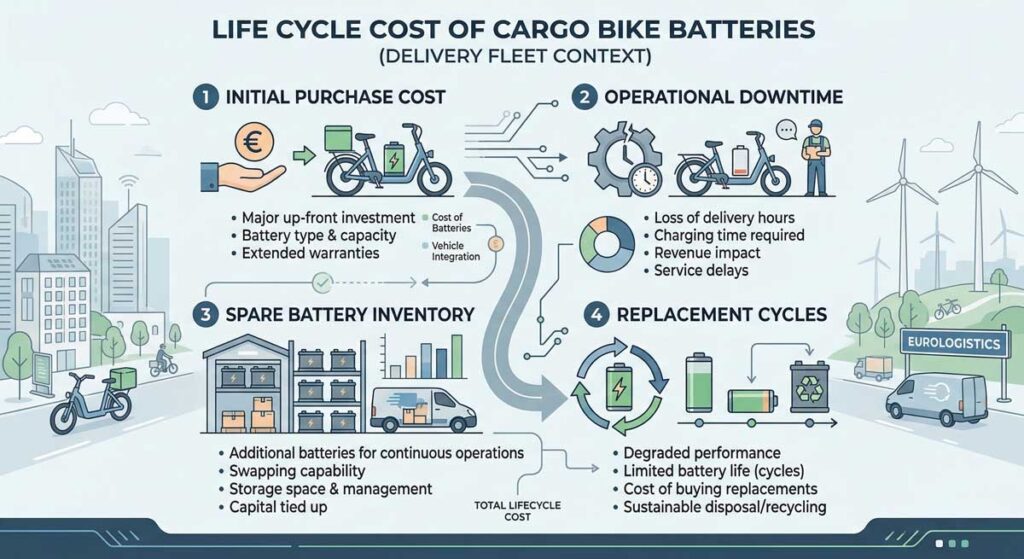
However, the real cost often includes several hidden components.
The first is downtime cost. When a delivery bike cannot operate due to battery failure, it directly affects logistics productivity.
The second is inventory cost. Fleet operators often maintain spare batteries to avoid operational disruption.
The third is compatibility risk. Some battery systems change connectors or BMS protocols between production batches, making replacements difficult after several years.
A food delivery fleet in Berlin reported that inconsistent battery suppliers caused compatibility issues between different production batches, forcing them to replace entire battery sets earlier than expected.
These hidden costs are rarely visible during initial procurement but can significantly affect long-term profitability.
Understanding battery lifespan dynamics is therefore critical. This topic is explored in detail in our article:
Cargo Bike Battery Lifespan and Replacement Cost Guide
How to Source a Cargo Bike Battery That Meets EU Compliance
For B2B buyers, sourcing compliant batteries requires evaluating both certification and manufacturing reliability.
A robust procurement process usually includes:
Verification of EN 15194 and EN 50604-1 compliance documentation.
Confirmation of UN38.3 transportation certification.
Review of battery cell suppliers and BMS design.
Evaluation of warranty policy and replacement support.
Warranty terms deserve particular attention. In the cargo bike industry, two-year battery warranty is common, but the starting point of the warranty may differ.
Some manufacturers define the warranty period starting from factory shipment date, while buyers may negotiate warranty activation from market launch or delivery date.
Clarifying this detail can significantly affect long-term risk exposure.

Why Battery System Integration Matters
Battery safety does not depend only on certification.
It depends on how the battery is integrated into the complete cargo bike system, including motor controller tuning, thermal management, and structural mounting.
Poor integration can lead to excessive current draw, overheating, or premature battery degradation.
This is why many experienced cargo bike manufacturers treat battery system engineering as a core competence rather than a component purchase decision.
Conclusion: Choosing a Reliable Cargo Bike Partner
As the European cargo bike market continues to grow, battery compliance and long-term reliability are becoming key differentiators for manufacturers and distributors.
Understanding the relationship between EN 15194, EN 50604-1, UN38.3, and CE certification helps businesses avoid regulatory risks and operational failures.
But certifications alone are not enough. Battery lifespan, system integration, and supply chain stability are equally important for long-term fleet performance.
If you are evaluating cargo bike suppliers or planning to launch a cargo bike product line in Europe, working with an experienced manufacturing partner can significantly reduce technical and compliance risks.
At United Mobility, our cargo bike development team includes electric control system engineers with more than 20 years of experience in battery integration and vehicle electronics. Our approach focuses on designing battery systems that balance safety certification, real-world durability, and commercial operating efficiency.
 English
  German
  Dutch
Dutch  Danish
  French
  Polish
  Portuguese
  Spanish