


For urban planners and automotive fleet operators in Europe and North America, the car replacement conversation has long been a theoretical exercise. However, product managers within the long john cargo bike industry know the transition is actively happening, catalyzed not by environmental idealism, but by structural shifts in urban logistics and household management.
As we approach electric cargo bike trends 2026, the primary market for the front-loader—the traditional “Long John” layout—has shifted from enthusiast couriers to demanding families. This shift requires a radical re-engineering of the vehicle. Families do not view these bikes as rugged industrial tools; they view them as safer, more efficient alternatives to the family SUV for city use management. The engineering hurdles are complex, demanding sophisticated solutions in stability, drivetrain capability, modularity, and connected security.
For B2B stakeholders—from brand founders to sourcing managers—understanding these technical trajectories is crucial for product roadmap planning and evaluating OEM electric bike custom development support. The era of the “one-size-fits-all” wooden box is over. The next generation of long johns must be high-performance, versatile hubs.
The Versatility Engineering Challenge: When “One Bike” Must Do Everything
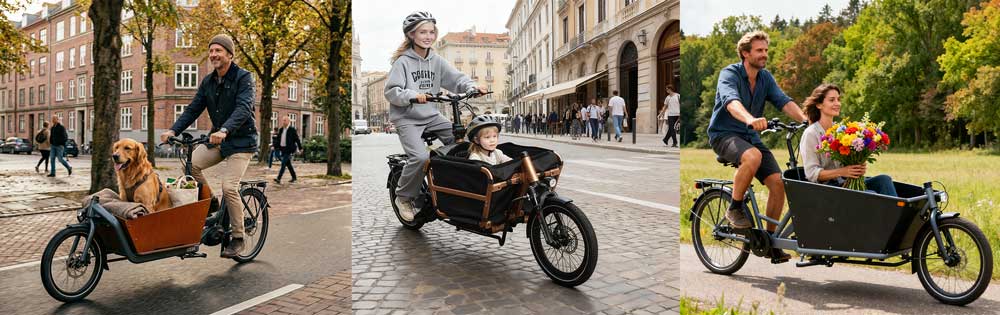
The dominant family bike trend is the desire for total daily routine elimination of the secondary car. This means a single vehicle must handle the morning school run, a significant grocery shop on the way home, a weekend trip to the park with pets, and potentially short-haul camping equipment for a forty-kilometre getaway.
This versatility creates immense stress on traditional long john bike engineering. A courier load is usually static and inanimate. A family load is dynamic: two kinetic toddlers, a shifting pet, and fluctuating grocery weights.
From a design engineering perspective, this requires focusing on the center of gravity. Traditional models often suffered from high front-wheel instability when fully loaded. 2026 designs are increasingly moving toward lower cabin floor heights and integrating battery packs into the down tube or under the cabin floor itself to drop the center of gravity, rather than mounting them high on the rear rack. This optimization is a key area where specialized ODM electric bike design engineering provides a competitive edge over standardized platforms.
Zoning and Dual Platforms: Engineering for Separation

One of the key things families look for in electric cargo bike city use management is the ability to compartmentalize their lives. Mixing children with sharp-edged groceries or hardware supplies is a safety compromise families are no longer willing to make.
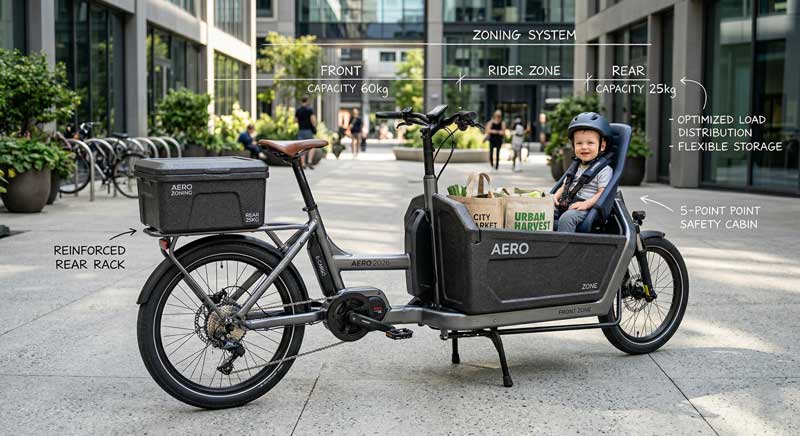
The technical solution is the emergence of dual-cargo platforms and partitioned zones. While the primary cabin remains a dedicated, protected safety cell for passengers—increasingly using impact-absorbing materials like Expanded Polypropylene (EPP)—engineering is expanding elsewhere.
Product managers must evaluate how to utilize the space behind the rider. We are seeing a significant rise in “Extended Long John” designs that incorporate a reinforced rear rack, capable of mounting a standard third child seat or a secondary cargo box. This “Front/Rear Zoning” approach allows families to keep passengers separate from property. Furthermore, internal cabin partitioning—using modular, adjustable dividers within the front box—allows for the secure separation of a pet from shopping bags on the same journey.
Active Safety Reconstruction: ABS as the Heavy-Duty Standard
In recent years, safety engineering has evolved from passive frame reinforcement to active electronic intervention. For a long john cargo bike frequently operating at a gross vehicle weight exceeding 200kg, front-wheel lock-up during emergency braking—especially on wet cobblestones or loose gravel—remains a primary cause of instability and lateral slides.
The 2026 technical benchmark is the integration of cargo-specific Anti-lock Braking Systems (ABS). Unlike standard e-bike ABS, these systems are calibrated for the unique weight distribution and longer brake-line hydraulic pressure requirements of a front-loader. For sourcing managers and product leads, evaluating oem electric bike custom development support now requires a rigorous audit of how the front fork geometry and hub interfaces accommodate ABS sensor rings without compromising torsional stiffness.
Implementing this technology is no longer just a premium “add-on”; it is a critical requirement for brands looking to meet the tightening safety expectations of the North American and European family markets, as detailed in our analysis of Long John Cargo Bike: Engineering, Safety, and Real-World Decisions Behind Europe’s Most Versatile Urban Workhorse.
Cognitive Load Elimination: Automatic Shifting and Integrated Powertrains
A significant barrier to the family bike trend has been the “operator complexity” of managing gears, motor assist levels, and heavy traffic simultaneously. For the 2026 product cycle, the industry is moving toward “set-and-forget” mobility via Integrated Powertrains and Motor Gearbox Units (MGU).
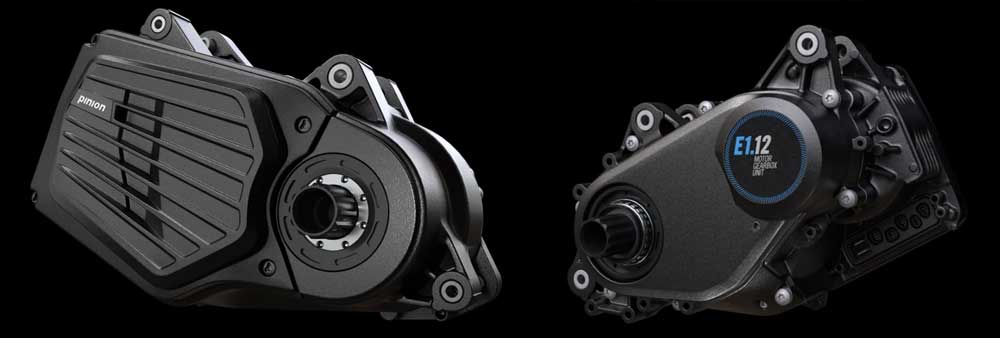
By utilizing sophisticated systems such as the Pinion MGU or Enviolo’s automatic stepless shifting, the long john bike can now manage gear ratios autonomously based on real-time sensor data—input torque, cadence, and incline. This eliminates the risk of drivetrain damage caused by shifting under high load—a common failure point in heavy cargo applications.
From a odm electric bike design engineering perspective, these integrated units significantly lower the Total Cost of Ownership (TCO) by protecting the internal components from the elements and reducing mechanical wear. This shift toward maintenance-free, intuitive operation is a cornerstone of the cargo bike market trends in 2026, allowing brands to appeal to non-cyclist parents who prioritize a car-like user experience over mechanical tinkering.
Eliminating the “Pivot Panic”: One-Click Reverse and Heavy-Load Handling
The debate between a two-wheeled long john and a three wheeled bike often comes down to perceived stability vs. maneuverability. Two-wheeled front-loaders are more agile and faster, but they can be daunting for smaller riders to manage when fully loaded and stationary.
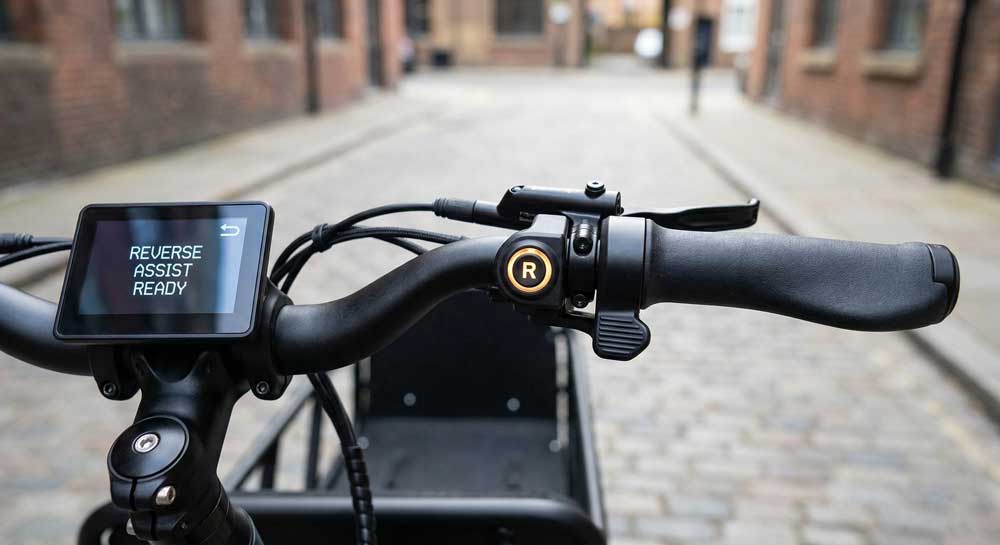
The most critical operational challenge for families using a two-wheel 3 wheel cargo bike alternative is maneuvering the vehicle in tight spaces—parking structures, Fahrradkeller (bike cellars), or crowded grocery store entrances. When carrying a gross vehicle weight exceeding 200kg, the standard multi-point turn is physically exhausting and risks a tip-over.
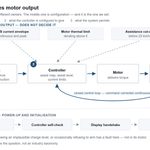
The 2026 technology standard is eliminating this “pivot panic” via electronic reverse assist. Unlike a mechanical reverse gear, which adds substantial weight and complexity, modern motor controllers can reverse the rotation of the mid-drive motor at a regulated, slow speed (approx. 2–3 km/h). Actuated via a dedicated button on the handlebar cockpit, this feature allows a rider to effortlessly back a fully loaded long john out of a diagonal parking spot or turn around in a narrow alleyway without dismounting.
Solving the “Where do I put it?” Problem: One-Step Cabin Folding
For the North American market specifically, and many densely populated European cities, the sheer footprint of a long john is the single greatest barrier to adoption. If the vehicle cannot be stored in a standard apartment building’s elevator, a private garage, or a designated bike cellar, the purchasing decision is often a “no.”
For years, the industry accepted that the long john’s box was a static structural element. That is changing. The frontier of long john cargo bike engineering is “Cabin-Integrated Folding.” (eg. the compact long john bike with foldable cabin – UM ZIP )We are seeing sophisticated mechanisms—often protected proprietary designs requiring close OEM electric bike custom development support—where the front box can fold flat or collapse onto the main frame in one or two intuitive steps.
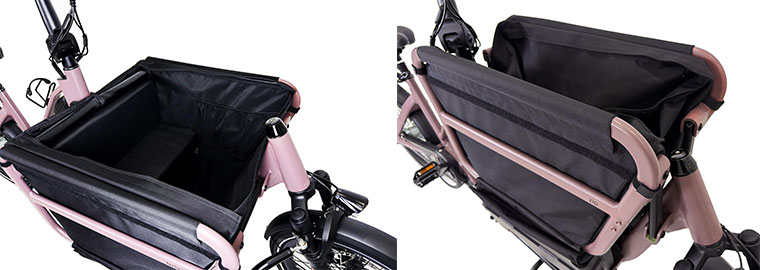
This engineering feat must be balanced against safety certifications. The folding mechanism cannot compromise the structural integrity of the child passenger safety cell. Manufacturing these hinges to tolerate thousands of cycles under heavy load requires industrial-grade materials and precision tolerance management that go beyond standard bicycle engineering practices.
Anti-Theft: Transitioning from Locks to Connected Ecosystems
Families view their cargo bike as a high-value asset, often comparable in price to a used car. Traditional D-locks and chain locks are necessary deterrents, but they do not solve the psychological hurdle of theft anxiety.
The technological solution is transitioning the bike from a passive vehicle to a connected ecosystem. “Find Me” technology—referring to integrated, deep-system tracking—is becoming standard. In 2026, a competitive family long john must have an integrated GPS and 4G/5G telematics module that operates independently of the main battery.
This system must offer:
- Always-on Geofencing: Immediate push notifications to the owner’s smartphone if the bike moves outside a predefined digital perimeter.
- Remote System Lockout: The ability to electronically disable the motor and drivetrain via the app, making the bike useless to a thief.
- Independent Power: A dedicated, hidden battery for the tracking module that lasts for weeks, even if the main powertrain battery is removed.
Conclusion
The technical evolution of the long john cargo bike is no longer about incremental gains—it is about a fundamental shift in vehicle architecture to meet family needs. From the safety of ABS to the convenience of automatic shifting and foldable cabins, these trends are defining the winners of the 2026 market.
At United Mobility | Cargo Bike Manufacturing, we provide the engineering depth and manufacturing reliability needed to bring these complex vehicles to market. Our team supports the full lifecycle of product development, from initial concept to global supply chain management.
We invite you to explore with our 20-years industrial experience experts to see how we address these engineering challenges at scale. For a consultation on your next product roadmap, please reach out to our technical lead.
 English
  German
  Dutch
Dutch  Danish
  French
  Polish
  Portuguese
  Spanish