


If you have read our previous analysis on What Actually Matters in a Cargo Bike Battery System and the Comprehensive Cargo Bike Battery Specs Guide 2026, you already understand voltage, capacity and BMS architecture at a technical level.
This article addresses the next question product managers actually ask:
How long does a cargo bike battery last, and what will it cost me over time?
For dealers, importers and fleet operators, battery lifespan is not a theoretical metric. It determines warranty exposure, replacement inventory, customer satisfaction and total cost of ownership.
How long does a cargo bike battery last?
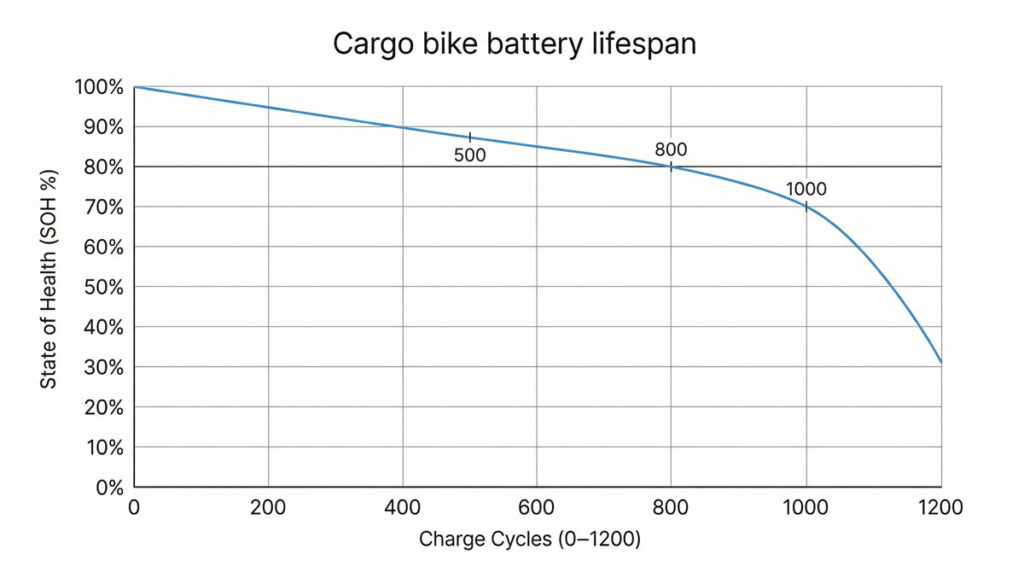
A typical cargo bike battery lasts 500 to 1,000 full charge cycles before reaching 80% State of Health (SOH). In real European commercial use, this often equals 2–4 years depending on payload, terrain, assist level, climate and charging behavior. High daily utilization in electric delivery bike fleets shortens lifespan, while moderate private use extends it.
1. Cargo Bike Battery Lifespan Is Not Just “Cycle Life”
Manufacturers often state “800 cycles” or “1,000 cycles,” but this number is measured under laboratory conditions. Real-world lifespan depends on:
- Depth of discharge
- Continuous discharge stress
- Ambient temperature
- Charging speed
- Payload and terrain
A utility electric bike used for school runs in flat cities may experience 30–40% daily discharge. A fully loaded electric delivery bike operating in hilly southern Europe may discharge 80–100% daily. That difference alone can halve usable lifespan.
State of Health (SOH) becomes the real indicator. Once SOH drops to 80%, customers begin to notice range reduction and performance instability. At 70%, most commercial fleets replace the pack.
2. Real Range vs Advertised Range
Many searches such as “real range cargo bike battery” or “why is my cargo bike battery draining fast” stem from misunderstanding energy consumption.
Battery capacity is expressed in Wh. Range is determined by Wh divided by real energy consumption (Wh/km).
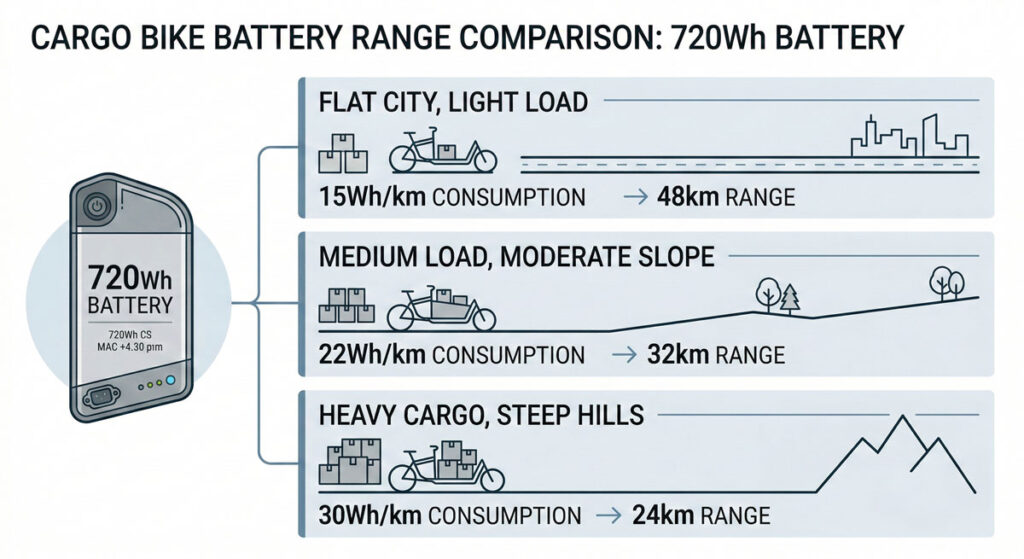
In practice, energy consumption varies significantly:
- 48V 15Ah battery = 720Wh
- Light load, flat terrain, eco mode: 12–15Wh/km
- Full load, moderate slope: 20–25Wh/km
- Steep terrain or throttle-heavy use: 25–35Wh/km
This means the same 720Wh battery can deliver 45–60 km under light conditions, but only 25–35 km under commercial load.
Throttle-dominant riding (where legally permitted) increases energy draw dramatically compared to pedal-assist mode. High assist levels and frequent acceleration phases also increase peak discharge frequency, accelerating degradation.
Range complaints often originate from usage mismatch rather than defective batteries.
What affects cargo bike battery range the most?
Cargo bike battery range is primarily affected by battery capacity (Wh), payload weight, terrain gradient, assist level, riding style, temperature and tire pressure. High load, steep hills and frequent throttle use significantly increase energy consumption and reduce range.
3. Fast Charging Is Possible but Often Counterproductive
Some buyers request fast-charging capability. While technically feasible, high charging currents increase internal heat and accelerate cell aging.
For commercial fleets operating daily cycles, moderate charging (0.5C–0.8C) typically extends battery lifespan compared to aggressive fast charging.
In practice, proper charging planning is more effective than fast charging infrastructure.
4. Improper Storage and “Battery Starvation”
Two common but overlooked factors:
Long-term overcharging and long-term deep storage without charging both damage lithium-ion batteries.
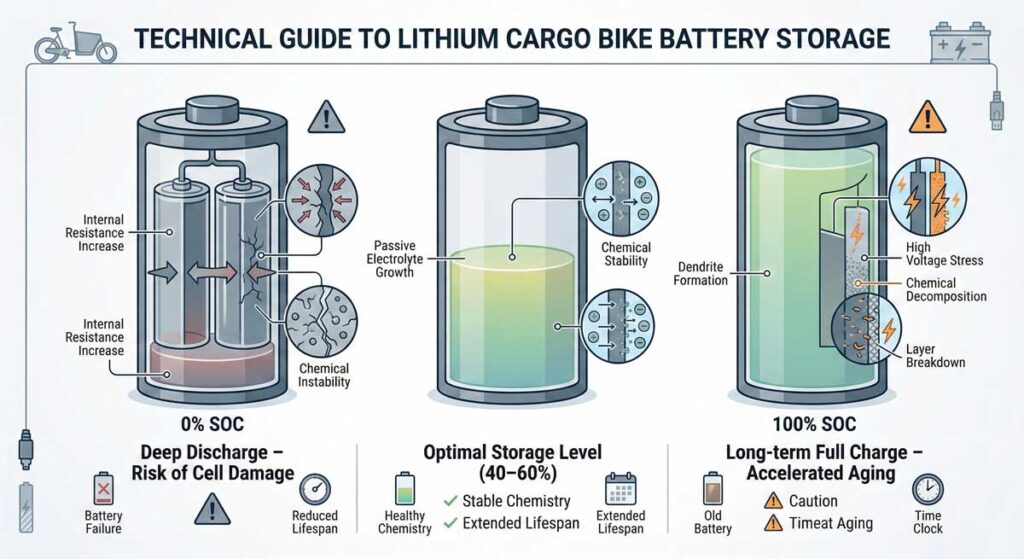
If a battery remains at very low SOC for extended periods, cells may enter deep discharge and become unrecoverable. Conversely, leaving batteries constantly at 100% SOC increases calendar aging.
European seasonal businesses must implement staged charging: maintain storage SOC around 40–60%, and recharge periodically during winter storage.
Many warranty disputes originate from improper storage, not manufacturing defects.
5. BMS Protection and Its Role in Lifespan
The battery management system (BMS) controls overcharge, over-discharge, overcurrent and thermal cut-off.
In heavy-duty cargo bike battery systems, BMS calibration directly affects usable capacity and safety margin. Aggressive settings may deliver stronger short-term performance but shorten lifespan. Conservative settings improve durability but slightly reduce perceived power.
For fleet buyers, stable BMS architecture is more valuable than peak marketing numbers.
6. Replacement Cost and Total Ownership Economics
A typical high-capacity ebike battery for cargo applications in Europe costs between €500 and €900 depending on configuration and certification level.
Replacement cost must be evaluated against:
- Average annual mileage
- Energy consumption
- SOH decline rate
- Warranty coverage
For example, a fleet operating 40 km per day at 22Wh/km consumes roughly 880Wh daily. A 720Wh battery will cycle more than once per day, accelerating wear. In such cases, a dual battery cargo bike architecture may reduce daily depth of discharge and extend lifespan.
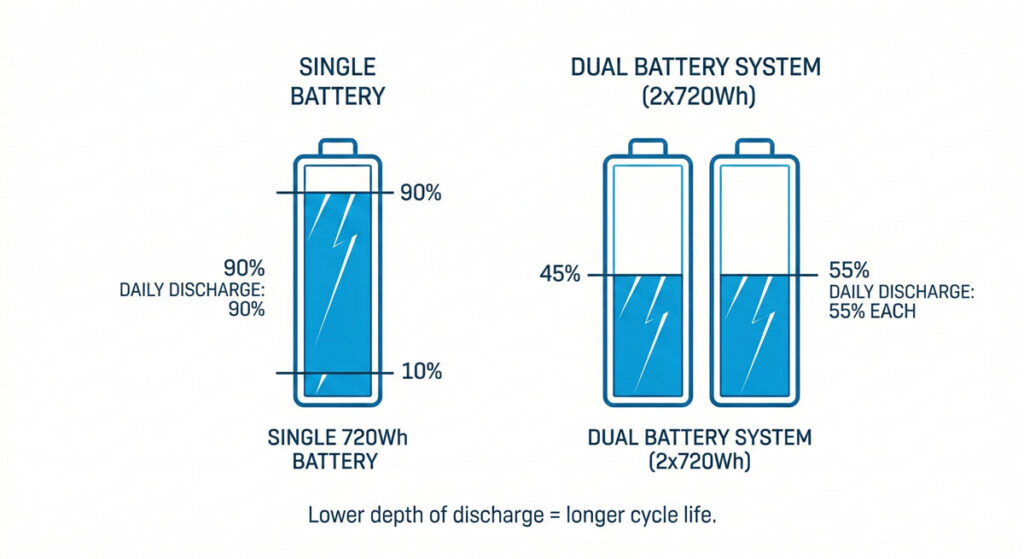
Single high-capacity vs dual battery decisions should therefore be based on usage patterns, not marketing.
7. Compliance and Safety Are Non-Negotiable in Europe
European buyers frequently search:
- cargo bike battery replacement cost EU
- EN 15194 battery compliance
- UN38.3 cargo bike battery
- CE certified ebike battery
UN38.3 covers transport safety. EN 15194 applies to EPAC systems. EN 50604-1 addresses light electric vehicle battery safety requirements. Compliance directly affects insurance validity and import legality.
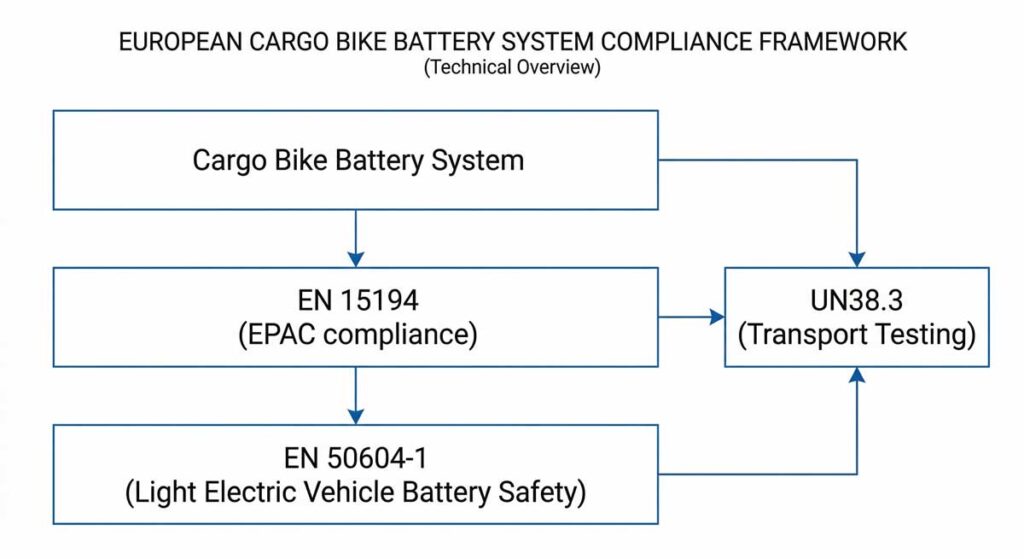
Using low-cost, small suppliers may reduce procurement price, but batch-to-batch consistency and long-term stability often suffer. Inconsistent cells across production batches create uneven SOH behavior and unpredictable replacement timing.
For B-side buyers, consistency across multiple production cycles is critical.
8. Warranty Start Date and Commercial Reality
Industry standard warranty is two years. However, many manufacturers define warranty start at factory shipment date.
Dealers should clarify:
- Does warranty start at shipment, delivery, or retail sale?
- Are batteries covered separately from frames?
- How are transport-damaged batteries handled?
- Is local replacement inventory supported?
Negotiating warranty start at product launch or retail sale date is possible in ODM relationships.
Clear documentation avoids disputes.
9. A Real Market Scenario
A Northern European logistics client operated electric delivery bikes in mixed urban terrain. Initial specification used single 720Wh packs. Within 18 months, SOH declined below 75% due to daily near-100% discharge.
Switching to a dual battery cargo bike configuration reduced daily discharge depth to 55–65%. Over the following cycle, projected lifespan increased by nearly 40%, despite higher initial investment.
Battery lifespan optimization often lies in system architecture, not cell chemistry.
10. Battery Safety in B-Side Procurement
Battery safety remains the highest risk factor in cargo platforms.
European buyers increasingly prioritize:
- Stable cell sourcing
- Documented compliance
- Clear recall procedures
- Defined replacement logistics
Lower-cost sourcing from small factories may reduce upfront expense but increases long-term unpredictability.
For professional cargo applications, stable suppliers with consistent production batches offer measurable lifecycle advantages.
Final Consideration for OEM and Fleet Buyers
Battery lifespan, replacement cost and range performance are interlinked variables. Capacity affects depth of discharge. Depth of discharge affects cycle life. Cycle life affects replacement timing. Replacement timing affects profitability.
Understanding these relationships complements the system-level framework discussed in our earlier battery architecture and specification guides.
At United Mobility, our electric control system specialists bring over 20 years of experience in battery integration and risk management. In our cargo bike platforms, battery selection, BMS calibration, frame integration and compliance strategy are engineered as one coordinated system.
If you are evaluating long-term battery economics for a utility electric bike, electric delivery bike or dual battery cargo bike platform, we can support specification review, warranty alignment and lifecycle optimization tailored to European market requirements. Contact us to get a free quote.
 English
  German
  Dutch
Dutch  Danish
  French
  Polish
  Portuguese
  Spanish