




Battery spec sheets list capacity and range; neither predicts how a pack performs in year three of fleet duty. This guide covers what actually determines battery lifespan in commercial use — cell sourcing, BMS design, thermal management and connector quality — and the questions to put to any manufacturer before signing.
Introduction: Why Battery Systems Decide the Real Cost
In the cargo bike industry, the battery is not just another component—it is often the single most expensive part of the entire vehicle, and the one that creates the highest downstream risk. A poorly defined cargo bike battery system can quickly inflate total cost through warranty claims, system incompatibility, software version conflicts, and aftersales complexity.
For B2B decision-makers, the battery influences far more than range or performance. It affects BOM cost structure, system integration effort, certification scope, spare parts strategy, and long-term maintenance expense. Once a cargo bike is in the market, battery-related issues are also among the hardest and most expensive to fix.
Are Cargo Bike Battery Requirements Different from eBikes?
Yes. Cargo bike battery requirements are fundamentally different from standard eBike batteries. Cargo bikes operate under higher continuous loads due to heavier payloads, more powerful motors, and frequent stop-and-go riding—especially in commercial use. This leads to higher discharge rates, faster battery aging, and stricter requirements for BMS design and thermal management.
In practice, many electric cargo bike manufacturers still adapt battery systems directly from conventional eBike platforms. This approach can work for low-intensity household use, but its limitations become clear as usage intensity increases. When cargo bikes shift from occasional family transport to daily delivery or fleet operation, differences in power demand, discharge behavior, software versions, and system communication quickly surface.
For brands and sourcing teams, the key challenge is knowing where eBike battery solutions still apply—and where they turn into a cost and reliability liability. Battery system decisions made early in development often determine not only performance, but also warranty exposure, maintenance cost, and whether a cargo bike platform remains commercially sustainable over its lifecycle.
Battery Types and Application Scenarios
Cargo bikes are, structurally speaking, a derivative of eBikes. Unsurprisingly, most cargo bike battery solutions today are based on mature eBike lithium-ion platforms, benefiting from high energy density, established supply chains, and proven certification paths.
How Much Battery Capacity Do Cargo Bikes Really Need for Home Use?
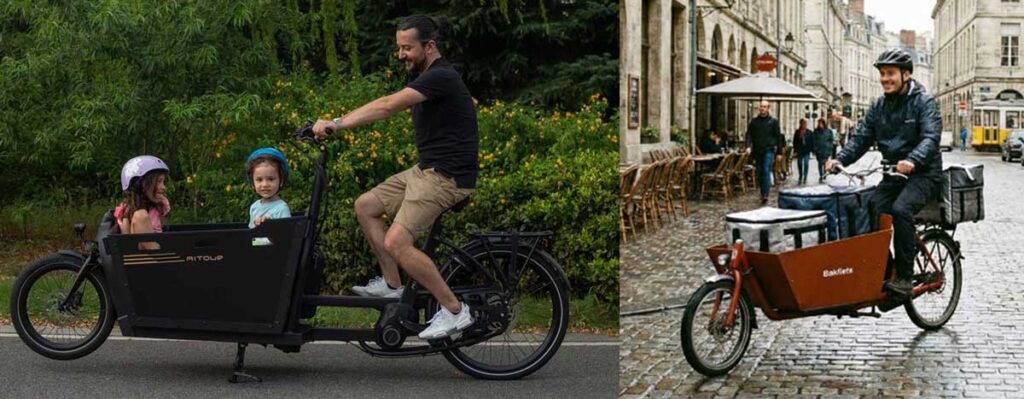
For most household use, cargo bikes typically require 500–700 Wh of battery capacity. Daily trips are usually short—such as school runs or grocery shopping—and prioritize load capacity over long-distance range. Larger batteries often add cost and weight without meaningful benefit in these scenarios.
This contrasts with many consumer eBikes, where extended range is a primary selling point and battery capacity is heavily marketed.
Commercial and Fleet Use: Capacity Becomes Strategic
In commercial applications—delivery fleets, municipal services, or shared logistics—battery requirements change fundamentally. Daily mileage increases, stop-and-go riding is frequent, and downtime has direct economic consequences. Fleet buyers often demand higher-capacity electric cargo bike batteries, dual-battery configurations, or swappable systems to maintain operational continuity.
The key mistake some buyers make is assuming that “bigger capacity” alone solves the problem. In reality, discharge capability, thermal behavior, and BMS logic often matter more than headline watt-hours.
How Frame Design Limits Cargo Bike Battery System Choices
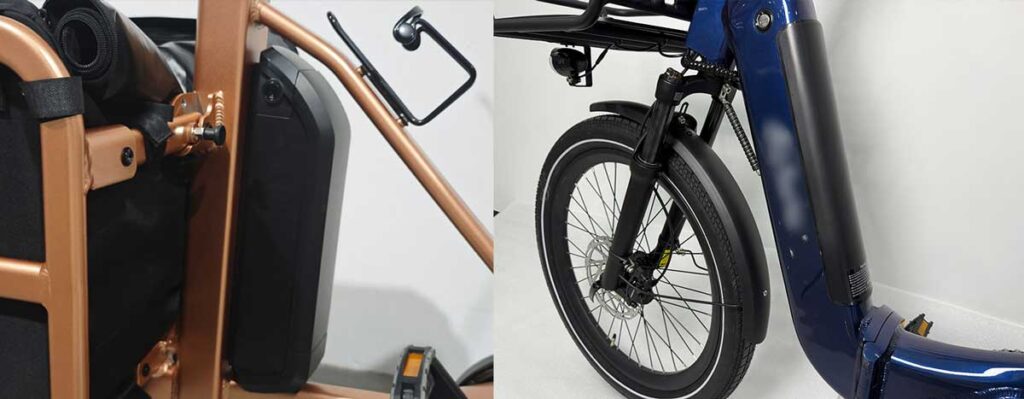
Unlike many consumer eBikes, cargo bikes frequently impose strict requirements on battery appearance and integration. Longtail ebike and longjohn platforms—especially those positioned close to premium eBike aesthetics—often require batteries to be partially or fully integrated into the frame. (Read more about Cargo Bike Frames Explained)
This creates several downstream implications:
- Battery dimensions must align with tube profiles and frame geometry.
- Structural reinforcement may be required to support heavier packs.
- Cable routing, connector placement, and service access must be considered early.
Dual-battery cargo bike systems are common on these platforms, not only to extend range but also to distribute weight and maintain visual balance. These design constraints mean off-the-shelf batteries are often insufficient, pushing OEMs toward custom or semi-custom solutions.
Which Cargo Bike Battery Specs Actually Matter in Real Use?
BMS Architecture: Hardware vs Software Logic
The Battery Management System is often underestimated. Hardware-based BMS solutions offer fixed protection logic—stable, predictable, but limited in flexibility. Software-based BMS platforms, by contrast, can support expandable protocols, remote diagnostics, and parameter tuning.
In cargo bike applications, CAN protocol compatibility is increasingly relevant. CAN communication allows the battery, controller, motor, and display to exchange real-time data—enabling power limitation under thermal stress, usage tracking for fleets, and advanced fault diagnosis. This is not a “nice-to-have” for commercial cargo bikes; it is becoming a baseline requirement.

Power Demand and Lifecycle Stress
Cargo bike motors typically operate at higher continuous power levels than standard eBike motors. This means batteries are asked to deliver higher discharge currents more frequently. The result is accelerated wear compared with an eBike battery used under lighter loads.
Cycle life expectations must therefore be adjusted. A cargo bike battery used in daily delivery service will accumulate cycles faster and degrade differently than a leisure eBike battery. Usage patterns—payload, terrain, rider behavior, and charging habits—often matter more than cell brand alone.
Why Nominal Battery Capacity Rarely Matches Real Cargo Bike Range
Nominal battery capacity does not reflect real cargo bike range because energy consumption varies significantly with payload, terrain, riding style, and motor power demand. A fully loaded cargo bike can consume 30–50% more energy than an unloaded one under the same conditions.
Real-world capacity varies with load. An unloaded cargo bike and a fully loaded one can experience dramatically different consumption, even with the same battery. Buyers should also distinguish clearly between SOC and SOH.
SOC vs SOH: Two Battery Metrics Cargo Bike Buyers Often Confuse
SOC (State of Charge) describes the current charge level of a battery after a single charge cycle, while SOH (State of Health) reflects the battery’s remaining capacity compared to its original specification. Warranty disputes often arise when these two metrics are confused.
Many disputes over warranty stem from confusion between these two concepts. Experienced suppliers will provide testing methods and degradation benchmarks rather than relying on nominal specifications alone.
Voltage, Power Matching, and System Compatibility
Voltage selection—36 V, 48 V, or higher—should never be isolated from system design. Higher voltage can reduce current for the same power output, improving efficiency and reducing thermal stress, but it also affects controller selection, certification scope, and component sourcing.
In CAN-based cargo bike battery systems, voltage and communication protocols must be aligned across the entire drivetrain. Mismatched components can limit performance, complicate certification, or introduce long-term reliability risks that only appear after months of use.
Aging, Safety, and Compliance Realities
Battery aging is driven by chemistry, thermal exposure, and usage patterns. In cargo bikes, higher average load and frequent charging accelerate degradation. Design choices—cell spacing, enclosure materials, and thermal pathways—play a significant role in safety and longevity.

Which battery certifications are mandatory for cargo bike manufacturers? From a compliance perspective:
- UN38.3 is mandatory for lithium battery transport and cannot be bypassed for international logistics.
- CE compliance for eBikes has traditionally aligned with EN 15194.
- In Europe, newer battery safety standards such as EN 50604-1 are being phased into regulatory frameworks, raising expectations for abuse testing and system-level safety.
Serious cargo bike manufacturers plan for these requirements early, rather than treating certification as a post-design formality.
How to Manage Battery Warranty and Aftersales Risk
When you select a cargo bike manufacturer, battery warranty is often the highest financial risk item. Key questions include:
- Is the battery sourced from a stable, traceable supplier?
- Are degradation curves and test data available?
- Is aftersales support localized, or dependent on cross-border logistics?
Transparent SOPs, documented testing, and integrated design processes reduce long-term risk far more effectively than headline specifications.
Conclusion: Building Battery Systems the Right Way
A cargo bike battery system is not just a component—it is an operational strategy. When designed and sourced correctly, it balances cost, performance, compliance, and lifecycle value. When treated as an afterthought, it becomes the most expensive failure point in the product.
UnitedMobility (UM) brings decades of experience in eBike and cargo bike electrical systems, supported by certified battery solutions, rigorous SOPs, and anODM process that integrates battery considerations from industrial design through final delivery. By addressing battery architecture early, UM helps brands control cost while maximizing reliability and long-term value.
If you are developing or expanding a cargo bike product line—especially for European or North American markets—contact UM to discuss how a properly engineered battery system can support your business goals.
 English
  German
  Dutch
Dutch  Danish
  French
  Polish
  Portuguese
  Spanish