




The container you are importing is not a consignment of bicycles. It is a consignment of dangerous goods that happens to have wheels attached. Ebike battery shipping regulations put duties on you as well as on your factory — the test summary obligation reaches distributors, not just manufacturers — and the rules differ by mode. Air and sea are separate instruments. Knowing which paper you personally owe is the difference between a clean clearance and a bricked pallet.

What you are actually shipping
Ebike battery shipping regulations begin from one classification: a lithium battery is dangerous goods before it is a bicycle component. For sea freight — which is how virtually all ebike volume moves — the governing instrument is the International Maritime Dangerous Goods Code, which the International Maritime Organization gave mandatory status under the SOLAS Convention from 1 January 2004 and which sits under SOLAS chapter VII. The Code is amended on a two-year cycle, so “we shipped it this way last time” is a statement about a superseded edition roughly half the time you hear it.
Air freight is a different instrument with different numbers, and that is where most of the confusion in this category starts. The widely quoted rules about shipping at 30% charge are air rules, from the ICAO Technical Instructions as implemented in the IATA Dangerous Goods Regulations, and IATA’s own guidance is explicit that other modes have their own requirements. Do not carry an air figure onto a sea booking, and do not accept a sea shipment being called compliant because it meets an air threshold.
Three UN numbers cover almost everything in this industry: UN 3480 for cells and batteries shipped on their own, UN 3481 for batteries packed with or contained in equipment, and the packing instruction for battery-powered vehicles, which is where a complete ebike or e-trike usually sits. Which one applies changes the paperwork, the packaging, and the charge state you are allowed to ship at. Getting the number wrong is not a clerical error; it is a misdeclaration, and it is the first place ebike battery shipping regulations bite a new importer. If you are still mapping the whole buying sequence, our cargo bike procurement guide sets out where this file sits in it.
UN 38.3 test summary: who issues it, who must provide it
UN 38.3 is sub-section 38.3 of Part III of the UN Recommendations on the Transport of Dangerous Goods, Manual of Tests and Criteria. It is a test series — altitude simulation, thermal cycling, vibration, shock, external short circuit, impact, overcharge, forced discharge — and a cell or battery that has not passed it cannot be moved legally by any mode.
Two practical points about who holds this document.
The cell or battery manufacturer issues the report, not the bike factory. No vehicle assembler can write a UN 38.3 report for a pack it did not test. A competent assembler obtains the report and the summary from the cell supplier and passes them to you. UnitedMobility treats this as part of the shipping file rather than as a document produced on request after a booking is made, because a battery plant that cannot produce one promptly is telling you something about itself.
The obligation to provide the summary reaches you too. This is the part importers consistently miss. IATA’s Battery Guidance Document states the requirement applies to “manufacturers and subsequent distributors of cells or batteries” — and to equipment powered by them. If you buy packs or complete vehicles and sell them on, you are a subsequent distributor, and the duty to make the summary available attaches to you as well as to the factory. Your own customers can ask you for it.
The good news is that the format is undemanding. There is no mandated layout, it does not have to travel with every shipment unless a State or operator says so, and compliance “may be achieved by placing the test summary on a website and providing a QR code or URL.” IATA goes further and says it does not support requiring a shipper to provide a summary with every consignment. A single hosted PDF with a QR code on your technical file page discharges the duty for your whole catalogue.
A valid UN 38.3 test summary contains ten things, and a summary missing any of them is not a summary:
- Manufacturer name for the cell, battery or product, and full contact details — address, phone, email and website
- Name and contact details of the test laboratory
- A unique test report identification number
- The date of the test report
- A cell or battery description: chemistry type, mass, watt-hour rating or lithium content, physical description and model numbers
- The list of tests conducted and the pass or fail result of each
- A reference to assembled battery testing under 38.3.3(f) and (g), where applicable
- The revision of the Manual of Tests and Criteria used, plus any amendments
- The name and title of the person responsible for the document
Check the revision line in particular. It is the field that quietly tells you whether the pack was tested against a current edition of the Manual or an old one.
State of charge, transit time, and dead packs
For air transport the charge-state rules are precise, and they are not the same for every UN number:
| Consignment | Packing instruction | State of charge rule | Estado |
|---|---|---|---|
| Batteries shipped alone (UN 3480) | PI 965 | Not exceeding 30% of rated capacity | Mandatory; higher needs State of Origin and Operator approval |
| Batteries contained in equipment (UN 3481) | PI 967 | 30% of rated capacity, or indicated capacity ≤25% | Recommended, not mandatory |
| Battery-powered vehicles, pack above 100 Wh | PI 952 | 30% of rated capacity, or indicated capacity ≤25% | Mandatory above 100 Wh |
| Battery-powered vehicles, pack 100 Wh or below | PI 952 | Same thresholds | Recommended, not mandatory |
Every row of that table is an air rule. Sea freight is governed by the IMDG Code and you must have your forwarder confirm the requirements of the amendment in force on your booking date rather than assuming the air thresholds apply.
Now the failure that actually costs money, and it is not a regulatory one.
Packs arrive dead. A battery leaves the factory at a deliberately low state of charge, spends five to eight weeks at sea, sits in a bonded warehouse, and self-discharges the whole time. If the cell voltage falls below the protection floor the battery management system enforces, the BMS latches off and the pack will not wake up on a normal charger. The vehicle is undamaged, the cells may be physically fine, and the unit is still unsellable — you now have a warranty conversation about a product that was never ridden.
This is why transit time and shipping state of charge have to be managed as one decision rather than two. A charge level chosen only to satisfy a transport rule, with no allowance for how long the box will actually be closed, is how a compliant shipment becomes a dead one. It is also the clearest practical argument for a software-configurable BMS over a fixed hardware one: a pack whose sleep and wake thresholds can be set for a long sea leg survives the journey that a fixed-threshold pack does not. We work through those trade-offs in Estrategia del sistema de baterías para bicicletas de carga.
Ask any prospective supplier two questions here: what state of charge do you ship at, and what is your recovery procedure for a pack that arrives below the BMS floor. A factory that has shipped volume to your market has an answer ready. One that has not will tell you it has never happened. UnitedMobility quotes shipped state of charge against the booked transit time rather than against the regulatory minimum, because the two numbers answer different questions and only one of them shows up as a warranty claim. Transit length itself is a planning input, not a given — see cargo bike ODM lead time.
By destination: EU, US, Australia and the rest
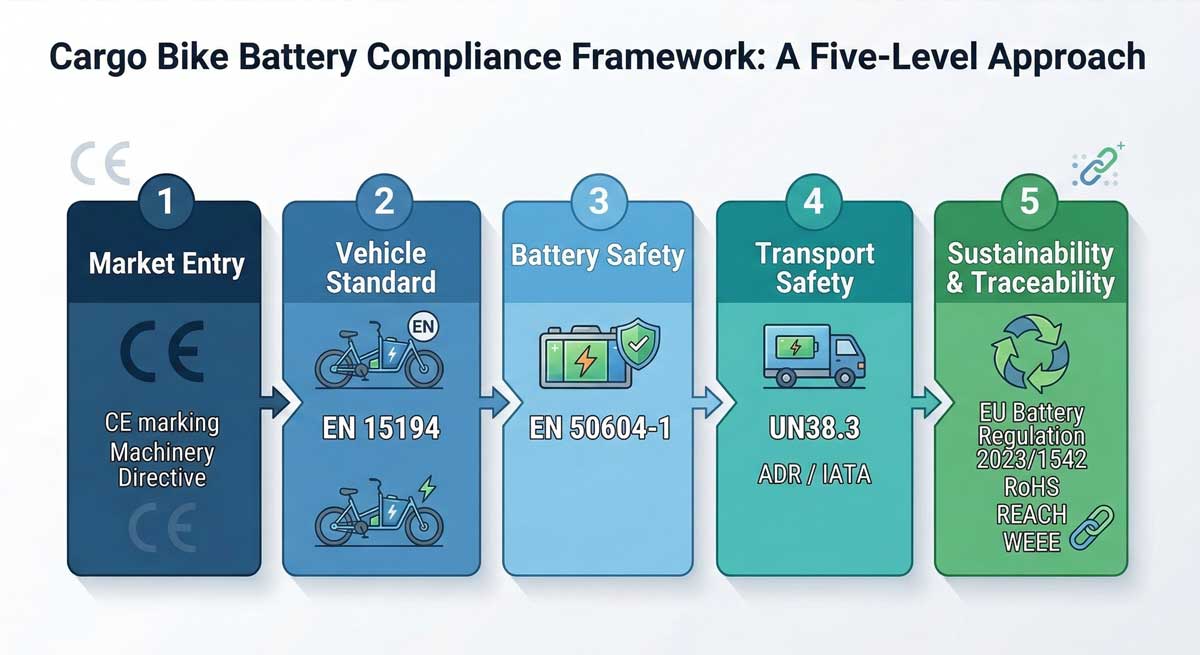
Transport compliance gets your container to the port. Market compliance is what lets you sell what is inside it, and the two are separate files with separate owners. Treat the table below as the list of questions to close out per market, not as a set of conclusions — classification and marking duties turn on your exact product and your exact role in the chain.
| Destination | What to close out before you commit |
|---|---|
| UE | Product safety file under the applicable EN standard and CE marking; EPR registration in each member state where you sell; and the battery passport. Reglamento (UE) 2023/1542 entered into force on 17 August 2023 and creates “light means of transport batteries (LMT batteries)” as a separate category expressly covering traction batteries for e-bikes, with a QR code giving “access to a battery’s product passport”. Confirm the date the battery passport obligation bites for your battery category against the Regulation itself before you plan around it. |
| A NOSOTROS | UL 2849 for the complete electrical system and UL 2271 for the pack, plus the growing set of state and city rules that make those certifications a condition of sale rather than a selling point; and domestic transport under the DOT hazardous materials rules in 49 CFR. |
| Australia | RCM marking and the applicable AS/NZS standards, plus lithium battery import conditions. Confirm the current standard references with the certifying body rather than from a supplier’s marketing sheet. |
| Everywhere else | UKCA alongside or instead of CE depending on the product; Canada, the Middle East and South-East Asia variously accept IEC-based certification or CE. The common floor everywhere is UN 38.3 plus the IMDG Code for the sea leg. |
Two of those rows already have their own treatment on this site: the European certification split is set out in EN 15194 frente a EN 17860, and the American pack and system requirements in UL 2849 certification for electric trikes. Extended producer responsibility is a different legal identity again, and if you import into Europe you hold it personally — see EPR for e-bike importers y el EPR data checklist for the data you must extract from your factory to discharge it.
Who does what: the factory, the forwarder, and you under FOB vs CIF
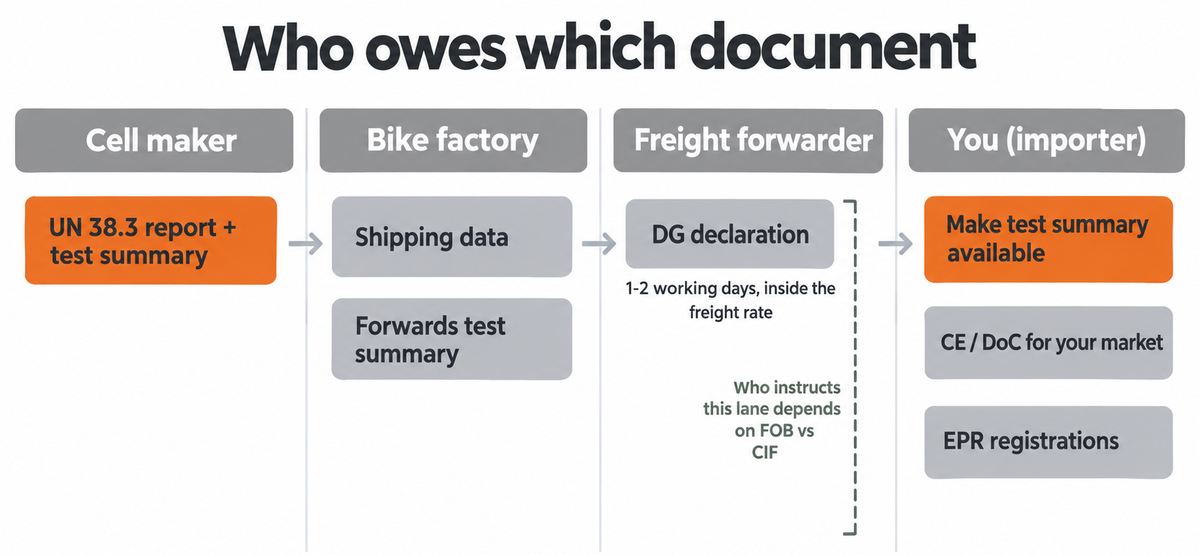
The dangerous goods declaration itself is routine. A DG declaration for a battery consignment is normally prepared by the freight forwarder from data the factory supplies, takes one to two working days, and the cost is already inside the freight quote rather than appearing as a line item. Nobody should be charging you a premium to lodge it.
What is not routine is who is responsible for it, and that follows from a decision you make at quotation stage.
If the factory arranges the forwarder, the factory hands the shipping data over and the declaration is handled as part of the booking. You receive the documents.
If you arrange your own forwarder — which is the normal arrangement on FOB terms — the factory supplies the data and you run the process with your agent. The obligation to get it right moves to your side of the table along with the booking.
That is the real content of FOB vs CIF in this category. The two terms are usually compared as a freight-cost question, and they are, but they also decide who holds the dangerous goods process, who chases the paperwork when a carrier queries a declaration, and who absorbs a demurrage bill if a container is held while a document is corrected. A buyer new to the category who takes FOB to save on freight has also quietly taken on a compliance workflow they may have never run before.
None of this argues for a supplier who promises to make it all disappear. It argues for one with the shipping file already assembled, that names the forwarders it has actually moved batteries with and can say which markets it has cleared. A factory whose first UN 38.3 summary appears after you ask for it is learning dangerous goods logistics on your order. The Servicio ODM conversation worth having is about documentation history, not reassurance.
What you must already hold before you list for sale
Certificates are not something to produce when a problem arrives. They are the precondition for selling at all, and the sequencing trips up new entrants more than the content does.
- UN 38.3 report and test summary for the exact cell and pack in the shipment, with the Manual revision stated
- The safety certification for your destination market, issued and in your possession — not “in progress at the lab”
- Your technical file and declaration of conformity, signed by whoever is the legal manufacturer for that market
- Producer or EPR registrations, in every member state or jurisdiction where you will sell
- The DG declaration and packing documentation for the consignment itself
- A written statement of shipped state of charge and the pack recovery procedure, which is not a legal requirement and will save you more money than most things on this list that are
Figures current as of October 2026; verify the IMDG amendment in force, the applicable UN packing instructions and all market certifications directly with your forwarder, your certification body and the regulations themselves before shipping.
Preguntas frecuentes
Can ebike batteries be shipped by air at all?
Complete vehicles above 100 Wh can move under the battery-powered vehicle packing instruction at 30% state of charge or less, with State approvals needed above that. In practice air freight for this category is exceptional: the charge limits, packaging and cost make sea the default, and the economics rarely survive the quote.
Who issues the UN 38.3 test summary?
The cell or battery manufacturer, based on the test report from the laboratory. A vehicle assembler cannot issue one for a pack it did not test; it obtains and forwards it. If you resell the product you must in turn be able to make the summary available to your own customers.
Does the test summary have to travel with every shipment?
No, unless a particular State or operator requires it. IATA accepts a summary hosted on a website and reached by QR code or URL, and says it does not support a requirement to supply one with every consignment.
How long does a DG declaration take and what does it cost?
Typically one to two working days, prepared by the forwarder from factory-supplied data, with the cost already included in the freight rate. Treat a separate charge for it as a question worth asking.
Why would a new battery arrive unable to charge?
Low shipped state of charge plus a long transit plus self-discharge can take cells below the BMS protection floor, at which point the pack latches off and will not accept a normal charger. The fix is to manage charge level and transit time together, and to agree a recovery procedure with the factory before the first container sails.
 Spanish
 English
 German
 Dutch
 Danish
 French
 Polish
 Portuguese