


A courier cargo bike covering 60 km a day needs a fundamentally different maintenance schedule than a family bike ridden twice a week. This guide sets out service intervals, common wear items and per-bike annual maintenance budgets for commercial fleet operation.
Uptime is the metric that quietly decides whether a commercial cargo bike fleet renews. It rarely shows up in the procurement RFP. It almost always shows up in the year-three financial review.
The reason it’s so often underweighted at purchase is that uptime depends on dozens of small decisions made well before the bike ever rolls — drivetrain spec, brake compound, bearing rating, warranty fine print, service network density, parts inventory strategy. Each one individually feels too granular to optimise. Together, they decide whether your fleet runs at 95 percent or 78 percent. For last mile delivery companies running daily commercial routes, those decisions compound faster than for any other operator profile.
This article walks through the maintenance and uptime decisions that have the largest financial leverage over the life of a commercial cargo bike fleet, in roughly the order they matter.
What Uptime Actually Costs You
Before the engineering, the economics. A 10-bike fleet running at 90 percent uptime is effectively a 9-bike fleet, with the cost base of 10. If each bike generates €250 per shift in delivery revenue, a single point of uptime is worth €625 per bike per year (at 250 working days). Moving a 10-bike fleet from 85 percent to 95 percent uptime is worth approximately €6,250 per year per bike — €62,500 across the fleet — without any other change. In last mile logistics, where route density already pushes vehicles to their utilisation ceiling, every recovered uptime point lands directly on the P&L.
That’s the budget you have to work with when deciding whether a premium component spec or a better warranty is worth the upfront cost. The arithmetic favours uptime almost every time.
Drivetrain: The Single Largest Maintenance Lever
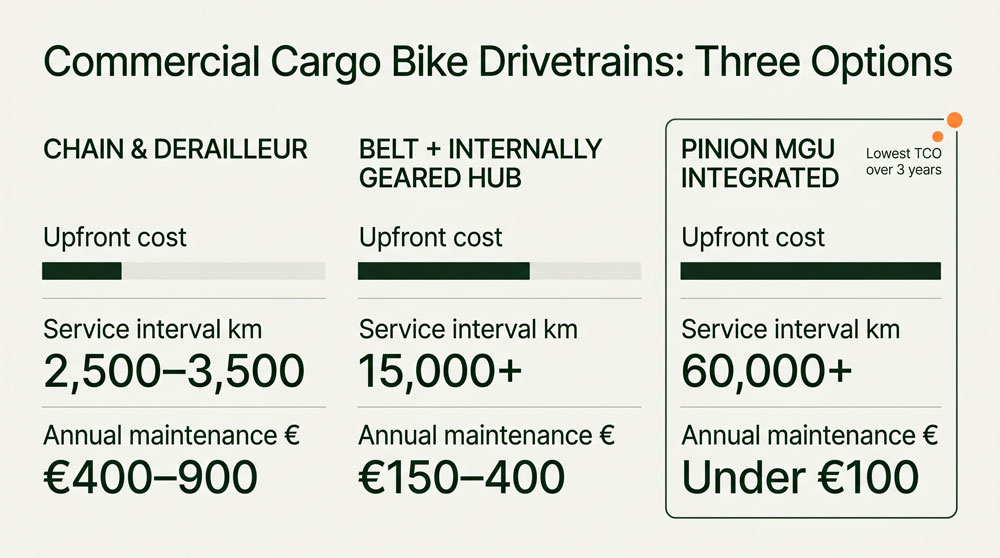
In a commercial-duty cargo bike, the drivetrain is where most maintenance euros land. Daily mileage, heavy loads, frequent stop-start, and exposure to road grime accelerate wear on every chain-and-derailleur drivetrain. The three options, in roughly increasing order of cost and reliability:
Chain and derailleur. Lowest upfront cost. Chains stretch to replacement at 2,500–3,500 km in commercial duty. Cassettes go at 8,000–10,000 km. Derailleur hangers bend on the first kerb strike. Realistic annual maintenance cost: €400–€900 per bike, plus 1–3 hours of mechanic time per failure.
Chain or belt with internally geared hub. Mid-range upfront cost. The Enviolo CVT and Shimano Nexus/Alfine hubs eliminate derailleur exposure; belt drive (Gates Carbon Drive) eliminates chain wear. Service interval extends to 15,000+ km. Annual maintenance drops to €150–€400 per bike. Payback versus chain drivetrain typically lands between months 12 and 18 in commercial duty.
Integrated motor-gearbox unit (Pinion MGU and equivalents). Highest upfront cost. Sealed drivetrain, no exposed chain or derailleur, no belt tension adjustment. Service interval at the gearbox level extends past 60,000 km. Annual maintenance below €100 per bike on the drivetrain side. Used increasingly by postal fleets, shared mobility operators, and service-bike applications where uptime is critical and maintenance windows are short.
For commercial-duty bikes running daily, the financial case against chain-and-derailleur is increasingly hard to argue. Even the upfront premium of an internally geared hub pays back inside 18 months; the Pinion MGU pays back inside 36 months in heavy-duty use. The exception: very low-duty operations or specific applications where rider preference for derailleur shifting is strong. For most commercial fleets, those exceptions are rarer than they used to be.
Brakes, Bearings, and the Other Wear Items
After the drivetrain, the next-largest maintenance line items in a commercial cargo bike are predictable.
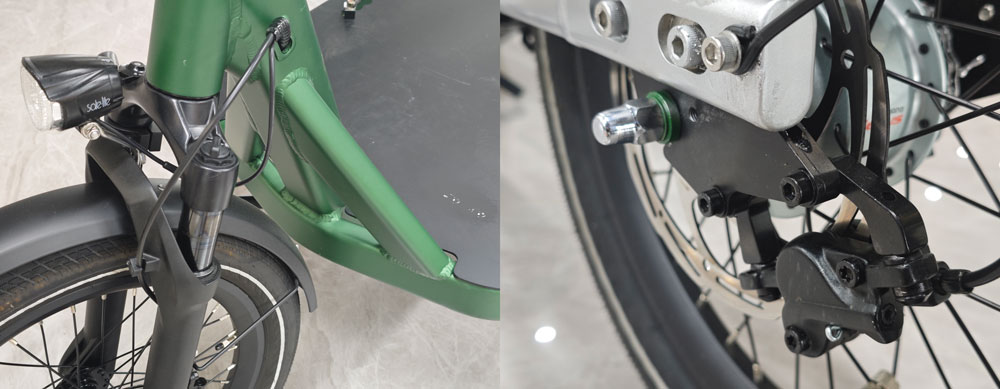
Brakes. Hydraulic discs are the only commercial-spec answer. Pad replacement intervals vary by compound: organic pads last 1,500–2,500 km in commercial duty; semi-metallic 4,000–6,000 km; sintered 6,000–9,000 km. Sintered pads are the right spec for fleet use despite their squeaking reputation — they outlast cheaper pads enough that the labour saving covers the comfort cost. Rotor diameter matters: 180 mm minimum for two-wheel cargo bikes, 203 mm for trikes or any platform regularly running at maximum payload.
Bearings. Headset, bottom bracket, and wheel hub bearings see the harshest duty cycle on a commercial cargo bike. Sealed cartridge bearings in industrial or marine grade extend service life from 12–18 months (standard consumer spec) to 3–5 years. The cost upgrade is typically €40–€80 per bike at build; the labour saving over the fleet lifetime is multiples of that. Spec the upgrade.
Tyres. Schwalbe Pick-Up, Continental Contact Plus, and equivalent cargo-rated tyres have replaceable puncture protection layers and harder compounds. Expect 6,000–10,000 km of service life in commercial duty. Standard city tyres will last a fraction of that and increase puncture frequency. Punctures aren’t a maintenance cost; they’re an uptime cost — every roadside puncture is a route disruption.
Cables and electrical connectors. Often overlooked. Daily flexing, vibration, and water exposure degrades cable jackets and connector seals. Commercial-spec wiring should be hardwired (not Anderson-style quick-disconnect) wherever possible, and routed internally through the frame to minimise exposure. Wiring failures are responsible for a non-trivial share of commercial cargo bike downtime, and they’re frustrating because they’re cheap to fix once diagnosed but slow to diagnose.
Warranty Terms: Reading the Fine Print
Warranty terms on commercial cargo bikes are where vendor differences become real. Headline claims like “5-year warranty” hide enormous variation in what’s actually covered and how fast claims are processed. The questions to ask, in writing:
Frame warranty in cycles, not years. A frame warranty of “5 years” is meaningless if it’s voided by 8 hours of daily duty. Ask for a warranty term measured in load cycles or kilometres, or get the duty-cycle definition in writing.
Component coverage tier by tier. Don’t accept blanket “all components covered” language. Get the warranty period for: motor, controller, battery, drivetrain, brakes, suspension (if applicable), and electrical wiring, each separately. Industry standard for commercial use:
- Frame: 5 years minimum
- Motor and controller: 2–3 years
- Battery: 800 full charge cycles or 3 years, whichever comes first (not just “2 years”)
- Drivetrain (excluding wear items): 2 years
- Wear items (pads, chains, tyres): not covered, but parts pricing should be transparent
Recommended reading: Cargo Bike Battery Systems: What Fleet Buyers Should Inspect E-Cargo Bike Spring Check: 5-Step Seasonal Fleet Inspection
Labour coverage, not just parts. A warranty that ships you a replacement motor but doesn’t cover the 4 hours of installation labour is half a warranty. Insist on labour coverage for drivetrain and electrical work.
Response time guarantee. “Best effort” is not a response time. Ask for: how many business days from claim filing to part shipment, what happens if the part isn’t in stock, what loaner-bike provisions exist.
Survivability across ownership transfer. If you sell the bike after three years, does the warranty transfer? For fleet operations with normal asset rotation, the answer matters.
A useful filter: if the warranty is two pages of legal language with no specifics on response time or labour coverage, treat the warranty as marketing rather than commercial substance. Push back hard.
Service Network: The Decision That Becomes Visible Only When You Need It
A warranty without a service network behind it is paperwork. When evaluating commercial cargo bike suppliers, ask:
How many service technicians are accessible in your operating region. Names, not promises. The supplier should be able to tell you which authorised service partners exist in the country, ideally in the city.
What parts inventory exists locally. Critical parts — motors, controllers, batteries, brake components — should be available within 5 business days. Less critical parts, within 10. A supplier with no local parts inventory is offering you sea-freight delays on every part replacement.
Diagnostic tool compatibility. Bosch, Bafang, Shimano, Pinion, and proprietary systems each require different diagnostic interfaces. Confirm your service network has the tools for your specific drive system. Mismatched diagnostic capability means problems get misdiagnosed, which means more parts replaced than necessary.
Documentation depth. A commercial-grade supplier provides a service manual at the part level, with torque specs, fastener identification, and step-by-step repair procedures. This isn’t optional — it’s how an in-house workshop or a third-party service partner does the job right. Suppliers without proper service documentation are betting that you’ll send everything back to them. That bet is bad for your uptime.
The In-House Workshop Calculation
At what fleet size does an in-house workshop pay for itself?
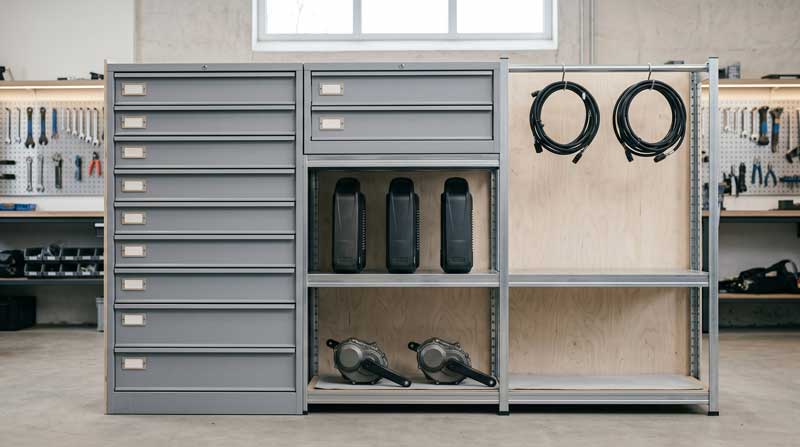
Rough math: a basic commercial cargo bike workshop — bike stand, tooling, diagnostic equipment, parts inventory — costs €15,000–€25,000 to set up, plus a part-time or full-time mechanic at €40,000–€55,000 annual loaded cost. The break-even versus paying vendor service rates is typically around 15–20 bikes for full-time staffing; 8–12 bikes for part-time.
Below that threshold, vendor service or a local bike-shop partnership is more economical. Above it, the in-house workshop wins on cost and wins by even more on MTTR, which directly improves uptime.
A workable mid-stage approach: contract a local bike shop for routine maintenance, train one of your own staff in basic emergency repairs (puncture, brake adjustment, battery swap, basic electrical diagnosis), and keep a small parts stock at the micro-hub. This hybrid handles 80 percent of breakdowns without leaving the operation and reserves the local shop for jobs requiring proper bench time.
What Good Looks Like
A commercial cargo bike fleet running well in 2026 — whether operated in-house by a retailer or contracted out to last mile delivery companies — looks roughly like this:
- 95+ percent uptime measured monthly
- Mean time to repair under 48 hours
- Annual per-bike maintenance cost between €400 and €900 (depending on drivetrain spec and use intensity)
- Frame failure rate below 2 percent per year
- Battery replacement at year 4–5 (not year 2)
- Rider satisfaction stable enough that 12-month rider retention beats 70 percent
These are achievable numbers. They require getting the upfront spec right, getting the warranty right, getting the service network right, and treating maintenance as an operations function with its own metrics — not as something the bike vendor will somehow take care of.
Building the sustainability case alongside the cost case? Our cargo bike CO2 calculator turns your route profile into a board-ready emissions figure.
Bringing It Together
The three articles in this series cover the questions a commercial cargo bike fleet has to answer in sequence: which vehicle type (Choosing the Right Commercial Cargo Bike Type), how to deploy it (Cargo Bike Fleet Deployment), and how to keep it running (this article).
UM has supported commercial cargo bike fleets across Europe since 2009. Our service contracts include documented repair procedures, parts inventory programmes, and trained third-party service partner networks across the major EU markets. If you’re building a fleet and want to talk through the service architecture before you commit to a supplier, get in touch →.
 English
  German
  Dutch
Dutch  Danish
  French
  Polish
  Portuguese
  Spanish