

Most European cargo bike manufacturers quote 500-unit minimums for ODM work. That number tells you almost nothing. What decides your economics is not the minimum a factory will accept — it is what your volume unlocks, where the tooling cost lands, and the point at which owning your own design becomes cheaper than renting someone else’s platform. This guide puts the numbers on both sides of that line.
What an MOQ number actually reflects
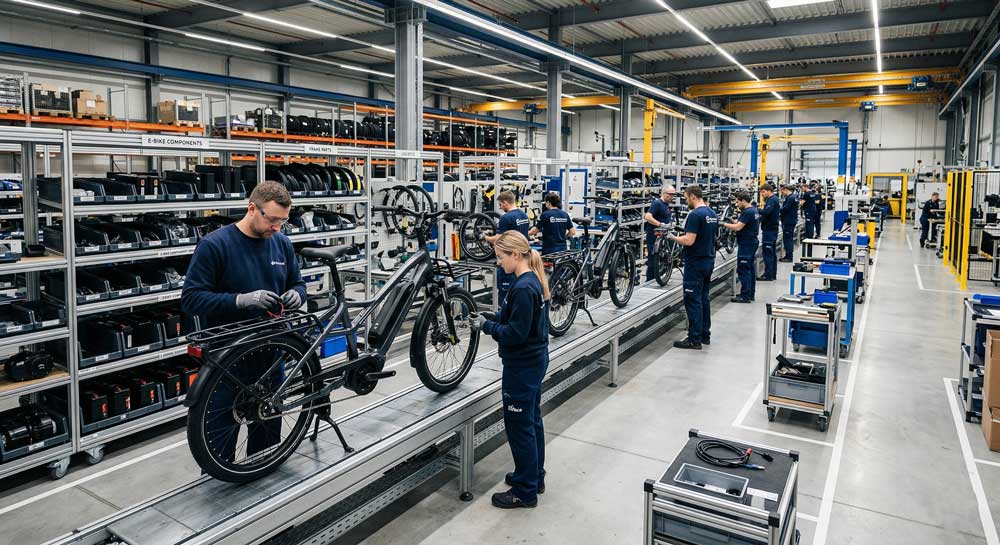
Minimum order quantity is not gatekeeping. It is the point at which a factory can run your configuration without losing money on setup, component sourcing, and quality assurance for a batch that may never repeat.
Which means the number varies enormously by what kind of supplier you are actually talking to. Three categories get called “manufacturer” in this industry, and they are not the same business.
Atacadistas de produtos acabados sell existing inventory under your label. Minimums run as low as 5–10 units. You control nothing — not specification, not components, not compliance scope. You are reselling someone else’s product with your sticker on it.
fabricantes OEM build to a defined specification, drawn from existing frame geometries and approved component libraries. Minimums typically start at 50–100 units.
Fabricantes ODM develop a product that carries your brand identity — potentially proprietary frame design, integrated battery systems, and market-specific compliance configurations. Genuine ODM work starts at 100–200 units and scales with customisation depth.
A supplier quoting a 20-unit minimum for “custom” cargo bikes is offering cosmetic changes to a stock product. That may be exactly what you need. It is not ODM, and you should not pay ODM prices for it.
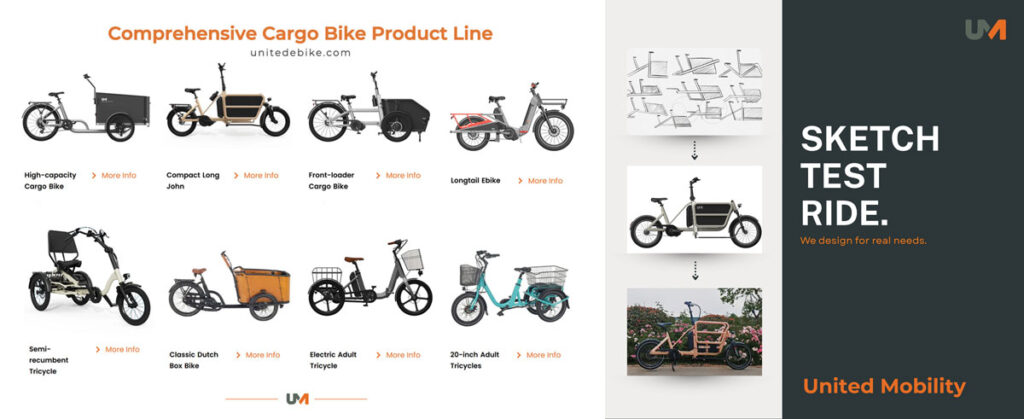
Fabricante experiente de bicicletas de carga ODM/OEM Mobilidade Unida‘'s gama completa de modelos de bicicletas de carga. Selecione o tipo certo de bicicleta de carga para o seu negócio.
What each volume tier unlocks
A fixed price table would be dishonest — the number moves with component selection, complexity and timing. The useful thing to understand is the logic.
Entry volumes work from existing validated platforms. You choose base configuration and customise within a defined scope: brand livery, component substitutions from an approved list, battery configuration, market-specific accessory packages. This is the right entry point for a distributor testing a market or launching a first private-label run without committing to bespoke tooling.
Encomendas de escala média open materially more: custom RAL colours, brand-specific component integration, localised documentation and packaging, and in some cases CE documentation issued under your own brand. This is where most established European distributors with a proprietary range operate. Repeat order windows shorten once your specification becomes a known quantity in the factory’s planning system.
Produção em escala unlocks genuine platform differentiation — unique frame geometry, proprietary battery integration, exclusive component configurations, co-developed accessory ecosystems. The relationship shifts from order fulfilment to product development, with dedicated capacity.
Desenvolvimento ODM completo — ground-up platform design, new frame tooling, bespoke tube profiles — is for programmes with both a clear product vision and the market depth to carry the investment. Longer timelines; a product that is genuinely yours.
The honest answer to “what’s your MOQ?” is: it depends what you are trying to build. A manufacturer worth working with will tell you what a given volume realistically unlocks rather than quoting a minimum and leaving the rest vague.
Tooling amortisation is the whole story
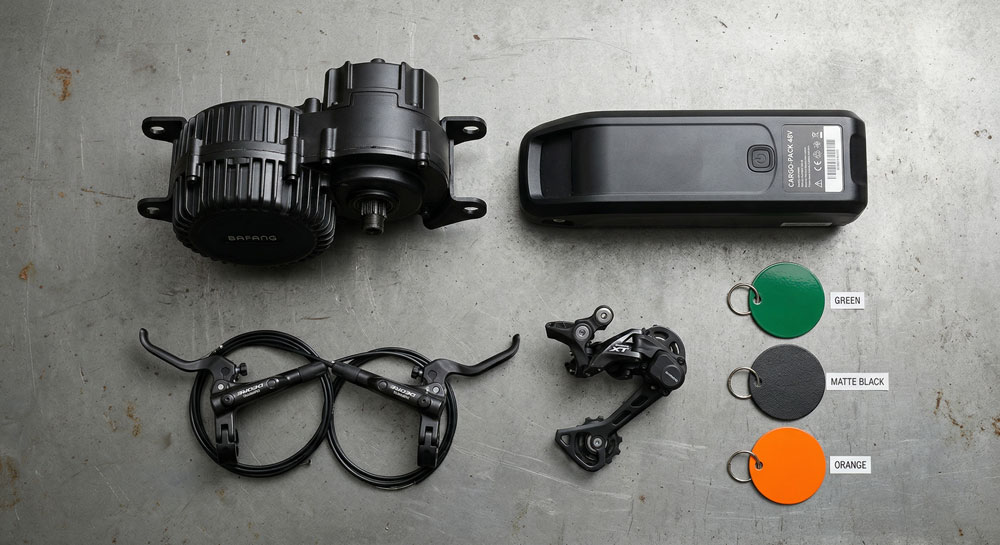
Every customisation requiring dedicated tooling — a new frame jig, a custom colour batch, a proprietary component mould — carries a fixed cost spread across your order.
United Mobility’s production planning puts that spread at roughly €80–€150 per unit at 50 units, falling to €15–€25 per unit at 300. Same tooling, same factory, same specification. Only the divisor changed.
This is why distributors systematically underestimate what is achievable at 200–300 units. A manufacturer with a mature component supply network can deliver real differentiation at that scale — not badge engineering.
The practical implication: do not negotiate primarily on the minimum. Negotiate on what the minimum unlocks. Two factories may both quote 100 units, and one delivers a sticker while the other delivers a specification nothing else in your market can match.
Past a few hundred units, the question changes
Once your annual volume clears the low hundreds, MOQ stops being the binding constraint and a different question takes over: do you rent a platform or own one?
OEM means you own the design. You supply engineering specification, geometry, component selection and brand identity; the factory produces to your blueprint. Tooling, moulds and IP stay yours. You absorb the full development cost and lead time, and in return you get exclusivity and no dependency on anyone else’s platform decisions.
ODM means the manufacturer owns the base platform. You select from pre-engineered frame architectures, configure within defined parameters, apply your identity and go to production on a compressed timeline. Tooling cost is amortised across multiple buyers, so your entry investment is far lower and your per-unit cost is higher.
Neither is better. The right answer depends on annual volume, internal design capability, compliance budget, and how much supplier dependency your contracts can absorb.
The three-year numbers at 1,000 units a year
The upfront comparison is simple. The three-year picture is not.
| OEM | ODM | |
|---|---|---|
| Frame tooling and mould development | €150,000–€220,000 | — |
| Platform access and branding configuration | — | €8,000–€20,000 |
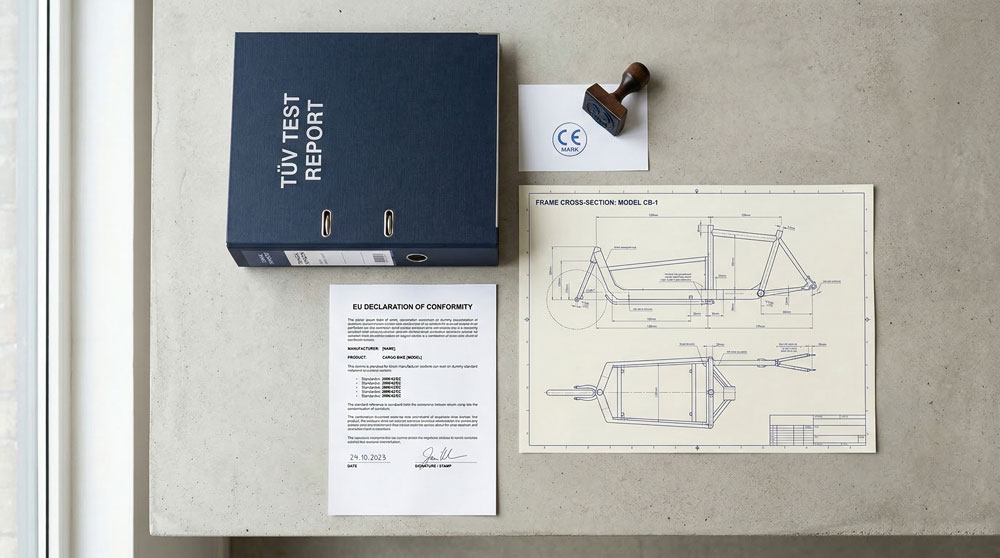
| EN 15194 / EN 17860 certification | €18,000–€35,000 (custom geometry) | €5,000–€15,000 (configuration delta) |
| Prototype and validation (3–5 rounds) | €25,000–€45,000 | €3,000–€8,000 |
| Year 1 pre-revenue investment | €193.000–€300.000 | €16.000–€43.000 |
| Per-unit manufacturing cost | 12–18% lower | +€180–€380 per unit |
At 1,000 units a year, an OEM per-unit advantage of roughly €250 means the tooling investment pays back at around mês 22–26, assuming no production disruption.
That math is clean, predictable, and misleading — because it ignores the three variables that actually decide year two and year three.
Spare parts obligation. OEM buyers self-fund a rolling spare parts buffer, typically 8–12% of fleet value for active municipal or logistics contracts. ODM buyers can offload that capital requirement onto a supplier who maintains a parts warehouse — but only where the supplier contractually commits to minimum stock levels. Without that clause, you carry the inventory anyway and lose the OEM upside too.
Warranty resolution speed. OEM warranty disputes are negotiated against your custom geometry, which stretches resolution to 60–90 days. ODM platforms resolve most claims against catalogued parts in 10–20 days. On a municipal contract with uptime penalties, that gap is money.
Component substitution exposure. When Bosch or Shimano allocation runs 16 weeks or longer — a recurring reality since 2022 — an OEM contract permitting defined substitution protects your production schedule. An ODM platform that locks you to specific component tiers without a substitution clause leaves you entirely dependent on your supplier’s allocation relationships.
What the ODM pitch leaves out
Lower entry cost, faster launch, pre-certified platform. All true, and all incomplete.
The differentiation ceiling. When three European distributors source from one ODM platform with minor component variations, price competition is not a risk — it is arithmetic. Without unique geometry or a patented cargo system, the conversation reduces to price per unit, and the only party whose margin survives is the manufacturer.
Restocking queue conflicts. ODM suppliers serving multiple clients face production queue contention that OEM buyers with dedicated tooling do not. A 6–8 week restocking delay on a top-selling model is survivable for B2C retail. For a fleet operator holding municipal contracts with defined replacement windows, it triggers penalty clauses.
Territory exclusivity. Without a drafted exclusivity agreement, the platform you launched your brand on can be licensed to a competitor in your territory within twelve months. Some ODM suppliers offer formal territory exclusivity; most do not by default. Negotiate it before signature, not during a competitive conflict.
How to decide
Work the decision in this order, not in reverse:
- Тwelve-month realistic volume, not aspirational. Below ~300 units, ODM is the only model whose arithmetic closes.
- Where differentiation has to live. If your market position depends on a product competitors cannot copy, tooling is not a cost — it is the moat. If it depends on service, coverage or price, it is pure overhead.
- Contract exposure. Municipal and corporate fleet contracts with uptime penalties shift the calculus toward whichever model resolves warranty and restocking fastest in your specific supplier relationship.
- Then, and only then, the unit price.
United Mobility quotes both models against the same specification so the comparison is like-for-like, and will tell you where your volume actually sits on the curve rather than quoting a minimum and leaving you to work it out.
Para discutir suas necessidades específicas de volume, cronograma de mercado e objetivos de personalização, Entre em contato com nossa equipe de parcerias B2B.. Forneceremos uma análise transparente do que sua quantidade mínima de pedido (MOQ) desejada permite, incluindo estimativas de preços unitários, prazos de entrega e uma visão clara do escopo de personalização disponível para o seu volume.
Perguntas frequentes
What is the minimum order quantity for a custom cargo bike? It depends on the supplier type. Finished-goods wholesalers start at 5–10 units, OEM production at 50–100, and genuine ODM development at 100–200. A 20-unit “custom” quote is cosmetic customisation of a stock product.
How much does cargo bike tooling cost per unit? Tooling and setup amortisation runs roughly €80–€150 per unit at 50 units and €15–€25 per unit at 300. Full frame tooling for an OEM programme is €150,000–€220,000 as a fixed investment.
At what volume does OEM become cheaper than ODM? At around 1,000 units a year, an OEM per-unit advantage of about €250 pays back tooling investment at month 22–26. Below roughly 300 units a year, the arithmetic does not close.
Can I get CE documentation under my own brand name? At mid-scale volumes, yes — some manufacturers will issue CE documentation under the distributor’s brand. Confirm this explicitly; it is not standard at entry volumes.
What should I negotiate instead of the MOQ? Negotiate what the volume unlocks: component substitution rights, territory exclusivity, minimum spare-parts stock levels, and warranty resolution timeframes. These decide year-two profitability far more than the minimum does.
Para obter um contexto mais amplo sobre a abordagem de fabricação ODM/OEM da United Mobility, consulte nosso Guia completo para fabricação ODM/OEM de bicicletas de carga. Para obter detalhes sobre as opções de personalização disponíveis em diferentes volumes de produção, consulte [link para a página de personalização]. Bicicletas de carga de marca própria: opções de personalização da marca. Para uma visão geral completa dos requisitos de conformidade europeus, consulte [link para a página sobre requisitos de conformidade europeus]. Certificação Europeia para Bicicletas de Carga: Conformidade com as normas CE e EN 15194..
 Portuguese
 English
 German
 Dutch
 Danish
 French
 Polish
 Spanish