




Nobody is counting them. Europe has 91 million dogs and the United States has 95 million pet-owning homes, yet almost every cargo bike brochure still sells the school run. The pet cargo bike buyer is already in the market — she just cannot find a bike built for a 28 kg dog. This piece sizes that buyer, splits her into four profiles, and shows the three channels that reach her.
Nobody counts dogs when they size the pet cargo bike market
Open any category forecast and you will find the same denominators: urban households, child-rearing households, last-mile parcel volumes. Dogs never appear. That is an odd omission, because the companion-animal numbers are larger than the family numbers in most of the markets your brand already sells into.
FEDIAF’s Facts & Figures 2026 report counts 91.2 million dogs living across 41 European countries in 2024, inside 140 million pet-owning households — 49% of all households on the continent, according to the European Pet Food Industry Federation’s published statistics. The dog figure alone is roughly the population of Germany. In the United States, the American Pet Products Association’s industry data puts pet-owning households at 95 million and projects USD 165 billion of category spending for 2026.
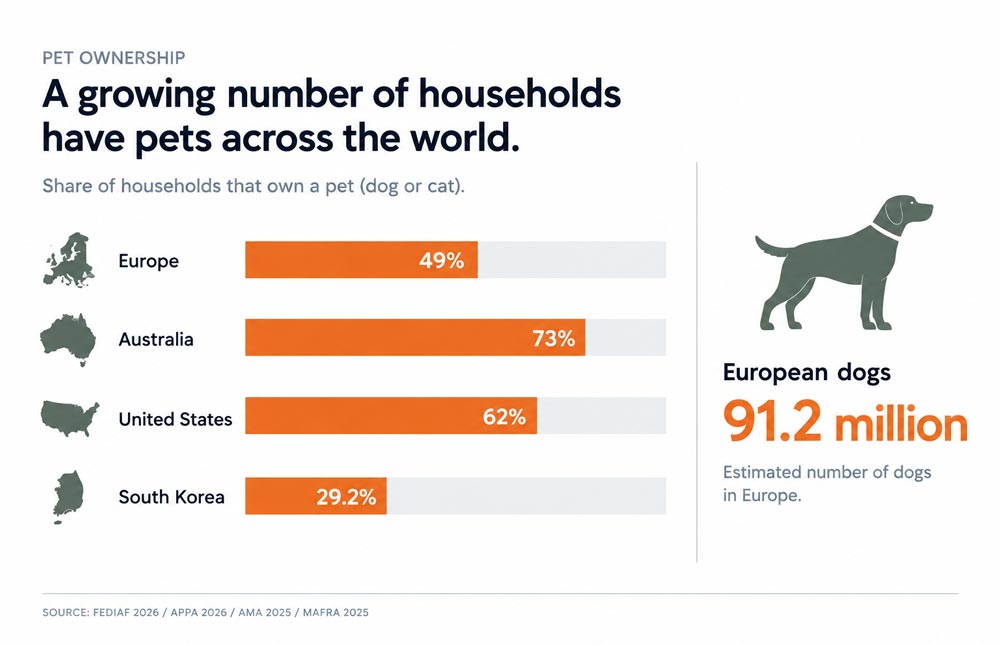
Australia is the sharpest case. Animal Medicines Australia’s Pets in Australia 2025 study found 73% of households keep a pet and 49% keep at least one dog — about 7.4 million dogs in a country of 27 million people. In Asia the structure differs but the direction does not. Japan’s Pet Food Association estimates roughly 15.7 million dogs and cats nationally in its annual dog and cat ownership survey, against a population of children under 15 that has fallen below 14 million. Korea’s agriculture ministry reported in its 2025 pet-ownership survey that 29.2% of households keep a pet, and that dogs are present in about four out of five of those homes.
| Market | Pet-owning households | Dog signal | Source (data year) |
|---|---|---|---|
| Europe (41 countries) | 140 m — 49% of all households | 91.2 m dogs | FEDIAF Facts & Figures 2026 (2024) |
| United States | 95 m | USD 165 bn category spend projected | APPA, 2026 State of the Industry (2025) |
| Australia | 7.7 m — 73% of all households | 49% of households own a dog | Animal Medicines Australia (2025) |
| South Korea | 29.2% of all households | ~80% of pet households keep dogs | MAFRA pet ownership survey (2025) |
| Japan | — | ~15.7 m dogs and cats | Japan Pet Food Association (2025) |
The table should make one thing uncomfortable. Your family cargo bike addresses a slice of households with children at home. A pet cargo bike addresses a slice of a pool that is two to three times larger and still growing in three of these five markets.
Four buyers who do not know they want this yet
Most of these people have never searched for a dog cargo bike. They do not know the category exists, which is exactly why the segment is cheap to enter and expensive to ignore later. UnitedMobility’s analysis of the 2024–2026 ownership data is that pet transport is not a niche inside the family segment — it is a second segment that happens to share a platform.
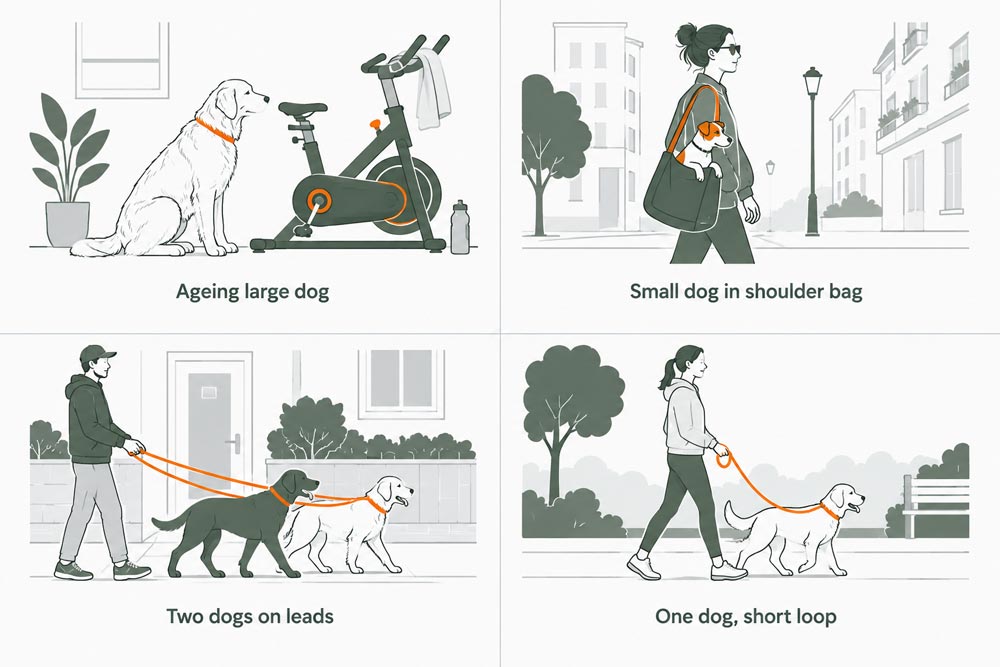
The ageing-dog owner. Her Labrador is eleven. He has hip dysplasia and manages four hundred metres before he stops. She still wants him at the lake, at the café, in the park with his pack. Right now she drives, or she stays home. This buyer has the highest emotional urgency in the entire category and the shortest decision cycle, because the dog’s decline has a clock on it.
The small-breed urbanite. Lives in Lisbon, Rotterdam or Melbourne, owns a 6 kg dog, already owns an e-bike, already carries the dog in a shoulder bag that the dog hates. She is not buying a bike — she is buying a better box. Sell her the platform and the pet module together, or a competitor sells her a basket.
The multi-dog household. Two medium dogs, no car, or a car she is trying to give up. Nothing on the market carries two 20 kg dogs safely. She currently makes two trips or does not go. This is the buyer who justifies a 250 kg gross-vehicle-weight platform rather than a rack accessory.
The one who has not noticed yet. The largest group by far. She walks the same three streets every day because the dog cannot go further and the car is a hassle for a twenty-minute outing. She has never framed this as a transport problem. She will only convert when she physically sees a dog riding in a box and thinks oh. That is a demo problem, not an advertising problem — and it decides the channel strategy below.
Why a cargo bike for dogs is not a cargo bike for kids
Brands assume a child box carries a dog. It does not, and the reasons are structural rather than cosmetic.
A child is strapped into a fixed three-point harness and stays where you put it. A dog stands up, turns around, leans over the sidewall at a passing cat and redistributes 25 kg of mass sideways while you are mid-corner. A child’s centre of mass is low and restrained. A dog’s is high, mobile and unrestrained by design, because you cannot belt an animal across the chest the way you belt a toddler.
Then there is the exit problem. A child cannot climb out of a moving box. A dog can, and will, and the first thing experienced riders discover is that a leash clipped to a collar turns a jump into a hanging hazard. Ventilation, floor grip, claw-resistant liners, washable surfaces, a sidewall height tuned to a sitting dog’s eye line rather than a seated child’s shoulder — none of this is in a family specification.
The regulatory position is the part almost nobody in the trade has read. The European carrier-cycle standard series covers passenger transport in one part and cargo trailers in another. The trailer part is explicit: in its scope table, cargo is applicable and people, children and pets are not. There is, in other words, no harmonised European test standard that tells you how to carry a dog on a cycle. That gap is covered in detail in our companion piece on building a cargo bike for dogs, and it is the single strongest technical argument a serious brand can make against a basket-and-bungee competitor.
Where your pet buyer actually is, and it is not a bike shop
Here is the uncomfortable commercial truth. Your pet buyer walks past the bike shop. She has no reason to go in — she already has a bike, or she does not think of herself as a cyclist. She goes to the vet, the groomer, the dog park, the pet superstore and, three or four weekends a year, to an event built entirely around her dog.
Trade shows get you the account. Interzoo in Nuremberg is the category’s centre of gravity: the 2026 edition drew around 2,400 exhibitors from 70 countries and 39,000 visitors, with roughly 87% of exhibitors arriving from outside Germany, according to PET worldwide’s post-show report. Interzoo runs biennially, so the next window is 2028 — which means Global Pet Expo in Orlando each spring and SuperZoo in Las Vegas each summer carry the North American calendar in between, and Interpets in Tokyo and Osaka carry Japan. A cargo bike stand at a pet show is the only stand on the floor that is not a bag of treats. You will be photographed.
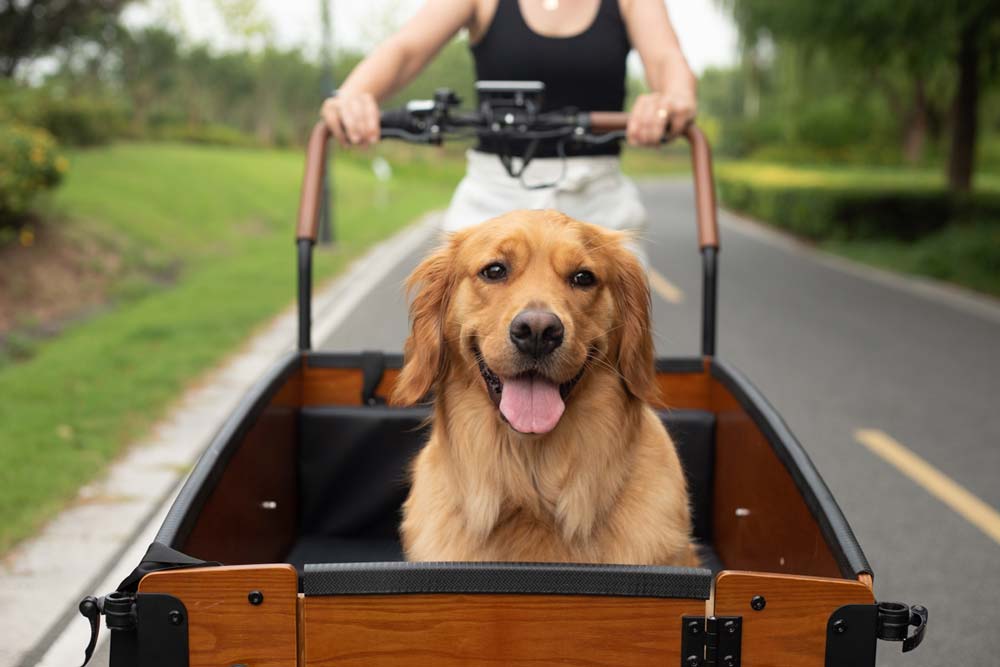
Consumer dog events get you the demo. This is where the fourth buyer profile converts. Interpets Tokyo reported more than 23,000 pets brought through the doors by their owners, and the Osaka edition more than 13,000. Think about what that means operationally: thousands of dogs physically present, in a venue, with their owners, on a weekend. A test ride where the dog gets in the box and settles is worth more than any amount of specification copy, because the owner’s real objection is never the bike. It is my dog will hate it. Ten minutes of calm riding destroys that objection permanently.
Local and vertical channels get you the repeat. Dog-friendly café districts, Saturday markets, breed club meets, agility and canicross clubs, rescue charity fundraisers, veterinary waiting rooms with a geriatric caseload, mobile groomers who already drive between homes. In the Netherlands and Denmark the weekend market is already a cargo bike showroom by accident — park a loaded pet configuration at a markt and you will have conversations all morning. A rehabilitation vet with a shelf of hip-dysplasia cases is, in practice, a qualified-lead generator for your first buyer profile. None of this needs media budget. It needs one demo unit and a retailer willing to leave the shop.
Which platform to brief, and what to change on it
Three platforms cover the four profiles without a new frame programme, and all three are built on a 250 kg gross vehicle weight so the dog is not competing with the groceries for payload.
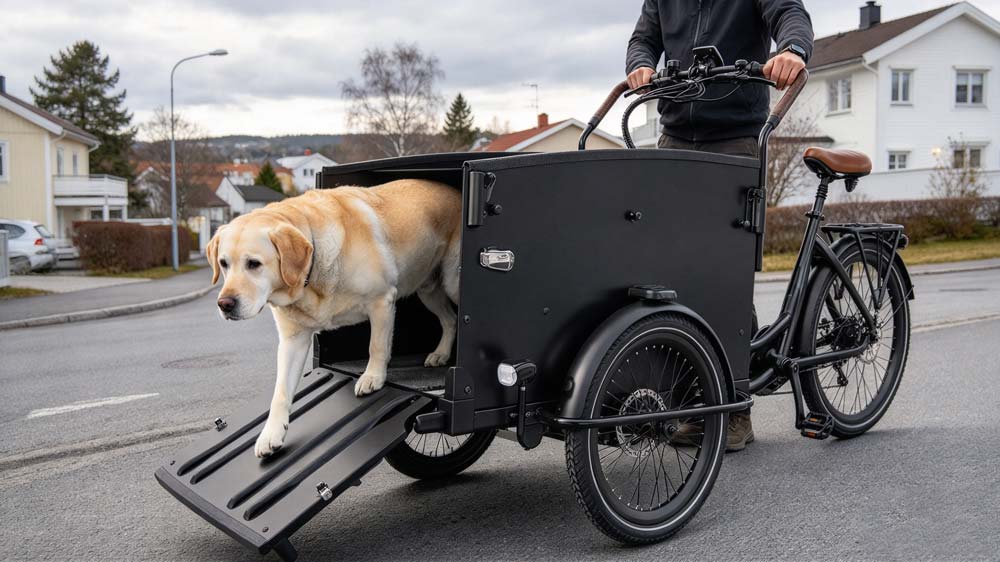
For the multi-dog household and the heavy-dog case, the three-wheeled UM Flow is the honest answer. A 140 L cabin with a front-side door means a stiff, arthritic 30 kg dog walks in rather than being lifted in — and lifting is the step that ends most purchases. Two tracked front wheels and a parking brake mean the bike does not need a human holding it upright while a nervous animal boards. For a brand selling to the ageing-dog buyer, the door and the parking brake are the product.
For the small-breed urbanite and anyone storing a bike in a Dutch or Spanish hallway, the UM Zip folds its front cabin and narrows from 573 mm to roughly 246 mm. It runs an Ananda M100 mid-motor at 120 N·m, which matters more with a live load than with a dead one, because a smooth, controlled launch is what stops a standing dog from being thrown backwards at the lights.
For retailers who need one SKU to cover several customer types, the modular UM Flex was designed around exactly this problem: the front cabin swaps between child, cargo and pet configurations on one spring latch, and the MIK HD rear rack carries the lead, the water, the towel and the bag of food at the same time. That is the cargo bike with pet carrier answer for a dealer who cannot afford four display models.
Customisation is where the margin is. A pet module is a liner, an anchor-point layout, a vent pattern, a sidewall height and a floor texture — not a new frame. Through our ODM service that is a tooling conversation, not a platform conversation, which is why a credible pet friendly electric bike variant can reach market far faster than most brands assume. Engineering detail on load paths, restraint geometry and stability under a shifting animal load sits in our breakdown of long john cargo bike engineering.
What to do with this before the spring season
Do not build a pet bike. Build a pet configuration, put it on a platform you already sell, and take it to one pet event before you take it to one bike event. The category’s problem is not price and it is not specification — it is that the buyer has never seen the thing exist. Every week your demo unit sits in a showroom is a week it is being seen by people who already own cargo bikes instead of the ninety-one million households that do not.
UnitedMobility’s view, after nearly two decades of building family and commercial platforms, is that the pet configuration will follow the path the child box took — accessory first, named SKU second, category third — and that the margin sits with whoever moves while it is still an accessory.
Then reframe the segment internally. Stop calling it an accessory. A household that will spend thousands a year on veterinary care, as the Australian and Korean spending data both show, is not buying a basket — it is buying a way to keep the animal in its life for another two years. Price and position accordingly.
FAQ
Can you just put a dog in a normal child cargo bike box?
For a small, calm dog on short trips, often yes. For anything above roughly 15 kg it becomes a safety compromise: child harnesses do not restrain animals, child box sidewalls are the wrong height, and the floor has no grip or drainage. The load also moves, which a child box was never tested against.
Is there a safety standard for carrying pets on a cargo bike?
Not a harmonised European one. The carrier-cycle standard series covers passengers in one part and cargo trailers in another, and the trailer part places people, children and pets outside its scope. Responsibility for restraint design, payload rating and documentation sits with the manufacturer.
Two wheels or three for a dog?
Three if the dog is heavy, old, anxious or boards unassisted, because a tracked front end stays upright while the animal gets in. Two if the dog is small, the rider is confident and storage width matters more than stability at standstill.
How big is this market compared with the family cargo bike market?
Larger on household count in every market with published data, and almost entirely unserved. Roughly half of European households own a pet, against a much smaller share raising young children at home — but the pet share of cargo bike product ranges is close to zero.
Where do you actually sell these?
Pet trade shows for accounts, consumer dog events for demos, and vets, groomers, breed clubs and weekend markets for recurring local lead flow. Bike retail is the fulfilment channel, not the discovery channel.
 English
 German
 Dutch
 Danish
 French
 Polish
 Portuguese
 Spanish