
There is a hole in the European standards you are probably not aware of. The carrier-cycle series tests cargo and it tests passengers — and its trailer part names pets as explicitly out of scope. So when a brand sells a cargo bike for dogs, no harmonised test tells it whether the box, the anchor points or the payload rating are adequate. That responsibility lands on you. Here is what actually changes.
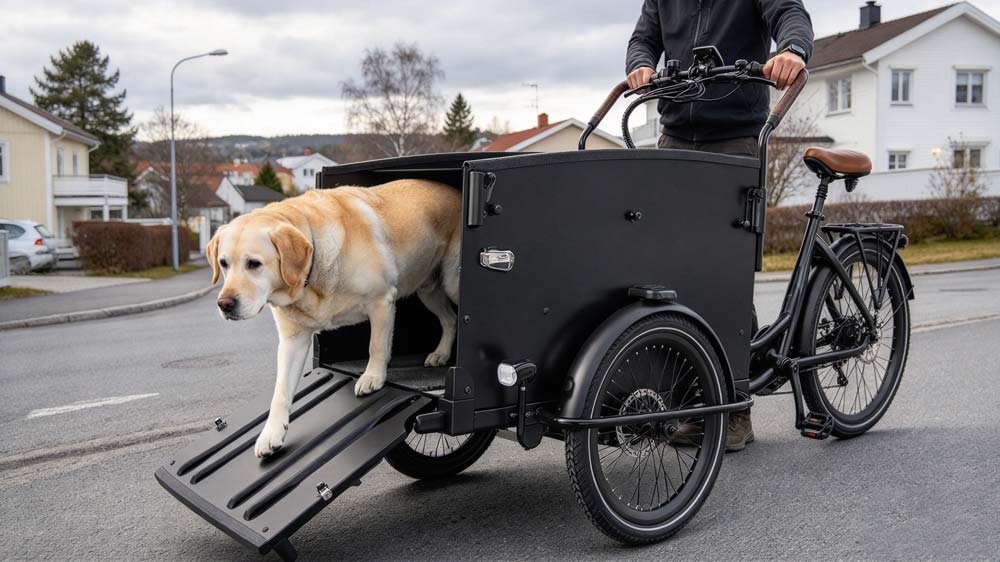
The standard that covers your box does not cover your dog
Most procurement teams assume that if a platform is certified, the use case is covered. With animals it is not, and the wording is unusually blunt.
The EN 17860 carrier cycle standard series splits the category into parts. Part 6, published in 2025, deals with passenger transport: it applies to carrying passengers facing forward or rearward on a carrier cycle, and excludes children in a child seat tested to EN 14344. Part 7, published at the end of 2024, deals with cargo trailers — and its scope contains a table of applicable usages. Cargo is applicable. People, children and pets are listed as not applicable. You can read both scopes on the Estonian standards body’s listings for EN 17860-6 passenger transport and EN 17860-7 cargo trailers.
Read those two together and the position is clear. A dog is not cargo, because cargo does not stand up and lean. A dog is not a passenger in the sense the standard means, because passenger requirements are written around human anthropometry and human restraint. The animal falls between the two parts of the EN 17860 carrier cycle standard, and nothing fills the gap.
This is not a reason to avoid the segment. It is the reason the segment is winnable. UnitedMobility’s engineering position is that a pet load should be specified as a live, mobile, low-restraint payload rather than derived from a child configuration — which is why pet modules are dimensioned and tested separately rather than inherited. A brand that can say that in a tender, with test evidence behind it, is doing something its basket-selling competitors cannot.
National road rules do not close the gap either. Germany’s road traffic regulation is permissive in an interesting way: §28 StVO forbids leading animals from a motor vehicle but allows dogs — only dogs — to be led from a bicycle, provided the handler can exert sufficient control. Austria takes the opposite line and prohibits tethered animals alongside a vehicle entirely. The practical consequence for a product team is the same in both countries: carrying beats tethering, and the box has to be good.
Four things change the moment your cargo bike carries a dog
Mass that moves. A belted child is a fixed point load. A dog is a 25 kg mass that stands, turns, shifts to the near sidewall when another dog passes and sits back down. Your cargo bike payload capacity number is unchanged, but the load case is not: you are now designing against lateral displacement at low speed, which is exactly where a two-wheel long john is least forgiving and where a tracked front end earns its cost.
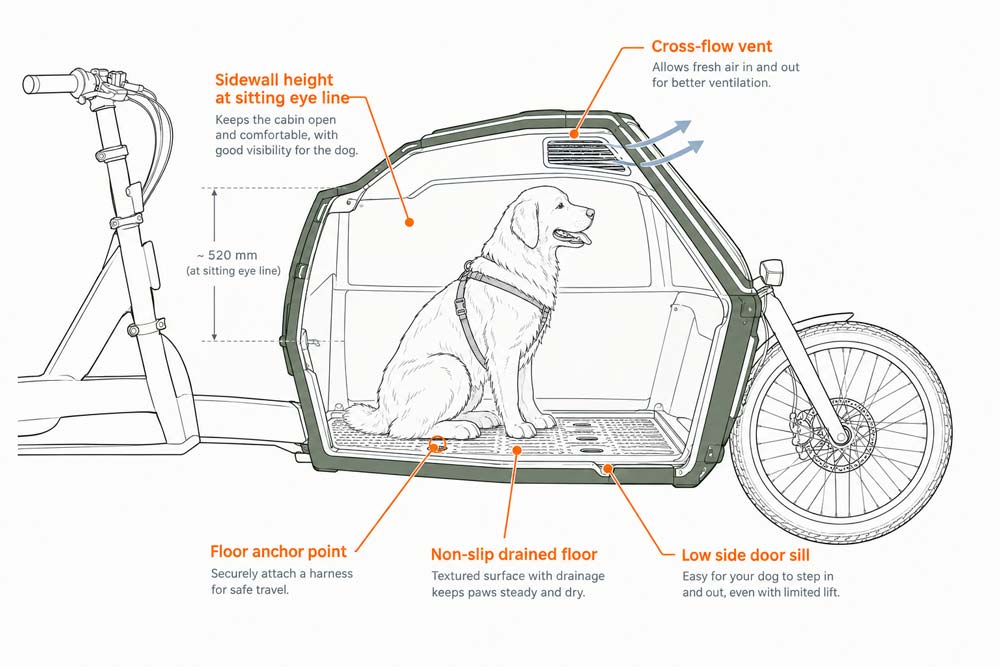
Restraint that cannot cross the chest. A three-point harness works because a human torso has shoulders. A dog does not, and a lead clipped to a collar converts a jump attempt into a strangulation risk. The correct answer is a short tether to a body harness, anchored low and centrally, with travel limited so the animal cannot get its front paws over the rail. That is an anchor-point layout decision taken at the box-moulding stage, not an accessory sold afterwards.
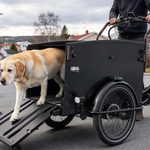
Boarding, which is where sales are won and lost. Lifting a stiff 30 kg dog into a waist-height box is not a one-person job, and owners of exactly those dogs are your highest-intent buyers. A front-side door, a low sill and a kickstand or parking brake that holds the bike without a hand on it turn an impossible purchase into an obvious one. Watch an owner in a showroom: the moment the dog walks in unaided, the objection disappears.
Environment inside the box. Dogs cool by panting, not sweating, and a sealed child cabin with a rain canopy is a heat trap in a Spanish or Australian summer. Cross-flow venting at the dog’s head height, a non-slip and washable floor, drainage, claw-resistant liner material and a sidewall tuned to a sitting dog’s eye line rather than a seated child’s shoulder are all different specifications from the family build. A dog that cannot see out panics. A dog that can see out settles within a few rides.
Dog bike trailer, basket or box: the honest comparison
Buyers arrive having already seen the alternatives, so a brand needs a defensible position rather than a dismissal.
| Format | Works for | Real limitation |
|---|---|---|
| Dog bike trailer | Large and very large dogs; retrofitting an existing bike | Sits outside the published trailer standard’s scope for pets; adds a second tracked vehicle to park and store; owners lose eye contact with the animal |
| Rack-mounted pet carrier for e-bike | Dogs under roughly 8 kg; short urban trips | Raises a live load above the rear axle, which is the worst place for it; little protection in a fall |
| Front box on a cargo bike | Small to large dogs; daily use; multi-dog households | Higher unit price; needs a dedicated pet module to be genuinely better than the other two |
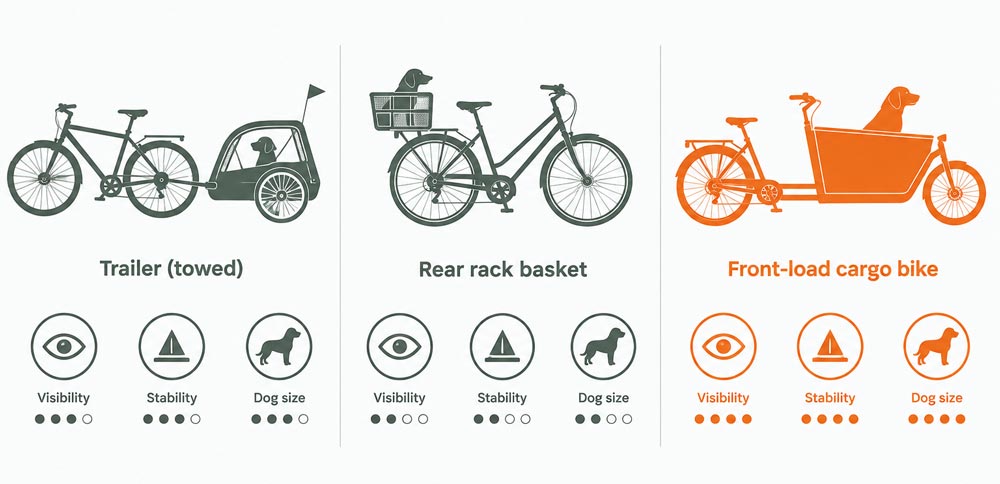
The front box wins on the thing owners actually care about, which is not specification at all. The dog is in front of the rider, visible, reachable and talked to. A dog bike trailer puts the animal behind and out of sight, and nervous dogs are measurably harder to settle when they cannot see their person. That is the emotional argument, and in this category the emotional argument closes the sale.
What belongs in the spec sheet for a cargo bike for dogs
If you are briefing a manufacturer, these are the items that separate a real pet configuration from a child box with a sticker on it:
- Anchor points moulded or bolted into the floor and lower sidewall, rated and documented, positioned for a short centre tether rather than a long lead
- Sidewall height specified against sitting shoulder height for a target breed range, not copied from the child build
- Non-slip, washable, claw-resistant floor with a drainage path, and a liner that can be removed without tools
- Cross-flow ventilation at head height, with any canopy designed to vent rather than seal
- Entry solution: side door, drop-down ramp or lowered sill, plus a kickstand or parking brake that holds the loaded bike hands-free
- A declared pet payload and a stated load case, including lateral displacement, so the retailer has something to say when a customer asks
Two platforms in our range already carry most of this as standard. The three-wheeled UM Flow combines a 140 L cabin, a front-side door and hydraulic disc brakes with a parking brake — the combination that lets an arthritic dog board unaided while the bike stands on its own. The modular UM Flex swaps its front cabin between child, cargo and pet configurations on a single spring latch, which is how a dealer covers several customer types from one display bike. Where a brand wants its own box geometry rather than ours, that is a tooling and validation programme our in-house design team runs from sketch to test report.
Stability under a shifting load is the part that is easiest to get wrong and hardest to retrofit. Our analysis of electric trike stability engineering covers the track-width, centre-of-gravity and tilt behaviour that decides whether a bike tolerates a dog standing up mid-corner. The broader commercial case — who buys these, and through which channels — sits in our overview of the pet cargo bike market.
The sentence your retailer needs
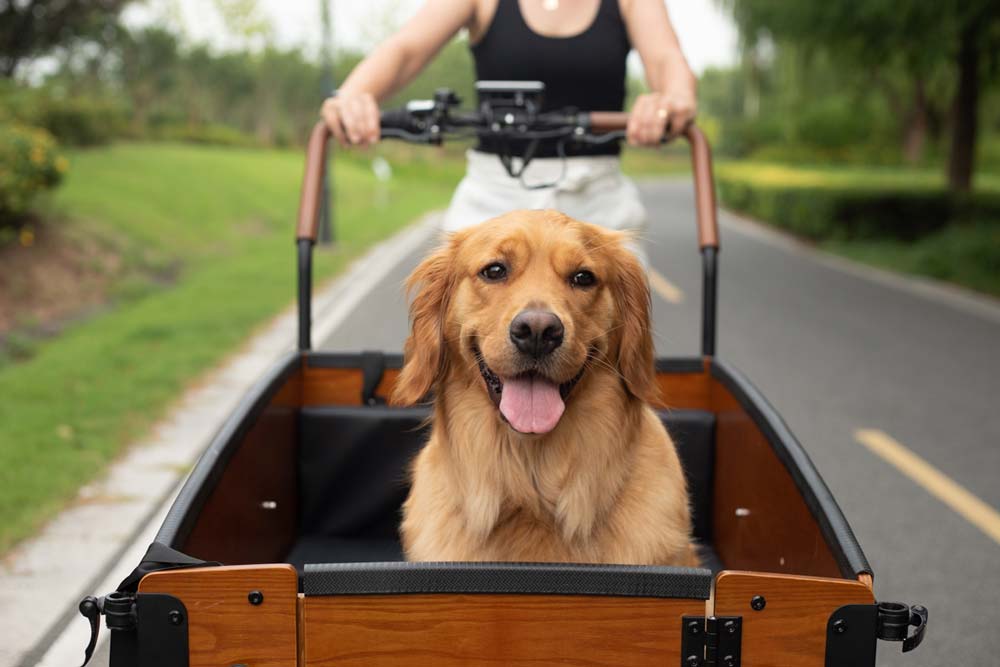
Here is the line that sells this product, and it is not about the bike: your dog walks in by himself, and you can reach down and touch him the whole way.
Everything above exists to make that sentence true. The anchor points, the sill height, the venting, the parking brake — none of it is a feature the end customer will ever read about. What she will notice is that her eleven-year-old dog got into the box without being lifted and lay down. UnitedMobility’s view is that the first brand in each market to make that moment repeatable in a showroom will define the category, because the standards are not going to define it for anyone.
FAQ
Is it legal to carry a dog in a cargo bike box in Europe?
Generally yes, and it is treated as carrying a load or a passenger depending on the country. Germany’s §28 StVO explicitly permits leading a dog from a bicycle; several countries, including Austria, prohibit tethering an animal alongside a vehicle, which makes carrying the only compliant option. Always check national and municipal rules for the market you sell into.
What size dog fits in a front-load cargo bike?
A 140 L front cabin comfortably takes one large dog up to roughly 30–35 kg sitting, or two medium dogs, within a 250 kg gross vehicle weight that still leaves payload for the rider and a shopping load. Breed shape matters as much as weight — long-backed dogs need floor length, tall dogs need sidewall height.
Can I use my child cargo bike box for my dog?
For a small, calm dog on short trips it usually works. Above roughly 15 kg the restraint system, floor surface and sidewall height all stop being appropriate, and the load case the box was tested against no longer matches what is happening inside it.
Which is safer, a dog trailer or a front box?
Both can be built well. The front box keeps the animal in the rider’s sight and within the bike’s own footprint, which helps with nervous dogs and with parking. The trailer carries larger dogs but is outside the published cargo-trailer standard’s scope for pets and doubles the vehicle you have to manoeuvre.
 English
  German
  Dutch
Dutch  Danish
  French
  Polish
  Portuguese
  Spanish