
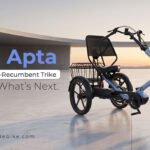
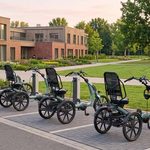
Réponse courte : The UM Apta carries two motors that never run at the same time. A 120 N·m mid-drive handles every forward metre through an internally geared hub; a separate front hub motor handles reverse on a button. That is not a compromise on all-wheel drive — it is the answer to a coordination problem that stops most mid-drive trikes from reversing at all, which is where senior trike sales quietly die.
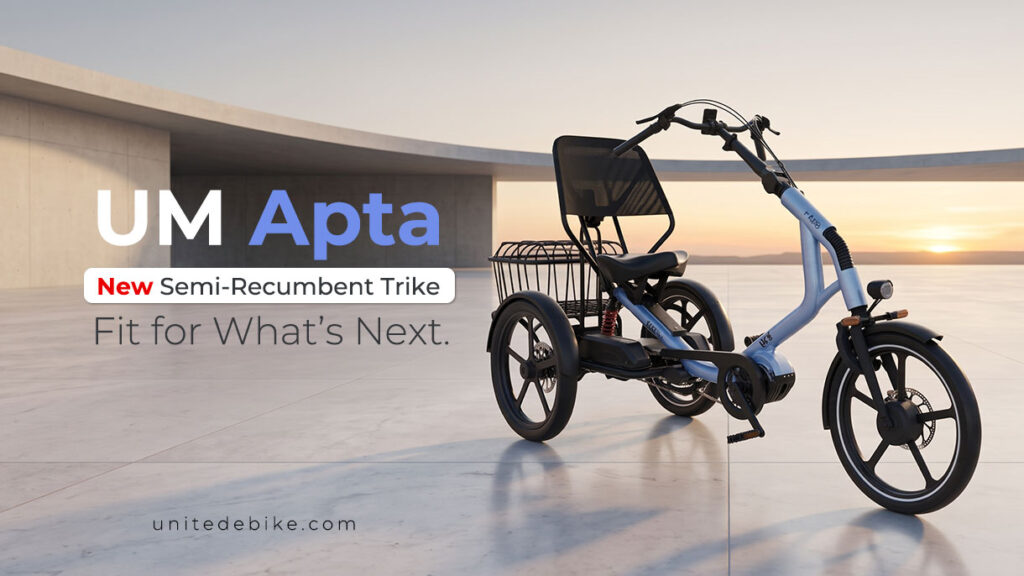
Why an electric trike with reverse exists at all
Watch a trike demonstration end badly and it is almost never about power. The rider manages the hill. What defeats them is a parking bay, a lift, or the end of a narrow garden path — the moment the vehicle has to go backwards.
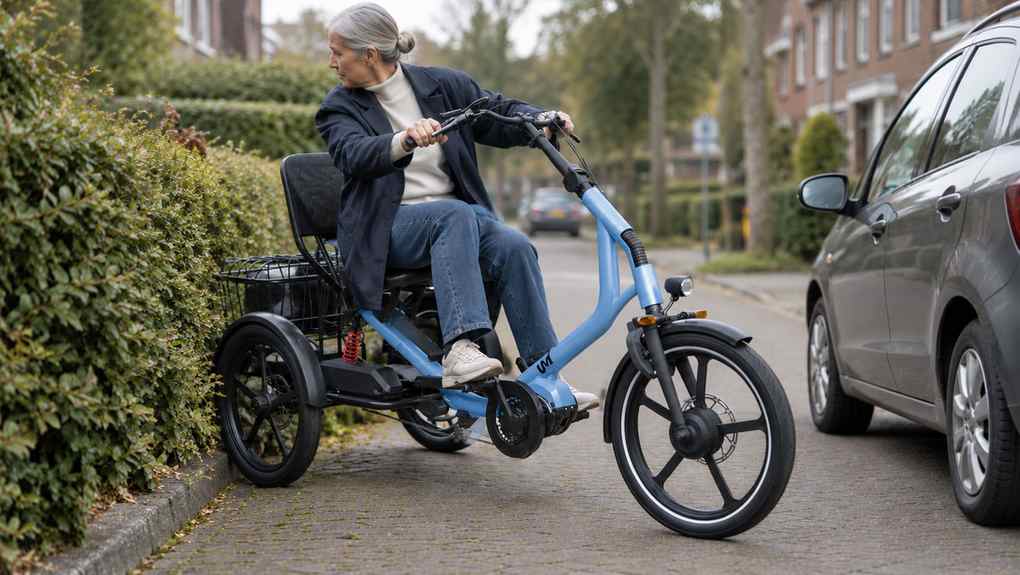
A 55 kg trike with a seated rider cannot be shoved backwards by that rider. On two wheels you put a foot down and walk it. On a semi-recumbent trike the rider is low, belted into a supported seat with a backrest, and their feet are out in front on a boom. There is no way to get leverage. For the older rider this category exists to serve, that is not an inconvenience; it is the reason the sale does not close.
Published comparisons of trike drive systems rarely mention it. Torque, range and motor brand get columns. Reverse gets nothing — and it is the single most common reason a configuration gets eliminated in a dealer showroom. UnitedMobility’s read of the senior channel is that an electric trike with reverse is not a premium feature but a precondition for the indoor-storage half of the market.
Why two motors instead of one bigger one
Because the obstacle is structural rather than a shortage of power.
A mid-drive sends its torque through the chain and a freewheel. A freewheel will not drive a wheel backwards — that is what a freewheel is for. So no amount of extra torque makes a mid-drive trike reverse. You either add hardware or you accept that the vehicle only goes forwards.
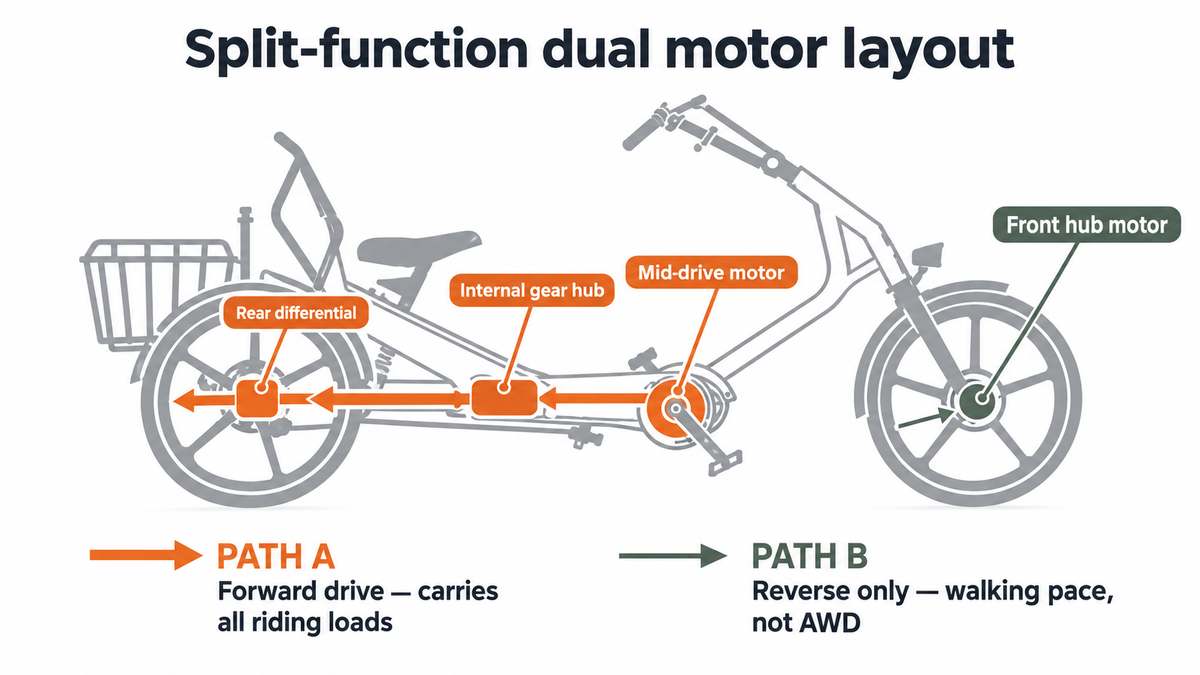
Meanwhile the mid-drive is there for a good reason. On a delta trike — one wheel at the front, two at the rear — the rear axle carries a differential so both rear wheels receive drive while the outer one travels further through a turn. Once the differential occupies the rear axle, those wheels are no longer available for a hub motor, and drive has to reach the axle through a chain. As the reference account of tricycle drive arrangements notes, trikes with a differential commonly use an internally geared hub as the gearbox in a mid-drive system. That is exactly the UM Apta layout: Ananda M100 mid-drive, 250 W continuous, 120 N·m, through a Shimano 8-speed internal hub, onto a differential rear axle.
So the forward drive is settled by the axle, and reverse needs a motor of its own. Hence two.
Why the reverse motor sits on the front wheel
This is the part worth explaining to your dealers, because it looks like an odd choice until you see the constraint.
On a delta trike the front wheel is the only one not doing anything. It steers, it carries little weight, and nothing else is competing for its hub. The rear wheels are occupied by the differential. So the front wheel is the one place a second motor can go without redesigning the driveline.
The usual objection to a front hub on a trike is traction: the rider’s mass sits rearward, so the front wheel is the lightly loaded end and the first to slip. That objection is correct — and it is why a front hub makes a poor primary drive. For reverse it does not apply. Reverse happens at walking pace, on flat ground, over a couple of metres, with no gradient to climb. The traction available at the front wheel is more than enough for the job, and the job is all it has to do.
Put differently: the weakness of a front hub motor is irrelevant to the only task it has been given. That is what makes the split sensible rather than a workaround.
What a dual motor electric trike does not mean here
This needs saying plainly, because the phrase is used loosely in this category and a mis-sold expectation comes back as a warranty claim.
Three different things get marketed as “dual”:
- Dual battery. Several trikes carry two packs and one motor. The product name says dual; the motor line says one.
- Simultaneous dual hub drive. This genuinely exists. In the US fat-tyre segment, trikes in the 750 W class are sold with front et rear hub motors and advertised all-wheel-drive modes, with combined torque claims near 180 N·m. It works because both motors are direct drive at their own wheel — same effective ratio, no gearbox between them — so a controller can split current without arbitrating anything.
- Split-function dual motor. What the Apta does. Two motors, two jobs, never simultaneous.
Blending a mid-drive and a hub motor at the same time is the one dual motor electric trike configuration nobody ships, and the reason is control rather than cost. The mid-drive’s output passes through a variable gear ratio while the hub is locked to wheel speed, so at any moment the two want different wheel speeds. Doing it well needs real-time torque arbitration between two unlike actuators; doing it badly produces one motor dragging the other, heat, and a surge the rider feels through the seat. On a vehicle capped at 25 km/h, that engineering has no payoff.
So the Apta is a tricycle électrique à double moteur in the split-function sense, and it should be sold that way. Train dealers to say “two motors, two jobs” — not all-wheel drive. A buyer who expects both motors to push will report a functioning product as broken. The wider engineering case for this is in our piece on tricycle à moteur moyeu vs tricycle à moteur central builds.
Specifying this dual motor electric trike for your market
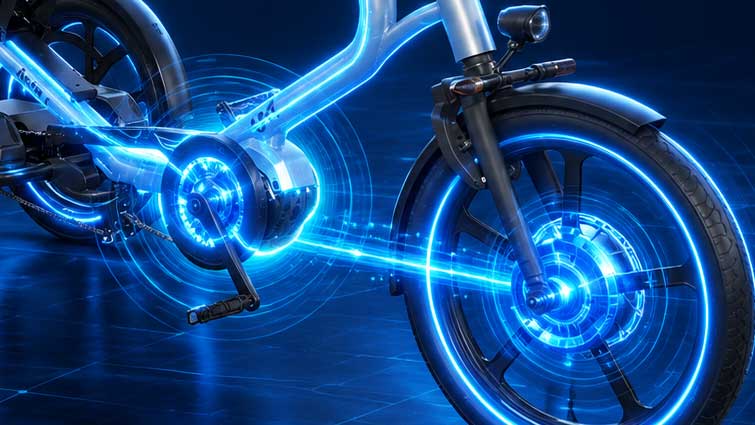
The Apta is a tricycle électrique semi-couché aimed at riders who have stopped trusting two wheels but are nowhere near a mobility scooter — the gap our positioning analysis covers in detail. In channel terms it is an Tricycle électrique pour seniors, and in most European markets that means it is judged on serviceability and documented test evidence as much as on ride feel, a pattern we break down in electric trikes for the elderly.
| UM Apta, standard EU build | |
|---|---|
| Forward drive | Ananda M100 mid-drive, 250 W, 120 N·m, torque sensing |
| Reverse | Dedicated front hub motor, button-activated |
| Rear axle | Differential, both rear wheels driven |
| Engrenage | Shimano 8-speed internal gear hub |
| Batterie | 672 Wh, Samsung cells, 6–8 h charge, 50–65 km |
| Freins | Hydraulic disc, 3 mm rotors, parking function |
| Fit | 380 mm step-through, seat 580–707 mm, backrest 22°, riders 150–190 cm |
| Footprint | 2200 × 800 × 1330 mm, wheelbase 1410 mm, turning radius 1.6 m |
| Weight / load | 55 kg kerb, 140 kg max gross |
| Conformité | Designed to EN 15194, CE marked; UL 2849 route available |
Three numbers in that table do more selling than the motor spec. The 380 mm step-through means the rider does not lift a leg over anything. The 1.6 m turning radius means the trike turns inside a cycle path rather than needing a three-point manoeuvre — which, combined with powered reverse, is what makes it usable in the places older riders actually ride. And riders from 150 cm brings in a group most trikes size out entirely.
What changes per market: motor torque, battery capacity and dual-battery setup, controller parameters, cadence sensing instead of torque for cost-driven builds, gearing, tyres, display, lighting ratings, brake brand, and a folding frame or geometry changes on request. A thumb throttle is available for the US and other markets where that is legal; the EU build has none, because EN 15194 and the 250 W pedelec envelope leave no room for one.
UnitedMobility has built electric bikes since 2009 and holds 50+ registered patents, with production in Wuxi and assembly in Poland. Small-batch runs from 50 units mean a market read on the Apta can be tested rather than assumed, and the reverse-motor split can be specified in or out depending on whether your dealers store indoors. How a configured build moves from brief to series production is on our Service ODM page, and the calibration work behind the assist feel is in comment nous calibrons un système de propulsion de tricycle électrique.
FAQ
Do both motors on the Apta run at the same time?
No, and deliberately so. The mid-drive handles all forward propulsion; the front hub motor handles reverse only. They never operate together, which is why the system needs no torque arbitration between them.
Is this all-wheel drive?
No. All-wheel-drive trikes exist, but they use two hub motors at the same effective ratio. The Apta splits two motors across two jobs instead. Selling it as all-wheel drive will generate warranty claims.
Why not just put the reverse motor in a rear wheel?
The rear axle carries the differential that drives both rear wheels, so there is no free hub there. The front wheel is undriven and available, and reverse at walking pace does not need the traction a forward drive would.
Can a mid-drive trike reverse without a second motor?
Not under power. The freewheel in a chain drive will not turn the wheel backwards. Powered reverse requires a hub motor somewhere in the driveline.
Can the reverse motor be left off to reduce cost?
Yes. It is a configuration choice. It is worth keeping wherever riders park indoors, use lifts, or demo in tight showrooms — which is most of the European senior channel.
 French
 English
 German
 Dutch
 Danish
 Polish
 Portuguese
 Spanish