
Electric Trike Drive Systems: How to Specify One for Your Market
- Home
- Resources
- Guide
There is no best drive system for an electric trike. There is only the one that matches how your market rides, what it pays, and what its regulator allows. A hub motor that wins in Florida loses in Flanders. This guide separates the decisions that are physics, the ones that are law, and the ones that are just taste — and shows how to tell which is which before you sign a BOM.
01. Start with your market, not with the motor
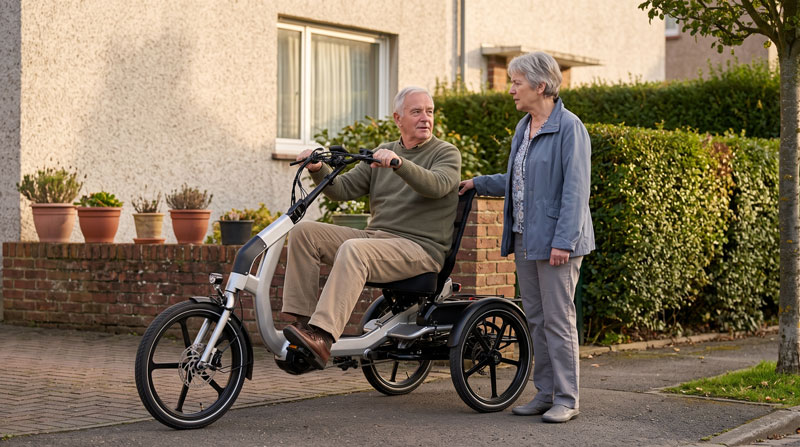
Most sourcing conversations start in the wrong place. A buyer arrives with a component preference — mid-drive, torque sensor, 48 V — and works backwards to justify it. That order produces a trike that demos well and sells badly.
Reverse it. Four inputs decide a build: the terrain your riders cover, the rider profile, the expected load, and the price position you need to hold. Everything downstream is arithmetic. The hard part is reading those four honestly, because the market rarely tells you directly. These signals do.
Read the reimbursement lists before the forecasts. In several European markets, trikes for older and less mobile riders move through a channel that looks nothing like bike retail — municipal or insurer-funded provision with its own tender rules. Where that channel is active, demand is procurement-shaped: spare parts availability, serviceability by a non-specialist technician and documented test evidence outweigh ride feel. Where it is absent, the same product is a consumer purchase and ride feel is most of the decision.
Watch what comes back, not what goes out. Your warranty claim mix is the cheapest terrain survey you will ever run. Thermal derating complaints mean riders are grinding up sustained gradients at low speed — a hub motor working outside its efficiency band. Cut-outs on hill starts usually mean the controller is demanding more current than the pack will release, not that the motor is too small. Two faults, two completely different fixes, and only claim data separates them.
Count abandoned test rides, not completed ones. Conversion tells you who bought. Abandonment tells you who nearly did and what stopped them. On trikes the most common stopper is not power: it is the first two metres from rest, and the moment the rider finds they cannot reverse the thing out of a tight space unaided.
Treat terrain as a number, not a country. “Germany” is not a terrain input. The average gradient inside a 5 km radius of your dealers is. Two German cities can need different gearing, and one national spec will under-serve one of them.
02. Hub motor vs mid-drive trike builds: what three wheels actually change
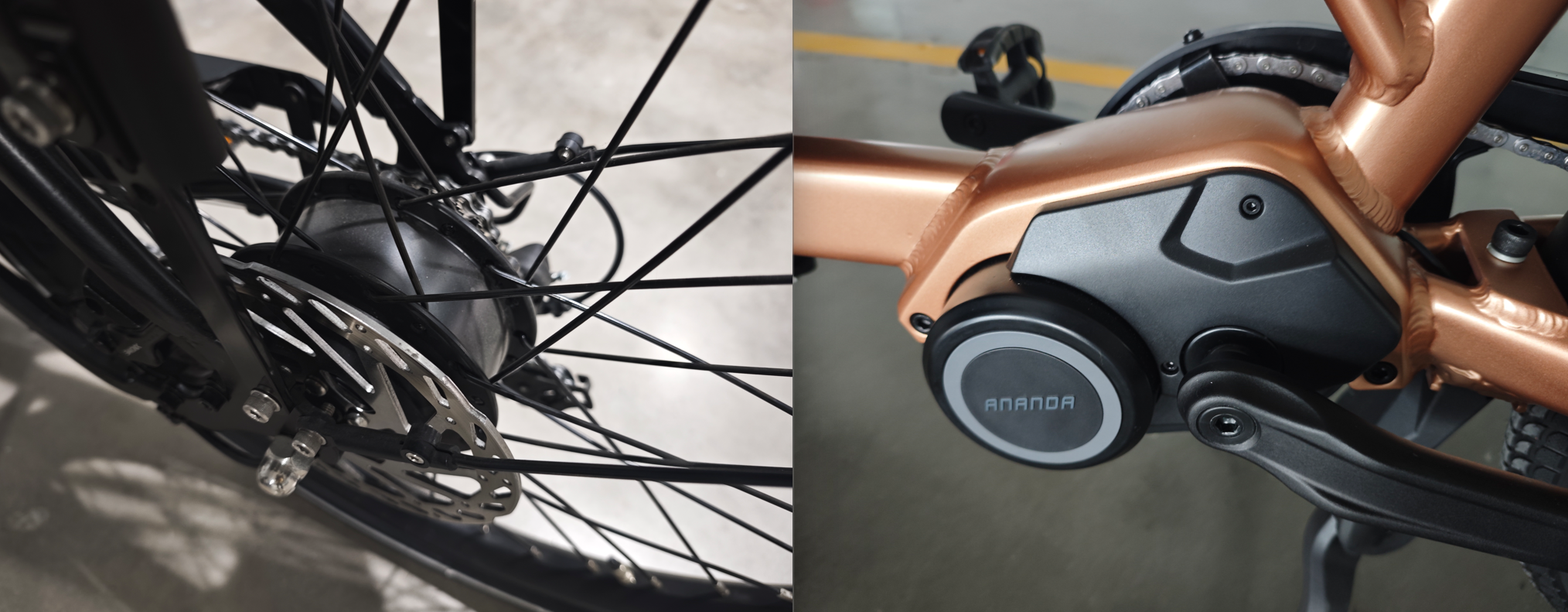
On a two-wheeler this is a familiar trade. On three wheels, four things change that rarely come up in bicycle discussions.
Which wheel the torque reaches. A trike with two rear wheels and a hub motor in one of them drives that wheel alone: under load the vehicle pulls toward the driven side, and on a wet surface that wheel spins first. A mid-drive feeds the rear axle instead, and with a differential both rear wheels turn at their own speed through a corner while sharing drive. Where the trike has a single front wheel, a front hub motor avoids the asymmetry but moves traction to the lightly loaded end — exactly where it is least useful on a climb.
Gearing multiplication at the moment it matters. A hub motor produces its torque at the wheel, fixed. A mid-drive produces it at the crank and multiplies it through whatever gear is selected. On a 25 kg two-wheeler that difference is academic. On a 55 kg trike carrying a 90 kg rider and a loaded rear basket, pulling away uphill from standstill is the load case that defines the product, and gear multiplication is what solves it.
Who services it. A rear hub motor is a sealed unit any competent workshop can swap. A mid-drive is a proprietary assembly needing a trained technician and a parts account. If your channel is mobility retailers and pharmacies rather than bike shops, the serviceable option may be worth more than the better-performing one. That is a channel decision wearing an engineering costume.
Whether you can reverse. This is the one that surprises people. A mid-drive delivers power through a chain and a freewheel, and a freewheel will not drive the wheel backwards — so reverse assist needs extra hardware. A hub motor reverses in software. Across UnitedMobility’s own range the pattern is consistent: the models that list a reverse function run hub motors, and the mid-drive models do not. If your riders park in lifts, hallways or narrow garages, reverse assist may be the single requirement that settles the hub motor vs mid-drive trike question before any performance figure is discussed.
| Decision driver | Points to a rear hub motor | Points to a mid-drive |
|---|---|---|
| Terrain | Flat to rolling; short gradients | Sustained climbs; frequent hill starts |
| Load | Rider plus light cargo | Rider plus heavy or variable cargo |
| Channel | Mobility retail, pharmacy, general workshops | Specialist bike dealers with trained service |
| Reverse assist needed | Yes — reverses in software | No — needs added hardware |
| Two driven rear wheels | Only with a differential-equipped axle or twin motors | Natural fit with a differential |
| Price position | Entry and mid | Mid and premium |
Neither column is the right answer. The right answer is whichever one your four market inputs land in most often — and a supplier who builds both from one frame, so the platform is not riding on the guess.
03. Torque sensing, cadence, and the calibration that decides the ride
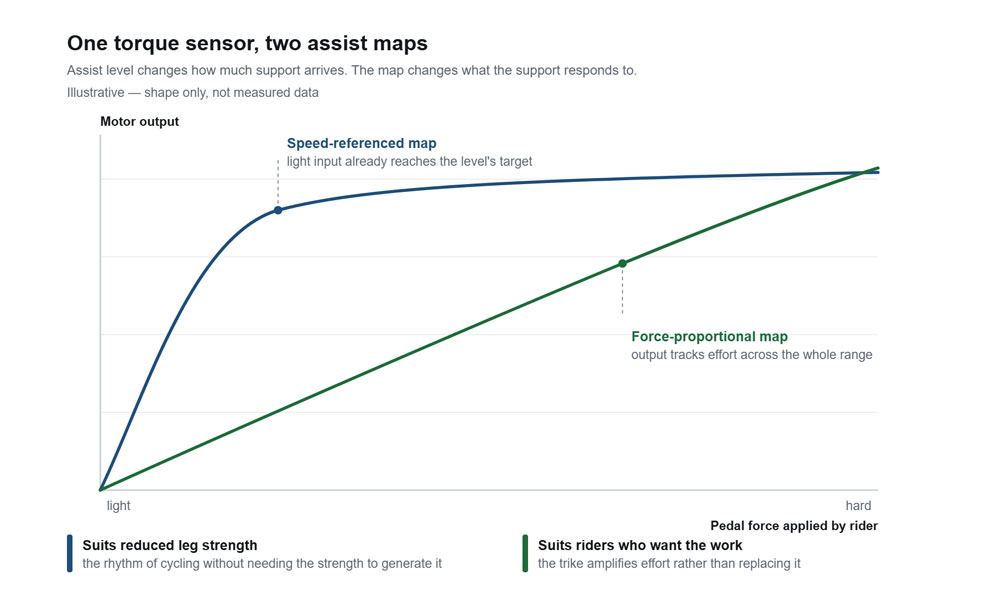
The torque sensor vs cadence sensor choice is usually framed as cheap versus good. It is closer to predictable versus proportional.
A cadence sensor detects that the pedals are turning and the controller applies the assist level you selected. Help arrives on rotation, at full strength, however hard the rider is pushing. A torque sensor measures pedal force and scales assist to it. On an upright bicycle most riders prefer the second and tolerate the first. On a trike the gap widens, because three wheels mean the rider feels the vehicle moving under them rather than with them, and assist that arrives in a step is felt as a lurch.
What produces the ride, though, is neither sensor. It is the assist map: the rule the controller follows when it converts sensor input into motor current. A speed-referenced map gives more help at low speed and tapers as the trike gains pace. A force-proportional map tracks what the rider’s legs are doing. Both can live on one trike as selectable modes, and offering both is often cheaper than arguing about which your market wants.
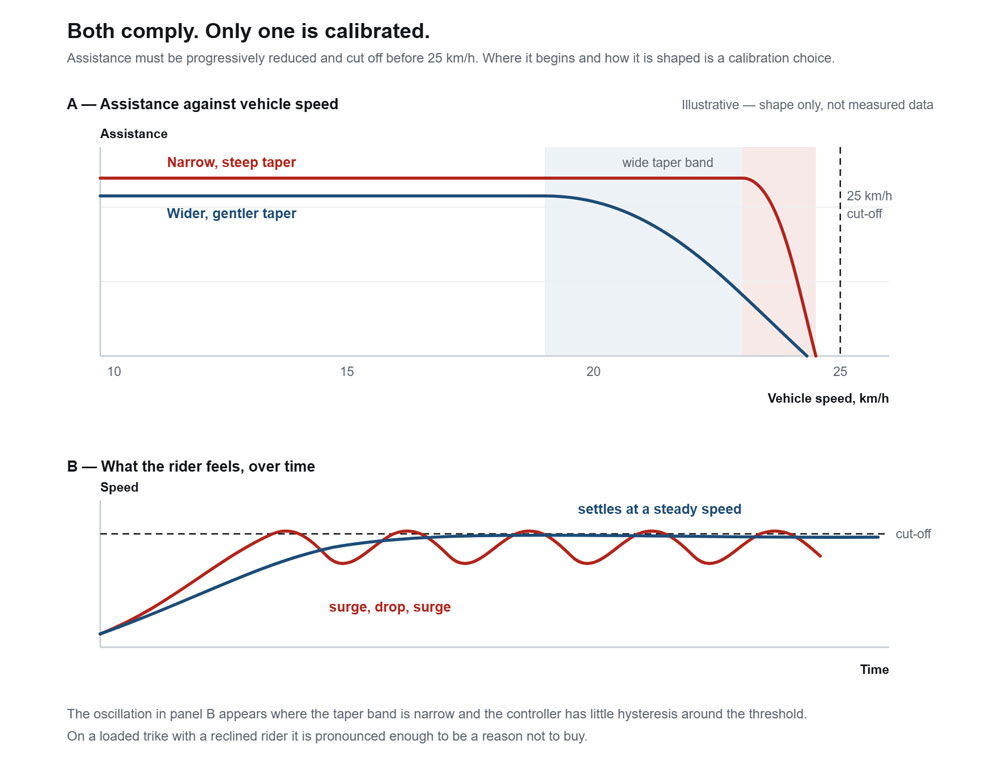
The taper near the assist limit matters more than most spec sheets admit. Cut assistance abruptly at the legal ceiling and the rider feels surging — help on, help off, help on — which reads as a fault. Widen the taper band, soften its slope, add hysteresis, and the same hardware holds a steady speed. This is the layer where electric trike drive systems are actually won or lost, and it is documented in how we calibrate an electric trike drive system.
The sourcing consequence: two quotations with identical component lists can produce trikes that ride nothing alike. Ask for the assist map and the taper behaviour, not just the motor part number.
04. Making the motor, battery and controller agree
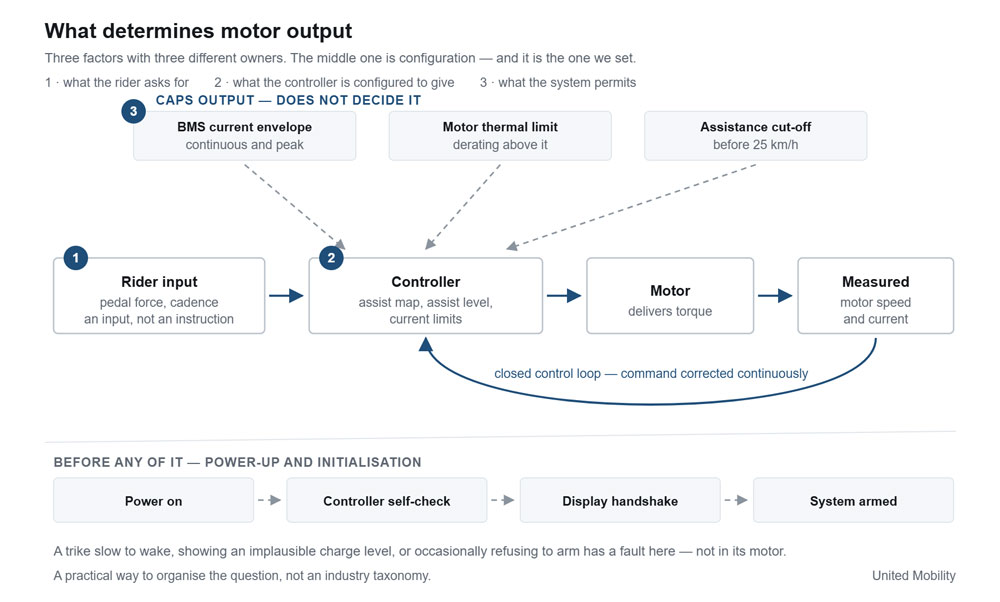
Three components, three independent ceilings, and the lowest one wins every time. The BMS sets the pack’s discharge envelope, the controller operates beneath it, and the motor has an efficiency band and a thermal limit. Configure the controller to demand more current on a hill start than the BMS will release and the system shuts down under exactly the load it was bought for — which the dealer reports as a battery fault, because that is what it looks like from the saddle.
This is why BMS type is a specification decision rather than a detail. A hardware BMS provides analogue protection and infers state of charge from voltage, which drifts under load and makes the display pessimistic on a climb. A software BMS counts charge, reports coded faults and can hand the controller a discharge limit that varies with temperature and state of charge — so the system derates gracefully instead of cutting out. It also gives you the data layer battery passport obligations will require of light-means-of-transport packs later this decade. Pack architecture itself — single, dual or swappable — is covered in our cargo bike battery system strategy.
Motor sizing is the last thing to fix, not the first. Electric trike motor torque figures are easy to compare and nearly meaningless in isolation: 120 N·m through a low gear on a mid-drive and 60 N·m at the hub are different currencies. Compare gradeability at your target gross weight, from rest, in the gear the rider will actually be in — which is why it is calculated per configuration at quotation rather than published as one number.
05. Upright and semi-recumbent electric trike drive systems are two different problems
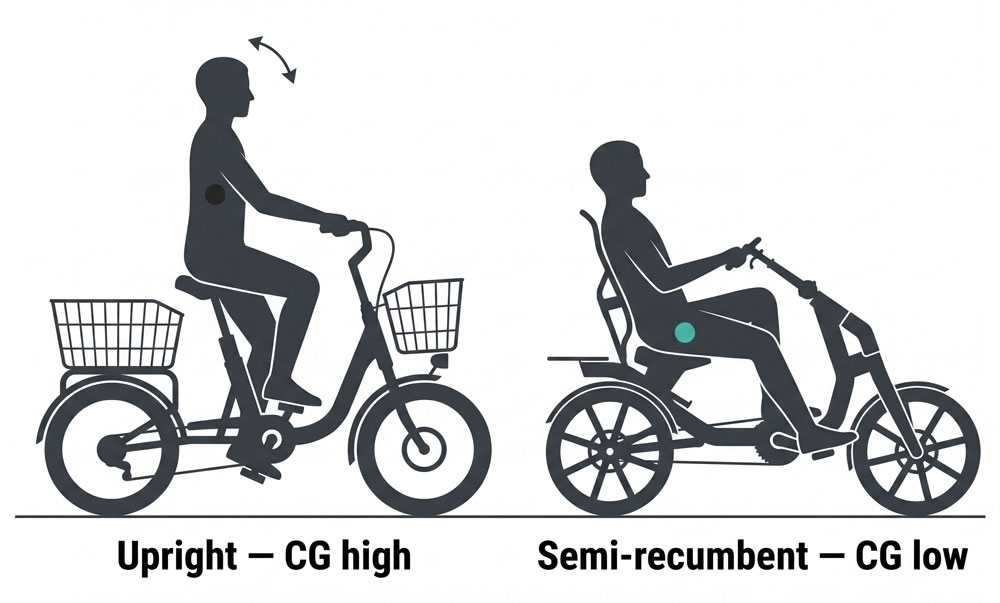
This is the distinction most sourcing conversations collapse, and the most expensive one to get wrong. The same calibration that suits an upright trike feels under-powered on a semi-recumbent.
An upright rider can lift off the saddle and put body weight into the pedals. Peak pedal force is high, and it arrives exactly when a hill start needs it. A semi-recumbent electric trike rider cannot. They push against a backrest from a reclined, seated position — excellent sustained output and back support, but a much lower peak. A drive system tuned around an upright rider’s force range sits near the bottom of its assist curve precisely when that rider needs the most help.
Seat geometry makes the gap concrete. The upright Heal Middle sets its saddle between 815 and 950 mm for riders from 165 to 195 cm. The semi-recumbent CHILL puts the seat base between 580 and 707 mm with a 380 mm step-through and a backrest adjustable through 22°, fitting riders from 150 to 190 cm. These are not two versions of one vehicle. Different bodies, different leg extension, different cadence, different force at the pedal — and therefore different electric trike drive systems.
| Upright trike | Semi-recumbent trike | |
|---|---|---|
| Peak pedal force | High — rider can stand on the pedals | Low — rider braced against a backrest |
| Sustained output | Limited by comfort | Higher; back support allows long efforts |
| Assist priority | Smooth mid-range, modest low-end | Strong, well-resolved low-end from rest |
| Sensor implication | Cadence tolerable; torque preferred | Torque sensing with fine low-force resolution |
| Gearing | Rider can muscle a gear | Needs a lower bottom gear; cannot stand |
| Centre of gravity | Higher; more tip-over sensitivity | Lower and rearward; more rear traction |
| Reverse assist | Rider can usually foot-push backwards | Seated low; reverse assist is close to essential |
| Rider reach | Taller riders, 165 cm and up | Wider fit range including shorter riders |
Two consequences follow. Torque sensing on a semi-recumbent has to resolve a narrower force range, so sensor selection and the floor of the assist map matter more than on an upright. And the lower, rearward mass of a reclined rider improves rear traction, which makes rear drive more attractive and front hub drive less so. The tip-over behaviour behind that second point is worked through in electric trike stability engineering; the commercial case for carrying both formats is in what a semi-recumbent offers over an upright trike.
06. What the law lets you build, market by market
Specification freedom ends where type approval begins, and the boundary sits in a different place on each side of the Atlantic.
In Europe, Regulation (EU) No 168/2013 excludes pedal cycles with an auxiliary electric motor from type approval only where continuous rated power stays at or below 250 W, output is cut when the rider stops pedalling, and assistance is progressively reduced and cut off before 25 km/h. A low-speed start-up assist is the conventional exception. Step outside any of those conditions — a throttle that works without pedalling, or more than 250 W — and the vehicle becomes an L1e-A powered cycle: still capped at 25 km/h but permitted up to 1,000 W, and now inside type approval. Ireland’s Department of Transport sets out what that means in practice, including registration and motor tax. Obligations differ by member state, so check before assuming a throttle is a free upgrade.
The electrical safety standard is where trike builders hit a boundary nobody warns them about. EN 15194:2017+A1:2023, valid from September 2023, is scoped to EPAC bicycles with a saddle height of 635 mm or more and electrical systems up to 48 V DC. That definition was written around a diamond-frame bicycle. A semi-recumbent trike with a seat base at 580 mm sits below that threshold; a 60 V pack sits outside the voltage scope. Neither makes the product unsellable — it makes the testing route a conversation to have with your notified body before tooling, not after.
North America inverts the problem. 15 U.S.C. §2085 defines a low-speed electric bicycle as a two- or three-wheeled vehicle with fully operable pedals, a motor under 750 W and a motor-only top speed below 20 mph — so trikes sit explicitly inside the federal consumer-product definition, and a throttle is permitted. Road rules are set state by state under the three-class system, and the electrical system is judged against UL 2849, which covers the drive unit, battery, BMS, wiring, inlet and charger as one system while excluding mechanical structure. The full entry requirement is mapped in UL 2849 for electric trikes.
The sourcing consequence: EU and US builds of the same trike differ in motor rating, throttle, cut-off speed and certification file. Plan two configurations from the start, or pay for the second one twice.
07. Turning this into a spec sheet
Bring these six lines to a supplier and you will get a quotation instead of a catalogue:
- Terrain — typical and worst-case gradient, and whether hill starts from rest are routine
- Rider — upright or semi-recumbent, height range, and realistic pedal force
- Load — gross vehicle weight including rider, cargo and any rear basket
- Market rules — assisted speed cut-off, throttle yes or no, target certification file
- Must-have functions — reverse assist, walk assist, parking brake, turn signals, app or CAN connectivity
- Price position and channel — who services the product, and how far from a specialist dealer
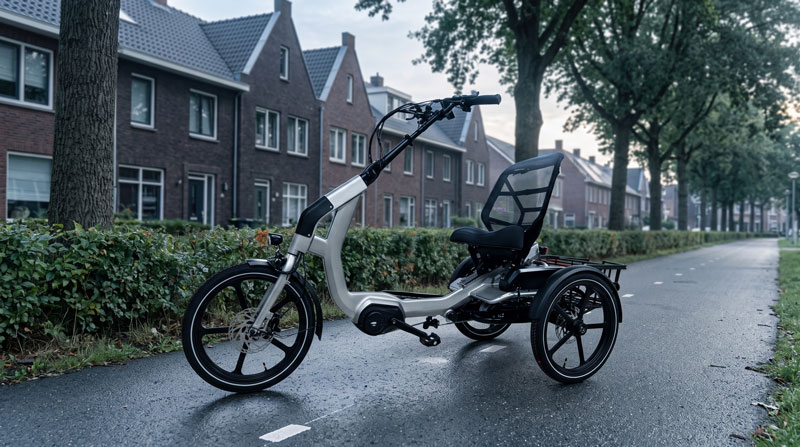
UnitedMobility‘s position is that electric trike drive systems are configurations rather than part numbers: the same CHILL frame ships with a 120 N·m Ananda mid-drive or a rear hub motor, torque or cadence sensing, a 15 A CAN-bus controller or a higher-current version, a Shimano 8-speed internal hub or an alternative, and EU or throttle-equipped settings — because all of those belong to the market, not to the engineer. The compact Vita runs the same logic at a smaller footprint, with an automatic 3-speed hub motor as standard and an 85 N·m mid-drive as an option.
Building electric bikes since 2009, with 50+ registered patents, a plant in Wuxi and an assembly facility in Poland, UnitedMobility treats the quotation question not as whether a configuration is possible but which of several working configurations fits your terrain, channel and price. Small-batch runs from 50 units mean a market read can be tested rather than assumed. How a configured build moves from brief to series production is set out on our ODM service page.
Start with the four inputs. Let the components fall out of them. Then test the read with a small batch before you commit a container.
Leave A Message
Tell Us Your Demand
Our experienced team is ready to provide tailored solutions to support your business growth.
Frequently asked questions
No. A mid-drive multiplies torque through the gears, which wins on sustained climbs and loaded hill starts. A hub motor is simpler, cheaper, serviceable by any workshop and reverses in software. On flat terrain, through a non-specialist channel, or where reverse assist is required, the hub motor is often the better decision.
There is no single figure, because torque at the crank and torque at the wheel are not comparable. Specify gradeability at your target gross weight from a standing start, and let the supplier calculate the motor, gearing and controller that deliver it.
It helps more on three wheels than two, because step changes in assist are felt as the vehicle moving independently of the rider. It matters most on semi-recumbent trikes, where pedal force is lower and the sensor must resolve a narrower range. Cadence sensing remains legitimate for cost-driven builds in flat markets.
Not as one configuration. The EU build is capped at 250 W continuous, no throttle, cut-off before 25 km/h; the US federal definition allows under 750 W, a throttle and under 20 mph, with state road rules on top and UL 2849 for the electrical system.
 English
 German
 Dutch
 Danish
 French
 Polish
 Portuguese
 Spanish