


The cargo bike industry has done a poor job of helping commercial buyers pick the right vehicle. Type names are inconsistent — “bakfiets,” “long john,” “front-loader,” and “box bike” all describe overlapping but non-identical things. Manufacturers tend to recommend whichever platform they happen to specialise in. And the differences between a family-configured cargo bike and a commercial-configured one on the same platform are routinely glossed over, even though those differences are what decide whether the bike still rolls in year three.
This article does the work the category brochures usually don’t: it maps the four structural cargo bike types against five real commercial use cases, then breaks down what changes when you spec the same platform for commercial duty instead of family duty. By the end you should know which type fits which operation, and which spec changes are non-negotiable before you sign a purchase order.
The Four Commercial Cargo Bike Types in Plain Language
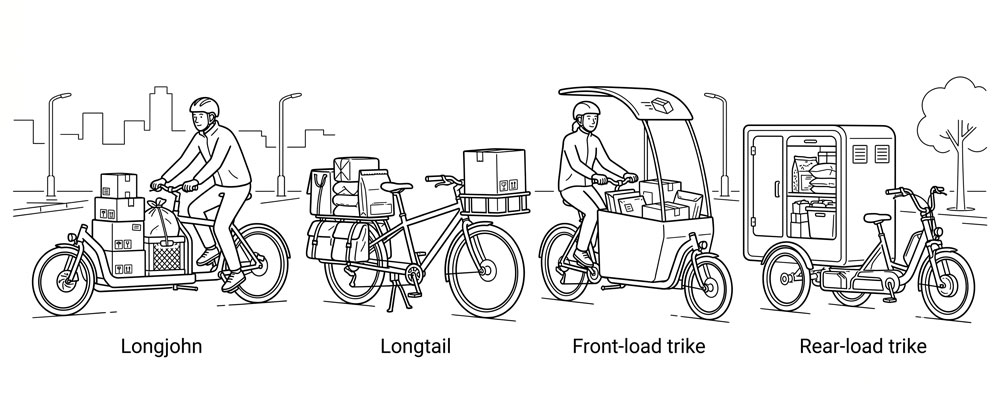
We covered the formats briefly in the pillar piece. Here they are again with the commercial implications spelled out.
Long John
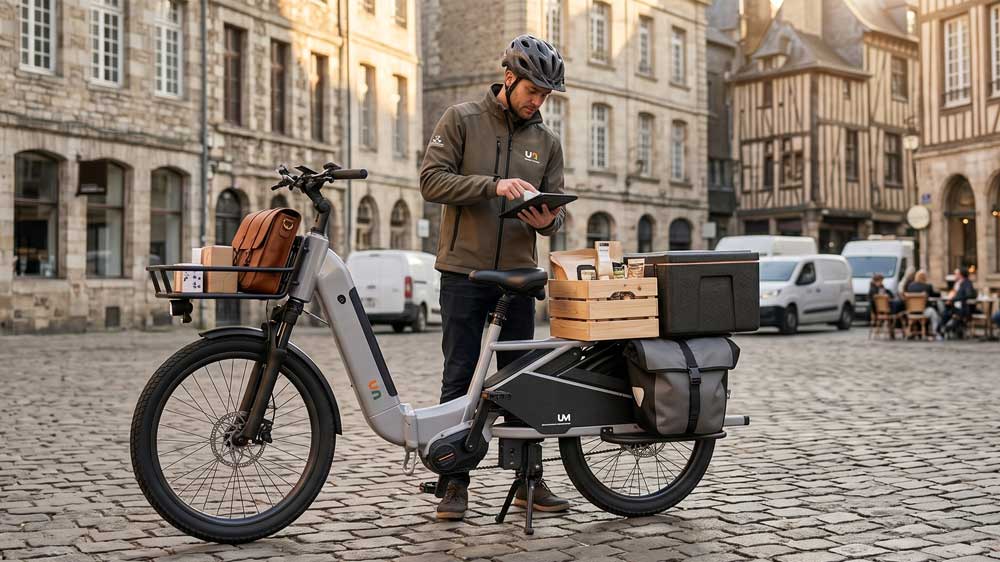
Two wheels. Cargo platform between the rider’s body and the front wheel, mounted low. Length: typically 2.4 to 2.7 metres. Strengths: load visibility, low centre of gravity, predictable handling under load. Weaknesses: longer turning radius than a standard bike, harder to learn quickly, parking footprint is awkward.
Longtail
Two wheels. Cargo extends rearward over the rear wheel; payload on racks, panniers, or a rear deck. Length: typically 2.0 to 2.2 metres. Strengths: rides closest to a conventional bicycle, lowest rider learning curve, most compact storage footprint (foldable variants like our Stretch compress further). Weaknesses: rear-biased load distribution requires careful loading, less load visibility, panniers cap practical payload below front-loader formats.
Front-load trike
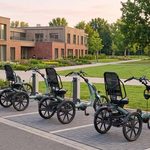
Three wheels — two at the front, cargo box between them. Strengths: static stability (no kickstand failures, no fall-over at lights, mountable with load aboard), largest cargo volume per platform length. Weaknesses: wider footprint limits agility in narrow streets and pedestrianised zones; older designs handle awkwardly at speed (modern tilt-steered units like the Flow largely solve this).
Rear-load trike (e-Trike)
Three wheels — single steering wheel at the front, two driven wheels at the back. Strengths: highest absolute payload, easiest accessibility (low step-over, no balance required at standstill), most stable on uneven ground. Weaknesses: slowest, largest footprint, least agile in traffic.
Five Commercial Use Cases, Mapped to Vehicle Types
The selection logic flips when you think in use cases rather than vehicle features. Here are the five commercial profiles we see most often.
1. Urban parcel delivery.
(DHL/UPS/Amazon profile)
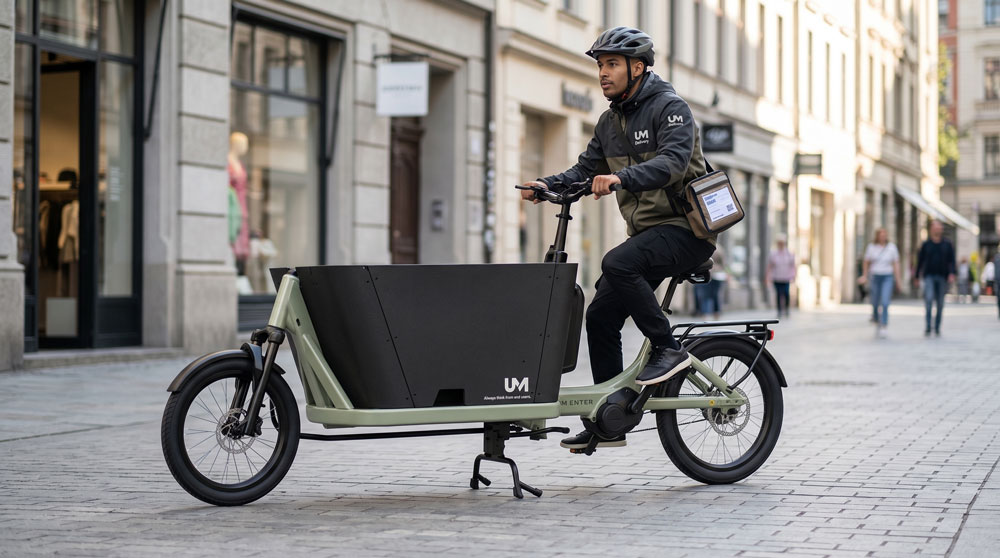
High stop density, moderate parcel weights, frequent rider rotation, micro-hub-fed routes. The Long John is usually the right answer here. Load visibility lets riders confirm parcel order without unloading; the box accommodates standard parcel dimensions; low CoG keeps the bike stable as the load empties over the route. Avoid front-load trikes in this role — their width slows down the kerb-to-door movement that defines parcel work.
>> Best UM platform: Frontier.
2. Food and grocery delivery, courier work, service calls.
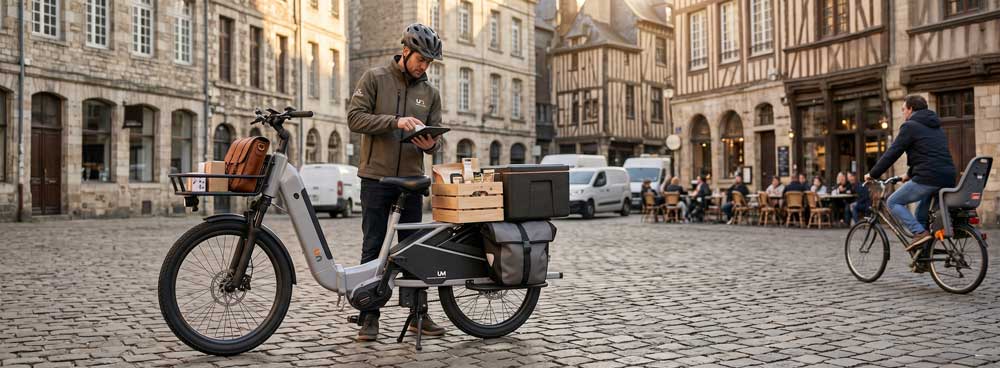
Lower payload, time-critical, rider-experience-dependent. Longtails are the strongest fit. They ride like a normal bike, which matters when your operational risk is a rider quitting in week six. Panniers and insulated cargo bags fit standard longtail rack systems without modification.
3. Municipal services and facilities work.
(cleaning, maintenance, postal collection)
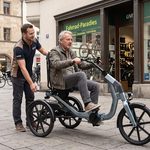
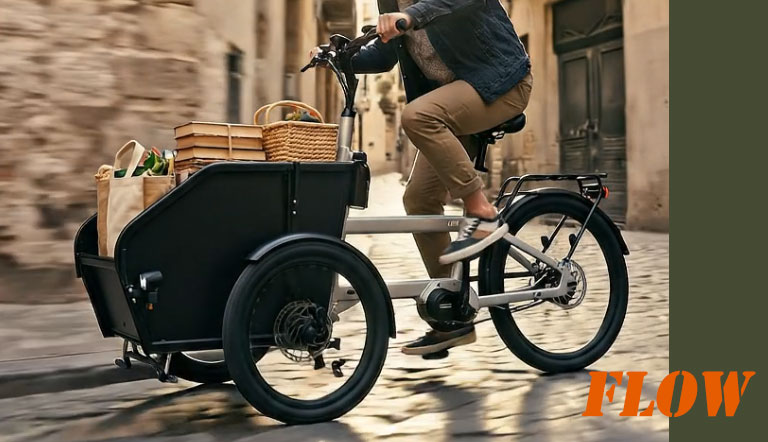
Mixed loads, fixed routes, lower daily kilometres, riders ranging from young to retirement-age, often with mobility considerations. Front-load trikes or rear-load trikes are usually the right call. The trike’s static stability matters more here than top speed — the bike is repeatedly mounted and dismounted to do work, not just to deliver.
>> Best UM platforms: Flow for general municipal work; SE for routes involving older or limited-mobility riders.
4. B2B same-day logistics in dense central business districts.
Mid-weight payloads, urgent delivery windows, navigating around pedestrians and parked vehicles. This is the operational sweet spot for Long John or longtail, depending on per-drop weight. Trikes lose too much time in this environment.
>> Best UM platforms: Frontier for heavier loads, Stretch for lighter and time-critical.
5. Heavy fixed-route fleet operations
(retail back-of-house, large-site internal logistics, brewery and beverage drop-off, sport/event services).
High payload, lower speed, predictable route geometry. Rear-load trikes or heavy-duty Long Johns dominate. Static stability matters when loads are bulky; rider speed matters less because routes are short.
>> Best UM platforms: Flow for bulk box-style loads; Frontier for parcels and stackable items.
Where Commercial Spec Diverges From Family Spec — On the Same Platform
The platform name in our catalogue can be configured for family or commercial duty. The chassis is the same in many cases; what changes is the specification of components that fail under commercial duty cycles. If you’re sourcing a commercial cargo bike, these are the spec lines that matter — and these are also the lines we change versus our family-targeted builds.
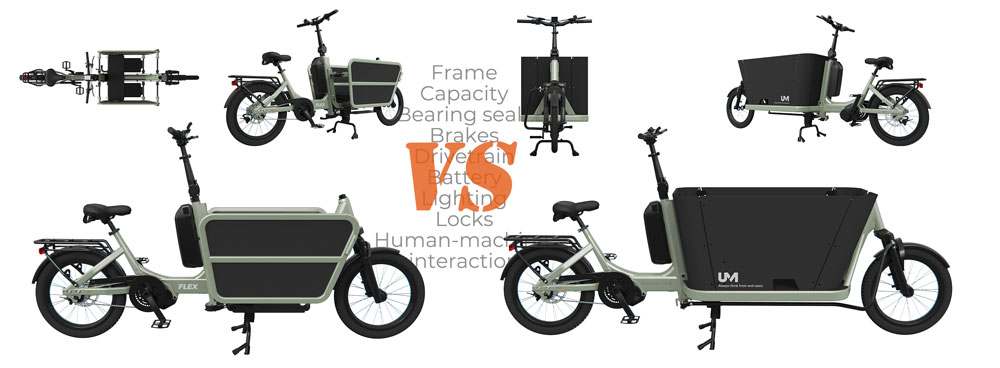
Frame fatigue specification. Commercial-spec frames are tested to higher cycle counts. EN 17860 sets a baseline; commercial-grade builds typically exceed it by 20–30 percent. We test commercial frames past 200,000 vibration cycles. Family-spec on the same chassis usually doesn’t need that buffer.
Bearing seals. Headset, bottom bracket, and wheel hub bearings on commercial bikes face daily exposure to road spray, pressure washing (in fleet wash cycles), and constant load. Standard sealed bearings rated for consumer use will need replacement within 12–18 months. Marine-grade or industrial-rated bearings extend this to 3–5 years. Spec the upgrade up front; it’s cheaper than a fleet-wide bearing swap.
Brake pad compound. Family bikes brake gently. Commercial cargo bikes brake hard, often loaded, often in the wet. Semi-metallic or sintered pads outlast organic pads by 3–5×. Hydraulic disc systems are non-negotiable for commercial duty; cable-actuated discs lose modulation under load. Tektro, Magura, or Shimano hydraulics are the standard commercial spec, with rotor diameters of 180–203 mm.
Drivetrain. This is the line item where commercial decisions differ most sharply from family ones. A standard derailleur drivetrain is fine for family use but expensive in commercial duty. Belt-drive or internally geared hub configurations cost more upfront and pay back in 12–18 months on a high-duty fleet. Pinion MGU integrated motor-gearbox units, increasingly available on premium commercial cargo bikes, eliminate chain and derailleur servicing entirely.
Battery. Family spec usually accepts single-battery configuration with 500–700 Wh. Commercial spec, in most use cases, justifies dual battery (1,000–1,500 Wh combined), not because the daily range demands it but because dual battery extends the practical operating window per charging cycle. A van that needs to refuel mid-shift is a productivity catastrophe; a bike that swaps to a second battery at lunch isn’t.
Lighting and visibility. Commercial spec requires lights that work in all conditions, hard-wired into the main battery, mounted to survive rear-end impact from kerb stops. Family lighting often runs off coin cells and falls off in the first hard winter.
Cargo lock and security. Commercial cargo bikes are parked unattended for hours daily in places consumer bikes never go. Frame locks rated to ART-2 or higher (Dutch insurance standard) are minimum spec; integrated GPS tracking and motion alerts are increasingly standard. The first cargo bike theft in a fleet rollout typically pays for the whole security upgrade across the fleet.
Cargo bay design. Family cargo bikes prioritise weather protection and child-seat compatibility. Commercial cargo bikes prioritise loading speed, lockability, modularity, and resistance to rough handling. Our Frontier’s modular cargo bay logic (with reinforced frame) — interchangeable parcel, bulk, and tool-transport configurations on one platform — is built around this. Don’t accept a “commercial” bike with a cargo bay designed for a child seat.
The Spec Sheet Checklist
If you only take one thing from this article, take this: before signing a purchase order, demand these spec lines in writing:
- EN 17860 third-party certification (not self-attestation)
- Frame fatigue test cycles (target: 200,000+)
- Bearing rating (target: industrial / marine-grade)
- Brake hydraulics with 180–203 mm rotors
- Drivetrain type (and expected service interval)
- Single or dual battery (and rapid-swap design if dual)
- Hard-wired lighting
- Lock standard (ART-2 minimum for EU)
- Cargo bay design — confirm commercial-spec, not family-spec
- Warranty terms by component, in writing
If a vendor pushes back on any of these as “not how we sell,” they’re selling you a consumer bike with a fleet decal. Walk away.
Where this fits in the larger commercial cargo bike decision
The vehicle-type and spec questions covered above are one part of the procurement picture. If you’re building a full commercial cargo bike programme, three other questions decide whether the fleet works in practice:
The pillar guide to commercial cargo bikes ties the full decision sequence together — from market context and TCO logic to compliance and platform selection.
If you’re scoping the supply side — ODM procurement, certification chains, subsidies across Germany / Netherlands / France — start with Commercial electric cargo bikes in Europe: what fleet buyers actually need to know.
Once you’ve chosen the right type and locked the supplier, Cargo bike fleet deployment: what actually happens after the bikes arrive covers the route redesign, micro-hub, and rider training decisions that decide first-year outcomes.
Finally, Commercial cargo bike maintenance addresses the uptime, warranty, and service-network decisions that determine whether your fleet lasts to year five — including why drivetrain choice has more impact on annual cost than motor choice.
Bringing It Back to the Fleet Decision
The vehicle-type question and the spec question are not separate. A longtail in family spec and a longtail in commercial spec are functionally different vehicles even though the type designation is identical. The use-case framework above tells you which type to consider; the spec checklist tells you which configuration of that type to insist on.
In our experience working with European fleet buyers, the operations that survive their first year with cargo bikes get both questions right, and the operations that struggle usually got the type right and the spec wrong — or vice versa. More fleet analysis, please read: Total Cost of Ownership: What Fleet Operators Actually Pay
If you want to talk through a specific fleet specification with our engineering team, get in touch →.
 English
  German
  Dutch
Dutch  Danish
  French
  Polish
  Portuguese
  Spanish