

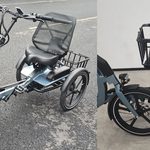

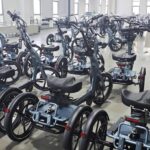
The procurement side of a commercial cargo bike rollout gets the attention. Trade-show demos, spec comparisons, OEM negotiations, certification compliance — months of work, often with senior management oversight. Then the bikes arrive, get rolled out to riders, and within ninety days a meaningful share of fleet operations are running below projection. We’ve seen first-year fleet failure rates between 25 and 35 percent in real operations, and almost none of those failures trace back to the bike itself.
They trace back to deployment.
This article covers what we’ve learned working with European brands and fleet operators about the operational decisions that decide whether a cargo bike fleet performs to its TCO model. None of it is glamorous. All of it costs less than a single fleet write-off.
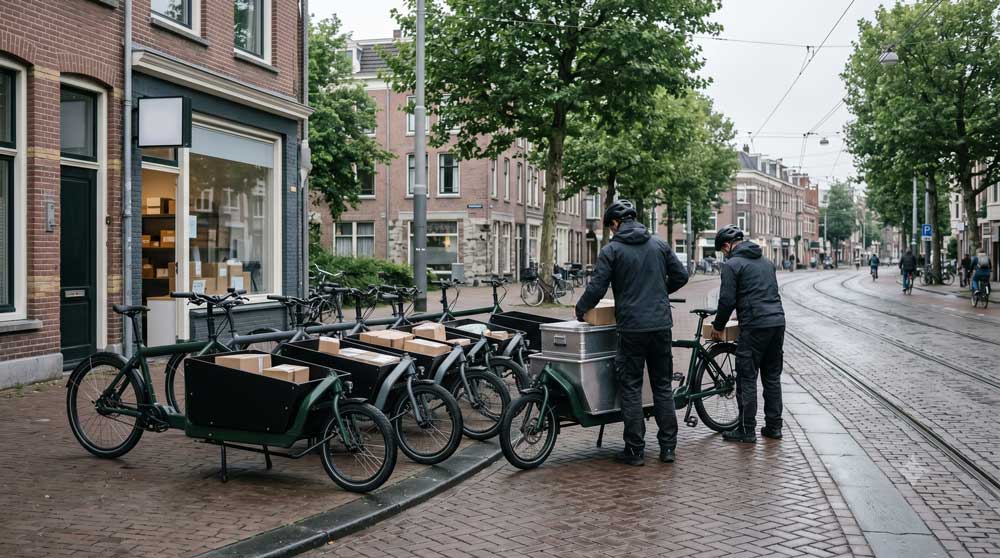
The Procurement-to-Deployment Gap
Cargo bike fleets fail in four predictable places: route design, micro-hub infrastructure, rider readiness, and maintenance access. Each of these is solvable. None of them is the bike’s job to solve. And all of them have to be in place before the first delivery shift, or you’ll spend the first six months reactively patching them while losing money.
The gap exists because the procurement team and the operations team are usually different people on different timelines. Procurement closes when the bikes ship. Operations begins when the bikes arrive. The handoff between them is almost never planned with the same rigour as the procurement RFP.
If you’re scoping a new cargo bike programme, plan the deployment side before you sign the purchase order. The cost of getting it right is in weeks of staff time; the cost of getting it wrong is in months of underperformance and rider attrition.
Factor in funding early — our cargo bike subsidies finder shows what support exists country by country.
1. Route Design: The Single Biggest Lever
Cargo bikes are not vans on two wheels. Forcing them to run van routes is the single most common deployment mistake we observe. Vans cruise at 50–60 km/h between stops; cargo bikes cruise at 20–25. Vans recover ground on highway-grade stretches; cargo bikes don’t. Vans tolerate one-way detours and bad parking; cargo bikes pay a much higher relative penalty.
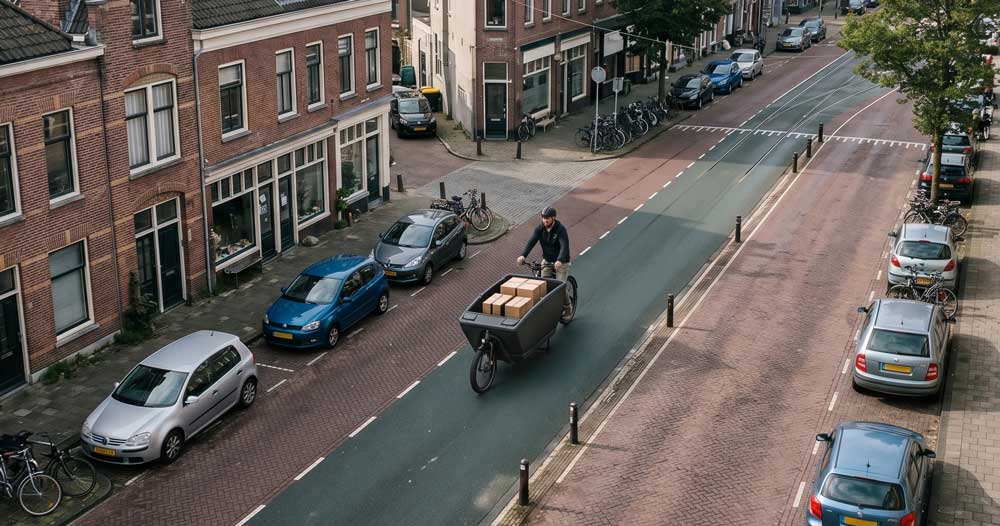
Operators who succeed redesign delivery zones around 3–5 km radius micro-hubs and roughly 6–10 stops per kilometre of route. Amazon’s first dedicated cargo bike micromobility hub in Europe used this geometry. DHL’s Berlin operation runs similar parameters. The reason is mathematical: at lower cruise speed, the time penalty of long inter-stop distance compounds quickly. A cargo bike doing 12 stops on a 4 km route will outperform itself on the same 12 stops on an 8 km route by 30–40 percent in shift time, even though the total work output is identical.
Plan on 8 to 12 staff hours per route segment to redesign, and another 4 to 8 hours per segment to validate the redesign with a real rider doing a real shift before going live. Don’t skip this step. The teams that skip it are the ones quoting van TCO at six months and wondering why their numbers don’t match the brochure.
2. Micro-Hubs: The Infrastructure Decision
A cargo bike fleet without a micro-hub is a fleet running half-blind. The micro-hub is where parcels arrive from the suburban distribution centre, get transloaded onto cargo bikes, and dispatch into the dense delivery zone. Without it, your cargo bikes are doing van work in their commute to and from the depot, killing the economics.
Three options exist:
Build your own. Most expensive, most control. Lease or purchase a 100–300 m² space in or near the delivery zone, fit it with secure parking, charging infrastructure, and a sorting bench. Permitting can take 3–9 months in EU cities. The Seattle Neighborhood Delivery Hub model and the Antwerp CULT partnership are documented case studies worth reading.
Partner with a hub operator. Reef Technology, Bpost, and a growing number of independent operators run shared micro-hubs that multiple delivery companies access. Lower fixed cost, less control. Good for pilot phases or operations that don’t justify a dedicated build.
Use municipal cargo bike corrals. A handful of cities (NYC, Amsterdam, Paris) provide on-street commercial cargo bike loading areas — effectively a public micro-hub with minimal infrastructure. Functional for early-stage operations; insufficient for sustained volume.
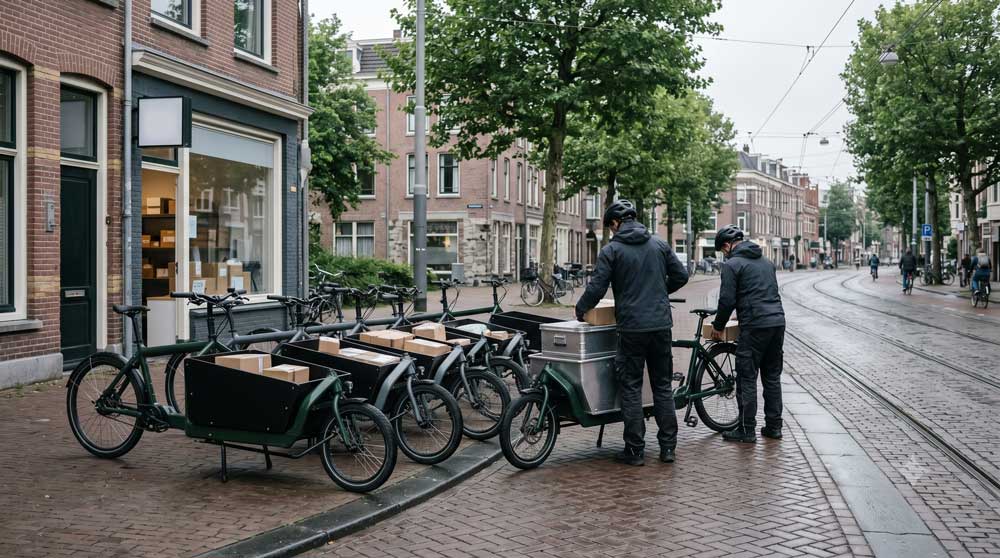
The financial answer is usually a mix. Pilot through a shared hub, then build dedicated infrastructure once your route volume justifies it. The trap is running too long on a shared hub at scale — the daily transload friction eats your route economics.
3. Rider Training and Onboarding: The Hidden Cost Line
Cargo bikes ride differently from regular bikes. Long Johns require learning a different steering geometry under load. Front-load trikes feel truck-like at first. Longtails are closest to a conventional ride but still introduce rear-weight handling characteristics that catch new riders out at low speed.
Operators we work with consistently underinvest in onboarding. A typical mistake: 2 hours of vehicle handover, no structured ride training, immediate deployment to commercial routes. The result is predictable. Riders quit at higher rates than van drivers in the first 90 days; minor accidents are common in weeks 2–4; insurance premiums creep up; rider attrition becomes the dominant operational cost.
A workable training programme looks like this:
- Day 1: Unladen ride training (4 hours). Mounting, dismounting, low-speed handling, emergency stops, kerb traversal. Empty bike, off-route.
- Day 2: Loaded ride training (4 hours). Repeat the Day 1 exercises with progressively heavier loads. Add cargo bay loading and unloading practice. Off-route or on quiet roads.
- Day 3: Route shadowing (full shift). New rider rides along with an experienced rider. Observes loading, route execution, customer handover. No solo delivery.
- Days 4–5: Supervised solo routes. New rider runs the route; experienced rider available by phone or in the area.
Total: roughly 24 hours of paid training time before a rider is fully autonomous. This sounds expensive. It is much, much cheaper than 30 percent rider turnover at month three.
4. Maintenance Access: The Decision That Decides Uptime
A van that breaks down can be at a garage within an hour in most European cities. A commercial cargo bike that breaks down often cannot, because the service network is thinner. This isn’t a complaint about the industry; it’s an operational reality you need to design around.
Three approaches work, in roughly increasing order of operational maturity:
Vendor service contract. Your bike supplier provides maintenance, either through their own technicians or a contracted local service partner. Easiest to set up; depends entirely on the supplier’s local service density. Confirm before signing: how many technicians, what response time guarantee, what parts inventory.
Local bike shop partnership. Find a commercial-grade bike shop in your delivery zone and put them on retainer. Works well in the Netherlands, Germany, Denmark; less reliable in markets with fewer commercial cargo bike specialists. Verify they have the diagnostic tools for your specific drive system — Bosch, Bafang, Shimano, and Pinion are not interchangeable.
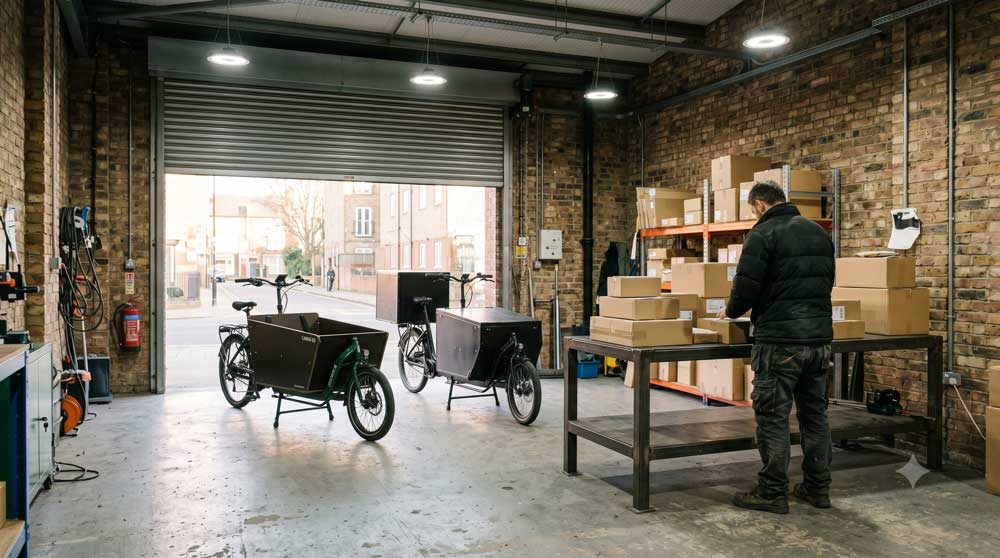
In-house maintenance. Most operationally mature; most capital intensive. Set up your own workshop at the micro-hub. Pays back at fleet sizes of approximately 15+ bikes. Allows you to enforce inspection intervals, control parts inventory, and reduce mean time to repair to hours instead of days. Suppliers should be able to provide service training and a documented repair procedure manual. (We do; we list this as a standard part of our commercial-grade supply contracts.)
The metric to optimise is mean time to repair (MTTR), not mean time between failures. Failures will happen; the question is how fast you turn them around. Commercial fleets that hit MTTR below 48 hours run at 95+ percent uptime. Fleets at MTTR of a week run below 85 percent, which destroys the TCO case.
5. The First-90-Day Plan
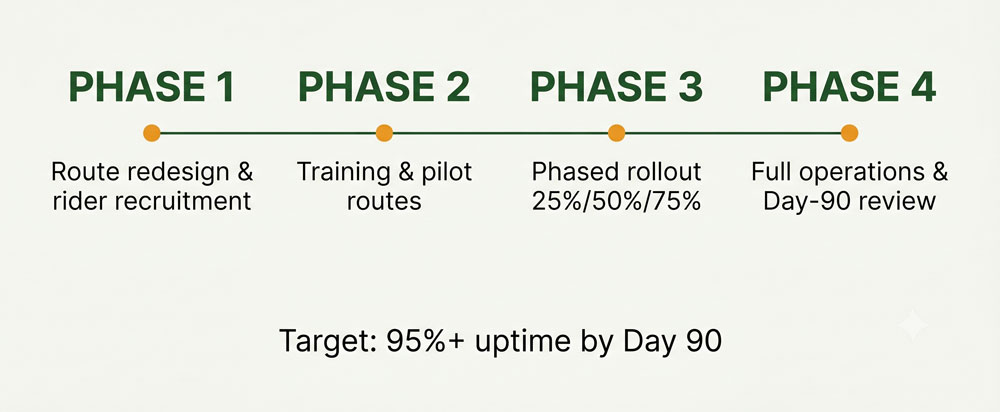
A realistic first-90-day deployment plan, drawn from operations we’ve supported:
Weeks 1–2: Route redesign and rider recruitment. Operations team redesigns delivery zones for cargo bike geometry. Recruit riders against the new role profile (riders who can handle a cargo bike are not always van drivers, and vice versa).
Weeks 3–4: Rider training and pilot routes. Run the 24-hour training programme. Operate pilot routes at reduced volume. Capture data: actual cycle times, charging behaviour, cargo bay friction points.
Weeks 5–8: Phased rollout. Add routes in increments of 25 percent of planned volume. Adjust route geometry based on Week 3–4 data. Calibrate charging schedule based on real consumption.
Weeks 9–12: Full operations and review. Run at planned volume. Conduct a structured operational review at Day 90: cycle times vs. plan, uptime vs. plan, rider retention, maintenance spend. Adjust the model before the next quarter.
This timeline assumes a small to mid-sized rollout (5–25 bikes). Larger rollouts compound the timeline, not multiply it — most of the planning effort is type-of-work scaling, not volume scaling.
What the Bike Vendor Should Be Doing
A useful test of your supplier: at what point in the deployment timeline do they show up? If they ship the bikes and disappear, you’ll handle deployment alone. If they offer service training, a documented repair manual, route design input, and rider training materials, they understand that commercial cargo bike fleet success is a partnership, not a transaction.
We treat deployment support as standard for commercial fleet customers. Our team has worked through hundreds of European deployments and brings the operational pattern recognition that takes individual operators years to accumulate. We don’t run your fleet; we keep you from making the predictable first-year mistakes.
If you’re planning a cargo bike fleet rollout in 2026 and want to talk through the deployment plan with our team before you commit to a procurement timeline, get in touch →.
Reading order for fleet operators
This article covers what happens after the bikes arrive. But deployment is one phase of a longer arc, and the decisions that determine deployment success are usually made earlier — at vehicle selection and procurement.
The commercial cargo bike guide maps the whole sequence: market context, vehicle types, TCO, compliance, and the platform options that match different operational profiles. If you’re earlier in the process than deployment, start there.
If you’re choosing between Long Johns, longtails, trikes, and the rest — Choosing the right commercial cargo bike type walks through how each format maps to specific commercial use cases, and why the same platform configured for commercial duty diverges meaningfully from the family spec.
On the supply side, Commercial electric cargo bikes in Europe: what fleet buyers actually need to know addresses the ODM and procurement reality — what total cost looks like across the major EU markets, what certification chains to look for, and the difference between a real manufacturer and an aggregator. Building the sustainability case alongside the cost case? Our cargo bike CO2 calculator turns your route profile into a board-ready emissions figure.
Once your fleet is deployed, Commercial cargo bike maintenance picks up where this article ends — covering the warranty, drivetrain, and service-network decisions that determine whether the operational gains hold over a 3–5 year fleet cycle.
Recommended reading: Cargo Bike Fleet TCO Calculator
 English
  German
  Dutch
Dutch  Danish
  French
  Polish
  Portuguese
  Spanish