



Folding is the easy part. Folding a trike that still rides like it does not fold — tight, quiet and safe under load — is the hard part, and it is the only version worth putting your name on. The folding mechanism itself is mature technology; almost anyone can add a hinge. What separates a folding semi-recumbent trike that sells from one that comes back is whether the fold actually earns its place, and whether the hinge behind it can be trusted.
Folding is one configuration of the platform covered in sourcing a semi-recumbent electric trike. This article looks at what folding is really for, where it makes sense, and what to check before you source one.
What folding is actually for
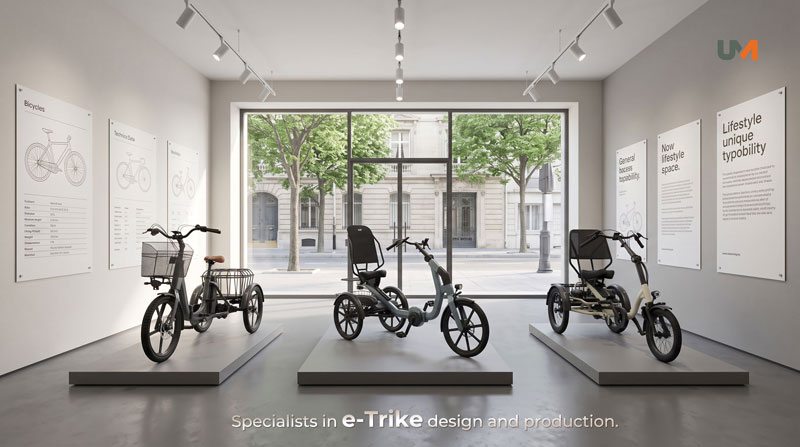
A folding semi-recumbent trike solves two practical problems: transport and storage. Transport covers fitting the trike into a car, onto public transport, into a caravan or motorhome, or through the entrance of an apartment building. Storage covers homes without a garage, apartments reached by a lift, and rental depots that need to pack stock tightly. Where those constraints are real, folding turns a trike that would not fit into one that does — and that can be the difference between a sale and a walk-away. Where those constraints are not real, folding is weight, cost and complexity the buyer never uses.
Two fold points, each with a job
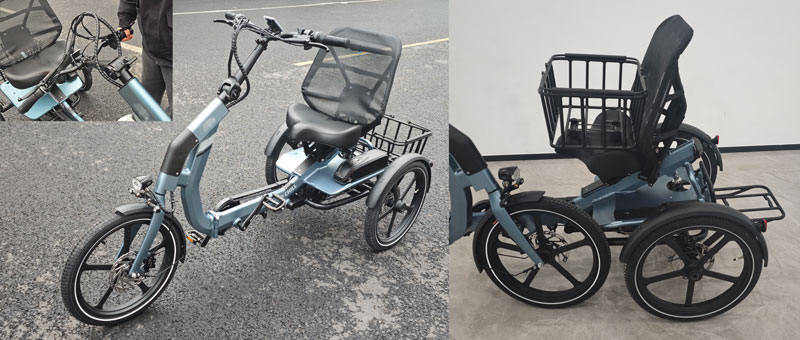
Our folding design uses two fold points rather than one, because each solves a different part of the problem. The first is at the handlebar stem, and it does double duty: the same point that folds the bars down for transport is also where the riding position is adjusted, so setting the trike up for the rider and folding it away use one well-made mechanism. The second sits lower, at the step-through section of the frame — the low, dropped part you step over to get on. Folding there collapses the trike’s length, bringing it down to a compact footprint that fits a car boot, a lift or a storage rack.
The point of two folds is not to fold more for its own sake. A stem fold alone reduces the height; a frame fold alone reduces the length. Together they bring the whole trike down to a size that actually solves the transport and storage problem it was built for.
The hinge is what you are really buying
This is where folding trikes are made or lost. A fold is only as good as the hinge that closes it, and a good hinge does three things: it locks solid, so the trike rides tight with no flex or rattle and you would not know it folds; it survives being folded and unfolded over and over without working loose; and it stays safe under a rider’s weight and a loaded basket. A weak hinge undoes all of it — the trike feels vague, develops play, and loses the rider’s trust the first time it rattles. When you compare folding trikes, the hinge and how it is built matter far more than the simple fact that it folds.
The honest version of this is short: do not fold for the sake of folding. If a market does not need to transport or store the trike compactly, a rigid frame is the better, lighter and cheaper build, and we would say so. Folding should answer a real need, not tick a feature box.
What to ask before you source a folding trike
These are the questions worth putting to any supplier — us included — before a folding trike goes into your range:
- Does the fold cost you the ride? A folding trike should feel rigid when unfolded. Ask how the hinge is secured and whether there is any flex or play.
- How does the hinge hold up over time? Folding is a repeated action; ask how the mechanism is built to survive it and whether it can be adjusted or serviced.
- What is the folded footprint, against your actual use? The figure that matters is whether it fits the car, the lift or the shelf your market needs — not a headline “it folds”.
- Is folding quick and manageable? A fold that needs tools or two people rarely gets used. Ask how many steps it takes and whether one person can do it.
- Does folding affect anything else? Ask how the fold interacts with the warranty and the overall build, so there are no surprises after it ships.
A supplier that answers these plainly is easier to trust than one that simply says “yes, it folds”.
One platform, folding or rigid
Folding is a configuration of our semi-recumbent platform, not a separate product. The same platform is built folding or rigid, with fat tyres for rougher ground (covered here) or a second battery for range and uptime (covered here), and configured for the market it ships to. That breadth is the point: a semi-recumbent trike is not one fixed product but a platform we adapt, and folding is one of the choices on it.
For a brand or distributor weighing a China-built semi-recumbent trike, that range — together with the willingness to tell you when folding is the wrong answer — is what a dependable manufacturer looks like. Our guide to choosing a trike manufacturer sets out the rest of what to check.
Common questions
Does a folding semi-recumbent trike ride as well as a rigid one?
It should. With a well-made hinge that locks solid, you should not feel the fold when riding — no flex, no rattle. If a folding trike feels vague or develops play, the hinge, not the concept, is the problem.
When does the folding version make sense?
When transport or storage is genuinely constrained — fitting a car, a caravan, public transport, an apartment or a tight depot. Where space is not a constraint, a rigid frame is usually the better build.
Is folding worth it if I do not need to store or transport it compactly?
Usually not. Folding adds cost, weight and a mechanism to maintain. If the market has room for a rigid trike, that is the simpler and often better choice.
Can folding be combined with fat tyres or a dual battery?
Yes. Folding is one configuration of the platform, and it can be specified alongside fat tyres, a second battery or other options to suit the market.
Can you build both folding and non-folding trikes for my range?
Yes. The semi-recumbent platform is built in folding and rigid versions and across configurations, so a single supplier can cover a full range rather than a single model.
Not sure whether your market needs the fold? Tell us how the trike will be transported and stored, and we will tell you honestly whether folding earns its place — and build it either way. Talk to our team about configuring for your market.
 English
  German
  Dutch
Dutch  Danish
  French
  Polish
  Portuguese
  Spanish