


Cargo bike CEE compliance FNUCI is still what French dealers type into a search box, and the answer has changed twice since August 2025. The national scheme existed for twenty-nine days. Its technical requirements did not go with it: the standards stack, the 175 kg proof, the 400 Wh floor and the FNUCI registration are now the vocabulary of every French fleet buyer.

What CEE meant here, and why the acronym misleads
Start with the disambiguation, because it costs enquiries. CEE in this context is certificats d’économies d’énergie — energy saving certificates, a French mechanism under which energy suppliers, rather than the state, fund equipment that reduces consumption. It has nothing to do with the old EEC mark on a product, and nothing to do with central and eastern Europe.
The instrument was a standardised operation sheet, TRA-EQ-131, titled achat ou location longue durée de vélos-cargos à assistance électrique neufs: the purchase or long-term lease of new electrically assisted cargo bikes. It was created by an arrêté of 18 August 2025, published in the Journal officiel on 22 August, and it applied to operations started from 1 September 2025. Each eligible vehicle generated 83,000 kWh cumac, worth roughly EUR 450 to 650 depending on the certificate price — a replacement, in part, for the national cargo bike bonus that had closed to new invoices in February 2025.
Buyers had to be legal persons with a SIREN number older than three months, the vehicle count could not exceed the previous year’s declared headcount, and a lease had to run at least 24 months. All of that is now history, and the history is the useful part.
Twenty-nine days: what happened to TRA-EQ-131
The sheet went live on 1 September 2025 and was withdrawn by an arrêté of 29 September 2025. The association that had campaigned for it, Les Boîtes à Vélo, published the withdrawal and the reasoning on its site: large numbers of offers had appeared promising professional cargo bikes at zero euros, funded entirely by the certificate.
The arithmetic behind that is worth understanding, because it explains the whole episode. The certificate was worth EUR 450 to 650 per vehicle. A cargo bike of the kind being offered cost EUR 300 to 400 to buy. A seller could give the bike away, claim the certificate, and keep the difference — and the fiche, unlike the earlier bonus, set no minimum price and had no pre-approved model list to stop it.
So the scheme did not fail on generosity or on uptake. It failed because a rule that pays a fixed sum per unit, against a product with no legal definition, is a rule that pays for units rather than for cargo bikes.
The four numbers: 400 Wh, 175 kg, class 6.11, ten characters
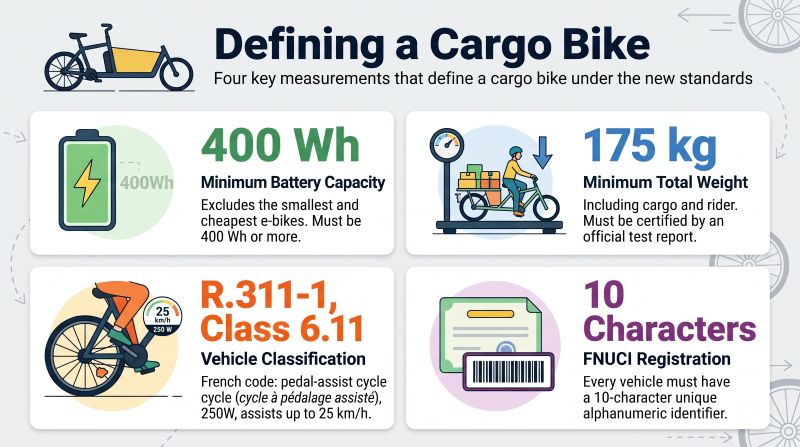
With no definition of a cargo bike in law, the fiche had to define one by measurement. Four numbers did the work.
- 400 Wh. The battery had to be at least that capacity. A 36V 10Ah pack sits just under the line at 360 Wh; a 48V 10Ah pack clears it at 480 Wh. This single threshold excluded the smallest and cheapest e-bikes from the scheme, and it is the point at which pack specification stopped being a technical annex and became a commercial argument.
- 175 kg. The maximum total weight, including cargo and rider, had to be at least 175 kg, and it had to be demonstrated by a test report to the relevant standard rather than asserted in a brochure.
- R.311-1, class 6.11. The vehicle had to be a cycle à pédalage assisté under the French highway code — 250 W, assistance tapering and cutting off at 25 km/h.
- 10 characters. Every vehicle had to be registered in the FNUCI, the fichier national unique des cycles identifiés provided for by Article L. 1271-3 of the transport code, and the identifier is a ten-character alphanumeric string that had to appear in the attestation and in a photograph of the bike.
That last one is the operational trap. FNUCI registration is done by the operator placing the bike on the French market, not by the factory, but the bike has to be capable of carrying the mark: a frame area reserved for the label, a serial number that matches the registration, and a production record that can tie the two together. A supplier who has never shipped into France will discover this at the point of delivery. UnitedMobility reserves the label area on the frame and issues serial ranges per shipment for French orders, which is the smallest part of the work and the one most often skipped.
The standards stack: EN 15194, NF R30-050, and why CE marking was not enough

The requirement that eliminated the most suppliers was the paperwork, not the hardware. A CE declaration covering the machinery directive alone was not accepted. The vehicle had to demonstrate EN 15194 for the pedal-assist system, plus at least one heavy-duty cargo standard where the 175 kg threshold applied, plus four directives.
| Requirement | Threshold | Evidence the file needed | Who produces it |
|---|---|---|---|
| EN 15194 | 250 W, cut-off at 25 km/h, ≤48 V d.c. | System test report naming motor, controller, pack and display | Factory, with the test house |
| One heavy-duty standard | NF R30-050, DIN 79010 or EN 17860 | Test report, in French or English, showing ≥175 kg | Factory, with the test house |
| Four directives | 2006/42/CE, 2011/65/UE, 2014/30/UE, 2023/1542/UE | Declaration of conformity listing each one | The economic operator placing it on the market |
| Battery | ≥400 Wh | Technical documentation, pack specification | Factory |
| FNUCI | Registration under L. 1271-3 | Identification certificate, photo of the mark | Importer or brand |
Two details in that table catch people out. The first is the EN 17860 reference: it is a series, not a single document, and a three-wheel cargo bike is covered by part 3 (multi-track vehicles) while the electrical requirements sit in part 5, which applies across the series. Asking a Chinese factory for “the EN 17860 report” without naming the part is how a buyer ends up with the wrong document; our note on EN 17860 parts sets out which part covers what.
The second is the declaration of conformity. It is a short document, and the standards line on it is the whole argument. A DoC that lists 2006/42/EC and stops there is a valid CE document for a machine and a failed document for this scheme. Read that line before you read anything else in a supplier’s pack.
The eight documents, and the two that fail most often
The fiche listed the supporting documents explicitly, which makes it an unusually clear specification of what a French buyer needs from a supplier:
- The vehicle identification certificate in the buyer’s name, or the lessor’s for a long lease.
- The manufacturer’s CE declaration of conformity, listing EN 15194, the heavy-duty standard and the four directives.
- The conformity test reports, in French or English, proving the ≥175 kg maximum weight.
- The technical documentation: contract photographs, model name, battery capacity, frame material, length, width, height, permitted total weight, wheel size and brake specification.
- The buyer’s last tax return or equivalent headcount evidence.
- A K-bis or RNE extract showing the entity is more than three months old.
- Photographs of each vehicle, including one showing the FNUCI mark.
- The summary sheet from the ministry’s template.
Items three and four are where packs break, and they are also where two apparently identical offers diverge — the same divergence our quote comparison note looks at from the commercial side. The test report has to state the maximum total weight and the standard it was tested to, in a language the administration reads; a Chinese-language report with a cover note is not the same document. And the technical documentation asks for factory-level data — frame material, brake reference, dimensions — that a trading company generally cannot produce from stock, because it belongs to the factory that made the bike.
Why it collapsed, and what that says about a supplier
The honest reading is uncomfortable for the whole category: the scheme was killed by sellers who treated a compliance document as a formality. Bikes were promised at zero euros, delivered late or not at all, and — in the cases the association examined — had technical sheets whose payload and total weight figures did not agree, mechanical disc brakes that would not plausibly pass a braking test, and a layout that could not be stable when loaded.
That is what an unverified file looks like from the inside. The fiche asked for a test report because a specification sheet can say anything; the fraud was possible precisely because nobody read the reports. The quality regime that produces a readable report is the same one that produces a bike which survives a fleet.
For a dealer, the lesson inverts the usual sales pitch. The question is not whether a supplier can produce a certificate, but whether the certificate names the vehicle in front of you. For a supplier, the lesson is that a French market entry now begins with a document set — and that the document set is the product. UnitedMobility prepares that pack per model rather than per platform: declaration of conformity listing the standards that apply to the configuration, test reports in the buyer’s language, and the battery documentation that the 2023/1542 requirements add to the file, which our battery regulation breakdown covers separately.
What a French dealer should ask for now
The fiche is withdrawn, and no replacement had been published when this was written — the sector was still lobbying for a new CEE programme in 2026. Local and regional aid still exists in many French cities, and those schemes tend to reuse the same vocabulary: a compliant vehicle, a standards-based file, an identified bike. So the questions remain worth asking, and they are the same ones a future national scheme would ask.
Ask for the declaration of conformity first, and check the standards line for EN 15194 plus a named heavy-duty standard. Ask for the test report and look for the maximum total weight figure in kilograms, not the payload claim in the brochure. Ask which EN 17860 part applies to a trike, and listen for the answer — part 3 if they know the series, a vague “we have EN 17860” if they do not. Ask how the FNUCI label area is reserved on the frame and whether serial numbers are issued in ranges per shipment. And ask for the technical documentation as a document, not as a link to a product page. Treat cargo bike CEE compliance FNUCI as a checklist rather than a subsidy question, and the answers tell you whether the supplier has done this before.
If the answers arrive as a pack, in the right language, naming the right model, you are dealing with a supplier who has done this before. If they arrive one email at a time over two weeks, the file will not survive an audit, the market entry file will not either, and the certification timeline a French launch needs will slip by a quarter before anyone notices.
FAQ
Does cargo bike CEE compliance FNUCI still apply in France?
The national fiche, TRA-EQ-131, was withdrawn on 29 September 2025 and had not been replaced when this was written. The technical requirements it set — EN 15194 plus a heavy-duty cargo standard, 175 kg proven by test report, 400 Wh minimum, FNUCI registration — remain the reference vocabulary for French fleet buyers and for local aid schemes. Check the current position before quoting a subsidy.
Is FNUCI registration the supplier’s job or the importer’s?
Registration is done by the operator placing the bike on the French market, which is normally the importer or the brand. What the supplier owes you is a bike that can be registered: a reserved area for the ten-character mark, a serial number that matches the frame, and production records that let you prove which bike carries which identifier.
We have a CE certificate. Is that enough for a French public tender?
Usually not. A CE declaration covering the machinery directive says the product may be sold; a tender or aid file asks which standards were tested and at what maximum weight. If the declaration does not name EN 15194 and a heavy-duty cargo standard, expect a request for the underlying reports — and expect the timeline to move.
Which standard applies to a three-wheel cargo bike?
EN 17860-3 covers multi-track cargo bikes, the electrical requirements sit in EN 17860-5, and EN 17860-2 covers single-track two-wheelers. DIN 79010 and NF R30-050 are the German and French alternatives that the French fiche also accepted. A report titled only “EN 17860” does not tell you which part was tested, and that is the first thing to check.
 English
 German
 Dutch
 Danish
 French
 Polish
 Portuguese
 Spanish