



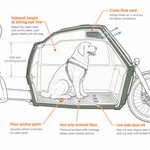

By 2026, the global electric cargo bike industry is no longer driven by experimentation or early-adopter enthusiasm. It is driven by replacement logic.
Replacement of vans in constrained urban cores.
Replacement of second family cars.
Replacement of short-haul commercial vehicles that no longer fit regulatory, cost, or labor realities.
Market forecasts show growth from USD 2.21 billion in 2026 to USD 11.73 billion by 2034, a 23.19% CAGR1. Europe already accounts for over 80% of mature-market adoption, while North America is transitioning rapidly from recreational use to family and commercial deployment. Asia remains high-potential but structurally different.
Those figures are widely cited. What matters more is how demand is changing in character. Let’s take a look at what the top 10 cargo bike market trends are in 2026.
1. Logistics Is No Longer a “Use Case”—It Is the Market Anchor
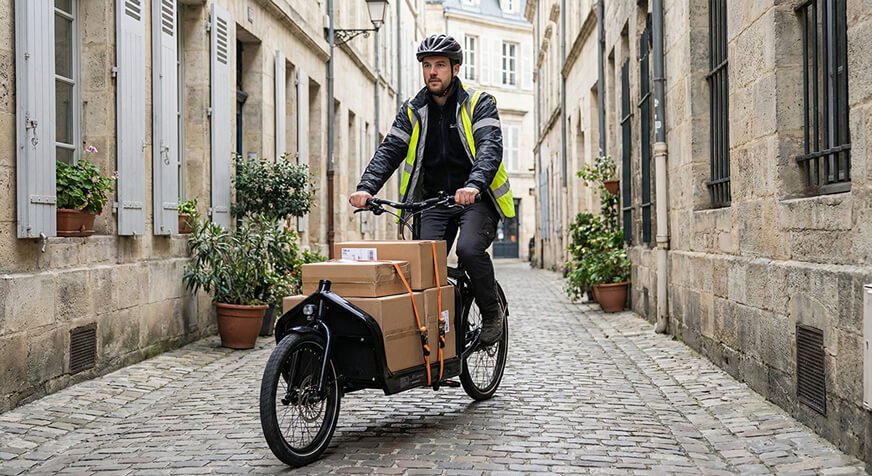
Last-mile delivery now represents around 35% of all e-cargo bike deployments, growing at 12–15% annually through 20302. That growth is not driven by sustainability narratives, but by operational math.
In dense European and North American cities, e-cargo bikes are completing urban delivery routes roughly 30% faster than vans, particularly where parking friction dominates route time. In New York City alone, adoption for parcel services increased 25% in 2025, driven by congestion pricing pressure and curb access constraints.
Large operators such as DHL and UPS have moved well beyond pilots. Internal fleet data shows that e-cargo bikes already handle over half of urban commercial trips in certain districts. The bike itself is no longer the innovation; route design and hub density are.
A common failure pattern still appears among new fleet entrants: trying to force a cargo bike to behave like a van. The operators who succeed redesign routes around payload frequency, not payload size.
2. Why Modularity Is Now a Procurement Filter, Not a Feature
In 2026, modularity is no longer discussed in marketing terms. It is discussed in asset depreciation meetings.
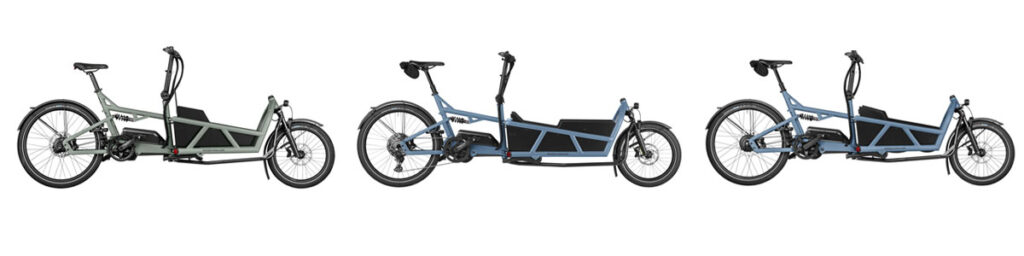
Fleet buyers increasingly expect one platform to serve multiple missions over its service life. That expectation explains why modular longtail and front-loading cargo bike platforms are outperforming fixed-body designs. Riese & Müller’s modular Load series, for example, recorded a 20% sales increase in 2025, largely because buyers could reconfigure rather than replace.
Optima Cycles’ acquisition of Dolly Bikes followed the same logic: extend asset relevance across logistics, municipal services, and family use.
This is directly reflected in market data. The longtail segment alone is projected to grow at 20.03% CAGR, expanding from USD 2.94 billion in 2025 to USD 12.66 billion by 20333. Buyers are not chasing trends; they are minimizing write-offs.
3. Smart Technology Has Quietly Shifted from “Nice to Have” to Cost Control
Connectivity in e-cargo bikes is often presented as a rider experience upgrade. In fleet environments, its value is far more mundane—and more decisive.
GPS tracking, battery diagnostics, and telematics now support:
- Maintenance scheduling
- Theft recovery and insurance negotiations
- Route optimization under labor constraints
By early 2026, over 35% of new e-cargo bike models include connected features, contributing directly to the sector’s 23.19% CAGR. New York’s Citi Bike system, for instance, avoids 1.8 million pounds of CO₂ per month, enabled partly through smart fleet coordination rather than raw vehicle count.
The practical takeaway: buyers are no longer paying for “apps.” They are paying for downtime reduction.
4. Sustainability Is Being Enforced, Not Marketed
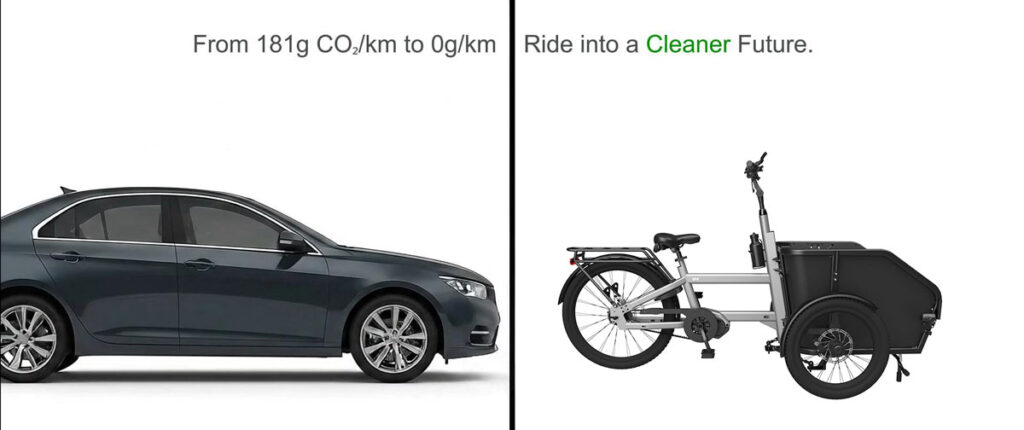
Low-emission zones in cities such as London and Paris drove a 28% adoption increase in 2025. This is not consumer sentiment—it is regulatory compulsion.
Sustainability now intersects with:
- Battery sourcing transparency
- Recyclability documentation
- Compliance with public procurement rules
The sustainability-driven segment shows a 17.0% CAGR, growing from USD 940 million in 2022 to USD 3.66 billion by 2031. Battery costs have dropped 20–30%, and e-cargo bikes are already replacing around 40% of short car trips in some urban contexts4.
Manufacturers who fail to align with policy frameworks are increasingly excluded, regardless of product performance.
5. Payload Capacity Is Expanding, but Engineering Reality Is Catching Up
Heavy-duty applications now account for 28% of deployments, growing at 12–15% annually. Models like Addmotor’s GRAOOPRO, rated at 500 lbs payload and up to 210 miles of range, are opening doors in retail replenishment and urban services.
Yet experienced operators know the constraint is no longer motor output. It is frame fatigue, braking systems, and long-term structural integrity. This is where many new entrants miscalculate, especially in three-wheeled cargo bike designs intended for continuous commercial use.
6. Safety Has Become a Gatekeeper for Market Access
Between 2019 and 2023, New York City recorded a 300% increase in battery-related fire incidents. The result has been a sharp rise in certification requirements and insurance scrutiny.
By 2026, safety features—ABS braking, reinforced frames, certified battery systems—are present in around 60% of new models5. They are no longer selling points; they are entry tickets.
This shift is quietly reshaping supplier shortlists across Europe and North America.
7. Battery Innovation Is About Predictability, Not Maximum Claims
Advancements in battery density now support 60+ mile real-world ranges, contributing to sustained 12–15% CAGR in the sector. Bosch-powered systems, for example, offer up to 50% higher energy density in recent generations.
Fleet buyers, however, are not optimizing for headline range. They are optimizing for predictable degradation curves and cold-weather reliability—especially in Northern Europe and Canada.
8. Longtail E-Bikes: A Clearly Defined Family and Urban Utility Sub-Market
The rapid rise of the longtail e-bike is not a general market trend, but the formation of a distinct sub-market inside the Electric Cargo Bike Industry.

Longtail designs—with extended rear frames and conventional front geometry—are increasingly chosen by families and urban users who want to replace daily car trips without changing riding habits. This explains why longtails perform particularly well in car-dependent markets rather than dense logistics scenarios.
Market data confirms this segmentation. The longtail segment is growing at a 20.03% CAGR, holding around 40% market share in North America, with global search interest up 150% in 2025. In practice, brands such as Yuba Bikes have seen strong uptake in Europe, while Xtracycle reports that its longtail platforms replace car trips in about 25% of U.S. households that adopt them.
The key point for manufacturers and buyers is clarity: longtail e-bikes are winning because they serve a specific family and urban utility demand, not because they compete across all cargo use cases.
9. New User Groups Are Driving More Focused Product Definitions
The growing adoption of e-cargo bikes by women, seniors, and teenagers reflects not just market expansion, but finer demand segmentation.
These users prioritize accessibility, weight, and stability over maximum payload or speed. Women consistently identify lighter overall system weight (around 20% reduction) as a decisive factor. Seniors and teens together are contributing to the broader 11.2% e-bike CAGR, with the global market projected to reach USD 73.2 billion by 2026. In Europe, 25% of multi-child families already rely on e-cargo bikes for daily transport.
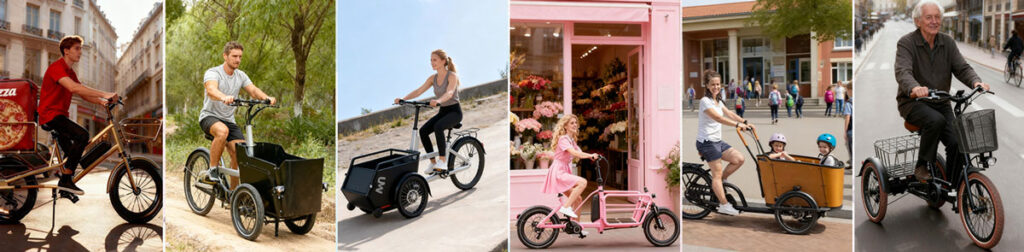
This demand has translated into targeted designs rather than generic platforms. Isinwheel has introduced women-focused e-cargo models emphasizing handling and weight. Woom’s “Up” platform caps assist speed at 12 mph for teens, prioritizing control. Specialized’s Haul appeals to seniors by accommodating riders from 4’5” to 6’4”, reducing fit barriers that often limit adoption.
What emerges is a clearer picture: these buyers form well-defined demographic segments, each shaping product specifications rather than adapting to them.
10. Semi-Recumbent and Three-Wheeled Cargo Bikes Form a Stability-Driven Segment
Semi-recumbent layouts and three-wheeled cargo bikes are no longer niche alternatives; they represent a stability- and comfort-focused sub-market with its own growth logic.
EU data shows around 150% growth in e-tricycle adoption, particularly among senior users and institutional buyers. Within this group, approximately 40% of seniors prefer recumbent or semi-recumbent designs, aligning with the overall 11.2% CAGR of the senior e-bike segment.
Products such as UM’s semi-recumbent e-trikes, with padded seating and relaxed ergonomics, has illustrated how focused this demand has become. These platforms are selected not for speed or versatility, but for predictable handling and rider confidence. Watch the video and see how experienced trike expert test such product in the factory>>
For the Electric Cargo Bike Industry, this marks a clear separation: three-wheeled and semi-recumbent designs serve specific user groups and institutional scenarios, not the broader family or logistics markets.
Final Note: The Cargo Bike Market Is Still Expanding—But Experience Now Matters More Than Speed
The Electric Cargo Bike Industry is still in a clear growth phase, but the nature of competition is changing. As the market becomes more segmented and requirements more specific, success increasingly depends on execution capability, not just product ideas or market timing.
If you are entering the cargo bike sector, or if you are looking to expand or refine your existing product line—whether for family mobility, logistics, or institutional use—the difference is often made at the ODM and delivery level: platform selection, compliance readiness, supply chain stability, and real-world validation.
UM brings nearly 20 years of e-bike industry experience, with a dedicated focus on cargo bike ODM services. We support partners with certified platforms, European warehouse capability, and proven design-to-delivery execution across multiple cargo bike categories. Our work is grounded in long-term manufacturing practice, regulatory alignment, and market-tested design—not short-term trends.
If you’re evaluating your next move in the cargo bike market, we’re available for a practical, no-obligation discussion—to assess fit, risks, and opportunities before you commit resources.
The market is still growing. Choosing the right partner now determines how well you grow with it. Contact us for a free quote.
Sourcing Under These Trends: Practical Guides
Market trends only matter if they change what you buy. These guides translate the numbers above into procurement decisions:
Cargo bike buying guide for first-time B2B buyers
OEM vs ODM: cost comparison for European distributors
EU compliance checklist for cargo bike market entry
EU Battery Regulation 2023/1542 explained for importers
Reference:
- Electric Cargo Bike Market Size, Share & Industry Analysis, By Product Type (Two-wheeler, Three-wheeler, Four-wheeler), By Battery Type (Lithium-ion, Lead-based, Nickel-based), By End-User (Courier and Parcel Service Providers, Service Delivery, Personal Use, Large Retail Suppliers, Waste Municipal Services, Others) And Regional Forecast, 2026-2034 ↩︎
- 2026 Best Cargo Bikes for Commuting and Delivery Solutions? ↩︎
- Cargo Bicycles Market Report 2026 ↩︎
- Electric Cargo Bikes Market Size, Share, Industry,Forecast and Outlook (2024-2031) ↩︎
- Predictions: What will the electric bike market deliver in 2026? ↩︎
 English
  German
  Dutch
Dutch  Danish
  French
  Polish
  Portuguese
  Spanish