



When a Berlin-based last-mile delivery startup needed 50 custom cargo bikes by April for their peak season launch, they contacted an ODM manufacturer in January—and were shocked to learn they’d missed the window by 8 weeks. Understanding cargo bike ODM lead times isn’t just about production speed; it’s about aligning manufacturing cycles with your business-critical dates, cash flow planning, and competitive market timing.
For European distributors and fleet operators, lead time predictability isn’t a nice-to-have—it is the procurement decision. Miss your seasonal window and you miss revenue. Underestimate customs clearance and you miss your fleet deployment date. Choose the wrong ODM path and you spend six months developing something that could have launched in three.
This guide breaks down every phase of the cargo bike ODM timeline, explains the two distinct development paths and what each realistically takes, and gives you a backwards-planning framework to anchor your order to your market launch date.
Why Lead Time Matters for Cargo Bike Distributors and Fleet Buyers
The cargo bike market is seasonal and competitive. Spring and autumn represent peak demand windows across northern Europe for both consumer e-cargo and commercial last-mile segments. Miss a launch window by even four weeks and you may be waiting an entire season. The seasonal patterns of the European electric cargo bike market are supported by industry data, with the Conebi Annual Industry Report documenting the demand cycles of various market segments.
For fleet operators, the stakes are contractual. Municipal and logistics fleet tenders typically carry hard deployment deadlines—and penalties for late delivery fall on the distributor, not the manufacturer. A six-week slip in production can cascade into a six-figure problem.
Lead time also drives cash flow. Longer production cycles require earlier purchase orders, which ties up working capital before a single unit is sold. For distributors managing multi-SKU portfolios across several brands, understanding exactly when each model needs to be ordered—and from which ODM path—is the difference between healthy inventory turns and a liquidity squeeze.
The first question any serious B2B buyer should ask a potential ODM partner is not “what’s your minimum order quantity?” It is: “Which development path fits my timeline, and what does that realistically look like week by week?”
Two ODM Paths, Two Very Different Timelines
Not all custom cargo bikes start from the same point—and your timeline depends almost entirely on which development path you choose. At United Mobility, we offer two clearly defined ODM tracks:
Path 1: Derivative ODM — Customisation on Proven Platforms
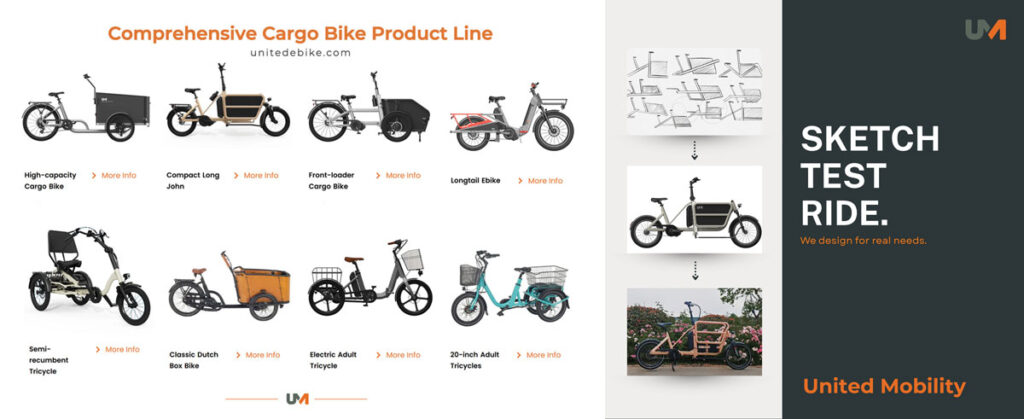
The fastest route to a branded, market-ready cargo bike is building on an existing, validated platform. Rather than developing a new frame from scratch, your product is derived from one of our proven base models—then customised through our modular design system to match your brand identity, use case, and specification requirements.
What can be customised within this path:
- Frame colour, finish, and graphic packages
- Component specifications (drivetrain, motor, battery capacity, display)
- Geometry adjustments within existing tooling parameters
- Cargo configurations (box dimensions, rack systems, carrying capacity)
- Accessories and integration (locking, GPS, IoT connectivity)
Realistic timeline for Derivative ODM: 14–20 weeks from confirmed order to delivery in Europe
| Phase | Duration | What Happens |
|---|---|---|
| Brief & specification alignment | 1–2 weeks | Scope lock, customisation matrix, pricing confirmation |
| Design & rendering | 2–3 weeks | Branded visuals, colourway approval, spec sheet sign-off |
| Sample production | 3–4 weeks | Pre-production sample built to confirmed spec |
| Sample review & approval | 1–2 weeks | Your team reviews, requests adjustments if needed |
| Mass production | 5–7 weeks | Full batch manufacturing, component procurement, assembly |
| Quality control & pre-shipment inspection | 1 week | Final QC, documentation, CE compliance check |
| Ocean freight (China → Europe) | 4–5 weeks | Standard FCL shipping |
| Customs clearance & local delivery | 1–2 weeks | EU import processing, delivery to your warehouse |
Who this path is for: Distributors who want to launch a branded cargo bike range quickly, operators adding a complementary model to an existing fleet, and brands entering new market segments without the development cost and time of a ground-up design. The modular architecture means a single platform can address multiple application scenarios—urban cargo delivery, family transport, food service—simply by changing configuration packages.
Path 2: Full ODM Co-Development — From Concept to Certified Product
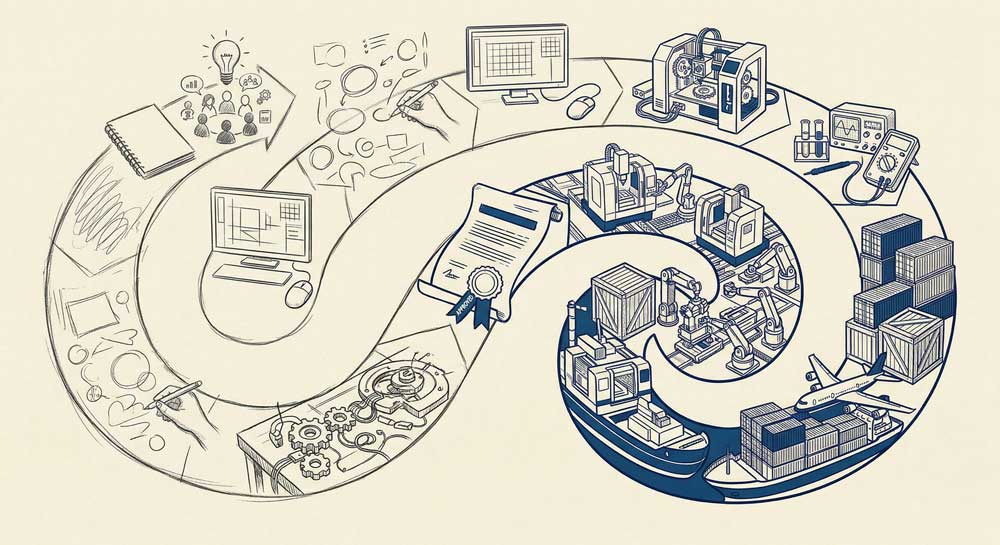
If your vision requires something that doesn’t exist on the market—a new geometry for a specific application, a proprietary integration, or a product built to compete on specification rather than price—then full ODM co-development is the right path. For more details on the specific deliverables and collaboration methods for each phase, read the article Cargo Bike ODM Process: How to Build a Market-Ready E-Cargo Bike in 12 Steps
This is a genuinely collaborative process. We start from your brief, your sketches, or simply your problem statement, and take the project through every phase: concept design, engineering, prototype iteration, regulatory certification, field testing, and production. You get a product that is genuinely yours—not a re-skin of someone else’s platform.
Realistic timeline for Full ODM Co-Development: 36–52 weeks from project kickoff to delivery in Europe
| Phase | Duration | What Happens |
|---|---|---|
| Discovery & requirements workshop | 1–2 weeks | Use case mapping, technical brief, commercial targets |
| Concept design | 3–5 weeks | Sketches, CAD concepts, geometry studies, design direction approval |
| Engineering & detailed design | 4–6 weeks | Full CAD, stress analysis, component selection, BOM development |
| Prototype tooling | 6–8 weeks | Frame jig and tooling fabrication for first prototype |
| Prototype build | 2–3 weeks | First physical prototype assembled |
| Testing & iteration (Round 1) | 3–4 weeks | Structural testing, ride validation, issue identification |
| Design revisions & Round 2 prototype | 4–6 weeks | Engineering updates, second prototype if needed |
| Regulatory certification | 4–8 weeks | EN15194 / EN ISO 4210, CE marking, documentation package |
| Pre-production run | 3–4 weeks | Small batch to validate production process |
| Pre-production review | 1–2 weeks | Final approval before mass production commitment |
| Mass production | 6–8 weeks | Full order manufacturing |
| Quality control & pre-shipment inspection | 1–2 weeks | Final QC across 100% or statistical sample |
| Ocean freight (China → Europe) | 4–5 weeks | Standard FCL shipping |
| Customs clearance & local delivery | 1–2 weeks | EU import processing, warehouse delivery |
Who this path is for: Brands with a proprietary concept, operators with highly specific technical requirements, businesses building a product for a use case the market doesn’t yet serve, and buyers who need a defensible IP position. Because we handle design through certification through testing as a single integrated service, there is no handoff risk between agencies—the team that designed the frame is also the team validating it against EN15194.
Whether the certification can be successfully passed fundamentally depends on the engineering quality of the frame — Learn about the key design elements of freight frames that affect actual use.
What Affects Your Cargo Bike ODM Lead Time
Within both paths, several variables can compress or extend your timeline. Understanding these upfront is essential for realistic planning.
1. Customisation complexity (Derivative ODM) Standard colourway and component swaps sit at the fast end. Structural modifications that require new tooling—even minor ones—add 3–6 weeks. Always ask which changes require new tooling versus which are achievable within existing parameters.
2. Brief clarity at kickoff Projects that begin with a clear, locked brief move faster. Projects where scope evolves mid-development—common in Full ODM co-development—add time at every phase. Front-loading your requirements workshop saves time overall.
3. Approval turnaround on your side Sample approval, design sign-off, and prototype reviews all have waiting periods. If your internal approval chain takes two weeks where one was assumed, that adds two weeks to the project. Build your own internal approval timelines into the backwards plan.
4. Component availability Motor controllers, battery cells, and display modules have their own supply chains. For Derivative ODM, we maintain strategic component stock for our platform models. For Full ODM, component lead times need to be mapped in the engineering phase—some specialist components have 10–14 week lead times of their own.
5. Order volume Smaller orders (under 50 units) can often be scheduled into existing production slots more flexibly. Larger orders (200+ units) require dedicated production scheduling and may need 4–6 weeks of additional lead time for capacity allocation.
6. Certification requirements For Full ODM, EN15194 (electric cycle) or EN ISO 4210 (non-powered) certification is mandatory for European market entry. If your product requires additional testing—for example, specific IP ratings, load ratings, or country-specific requirements—factor in extra time. Our certification team manages this process entirely, but we always recommend building a 2-week buffer around expected certification completion dates. More info about EU compliance for cargo bikes, please visit Cargo Bike Compliance page.
7. Shipping method and incoterms Ocean freight adds 4–5 weeks from port. Air freight reduces this to approximately 1–2 weeks but at significantly higher cost—typically viable only for sample shipments or urgent initial inventory. Your incoterms choice (FOB vs CIF vs DDP) also affects who manages customs at the EU entry point.
ODM vs OEM vs Private Label: Lead Time Comparison
| Route | Typical Timeline to EU Warehouse | Customisation Level | Minimum Investment |
|---|---|---|---|
| Stock / catalogue model | 6–10 weeks | Cosmetic only | Low |
| Private label (white label) | 8–14 weeks | Branding + minor spec | Low–Medium |
| Derivative ODM (existing platform) | 14–20 weeks | High (within platform) | Medium |
| Full ODM co-development | 36–52 weeks | Complete | High |
| OEM (supply to your design) | 20–30 weeks | Your spec | High |
The timeline difference between Derivative ODM and Full ODM is not bureaucracy—it is the time required to do engineering properly. Cutting prototype and testing phases to compress the schedule is the most common cause of product quality failures at launch.
European Import Logistics: The Hidden Timeline Factor
Many B2B buyers focus exclusively on production timelines and overlook what happens after the container leaves the factory.
Ocean freight from China to major European ports (Rotterdam, Hamburg, Antwerp) currently runs 28–35 days on standard routing. Transit times can extend during peak shipping seasons (pre-Chinese New Year, Q4) or due to port congestion.
EU customs clearance typically takes 3–7 business days for standard cargo with complete documentation. Missing or incorrect documentation—CN22 declarations, CE certificates, technical files—can trigger delays of 2–4 weeks or referral to specialist customs brokers.
CE compliance documentation must accompany every shipment. For Derivative ODM products, we maintain the technical file and Declaration of Conformity. For Full ODM products, the certification process includes the full technical file, which we provide as part of the one-stop-service package. For a complete list of documents required for EU import customs clearance, please refer to the Official Guidelines of the EU Trade Helpdesk.
Inland delivery from port to your warehouse adds 3–10 business days depending on location and whether you’re using a logistics partner with existing cargo bike handling experience.
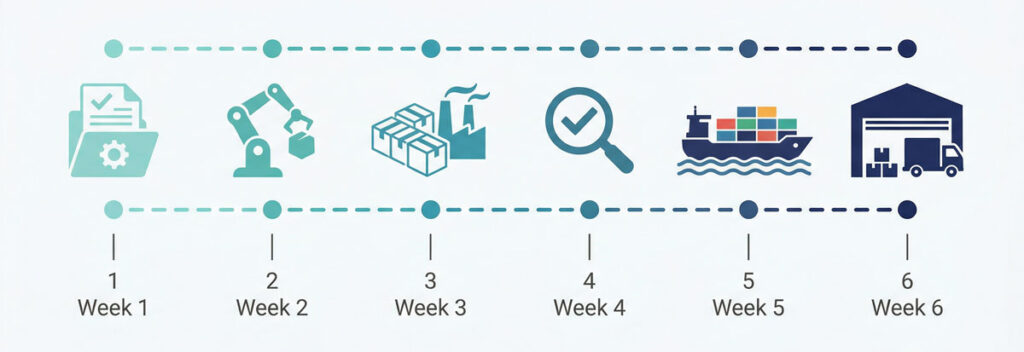
Total time from factory sign-off to your warehouse: budget 6–8 weeks in your planning model.
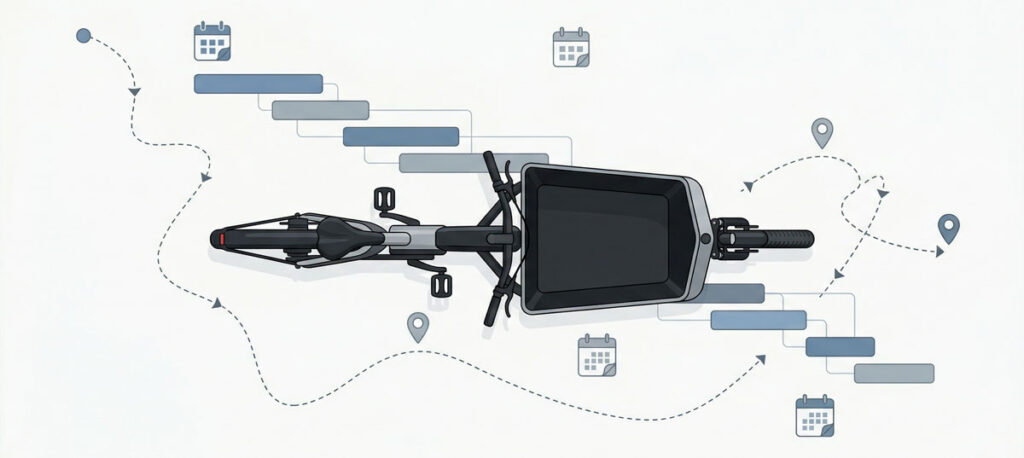
How to Plan Your Order Timeline: Backwards Planning Framework
Start with your market launch date and plan backwards. Here is how to apply this to each ODM path.
For Derivative ODM targeting a Q2 (April) launch:
| Milestone | Date |
|---|---|
| Target in-warehouse date | 1 April |
| Allow for customs + inland delivery | 18 March |
| Allow for ocean freight | 10 February |
| Factory sign-off / QC completion | 3 February |
| Mass production start | 6 January |
| Sample approval deadline | 23 December |
| Sample delivery to you | 9 December |
| Production sample start | 25 November |
| Design approval deadline | 11 November |
| Project kickoff deadline | 28 October |
For an April launch, your project needs to be live by the end of October. Contact your ODM partner by mid-October at the latest.
For Full ODM targeting a Q1 (January) launch in the following year:
Working back 52 weeks from a January target, your project kickoff needs to happen in January of the prior year—a full 12 months before market entry.
Always build a 2-week contingency buffer into your plan. Unexpected delays in sample approval, certification, or shipping are the norm, not the exception. The buyers who miss their launch windows are those who planned with zero buffer.
United Mobility’s Lead Time Approach: Transparency and Flexibility
Timeline transparency is the most common failure point in ODM partnerships. Manufacturers who provide vague “8–12 week” estimates without phase-by-phase breakdown are not giving you the information you need to run your business.
Our approach is built around three principles:
1. Path clarity from day one. Before any commercial discussion, we establish whether your project is Derivative ODM or Full ODM co-development. These are different products, different timelines, and different investments. Clarity here prevents the most expensive misunderstandings in B2B cargo bike procurement.
2. Phase-locked scheduling. Every project receives a master production schedule with fixed milestones and explicit approval windows. You know exactly when we need your sign-off, and we commit to exactly when each phase will be complete.
3. Proactive risk flagging. Component lead time concerns, capacity constraints, and certification complexity are flagged in the first two weeks of a project—not three months in. This gives you time to make decisions rather than react to surprises.
For European distributors managing multi-SKU launches and seasonal cycles, predictability is the product. A cargo bike that arrives on time for your spring launch is worth more than a slightly better-specified bike that arrives in June.
If you are planning a launch in the next 12–18 months, the first step is establishing which development path fits your timeline. Contact our specialized cargo bike ODM team to start that conversation—and to get a phase-by-phase timeline scoped to your specific project.
 English
  German
  Dutch
Dutch  Danish
  French
  Polish
  Portuguese
  Spanish