



Parts one and two of this series covered what EPR is and where to register. This part is the operational core: EPR registrations and annual declarations are only as good as the product data behind them, and that data lives with your manufacturer. Here is the complete request list, the labelling decisions that must happen at artwork stage, and the failure modes that surface at your first annual declaration — when they are most expensive to fix.
Reference documents: the underlying legal texts and national registers are consolidated in the source list at the top of Part 1. For labelling specifics, see WEEE Directive Annex IX (crossed-out wheeled bin) and Regulation (EU) 2023/1542 (battery marking and documentation).

Why the data conversation belongs in the sourcing phase
Every EPR declaration you will ever file reduces to the same primitive facts: what did each unit weigh, what was its battery, and what packaging surrounded it. None of those facts originate in your office. They originate on the factory floor — in the BOM, the battery supplier’s test file, and the packaging specification. An importer who requests this data after the first container has shipped is reconstructing it; an importer who makes it part of the purchase agreement receives it as routine documentation. The difference shows up twelve months later as a declaration filed in an afternoon versus a week of weighing cartons in a warehouse.
The checklist below is written per SKU deliberately. National registers increasingly expect declarations broken down by category and equipment type, and — as covered in Part 1 — two-wheel and three-wheel models can even sit in different scope positions under WEEE. Aggregate shipment data cannot be un-mixed later; per-SKU data can always be aggregated.
The seven-item request list
1. Per-SKU packaging specification, by material and weight
A table per model: carton board, plastic film, foam, strapping, staples and fittings, and the pallet share per unit — each in grams. This single document drives your packaging declarations in every country, and under the PPWR era it increasingly drives your fees too, as schemes weight charges by material recyclability. Ask for it per packaging revision, not once: a carton redesign mid-year silently changes your declaration basis. Where the packaging uses printed inks, metal staples or coloured films, request the material suppliers’ conformity declarations for the heavy-metals limits carried into the PPWR as well — a standing declaration on file saves the question resurfacing with every technical documentation review — and a short confirmation that the packaging is not intended for food contact, which scopes your file out of the PPWR’s food-contact requirements cleanly.
2. Battery data sheet with UN 38.3 test summary
Chemistry, nominal voltage and capacity, watt-hours, pack weight, and the UN 38.3 test summary that carriers and authorities may request. The pack weight feeds battery declarations; the electrical data feeds labelling and, from 2027, the battery passport chain. Request the safety data sheet (SDS/MSDS) in the same bundle — logistics and insurance will ask for it even where the register does not.
3. Unit weights — with and without battery
WEEE declarations are weight-based and typically concern the equipment; battery declarations concern the pack. You need both numbers separated, per model and per variant, because a 48V/15Ah and a 48V/20Ah build of the same bike are different declaration lines.
4. Packaging Declaration of Conformity (PPWR Annex VIII)
The PPWR introduces its own Declaration of Conformity for packaging, made against Annex VIII — a document distinct from the vehicle’s CE Declaration of Conformity under the Machinery Directive, and covering a different thing: the packaging’s compliance with PPWR’s design, substance and recyclability requirements, not the bike itself. Compliance schemes and technical documentation files will expect this as a standalone document per packaging specification, in the language(s) your registrations require — request it in English and German at minimum if Germany and Austria are target markets. Keep it filed separately from the vehicle’s own CE Declaration of Conformity; the two serve different audiences and get requested by different reviewers.
5. Labelling evidence — settled at artwork stage
Three marks need to exist physically before goods ship: the crossed-out wheeled bin on the product (WEEE Annex IX), the battery marking required under the Battery Regulation, and — for France — Triman with sorting information on consumer-facing packaging. All three are trivial to include when the factory prints and moulds, and genuinely awkward to retrofit on landed stock. Ask for photographs of the applied markings as part of pre-shipment documentation.
6. Battery removability and service documentation
The Battery Regulation pushes toward batteries that are removable and replaceable, and national schemes increasingly ask producers about end-of-life dismantling. A short factory document describing how the pack is removed, with tooling requirements, supports both your register questionnaires and your dealers’ service reality.
7. HS codes and customs description alignment
Not an EPR document either, but keep it in the same bundle: authorities cross-reference customs import data against EPR declarations, and a mismatch between what your customs entries say you imported and what your EPR declarations say you sold is exactly the discrepancy that triggers questions.
What United Mobility provides
As a manufacturer, United Mobility supplies a documentation set alongside production orders. For the packaging stream: a per-model packaging component list covering materials and weights, confirmation that the packaging is not intended for food contact, supplier conformity documentation for substance restrictions where applicable, and a PPWR Annex VIII packaging Declaration of Conformity in English and German. This sits alongside — and is separate from — the vehicle’s own CE Declaration of Conformity under the Machinery Directive, which covers the bike itself rather than its packaging. Battery documentation — data sheets with UN 38.3 test summaries, alongside EN 50604-1 battery certification — and unit weight data come from the same production records, and labelling on product and packaging is agreed at artwork stage as part of the OEM/ODM process. Because the numbers come from the production BOM and the actual packaging specification rather than post-hoc estimates, your registrations and declarations rest on manufacturer data — the standard your compliance scheme, and increasingly your marketplace, expects.
Sourcing from more than one factory? Hold every supplier to the same list
Your EPR declarations cover everything your company places on the market — every supplier’s products, in one report, under your producer number. That has a hard implication: your compliance is only as strong as your least-documented supplier. If one factory delivers per-SKU material weights and another delivers a shrug, the gap does not stay contained to that supplier’s products; it undermines the accuracy of the entire declaration and, with it, your standing with the scheme. Before adding any manufacturer to your supply base, put the seven-item list above into the supplier conversation and treat the response as diagnostic. A factory that cannot produce its own packaging weights is telling you something about its documentation discipline generally — and you will be certifying numbers built on that discipline with your own company’s name.
Five failure modes to pre-empt
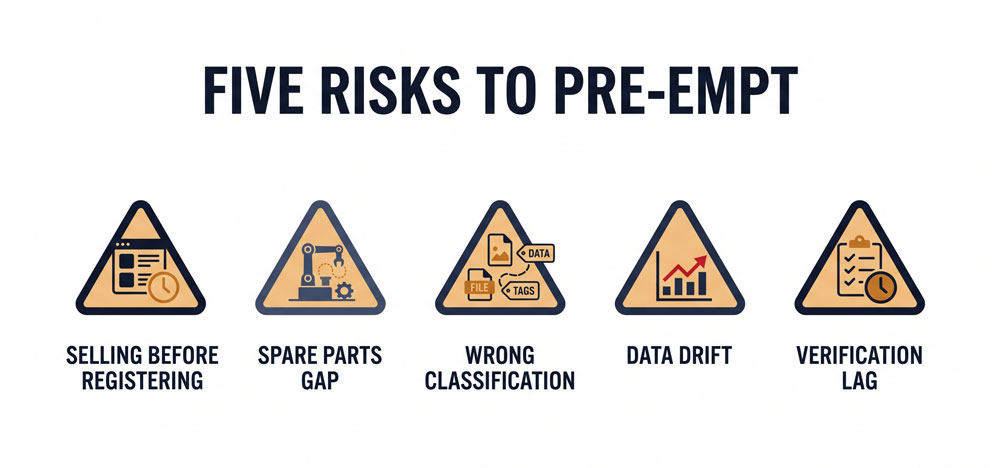
Selling before registering.
The most common and most expensive error. In Germany, offering products without registration is prohibited outright; elsewhere, late registration means back-paying fees on everything already sold. Registrations belong on the launch-critical path with realistic lead times — some registers take weeks to approve.
The spare parts blind spot.
Spare battery packs, chargers and electronic accessories sold separately are placements on the market in their own right — the spare pack is a battery placement, the charger is an electrical-equipment placement, and each arrives in packaging. Brands that declare bikes meticulously and forget the accessories aisle discover the gap at audit, not before.
Household versus professional classification.
Several national systems distinguish equipment destined for households from professional equipment, with different fee structures and take-back obligations. A cargo bike sold to fleet operators may classify differently from the same bike sold through dealers to families. Decide the classification per channel with your compliance scheme at registration, not retroactively.
Declaration data drift.
Product revisions change weights; packaging redesigns change material splits; a battery supplier change alters chemistry documentation. Every such change should update your master data file in the same month it reaches production. The failure pattern is filing year two’s declaration on year one’s numbers.
Marketplace verification lag.
Marketplaces verify EPR numbers against registers on their own schedules. Even with registrations complete, ensure the company name and number formats you enter match the register records exactly — verification failures for formatting reasons are common, and delisted weeks are lost revenue regardless of whose systems were at fault.
A closing sequence that works
Put the data request into the purchase agreement. Complete registrations for your first markets before stock ships, using manufacturer data rather than estimates. Fix labelling at artwork approval. Build one master data file per SKU and give it an owner. And when you expand — new markets, new models, new suppliers — run the same sequence again rather than assuming the existing setup stretches. EPR rewards exactly the discipline that good sourcing already requires: knowing precisely what you put on the market, down to the gram. For how these obligations sit within the broader European market-entry picture, see the EU cargo bike compliance guide.
Frequently asked questions
Can my manufacturer register EPR on my behalf?
No — registration is tied to the legal identity of the company placing products on the national market, which is the importer or brand owner. What a manufacturer provides is the product, battery and packaging data that registrations and declarations are built on, together with correct labelling applied in production.What if I already sold before requesting this data?
What if I already sold before requesting this data?
Reconstruct pragmatically: request current-production data from the manufacturer, weigh retained samples and packaging for anything that changed, and regularise registrations promptly. Schemes generally respond far better to proactive correction than to discovered gaps.Do I need this data for B2B-only sales?
Do I need this data for B2B-only sales?
Yes. EPR applies to placing products on the market regardless of customer type, and B2B channels raise their own classification questions — professional versus household equipment, commercial versus household packaging — that the same data set answers.How often should the data be refreshed?
How often should the data be refreshed?
At every production revision that changes weight, materials, battery or packaging — and at minimum reviewed annually before declarations are filed. Tie the refresh to your production change process, not the declaration deadline.
Building your supplier requirements list?
United Mobility structures its order documentation around the checklist above. If you are evaluating manufacturers for the European market, send us your data requirements — the response time will tell you as much as the response.
 English
  German
  Dutch
Dutch  Danish
  French
  Polish
  Portuguese
  Spanish