

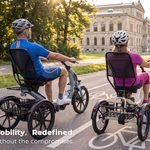
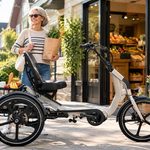
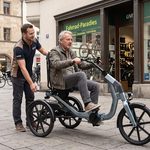
Extended Producer Responsibility (EPR) is the set of EU and national rules that make the company placing a product on a market financially responsible for that product’s end of life. If you import e-bikes, e-cargo bikes or electric trikes into a European country under your own brand, that company is you — not your manufacturer. This guide explains the three obligation streams that apply to electric bikes, the 2025–2027 regulatory timeline, and what to sort out before your first container lands.
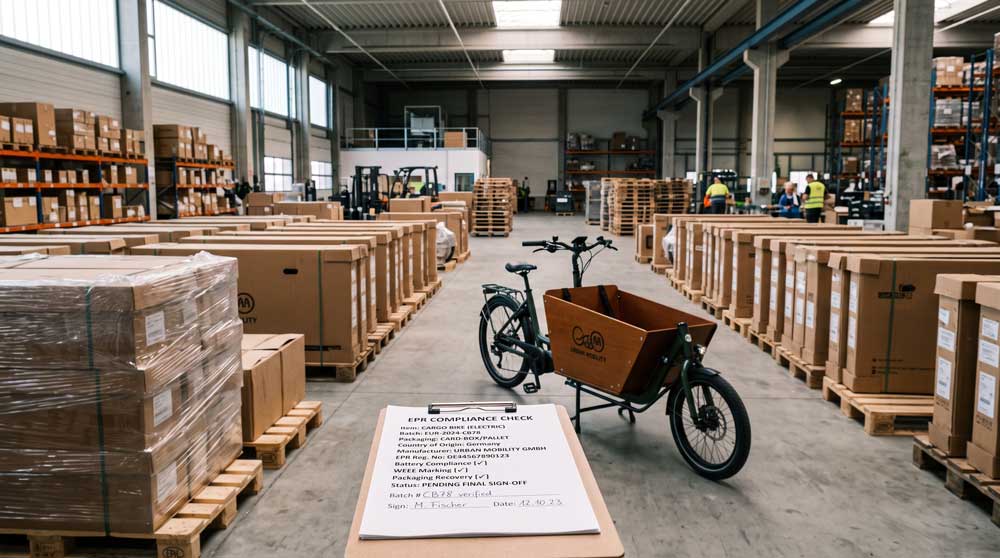
Official sources used in this guide — bookmark these; every claim below can be checked against them:
- WEEE Directive 2012/19/EU — scope, exclusions, producer definition (Art. 2–3)
- EU Battery Regulation (EU) 2023/1542 — battery EPR, LMT category, battery passport
- Packaging & Packaging Waste Regulation (EU) 2025/40 (PPWR) — applicable from 12 August 2026; the ELI text is the only legally authoritative version
- European Commission — Packaging Waste topic page — official interpretation, implementing acts and the Commission’s PPWR FAQ (2nd edition, July 2026)
- Commission Notice C(2026)3702 — interpretative guidance on contested PPWR provisions
- Stiftung EAR (Germany, WEEE + battery registers) · ZSVR / LUCID (Germany, packaging)
- ADEME — Filières REP (France, all EPR streams and the IDU identifier)
- Ecologic France (WEEE and sport & leisure articles eco-organisme)
- GOV.UK — WEEE producer responsibility · GOV.UK — Packaging EPR (United Kingdom)
Country-level registers for the Netherlands, Belgium, Denmark and Spain are listed in Part 2: country-by-country registration.
The one sentence that decides everything: who is the “producer”?
Under every European EPR regime, the “producer” is not the company that built the product. It is the company that first places the product on that national market. Import a container of cargo bikes from a factory outside the EU and sell them in Germany under your brand, and German law treats you as the producer — with registration, reporting and financing obligations attached to your company, your VAT number and your brand.
This is not a gap your manufacturer can close for you, and it is worth being clear-eyed about why: EPR registration is tied to the legal identity of the company selling in the market. What a manufacturer can do — and where suppliers differ enormously — is hand you the product data that every registration and every annual declaration is built on: packaging weights by material, battery chemistry and weight, unit weights, labelling evidence. Without that data package, EPR compliance becomes guesswork. With it, it becomes administration. Part 3 of this series is the full request checklist.
The three obligation streams for an electric bike
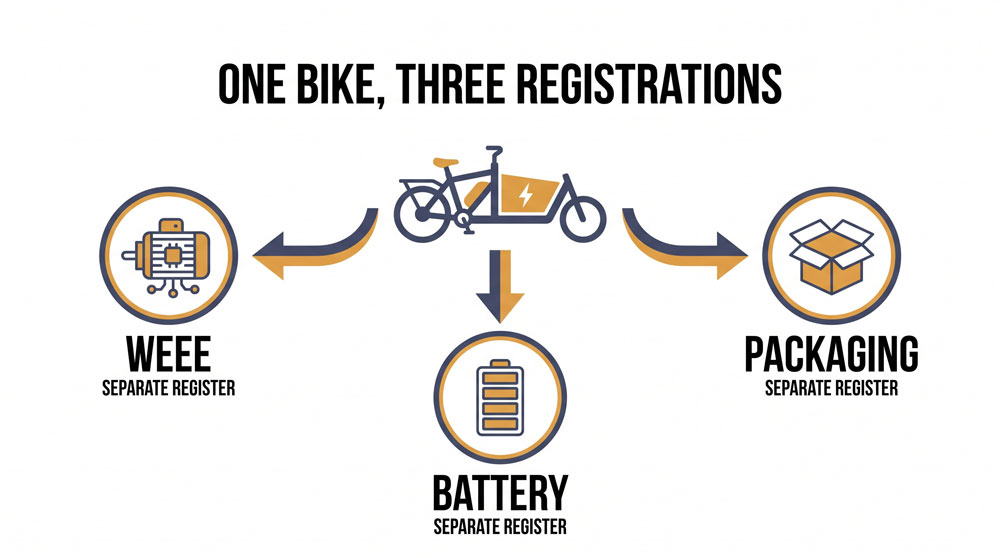
A single imported e-bike triggers up to three separate EPR streams, each with its own register, its own fees and its own annual declaration. They do not merge, even though they concern one product.
| Stream | Legal basis | What it covers on an e-bike | Typical register |
|---|---|---|---|
| WEEE / EEE | WEEE Directive 2012/19/EU, national transpositions | The vehicle itself as electrical equipment: motor, controller, display, wiring | National WEEE register (e.g. Stiftung EAR in Germany, producer compliance scheme in the UK) |
| Batteries | EU Battery Regulation (EU) 2023/1542 | The lithium-ion pack — including packs shipped installed in the bike, and any spare packs sold separately | National battery register in every member state where you sell |
| Packaging | National packaging laws; PPWR (EU) 2025/40 from 12 August 2026 | Carton, foam, film, strapping, pallets — everything around the bike when it reaches the market | National packaging register (e.g. LUCID in Germany) plus a licensed recovery scheme |
Two details routinely catch new importers out. First, a battery installed inside the bike still counts as a battery placed on the market: the bike triggers the WEEE stream and its battery separately triggers the battery stream, and both registrations must exist before sale. Second, packaging obligations are calculated on everything you introduce — including the export carton your factory packed the bike in. That carton’s material composition and weight, per SKU, is data only your manufacturer has.
Two wheels, three wheels: a scope detail most guides skip
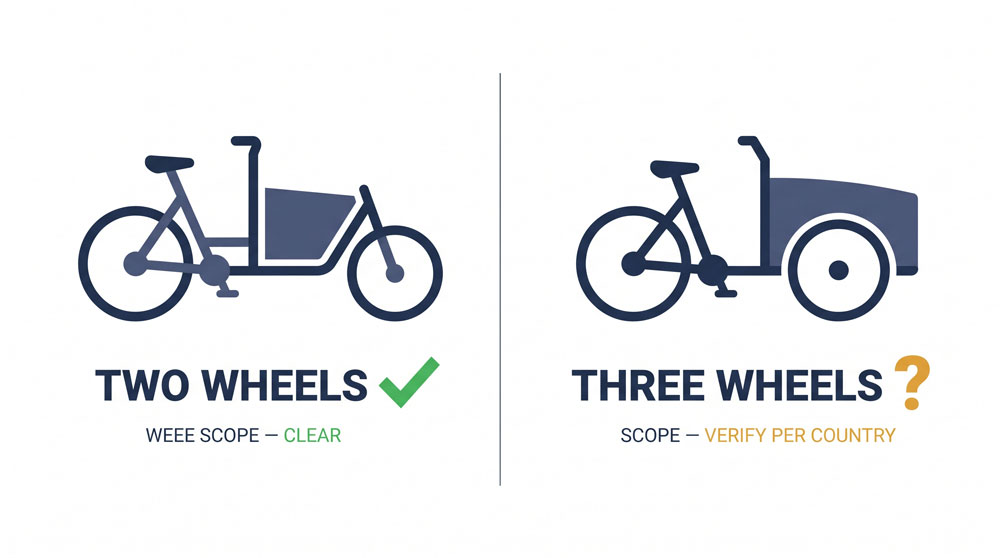
The WEEE Directive excludes “means of transport for persons or goods” from its scope — and then pulls one category back in: electric two-wheel vehicles which are not type-approved. A 250 W pedal-assist bike or long-john cargo bike is exempt from EU type-approval, so it lands squarely inside WEEE scope. That much is settled across Europe.
Electric tricycles are the interesting case. On the directive’s literal wording, only two-wheel vehicles are pulled back into scope; a three-wheeled cargo trike or semi-recumbent trike remains a “means of transport” and arguably sits outside WEEE. In practice, national registers interpret scope themselves, and interpretations are not uniform — some clearing houses assess electric vehicles case by case. Three practical consequences:
First, never assume a trike is WEEE-exempt without a written scope assessment from the national register or your compliance provider in each target country — a wrong assumption in either direction is expensive. Second, even where a trike falls outside WEEE, its battery and packaging obligations apply in full; those streams have no means-of-transport exemption. Third, if your range mixes two-wheelers and trikes, your WEEE declaration may legitimately cover only part of your volume — your reporting structure needs to separate the two from day one, which in turn means your manufacturer’s data must be broken out per model, not per shipment.
The 2025–2027 timeline: three dates that reshape the paperwork
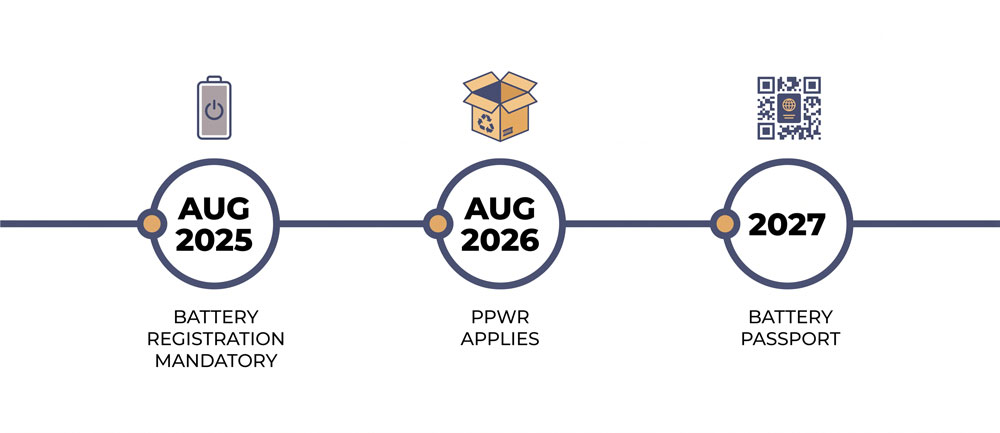
18 August 2025 — battery producer registration became mandatory everywhere
The Battery Regulation replaced the old Battery Directive’s patchwork with a directly applicable EU regulation. Since 18 August 2025, a producer must be registered in the battery register of every member state where its batteries are placed on the market — including batteries built into vehicles. E-bike batteries fall under the regulation’s LMT (light means of transport) category, which carries its own collection targets and labelling requirements. If you began selling before completing battery registration, regularise it now rather than waiting for a marketplace or authority query.
12 August 2026 — the PPWR applies
The Packaging and Packaging Waste Regulation now applies across the EU, harmonising packaging design rules, recycled-content requirements and labelling over the coming years. What it does not do is centralise EPR administration: registration, fee schedules and declarations remain national. Expect the data demanded by national schemes to become more granular — recyclability grading and recycled content will increasingly affect the fees you pay per kilogram, which makes your factory’s packaging specification a cost document, not just a compliance document.
February 2027 — the battery passport arrives for LMT batteries
From early 2027, LMT batteries newly placed on the EU market must carry a digital battery passport — a QR-accessible record covering composition, capacity and supply-chain data, prepared at manufacturing level. This is one of the few EPR-adjacent obligations where the workload genuinely sits upstream: the data has to come out of the battery supply chain. When comparing manufacturers for orders that will still be selling in 2027, battery-passport readiness is a fair and increasingly necessary question to put on the table. (Verify the exact applicability date for your battery category against Regulation (EU) 2023/1542 as implementing acts are finalised.)
What enforcement actually looks like
EPR enforcement rarely starts with an inspector at your warehouse. It starts with a marketplace compliance request, a customer’s procurement questionnaire, or a competitor report to a national register. Germany and France lead: online marketplaces there are legally required to verify sellers’ EPR registration numbers and to delist products without them, and German authorities can impose distribution bans and significant fines for selling before registration. The pattern is spreading — under EU market-surveillance rules, platforms across the Union increasingly demand WEEE, battery and packaging numbers as a listing condition.
The financial exposure is asymmetric. Registering properly costs administration time and per-kilogram fees. Registering late typically means back-payment of fees for everything already sold, potential fines, and in the worst case a sales stop while paperwork catches up — precisely when stock is sitting in a warehouse accruing cost.
How this series is organised
This guide covered the framework. Part 2 walks through registration country by country — Germany, France, the Netherlands, Belgium, Denmark, Spain and the UK — including which registers, which eco-organisations, and where an authorised representative is mandatory. Part 3 is the operational piece: the exact data set to request from your manufacturer before production, the risks to pre-empt, and the reporting problems that surface a year after launch. For the wider regulatory picture — CE marking, EN standards and battery safety certification — see our EU cargo bike compliance guide.
Frequently asked questions
Does my Chinese manufacturer have EPR obligations in Europe?
No — EPR obligations attach to the company that first places the product on a national market, which for imported goods is the importer or brand owner. The manufacturer’s role is to supply the product and packaging data your registrations and declarations depend on, which is why data capability is a genuine supplier selection criterion.Is an e-bike covered by the WEEE Directive?
Is an e-bike covered by the WEEE Directive?
Yes. Electric two-wheel vehicles that are not type-approved — which includes 250 W pedal-assist bikes and cargo bikes — are explicitly within WEEE scope. Electric tricycles are less clear-cut on the directive’s wording, and classification should be confirmed with each national register.Do I need a separate registration for batteries if they are installed in the bikes?
Do I need a separate registration for batteries if they are installed in the bikes?
Yes. A battery placed on the market inside equipment still counts as a battery placed on the market. The bike triggers WEEE registration and the battery triggers battery registration — two registers, two declarations, in every country where you sell.I only sell B2B to dealers — does EPR still apply?
I only sell B2B to dealers — does EPR still apply?
Yes. EPR applies to placing products on the market, regardless of whether the first customer is a consumer or a business. Some countries distinguish household from professional equipment in fee structures and take-back logistics, but registration is required either way.Can one registration cover all EU countries?
Can one registration cover all EU countries?
No. Despite EU-level framework law, EPR registers are national. Selling in five countries generally means registering in five countries across up to three streams each — one reason importers plan market entry sequentially rather than launching everywhere at once.
Sourcing e-bikes or cargo trikes for the European market?
United Mobility supplies the compliance documentation set — packaging specifications, battery data, CE Declaration of Conformity — alongside every production order, so your EPR registrations are built on manufacturer data rather than estimates. Talk to our team about your target markets.
 English
  German
  Dutch
Dutch  Danish
  French
  Polish
  Portuguese
  Spanish