


Vous avez trouvé un fournisseur de vélos cargo. La fiche technique semble correcte, l'échantillon paraît robuste et le prix vous convient. Puis, un membre de votre service juridique ou des achats demande : ‘ Pouvaient-ils obtenir la certification CE ? Et est-ce pour la bonne norme ? ’
C’est la question qui bloque le plus de projets d’approvisionnement, non pas parce que la réponse est compliquée, mais parce que les acheteurs savent rarement quoi demander, les fournisseurs donnent rarement spontanément tous les détails, et l’écart entre une certification valide et une certification papier reste invisible jusqu’à ce qu’un produit soit rappelé, refusé en douane ou fasse l’objet d’une réclamation en responsabilité.
Dans l'article précédent Guide de conformité des vélos cargo pour l'entrée sur le marché européen : EN 17860 et stratégie de certification multi-pays, nous en avons discuté en quoi consiste la conformité et quelles réglementations s'appliquent (cadre réglementaire), tandis que cet article expliquera la certification CE des vélos cargo du point de vue de l'acheteur et mettra l'accent sur Comment procéder à la certification, qui fournit quels documents, et quels sont les délais et les coûts requis ? (processus opérationnel).
Principes de base du marquage CE : définition et signification
Le marquage CE atteste qu'un produit est conforme aux exigences de l'UE en matière de santé, de sécurité et de protection de l'environnement. Pour les vélos cargo, il s'agit d'une obligation légale pour leur commercialisation sur le marché européen ; ce n'est pas un simple gage de qualité optionnel.
Ce que le marquage CE ne signifie pas : il n’est pas délivré par une autorité gouvernementale, il ne signifie pas que le produit a été inspecté en douane et il ne garantit pas qu’un laboratoire indépendant a vérifié chaque allégation figurant sur la fiche technique. Dans de nombreuses catégories de produits, les fabricants se contentent d’autodéclarer la conformité. Ce qui distingue une certification CE crédible d’une simple formalité administrative, c’est la qualité des tests qui la sous-tendent.
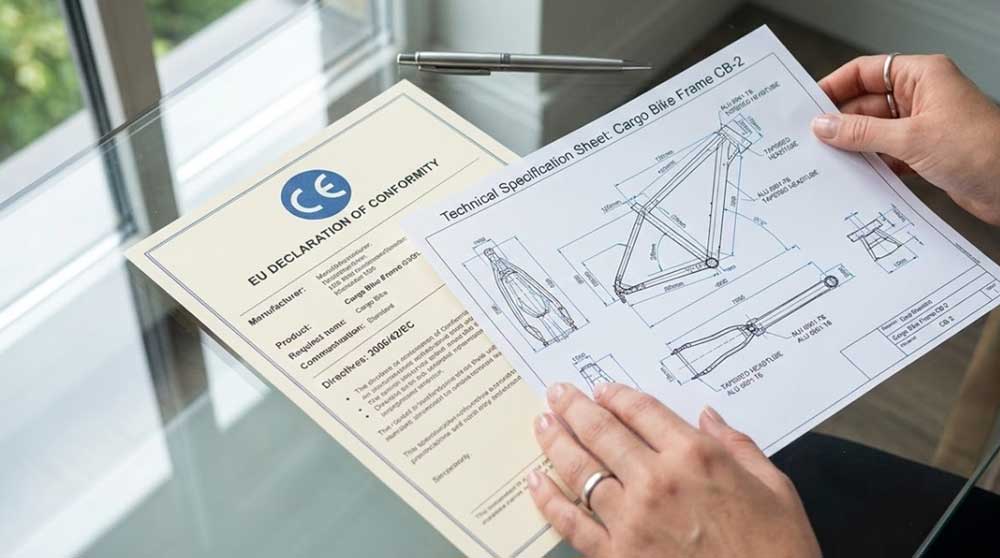
Pour les vélos cargo, une certification crédible signifie qu'un laboratoire tiers a testé physiquement le cadre et, selon le cas, le véhicule complet, conformément à la norme harmonisée applicable. Lorsque ce laboratoire est un organisme notifié accrédité comme le TÜV, le rapport d'essai est vérifiable par toute personne disposant du numéro de certificat et d'un accès à Internet. C'est cette vérifiabilité qui confère à la certification sa valeur commerciale.
| Pourquoi la vérifiabilité est importante pour vous en tant qu'acheteur Les numéros de certificat TÜV peuvent être vérifiés directement sur le portail en ligne de TÜV et comparés à ceux de NANDO (Nouvelle approche : organismes notifiés et désignésDans une base de données, si un fournisseur fournit un rapport TÜV et que vous ne trouvez pas le numéro de certificat, c'est un signe d'alerte important. Demandez toujours le numéro du rapport et vérifiez-le indépendamment avant de signer un contrat d'achat. |
Quelle norme s'applique au vélo que vous achetez ?
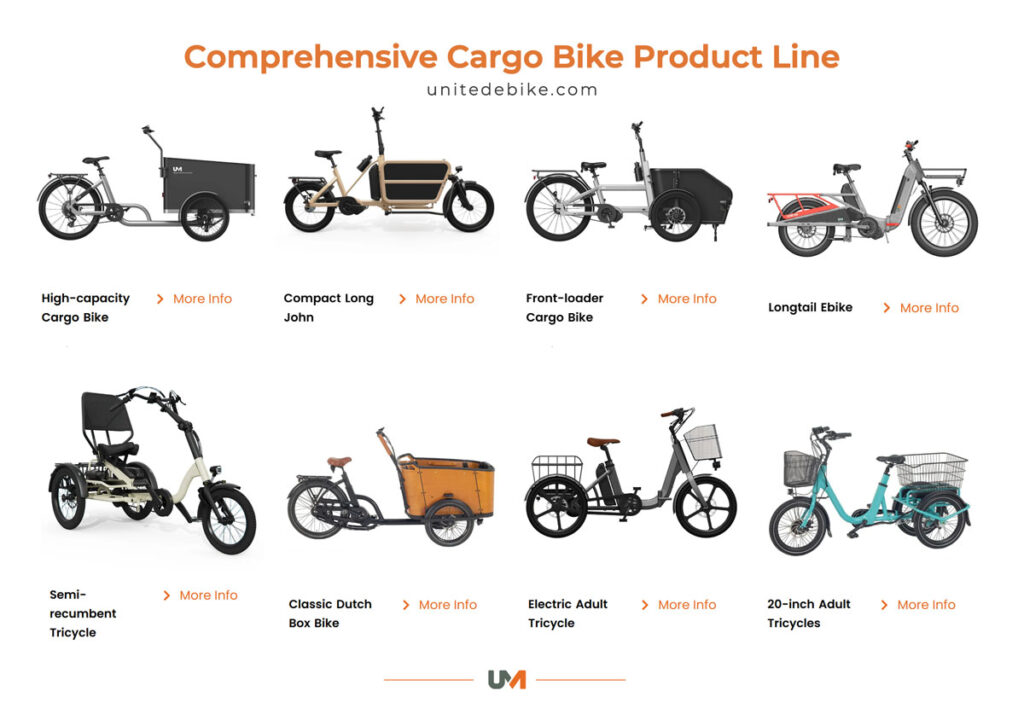
Les vélos cargo ne sont pas tous certifiés selon la même norme. Utiliser une norme erronée — ou accepter une certification qui ne correspond pas au produit que vous achetez — constitue un manquement à la conformité, même si le certificat est authentique. En tant qu'acheteur, il est impératif de comprendre quelle norme s'applique à votre produit. Explorez notre fabrication de vélos cargo Consultez notre gamme pour découvrir l'ensemble des modèles certifiés, conçus pour différents usages et exigences réglementaires.
Les deux principales normes : EN 15194 et EN 17860
EN 15194:2017 Il s'agit de la norme européenne harmonisée pour les vélos à assistance électrique (VAE). Elle couvre la majorité des vélos électriques vendus en Europe, y compris les vélos cargo longtail et midtail — des modèles dont le cadre et la géométrie sont fondamentalement similaires à ceux d'un vélo standard, avec une plateforme de chargement arrière mais sans grand coffre fermé.
EN 17860:2024 La norme EN 17860, plus récente et composée de sept parties, a été publiée par le CEN en 2024. Elle a été élaborée spécifiquement pour répondre aux exigences structurelles et de stabilité des vélos cargo dotés de grands compartiments fermés, d'un poids total autorisé en charge élevé et d'une configuration à trois roues, exigences que la norme EN 15194 n'était pas conçue pour évaluer. Les parties 2 et 3 de la norme EN 17860 sont les plus pertinentes sur le plan commercial.
- EN 17860-2 : Vélos cargo monoroues avec un grand coffre de chargement fermé à l'avant ou à l'arrière
- EN 17860-3 : Vélos cargo multi-pistes (à trois roues), y compris toutes les configurations de tricycles, quelle que soit la taille de la caisse.
| Type de produit | Configuration | Norme correcte | Erreur courante |
| vélo électrique Longtail | Voie unique, porte-bagages arrière uniquement | EN 15194:2017 | Il arrive que certains fournisseurs exagèrent leurs déclarations concernant la norme EN 17860 afin de paraître plus certifiés. |
| vélo électrique Midtail | Porte-bagages arrière compact à voie unique | EN 15194:2017 | Identique à ci-dessus |
| Tricycle semi-couché | Multi-pistes, charge utile légère | EN 15194:2017 | Le tricycle ne déclenche pas automatiquement la norme EN 17860. |
| Vélo cargo (2 roues) | Grande boîte fermée à l'avant et à l'arrière | EN 17860-2:2024 | L'utilisation de la norme EN 15194 pour un vélo-boîte présente un écart de conformité. |
| Tricycle cargo (3 roues) | Toute configuration de chargement | EN 17860-3:2024 | Ne doit pas être certifié selon la norme EN 15194 |
| vélo cargo lourd | Poids total autorisé en charge (PTAC) approchant les 300 kg et plus | Examen de la norme EN 17860 + catégorie L | Peut nécessiter une homologation de type – procédure réglementaire distincte |
| ⚠ Risque fournisseur Un fournisseur qui vous présente un certificat EN 15194 pour un triporteur cargo de grande capacité vous fournit des documents non conformes au produit. Il ne s'agit pas d'un détail technique : cela signifie que l'intégrité structurelle et la stabilité du véhicule que vous achetez n'ont pas été certifiées selon la norme appropriée. Refusez-le. |
Question sur la norme DIN 79010
Il est possible que certains fournisseurs fassent référence à la norme DIN 79010:2020, la norme nationale allemande qui a précédé la norme EN 17860. Cette norme transitoire, reconnue et toujours pertinente pour comprendre l'historique des essais de vélos cargo en Europe, est désormais remplacée par la norme européenne harmonisée EN 17860:2024. Pour le lancement de nouveaux produits destinés aux marchés européens, c'est la norme EN 17860 qu'il convient d'exiger, et non la seule norme DIN 79010.
Certification du châssis vs. certification complète du véhicule : la décision qui influe sur votre responsabilité
Lorsqu'un fournisseur affirme posséder la certification CE, cela peut concerner le châssis ou le véhicule complet. Ces deux notions sont fondamentalement différentes et cette distinction a des conséquences importantes sur votre situation commerciale et juridique.
Que couvre la certification de cadre ?
La certification du cadre valide l'intégrité structurelle du cadre, de la fourche et des principaux joints porteurs conformément au programme de fatigue et d'impact de la norme applicable. Pour un vélo cargo électrique, cela inclut généralement l'interface du moteur (milieu de gamme ou points de fixation de l'entraînement par moyeu) mais n'évalue pas le système électrique : le système de batterie, le contrôleur, le câblage, l'affichage ou les performances de freinage dans des conditions d'assistance motorisée.
Un vélo cargo certifié pour son cadre a démontré que sa structure répond aux exigences de sécurité européennes. Il n'a cependant pas été démontré que l'ensemble du système électrique fonctionne en toute sécurité ni que le véhicule intégré répond aux exigences de compatibilité électromagnétique (CEM).
Que couvre la certification complète du véhicule ?
La certification complète du véhicule étend le programme de tests à l'ensemble du système électrique : sécurité de la batterie, compatibilité électromagnétique (CEM), comportement du contrôleur moteur, freinage en accélération et, lorsque le règlement (UE) 2023/1542 relatif aux batteries s'applique, exigences supplémentaires spécifiques à la batterie. La déclaration de conformité qui en résulte couvre le vélo en tant que produit complet et commercialisable.
Pour la plupart des applications commerciales et de vente au détail, une certification complète du véhicule est indispensable, même si un fournisseur propose par défaut une certification du châssis uniquement.
Qui doit payer et que faut-il négocier ?
| Étendue de la certification | Qui supporte généralement les coûts | Quand un véhicule complet est indispensable |
| Certification du cadre | Fournisseur (fabricant) — il valide la conception de sa plateforme | Insuffisant pour les achats réglementés ou les grandes enseignes de distribution. |
| Certification complète du véhicule | Acheteur — il valide une configuration de produit spécifique | Appels d'offres gouvernementaux pour les flottes de véhicules, leasing d'entreprise, grands détaillants B2B |
| Nouveau test après échec | Cela dépend du contrat — à négocier à l’avance | La responsabilité non spécifiée est la source de litige la plus fréquente. |
La répartition classique des coûts (le fournisseur finance le châssis, l'acheteur le véhicule complet) est la norme du marché, mais elle doit être explicitement stipulée dans votre contrat. L'expression ‘ certification incluse ’ dans un contrat d'achat est trop vague et ne peut désigner que le contrôle du châssis. Si vous avez besoin d'une certification complète du véhicule, indiquez-le clairement, convenez qui prend en charge les frais et définissez la procédure en cas de nouvelle certification.
| Liste de contrôle du contrat : périmètre de certification Indiquez la norme applicable (EN 15194 ou EN 17860-2/-3) par son nom et son année. Indiquez si une certification du châssis seulement ou du véhicule complet est requise. Nommer l'organisme de contrôle (par exemple TÜV Rheinland, TÜV SÜD) Définir qui prend en charge les frais des tests initiaux et des éventuels tests de confirmation après échec. Précisez les éléments de livraison : rapport d’essai + déclaration de conformité + résumé du dossier technique Inclure une clause de responsabilité en cas de documentation de certification frauduleuse ou non conforme |
Échéanciers réalistes : Intégrer la certification à votre plan de lancement
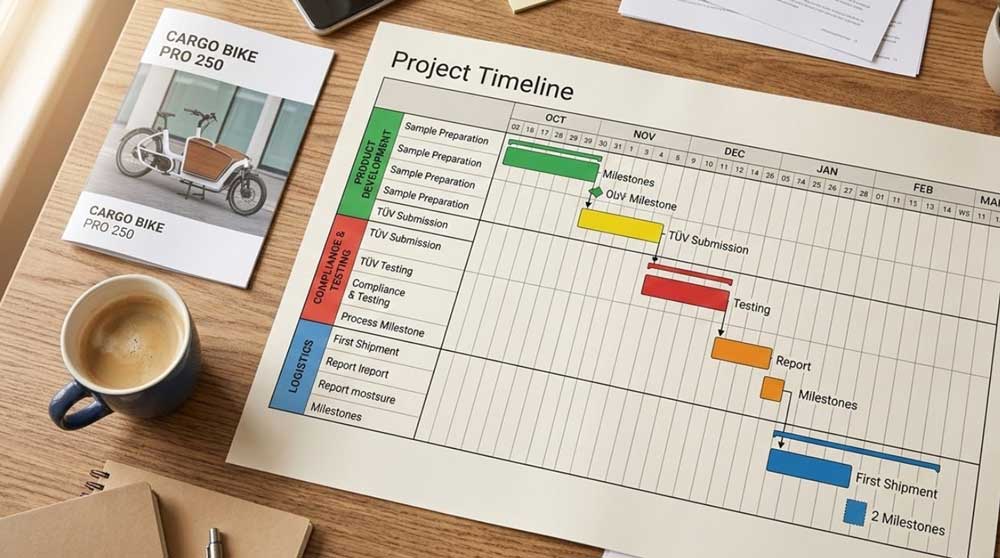
Les retards de certification sont l'une des principales causes d'échec des lancements de vélos cargo. Le problème réside rarement dans les tests eux-mêmes, mais plutôt dans le fait que les acheteurs établissent des échéanciers en supposant que les tests commencent dès l'expédition d'un échantillon, et que les fournisseurs annoncent une durée de test sans tenir compte de la préparation de l'échantillon, de la planification des analyses en laboratoire et du risque bien réel d'échec.
Calendrier de référence : Que prévoir ?
| Type de certification | Durée de base | Échec et nouveau test | Marge de planification réaliste |
| Cadre seul (EN 15194) | environ 10 jours ouvrables | +7 à 14 jours par échec | 4 à 5 semaines au total |
| Cadre seul (EN 17860-2/-3) | environ 10 à 14 jours ouvrables | +7 à 14 jours par échec | 5 à 6 semaines au total |
| Véhicule complet (toute norme) | ~45 jours calendaires | +14 à 21 jours par panne | 8 à 10 semaines au total |
| Véhicule complet, composants sur mesure | ~50 à 60 jours calendaires | +14 à 21 jours par panne | 10 à 12 semaines au total |
L'horloge cachée : Préparation avant soumission
Le délai de 10 ou 45 jours ne commence que lorsque le laboratoire d'analyse a reçu un échantillon complet et conforme, et non lorsque vous ou votre fournisseur déclarez que ‘ l'échantillon est prêt ’. Les laboratoires rejettent les soumissions incomplètes, et le délai ne commence à courir qu'à partir du moment où la soumission est acceptée.
Pour les essais de cadre, l'échantillon doit comprendre la fourche avant, le triangle arrière et, pour les modèles à moteur central, le moteur-pédalier monté sur le boîtier de pédalier. (Les moteurs-roues ne sont pas requis pour les essais de cadre seul.) Pour les essais de véhicule complet, le laboratoire a également besoin de la batterie complète avec sa documentation BMS, du contrôleur moteur, de l'écran, du faisceau de câbles complet et du dossier de documentation technique. Tout élément manquant entraînera le rejet de l'échantillon.
En pratique, prévoyez 2 à 3 semaines pour la préparation et l'expédition des échantillons avant le début des analyses en laboratoire. Le délai total entre la décision de certification et la réception du rapport est généralement de 8 semaines minimum pour les essais sur châssis et de 12 à 14 semaines pour les essais sur véhicule complet lors d'une première phase.
Que se passe-t-il lorsqu'un test échoue ?
L'échec des tests est fréquent ; cela ne signifie pas qu'un fournisseur est peu fiable, mais sa réaction, si. Un fournisseur doté de tests internes rigoureux devrait présenter des défaillances internes avant la soumission au TÜV, et non au laboratoire. Demandez directement : quel est votre protocole de test préalable à la soumission, et combien de vos certifications récentes ont été réussies du premier coup ?
En cas de défaillance en laboratoire, le fournisseur doit modifier l'échantillon, voire repenser le composant concerné, et expédier un échantillon corrigé. Chaque cycle de défaillance ajoute généralement 2 à 3 semaines. Pour une certification complète de véhicule, une seule défaillance dans la chambre CEM peut porter le délai total à plus de 16 semaines à compter de la première soumission.
| Recommandations relatives à la planification du calendrier pour les acheteurs Pour tout lancement dépendant de la certification complète du véhicule par une nouvelle plateforme fournisseur, prévoyez 14 semaines supplémentaires entre la signature du contrat et l'obtention de la certification dans votre plan de projet. Si le fournisseur peut réduire ce délai (parce que sa plateforme dispose déjà d'un rapport d'essais valide ou qu'il effectue des tests préalables approfondis), c'est un avantage. Un calendrier plus serré représente un risque pour vous, et non pour le fournisseur. |
Les documents que vous devez recevoir et comment les vérifier
Recevoir un PDF intitulé ‘ Certificat TÜV ’ ne signifie pas détenir une certification valide et applicable. En tant qu'acheteur ou propriétaire de marque commercialisant des produits sur le marché européen, vous devez comprendre quels documents constituent un dossier de conformité complet et comment vérifier l'authenticité de chaque composant.
Les trois documents fondamentaux
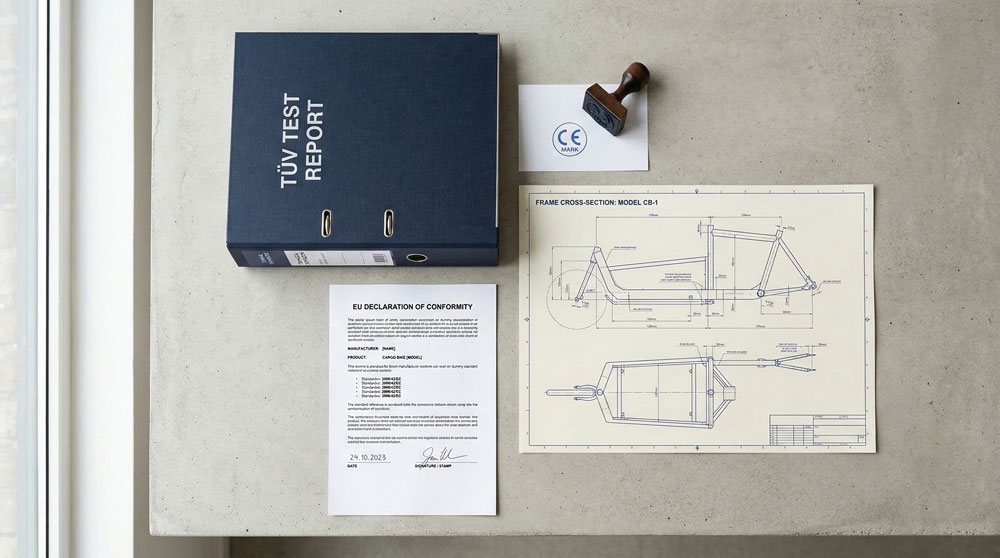
Un dossier complet de certification CE pour un vélo cargo électrique se compose de trois éléments :
- Rapport de test : Délivré par le laboratoire d'essais (par exemple, TÜV), ce document constitue la preuve matérielle de la conformité. Il répertorie tous les essais réalisés, leurs résultats et la conclusion (réussite/échec) pour chaque critère de la norme. Ce document ne peut être auto-délivré ; il provient exclusivement du laboratoire.
- Déclaration de conformité UE (DoC) : Il s'agit de la déclaration légale attestant que le produit est conforme aux directives européennes applicables. Elle est émise par le fabricant ou l'entité mettant le produit sur le marché. Elle doit mentionner les directives applicables, les normes harmonisées et l'organisme notifié utilisé. Elle doit être signée par une personne habilitée.
- Dossier technique : Le dossier complet de preuves – plans de conception, spécifications des composants, rapports d'essais, déclaration de conformité et tout compte rendu des actions correctives – ne doit pas être soumis aux autorités compétentes, mais doit être accessible pour les contrôles de conformité pendant 10 ans après la dernière production. En tant qu'acheteur, demandez un résumé ou un index du dossier technique afin de vous assurer de son existence.
Étapes de vérification prenant moins de 10 minutes
- Étape 1 : Notez le numéro de rapport TÜV (ou le numéro de certificat) figurant sur le document fourni par votre fournisseur.
- Étape 2 : Rendez-vous sur le portail TÜV concerné (TÜV Rheinland, TÜV SÜD ou TÜV NORD selon le laboratoire qui a émis le rapport) et consultez la base de données des certificats.
- Étape 3 : Vérifiez que le certificat est actif, que la description du produit correspond à ce que vous achetez et que la date d'émission est actuelle.
- Étape 4 : Vérifiez que la référence de l'organisme notifié dans la déclaration de conformité est bien celle indiquée dans le document. Base de données NANDO pour confirmer que l'organisme certificateur est légitimement notifié de la directive concernée.
| ⚠ Risque fournisseur La fraude à la certification est une réalité dans ce secteur. Elle consiste généralement en l'utilisation d'un rapport d'essai authentique pour un lot de production qui n'a jamais été testé, ou en la falsification d'un certificat provenant d'un laboratoire reconnu. Si un fournisseur rechigne à fournir le numéro du rapport, ou si le document qu'il envoie ne peut être vérifié par le système du laboratoire, considérez cela comme un risque de non-conformité et exigez une nouvelle analyse à ses frais avant de passer commande. |
Approvisionnement en marques privées et multimarques : ce que vous devez savoir
Si vous commercialisez un produit sous votre propre marque, la déclaration de conformité doit être établie au nom de votre entreprise, et non à celui de votre fournisseur. Il s'agit d'une obligation légale. Le rapport d'essai sous-jacent peut être celui du fournisseur (s'il couvre la configuration spécifique de votre produit), mais la déclaration de conformité est votre document, signé par votre représentant autorisé.
Cela signifie qu'en tant que propriétaire de marque, vous ne pouvez pas simplement accepter la déclaration de conformité (DoC) de votre fournisseur et la transmettre. Vous devez examiner son rapport de test, vérifier qu'il couvre bien votre produit et émettre votre propre DoC en y faisant référence. Votre fournisseur doit faciliter cette démarche en fournissant un rapport de test adapté à votre produit ainsi qu'un modèle ou un point de référence pour votre DoC. S'il ne l'a jamais fait auparavant, cela constitue en soi un signal d'alarme.
Réalité des coûts : budgétiser la certification sans surprises
Les surprises liées aux coûts de certification lors des négociations d'approvisionnement proviennent généralement de deux sources : un désaccord sur la répartition des coûts ou l'absence de provision pour les tests de confirmation. Ces deux problèmes sont évitables grâce à un accord clair et préalable.
Fourchettes de coûts selon le périmètre de certification
| Étendue de la certification | Fourchette de coûts typique | payeur conventionnel | Contingence de retest |
| Cadre seul (EN 15194) | 1 500 € – 3 500 € | Fournisseur | Budget 20% supplémentaire |
| Cadre seul (EN 17860-2/-3) | 2 000 € – 5 000 € | Fournisseur | Budget 20% supplémentaire |
| Véhicule complet (toute norme) | 8 000 € – 15 000 € | Acheteur | Budget 25–30% supplémentaire |
| Véhicule complet avec composants personnalisés | 12 000 € – 20 000 € et plus | Acheteur | Budget 30% supplémentaire |
Il s'agit des coûts du programme, et non des coûts unitaires. Une fois la plateforme certifiée, les unités supplémentaires fabriquées selon les mêmes spécifications ne nécessitent pas de nouveaux tests. Le coût redevient pertinent lorsque les spécifications du produit changent sensiblement : nouveau fournisseur de batteries, micrologiciel différent pour le contrôleur de moteur, modification structurelle du châssis.
Qu'est-ce qui déclenche la recertification ?
- Passez au matériau du cadre, géométrie ou spécification de soudure primaire
- Nouveau fournisseur de batteries ou changement important Paramètres du BMS
- Modification du contrôleur moteur ou du micrologiciel qui affecte le profil de puissance de sortie
- Toute modification qu'un ingénieur raisonnable jugerait susceptible d'affecter les résultats des tests
Les fournisseurs capables d'indiquer précisément quelles modifications de composants nécessitent une recertification — et lesquelles n'en nécessitent pas — connaissent bien leur propre produit. Les réponses vagues à cette question sont un signal d'alarme quant aux risques liés à l'approvisionnement.
Évaluer les capacités de certification de votre fournisseur : questions qui révèlent la réalité
La démarche de certification d'un fournisseur est un indicateur pertinent de sa maturité globale en matière d'ingénierie et de gestion de la qualité. Les questions ci-dessous mettent en lumière la différence entre les fournisseurs qui intègrent la certification à leur processus de développement et ceux qui la considèrent comme une formalité de dernière minute.
Questions à se poser avant de signer
- Quelle norme spécifique s'applique à ce produit (EN 15194 ou EN 17860 partie 2 ou 3) et pourquoi ?
- La certification actuelle concerne-t-elle uniquement le châssis ou le véhicule complet ? Pouvez-vous m’envoyer le rapport d’essai pour vérification ?
- Quel est votre taux de réussite dès la première soumission aux tests TÜV ? À quelle fréquence vos produits nécessitent-ils des tests de contrôle ?
- Quels tests internes préalables effectuez-vous avant d'envoyer des échantillons au TÜV ?
- Si j'ai besoin d'une certification complète pour ma configuration de véhicule, quelle est la procédure, qui gère la démarche auprès du TÜV et quel est le calendrier ?
- Si je lance un produit sous ma propre marque, comment soutenez-vous la publication de ma propre déclaration de conformité ?
- Que se passe-t-il avec la certification si je change la batterie pour une autre marque ou si le micrologiciel du moteur est mis à jour ?
- Avez-vous déjà eu une certification contestée ou invalidée ? Comment cela a-t-il été résolu ?
À quoi ressemblent des réponses pertinentes ?
Un fournisseur possédant une certification véritablement approfondie répondra immédiatement et correctement à la question standard, fournira sans hésitation des numéros de rapport vérifiables, expliquera son protocole de test préalable à la soumission en faisant référence à des paramètres de test spécifiques plutôt qu'à des généralités, et fournira un processus clair et documenté pour la délivrance de certificats de conformité en marque blanche.
Un fournisseur qui esquive la question standard, fournit un certificat non vérifiable ou décrit la certification comme ‘ gérée par un tiers ’ sans implication directe d'ingénieurs présente un profil de risque qui devrait influencer votre décision d'approvisionnement.
Résumé à l'intention des acheteurs : Cinq principes de certification pour un approvisionnement plus intelligent
- Adapter la norme au produit. La norme EN 15194 s'applique aux vélos électriques longtail/midtail ; la norme EN 17860-2 aux vélos cargo ; et la norme EN 17860-3 aux tricycles. Accepter une norme non conforme constitue un manquement aux règles de conformité, quelle que soit la validité du certificat.
- Vérifiez toujours le certificat. Utilisez le portail TÜV et la base de données NANDO. Si la vérification est impossible, considérez-la comme invalide.
- La distinction entre châssis et véhicule complet est une clause contractuelle, et non un manquement du fournisseur. Précisez par écrit la portée, le payeur et la responsabilité en cas de nouveau test avant le début du programme.
- Intégrez 8 à 14 semaines dans votre plan pour la certification complète du véhicule. Les fournisseurs qui effectuent des tests internes rigoureux réduisent ce taux de compression ; ceux qui n'en effectuent pas ne le font pas.
- Si vous êtes propriétaire de la marque, établissez votre propre déclaration de conformité. Le rapport d'essai de votre fournisseur constitue la base ; votre nom sur la déclaration de conformité est une obligation légale.
La certification n'est pas un problème que le fournisseur doit résoudre et que vous devez accepter. Il s'agit d'un risque commercial partagé qui doit être identifié, documenté et anticipé avant toute signature de commande. Les acheteurs qui l'envisagent ainsi protègent leur marque ; ceux qui la considèrent comme une simple formalité découvrent les véritables enjeux au pire moment.
L'équipe R&D d'UM affiche un ratio ingénieurs/effectif total nettement supérieur à la moyenne du secteur, avec une ancienneté moyenne des ingénieurs dépassant dix ans dans le domaine des véhicules électriques de micromobilité et de transport de marchandises. Le programme d'essais internes réalise des cycles de fatigue structurelle à des niveaux de charge supérieurs aux exigences de la norme EN 17860 et inclut un contrôle CEM préalable à l'envoi de tout échantillon à un laboratoire externe. Il en résulte un taux de certification dès la première tentative qui raccourcit considérablement les délais par rapport aux fournisseurs qui s'appuient sur un laboratoire pour identifier les défaillances.
Contactez United Mobility Pour plus d'informations sur la réglementation et les certifications des vélos cargo, cliquez ici.
 French
  English
  German
  Dutch
Dutch  Danish
  Polish
  Portuguese
  Spanish