Un vélo cargo électrique destiné au marché de l'UE doit satisfaire à quatre exigences réglementaires : les essais de type EN 15194, la directive Machines, les exigences CEM et les obligations relatives aux batteries en vertu du règlement (UE) 2023/1542. Cette liste de contrôle couvre ces quatre exigences, les documents requis pour chacune d'elles et l'ordre dans lequel les traiter. Pour plus de détails sur les délais et les coûts de certification, veuillez consulter [lien/référence manquante]. calendrier de certification CE; pour plus de détails sur les règles relatives aux batteries, voir Guide des piles UE 2023/1542.
Lorsqu'un distributeur logistique berlinois nous a contactés pour le lancement de sa flotte de vélos cargo en marque blanche, il lui restait 47 jours avant sa première livraison et aucune documentation EN 17860. Voici comment comprendre la conformité des vélos cargo. avant Choisir un partenaire ODM peut faire toute la différence entre saisir les opportunités du marché et les rater complètement.
La réglementation européenne relative aux vélos cargo a connu une évolution fondamentale au cours des cinq dernières années. L'essor de logistique commerciale du dernier kilomètre, Cette situation, conjuguée au déploiement croissant de flottes dans les centres urbains néerlandais, allemands et français, a incité les autorités de réglementation à élaborer des cadres spécifiques allant au-delà de ce que les normes générales relatives aux vélos électriques avaient jamais envisagé. Fabricants ODM/OEM de vélos cargo Pour eux et leurs partenaires de distribution, naviguer dans ce paysage n'est plus une option, c'est le prix à payer pour entrer sur le marché.
Ce guide décrit l'intégralité du parcours de conformité : de la compréhension de… EN 17860 elle se situe par rapport aux normes existantes, aux réalités pratiques en matière de coûts et de délais de la certification CE, et à la façon dont le choix du bon partenaire ODM raccourcit votre délai de mise sur le marché de plusieurs mois.
1. Comprendre les exigences de conformité des vélos cargo en Europe : EN 17860 vs normes existantes
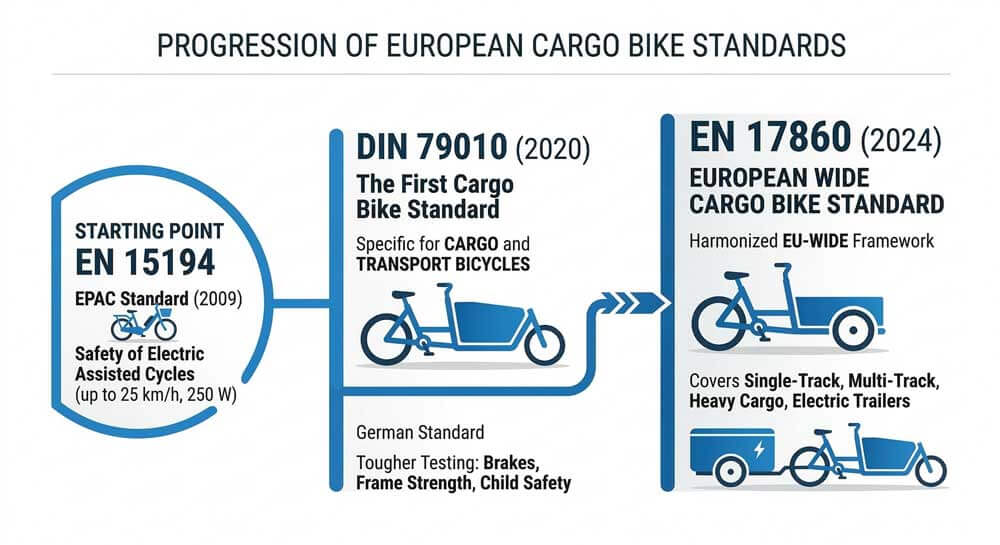
Pendant la majeure partie de la dernière décennie, les fabricants de vélos cargo ont opéré dans une zone grise réglementaire. La norme dominante, EN 15194, Conçu pour les vélos électriques classiques, ce système ne répondait ni aux exigences structurelles des cadres porteurs, ni aux configurations de transport de passagers courantes dans le cadre d'une utilisation urbaine, familiale ou logistique. Les fabricants et les distributeurs ont comblé cette lacune avec DIN 79010, une norme d'origine allemande introduite en 2020 qui a fourni le premier cadre de test et de sécurité systématique spécifiquement destiné aux vélos cargo, couvrant à la fois les configurations à une seule voie et à plusieurs voies, ainsi que les vélos conçus pour transporter des passagers.
DIN 79010 Il s'agissait d'un progrès significatif, mais la norme restait nationale. Les distributeurs opérant sur plusieurs marchés européens étaient confrontés à des exigences fragmentées : ce qui convenait à un détaillant allemand pouvait ne pas convenir à un assureur néerlandais ou à un responsable des achats d'une municipalité française. La conformité transfrontalière était coûteuse et incohérente.
EN 17860 modifie ceci. Développé par Groupe de travail 9 du CEN/TC 333—comprenant 57 membres issus de 11 pays—il s'agit d'une norme européenne harmonisée conçue pour être adoptée par tous les États membres de l'UE et de l'AELE. La norme est structurée en une série de modules, couvrant :
Vélos cargo à voie unique (à longue queue, à chargement frontal)
vélos cargo lourds jusqu'à poids total autorisé en charge du véhicule : 650 kg
remorques de fret électriques
Le calendrier de ratification s'étendait de 2022 à 2024. EN 17860:2024 La norme EN 17860 fait désormais office de document de référence pour la conformité sur les marchés réglementés. Pour les fabricants, la question pratique est celle de la transition : les vélos cargo précédemment certifiés selon la norme DIN 79010 peuvent continuer à circuler sur les marchés où ils étaient vendus, mais les nouveaux produits destinés aux circuits de distribution utilisant le marquage CE (Amazon DE, eBay, plateformes de commerce locales et approvisionnement de flottes) doivent être conformes à la norme EN 17860, qui constitue la norme de référence actuelle.
PAA : Les vélos cargo certifiés selon la norme DIN 79010 peuvent-ils encore être vendus en Europe après l’entrée en vigueur de la norme EN 17860 ? Les stocks existants certifiés selon la norme DIN 79010 ne sont pas automatiquement invalidés au niveau du produit, mais le marquage CE pour les nouvelles productions sur les principales plateformes de vente au détail fait désormais référence à la norme EN 17860. Pour tout distributeur entrant sur le marché, la certification EN 17860 est le point de départ approprié, et non la norme DIN 79010, qui est désormais obsolète.
2. Certification de qualité commerciale : pourquoi les tests de 200 000 cycles sont importants pour les exploitants de flottes
L'une des distinctions les plus importantes sur le plan commercial de la norme EN 17860 — et qui affecte directement les décisions d'achat des opérateurs de flottes logistiques — est la bifurcation des exigences de test en fonction de l'intensité d'utilisation.
Logistique du dernier kilomètre, flottes de location, services municipaux
Il ne s'agit pas d'une différence négligeable. Les vélos-cargos commerciaux fonctionnent à des fréquences de charge bien plus élevées : plusieurs tournées de livraison par jour, des charges utiles plus lourdes et constantes, et des conditions de conduite moins maîtrisées. Le seuil de 200 000 cycles vise à simuler la fatigue structurelle qu'un vélo subit au cours d'une utilisation commerciale réaliste. Les services d'achat de flottes chez DHL, DPD, les entreprises de coursiers urbains et les services municipaux de vélos en libre-service exigent de plus en plus une certification de qualité commerciale avant de signer les contrats d'achat.
Pour les fabricants ODM, cela implique un choix crucial concernant leur gamme de produits : se contenter d’une certification conforme aux normes pour un usage privé les exclut de fait du segment le plus dynamique du marché européen des vélos cargo. Les ventes aux flottes commerciales représentent le principal débouché pour les contrats à volume élevé. Obtenir la certification correspondant au seuil commercial engendre un surcoût initial, mais ouvre l’accès à des circuits de distribution inaccessibles avec une certification grand public.
Pour les distributeurs qui développent une marque de distributeur, cette distinction doit être clarifiée avec leur partenaire ODM au stade de la contractualisation, et non découverte lors de l'examen de la documentation.
3. Le processus de certification CE : son coût réel et sa durée
C'est la section que la plupart des articles sur la conformité omettent. Voici la réalité pratique pour tout acheteur ou distributeur B2B qui envisage un lancement sur le marché européen.
Quand la certification CE est-elle requise ?
Si vous envisagez de commercialiser votre vélo cargo sur une plateforme de vente en ligne européenne (Amazon.de, Amazon.fr, eBay, Bol.com ou plateforme locale), la certification CE est obligatoire. Il s'agit d'une condition légale pour la mise sur le marché de l'UE. Les ventes aux flottes d'entreprises et aux collectivités locales nécessitent également la documentation CE dans le cadre des vérifications préalables à l'achat.
Qui organise la certification ?
Vous avez deux itinéraires :
Faites appel directement à un laboratoire d'essais. — De grands organismes de certification tiers, tels que TÜV (présent dans plusieurs pays), SGS, Bureau Veritas et Intertek, exploitent des centres d'essais pour vélos cargo à travers l'Europe. Un distributeur peut faire appel à leurs services de manière indépendante.
Travaillez avec votre fabricant ODM Un fabricant préparé aux exigences réglementaires entretient des relations établies avec des laboratoires agréés et peut coordonner le processus de soumission pour votre compte. Pour les distributeurs ne disposant pas d'expertise réglementaire en interne, cette solution est nettement plus efficace.
Quel est son prix ?
Une certification CE complète et officielle pour un vélo cargo — que ce soit selon la norme EN 17860 ou l'équivalent pour les vélos électriques — coûte généralement environ €10,000, avec une période de validité du certificat de 5 ans. Ce coût s'applique de la même manière aux vélos cargo et aux vélos électriques standards. L'investissement comprend :
Essais structurels et électriques complets
Compilation de la documentation
délivrance de certificats
Rapports de tests pour chaque variante de produit
Chaque modèle de produit distinct nécessite son propre rapport de test. Si vous lancez plusieurs références, tenez-en compte dans votre budget de certification. Le regroupement des certifications des variantes apparentées auprès d'un seul partenaire ODM réduit les frais administratifs, même lorsque des rapports de test individuels sont requis.
Un point crucial concernant l'image de marque : Si vous souhaitez que votre propre marque — et non le nom du fabricant — figure sur le certificat, vous devez communiquer cette exigence au laboratoire et à votre partenaire ODM. avant Les tests commencent. Modifier rétroactivement la documentation de certification est une opération longue et parfois impossible sans frais supplémentaires.
Combien de temps dure le processus ?
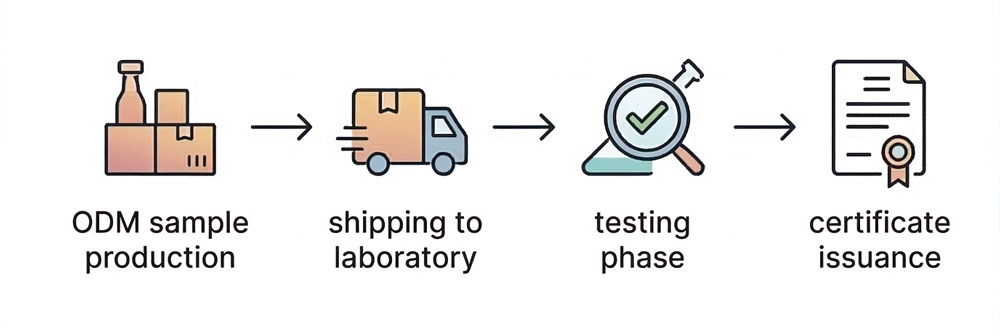
Une fois qu'un échantillon de production est prêt et expédié au laboratoire d'essais, le processus de bout en bout, y compris la logistique internationale des échantillons et les cycles d'essais, s'achève généralement dans un délai de deux mois. Dans les cas où la production d'échantillons est rationalisée et où la planification des laboratoires est alignée, le délai d'obtention des résultats est réduit. quatre à six semaines est réalisable.
Le calendrier pratique d'un distributeur préparant un lancement sur le marché doit donc tenir compte des éléments suivants :
Délai de production ODM pour les échantillons de certification
Expédition des échantillons au laboratoire d'essais (1 à 2 semaines à l'international)
Analyses et documentation en laboratoire (3 à 6 semaines)
Délivrance du certificat et livraison des documents (1 semaine)
En partant de la date de lancement, les distributeurs qui entament le processus de certification en parallèle de la planification de la production commerciale – plutôt qu’après la finalisation du produit – réduisent considérablement leur délai de mise sur le marché.
4. Stratégie de conformité multinationale : normes harmonisées vs exigences nationales
L'intérêt principal de la norme EN 17860 pour les distributeurs réside dans l'harmonisation : une norme européenne unique qui, une fois respectée, offre un cadre de conformité commun aux États membres de l'UE et de l'AELE. Ceci contraste fortement avec la situation antérieure à l'adoption de la norme EN 17860, où les exigences d'accès au marché allemand différaient des interprétations néerlandaises, françaises et nordiques des normes applicables.
En pratique, une stratégie de conformité multinationale pour les vélos cargo comporte trois niveaux :
Couche 1 : certification CE EN 17860 (paneuropéenne)
Exigence minimale pour le référencement des produits dans les circuits de distribution réglementés et l'approvisionnement des flottes de véhicules au sein de l'UE. Ce certificat, délivré une seule fois, est accompagné des documents nécessaires à l'accès au marché en Allemagne, en France, aux Pays-Bas, en Belgique, en Autriche, dans les pays nordiques et au-delà.
Niveau 2 : Nuances réglementaires propres à chaque pays
Bien que la norme EN 17860 harmonise les normes de sécurité des produits, chaque pays conserve son pouvoir discrétionnaire en matière de réglementation sur des points tels que les limitations de vitesse pour les vélos cargo à assistance électrique, l'accès aux infrastructures (pistes cyclables ou classification des routes par poids) et les exigences en matière de documentation d'importation.
L'Allemagne, les Pays-Bas et la France développent activement leur réglementation dans ce domaine. Les distributeurs présents sur plusieurs marchés ont tout intérêt à collaborer avec un partenaire ODM qui assure une veille réglementaire systématique.
Couche 3 : Exigences relatives aux détaillants et à la plateforme
Au-delà des exigences légales minimales, les principales plateformes de vente au détail et les appels d'offres relatifs aux flottes de véhicules imposent leurs propres exigences en matière de documentation. La place de marché européenne d'Amazon exige des formats spécifiques de déclaration de conformité CE. En Allemagne et en France, les appels d'offres pour les flottes de véhicules des municipalités requièrent de plus en plus de dossiers de documentation technique supplémentaires, allant au-delà du simple rapport d'essai.
L’approche multinationale la plus efficace consiste à obtenir la certification CE EN 17860 comme document de conformité principal, puis à la compléter par un examen consultatif spécifique à chaque pays avant chaque nouvelle mise sur le marché. Il est inutile de tenter de mettre en place des cadres de conformité spécifiques à chaque pays de manière indépendante : la norme harmonisée existe précisément pour éviter cette redondance.
5. Avantage du partenariat ODM : comment les plateformes pré-certifiées accélèrent la mise sur le marché
Le tableau de conformité présenté ci-dessus a une implication directe pour le choix des partenaires ODM que la plupart des évaluations des distributeurs sous-estiment : Le statut de certification de la plateforme de votre fabricant constitue en soi un atout commercial..
Un distributeur travaillant avec un ODM qui a déjà obtenu la certification EN 17860 CE sur sa plateforme de base de vélo cargo — ou qui a établi une relation avec un laboratoire d'essais agréé et un processus de soumission documenté — entre sur le marché dans une position fondamentalement différente de celle d'un distributeur travaillant avec un fournisseur non certifié.
La différence pratique :
Avec un ODM pré-certifié ou prêt à être certifié :
Des rapports de tests et des dossiers de documentation technique existent déjà pour la plateforme de base.
La certification en marque blanche (avec votre nom de marque sur le certificat) peut être transmise directement au laboratoire sans délai de préqualification.
ODM coordonne l'expédition des échantillons, la planification des analyses en laboratoire et la compilation de la documentation.
Délai d'obtention du certificat CE : 4 à 8 semaines à compter de la signature du contrat commercial
Coût de la coordination de la certification : généralement inclus dans la relation commerciale
Sans ODM certifié :
Le distributeur doit identifier et engager de manière indépendante un laboratoire d'essais.
La documentation technique doit être compilée à partir de zéro.
La planification des analyses en laboratoire pour un nouveau produit inconnu provenant d'un fournisseur non vérifié prend plus de temps.
Risque de non-conformités au stade de la conception nécessitant une itération d'échantillonnage
Délai d'obtention de la certification CE : 3 à 5 mois minimum, souvent plus.
Coût de coordination : allocation importante de ressources internes ou recours coûteux à un consultant externe
Dans le cadre d'un lancement de produit classique, l'écart entre ces scénarios représente 4 à 6 mois d'accès au marché. Dans un secteur concurrentiel où les périodes d'achat saisonnières et les cycles d'appel d'offres pour les flottes logistiques sont fixes, cet écart est irréparable.
PAA : Quel est le coût de la certification EN 17860 pour les vélos cargo pour les fabricants ?
Une certification CE complète coûte environ 10 000 € par modèle de produit, pour une durée de validité de 5 ans. Ce prix inclut les tests, la documentation et la délivrance du certificat. Pour les distributeurs proposant plusieurs références, chaque variante de modèle nécessitant son propre rapport de test doit faire l'objet d'un budget individuel. Coordonner la certification via un partenaire ODM conforme permet de réduire indirectement ce coût en évitant de recourir à des laboratoires indépendants, de gérer la documentation et d'éventuels tests supplémentaires liés à des non-conformités de conception.
6. Planification des coûts de conformité : tests, documentation et maintenance continue de la certification
L'élaboration d'un budget de conformité réaliste nécessite de prendre en compte les coûts en trois phases :
Phase 1 : Certification initiale
Tests et certification CE (par modèle) : environ 10 000 €
Production d'échantillons pour analyse en laboratoire : coordonner avec le fabricant d'équipement d'origine (ODM) les délais et le coût de l'échantillonnage
Frais logistiques pour l'acheminement des échantillons vers le laboratoire d'essais : 300 à 800 € selon l'origine et le poids
Personnalisation du certificat : à exiger avant le début des tests ; aucun coût supplémentaire si demandé dès le départ.
Phase 2 : Dossier de documentation
Outre le certificat lui-même, l'accès au marché européen requiert généralement :
Déclaration de conformité (DoC)
Dossier technique (tenu à jour par le fabricant)
Manuel d'instructions conforme aux exigences linguistiques applicables
Marquage CE apposé sur le produit et son emballage
Un ODM maîtrisant les exigences de conformité disposera de modèles de documentation et de processus adaptés. Les distributeurs doivent exiger des preuves de l'infrastructure documentaire existante dans le cadre de leur vérification préalable de l'ODM.
Phase 3 : Maintenance continue
La certification CE n'est pas un statut permanent. Un nouveau contrôle est déclenché par :
changements de fournisseurs de composants qui affectent les pièces essentielles à la sécurité (freins, cadre, système électrique, y compris la batterie et les modifications du BMS) — voir notre spécifications du système de batterie du vélo cargo (pour la documentation de conformité électrique au niveau de la plateforme)
Modifications de conception après certification, même des ajustements géométriques mineurs
Expiration du certificat à la marque des 5 ans
Révisions standard — Si la norme EN 17860 est mise à jour avec des exigences d'essai sensiblement différentes, des audits de surveillance ou des essais partiels peuvent être nécessaires.
Les distributeurs qui développent une marque de distributeur sur une plateforme de fabrication tierce ont besoin d'une clarification contractuelle quant à la prise en charge des coûts de nouveaux tests lorsque le fabricant d'origine modifie un composant dans la chaîne d'approvisionnement. Il s'agit d'un point de négociation que les distributeurs expérimentés abordent dès la signature du contrat d'approvisionnement, et non après l'apparition d'un problème de conformité.
Choisir votre voie de conformité
La conformité des vélos cargo européens à la norme EN 17860 en 2025 et au-delà n'est pas un obstacle bureaucratique, mais un gage d'accès au marché. Les distributeurs et les marques qui s'imposent durablement sur les marchés européens de la vente aux flottes et de la vente au détail sont ceux qui considèrent la certification EN 17860 comme un atout stratégique, planifient leurs échéanciers de certification en parallèle du développement de leurs produits et sélectionnent leurs partenaires ODM en fonction notamment de leur infrastructure de conformité, et non uniquement du prix.
Liste de contrôle pratique pour tout distributeur préparant le lancement d'un vélo cargo en Europe :
Confirmez votre catégorie d'utilisation cible (commerciale, cycle de 200 000 cycles, ou privée, cycle de 100 000 cycles) avant la réunion d'information de l'ODM.
Vérifiez le statut de certification actuel de votre ODM et ses relations avec les laboratoires.
Demandez que le nom de votre marque figure sur le certificat avant le début des tests.
Prévoir un investissement de certification d'environ 10 000 € et un délai de laboratoire de 4 à 8 semaines.
Intégrez les exigences relatives à la documentation (certificat de conformité, dossier technique, manuel multilingue) dans votre contrat ODM.
Aborder contractuellement et en amont la question de la prise en charge des coûts de nouveaux tests liés aux modifications de composants.
Mobilité unie travaille avec les distributeurs européens et les exploitants de flottes pour les aider à se conformer aux normes des vélos cargo, depuis la sélection initiale du fabricant d'origine jusqu'à la certification CE et la gestion continue de la documentation. Contact Notre équipe de conformité discutera de votre calendrier d'entrée sur le marché.


 French
  English
  German
  Dutch
Dutch  Danish
  Polish
  Portuguese
  Spanish