




Two suppliers send you a specification sheet. The torque figures are within a few newton-metres of each other, the batteries are both “20 Ah”, both quote the same payload, and one says IP67 where the other says IP65. On that evidence the cheaper one wins. The problem is that none of those four numbers means anything until you know how it was measured, and in each case the figure that looks worse can belong to the better vehicle.

This is not a quality checklist. What to demand from a factory — weld documentation, cell source, QC rejection logs, test reports — is covered in our guide to judging cargo bike quality. This article is narrower and comes later in the process: two quotes are already on your desk, and you have to make them comparable.
Two quotes, the same spec sheet, two different vehicles
When buyers compare cargo bike quotes, the four numbers below are the ones that most often go wrong, because each of them is a single figure standing in for a measurement that needs at least three conditions to be meaningful.
| The number | What makes two of them incomparable |
|---|---|
| Torque in Nm | Peak or continuous, and measured at the motor shaft or at the wheel |
| Battery in Ah | Amp-hours without voltage; nominal or usable |
| Payload in kg | Payload or maximum permissible total weight; and which rider mass was assumed |
| IP rating | Which component, which digits, and whether the sample was still or moving |
None of this requires suspecting anybody. Each of these figures is quoted in good faith by engineers using their own house convention. The conventions differ, and nothing in a quotation template forces them to be stated.
Peak torque against continuous rated power
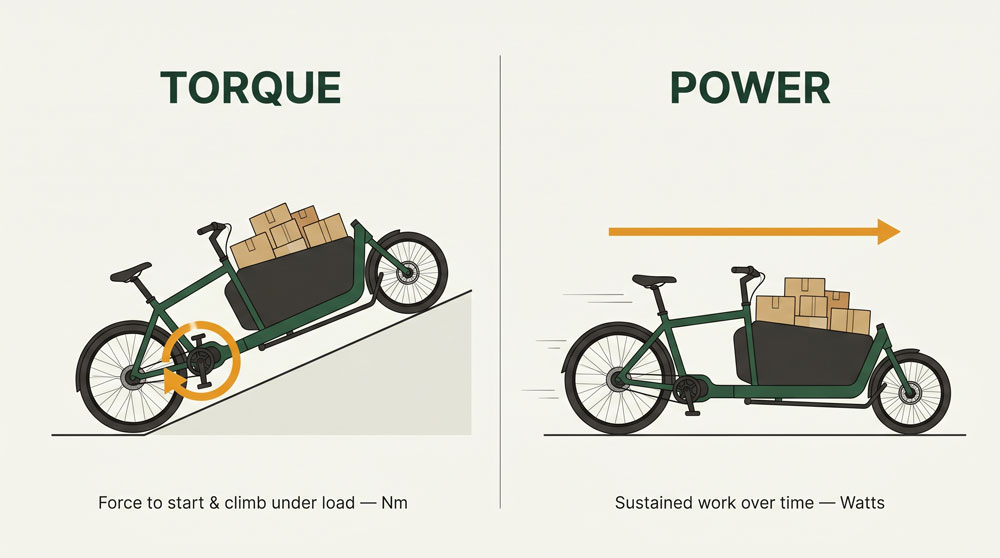
The only motor figure European law fixes is power, not torque. Regulation (EU) No 168/2013 excludes pedal-assisted cycles from type approval where the motor has, in Article 2(2)(h), a maximum continuous rated power of less than or equal to 250 W — and the European Commission’s own interpretation of the categorisation of cycles designed to pedal, prepared for the Motorcycle Working Group in May 2016, repeats that 250 W figure and says nothing at all about torque or peak power.
That absence is the whole problem. Torque has no regulated definition for this category, no required test, and no required duration, so a quoted Nm figure is whatever the supplier’s engineering team means by it. Two differences account for most of the confusion.
Peak against continuous. A peak figure is held for a few seconds while the motor and controller still have thermal headroom. A continuous figure is what survives a long gradient under load until the controller derates. A quote reading 75 Nm continuous and a quote reading 90 Nm peak can describe the same motor, and where they describe different motors the 75 Nm vehicle is often the one that will still be pulling at the top of the hill.
At the shaft or at the wheel. A mid-drive motor’s torque is multiplied by the transmission between it and the ground; a hub motor’s is already at the wheel. Compare a mid-drive’s motor-shaft figure against a hub motor’s wheel figure and you are comparing numbers in different units of effect. Which architecture suits which duty cycle is the subject of our piece on hub motor versus mid drive.
What to ask for is not a better number but the conditions: continuous torque at a stated duration, where it was measured, at what ambient temperature and state of charge, and the point at which the controller begins to derate. A supplier who can produce a derate curve has measured the thing. A supplier who can only repeat the headline has not.
Watt hours against amp hours
Amp-hours cannot be compared without voltage, because they are not a measure of energy. Energy is watt hours, nominal voltage multiplied by amp-hours, as set out in our cargo bike battery specs guide.
So “20 Ah” at 36 V is 720 Wh, and “20 Ah” at 48 V is 960 Wh. Identical on the page, a third more energy in the second one. Quotes that lead with amp-hours are quietly asking you to assume a voltage, and on cargo platforms the voltage varies far more than it does on city e-bikes.
Two further gaps sit behind the headline figure. The first is nominal against usable: a battery management system reserves capacity at the top and bottom of the pack to protect cell life, so usable energy is materially less than nominal, and neither term is standardised in a quotation. The second is that watt hours, not amp-hours, are the unit the rest of the vehicle’s life is counted in — dangerous goods classification, air and sea carriage, and the documentation that follows the pack are all denominated in Wh. The Ah figure never leaves the quotation; the Wh figure follows the vehicle.
Ask for nominal voltage, nominal Wh, usable Wh, and the cell configuration. If a supplier gives you all four without being pressed, that tells you something about the engineering file behind the quote.
Permissible total weight against payload
This is the most expensive of the four, because getting it wrong changes both the vehicle and its certification.
EN 17860-1 defines maximum permissible total weight for carrier cycles, and it is a ceiling on the whole loaded vehicle: kerb weight, rider, cargo, box, accessories, everything. Payload is only what remains after all of that. A quote offering “300 kg payload” and a quote offering “300 kg maximum permissible total weight” are describing vehicles that differ by the entire mass of the bike — on a cargo trike, commonly 55 to 90 kg before a box is fitted — plus whatever rider mass the supplier assumed, which is rarely stated and is not the same everywhere.
The same figure also decides which standard applies to the vehicle, since the lightweight and heavyweight parts of the EN 17860 series are separated by gross vehicle weight. A specification written in payload terms, then transcribed into a permissible total weight on a test request, can quietly put a vehicle into the wrong part — see which EN 17860 parts apply for that mapping.
UnitedMobility’s practice is to quote kerb weight and maximum permissible total weight on the same line, and to let payload be arithmetic rather than a claim, because payload on its own is not a specification — it is a subtraction with two of its three terms missing.
Ask for kerb weight, maximum permissible total weight, and the assumed rider mass. Then do the subtraction yourself, for both quotes, with the same rider mass in each.
IP rating: the same number, a different test
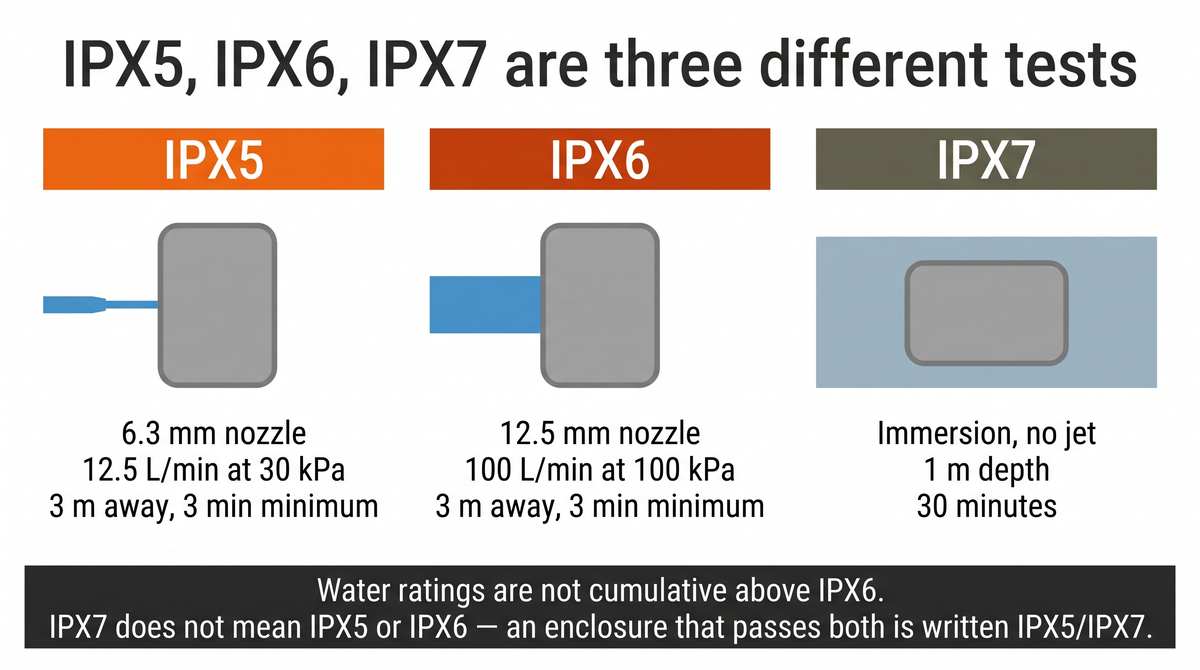
Most buyers read IP ratings as a single scale where a higher number is better protected. For water, that stops being true above IPX6.
Under IEC 60529, as summarised in the standard reference on the IP code, the water ratings are not cumulative beyond IPX6, and a device compliant with IPX7 — immersion — is not necessarily compliant with IPX5 or IPX6. An enclosure that meets both is written with both, as IPX5/IPX7. The practical consequence is that a quoted IP67 pack may be less protected against a pressure washer than a quoted IP65 pack, which inverts the comparison for any fleet that washes its vehicles.
The tests are also narrower than the label suggests. IPX5 is a 6.3 mm nozzle at 12.5 litres per minute and 30 kPa from three metres; IPX6 is a 12.5 mm nozzle at 100 litres per minute and 100 kPa; both run for at least three minutes. IPX7 is thirty minutes at a depth of one metre. Those are different physical events, and passing one says little about the others. Two more details rarely survive into a quotation: the IP code carries supplementary letters recording whether the sample was stationary or in motion during the water test, which matters a great deal for a connector that a wheel throws water at; and the tests are run with fresh water, which says nothing about winter road salt.
Ask which component each rating belongs to — pack, connectors, controller, display are separately rated — which digits, whether they are dual-coded, and whether the sample was tested still or moving. One rating for “the bike” is not a rating.
How to compare cargo bike quotes on the same basis
The method is short, and it is the same every time.
- Rewrite both quotes into the same units before you read either. Watt hours, not amp-hours. Continuous torque at a stated duration, with the measurement point named. Permissible total weight alongside kerb weight. Half the apparent difference between two quotes disappears in this step.
- Ask for the measurement condition, not a better figure. A supplier who answers with conditions has tested the vehicle; a supplier who answers with a bigger number has not understood the question.
- Pin each rating to a component. Ratings that float free of a part number cannot be verified at inspection.
- Put the normalised figures in the contract. A number agreed in an email is not a specification, and the gap is only ever discovered at acceptance.
When you compare cargo bike quotes this way, the cheaper quote sometimes stays the cheaper quote — and now you know what you are buying instead of hoping. If you want a quote broken down on this basis, including the conditions behind each figure, that is the conversation UnitedMobility has through its ODM-Service, and it sits inside the wider sequence set out in our Beschaffung eines Lastenrads guide and the drive specification work in elektrische Trike-Antriebssysteme.
Häufig gestellte Fragen
Which torque figure should a quote give, peak or continuous?
Both, each labelled, with the duration and measurement point for the continuous figure. Torque is not regulated for this category — European law fixes maximum continuous rated power at 250 W and says nothing about torque — so an unlabelled Nm figure has no standard behind it.
Is a 20 Ah battery bigger than an 18 Ah battery?
Not necessarily. Amp-hours are not energy. An 18 Ah pack at 48 V holds 864 Wh against 720 Wh for a 20 Ah pack at 36 V. Compare watt hours, and ask whether the figure is nominal or usable.
Is IP67 better than IP65?
Not for water jets. The water ratings are not cumulative above IPX6, so an IPX7 enclosure is not necessarily IPX5 or IPX6 compliant. If both matter, the rating has to be dual-coded, and the rating has to name the component it applies to.
A supplier quotes 300 kg. Is that payload or total weight?
Ask, in writing. Maximum permissible total weight under EN 17860-1 covers the whole loaded vehicle including its own mass and the rider; payload is what is left over. The two differ by the kerb weight of the bike, and the total weight figure is also what decides which part of the standard applies.
Why does any of this matter if we are buying a sample first?
A sample tells you whether this vehicle works; the normalised figures tell you what the next three hundred are contracted to do. Acceptance disputes almost always come from a number that was never defined, not from a number that was missed.
 German
 English
 Dutch
 Danish
 French
 Polish
 Portuguese
 Spanish