


Kurze Antwort: The import duty electric bikes from China to EU face is not one number, and it is not on your supplier’s quotation. It depends on whether your product is motorised, on a classification that is decided case by case, and on a second tariff regime that names delivery tricycles explicitly. Get those three wrong and a healthy-looking FOB price becomes a loss at the warehouse door.
Import duty electric bikes from China to EU: the number nobody quotes
A supplier quotes FOB. A forwarder quotes freight. Nobody quotes the duty, because the duty depends on facts about your product and your role that neither of them is in a position to settle for you. New entrants to this industry routinely build a business case on FOB plus freight, discover the tariff position afterwards, and find the margin was never there.
This article is only about money leaving your account between a purchase order and saleable stock in your warehouse: tariffs, landed cost, deposit terms and working capital. The separate question of which commercial model to choose, what development costs look like and how the supplier relationship is structured is answered in OEM vs ODM cargo bike cost for European distributors, and we will not repeat any of it here. If you want the whole buying sequence in order, start with cargo bike procurement.
Two tariff regimes: CN 8711 60 and where delivery tricycles sit
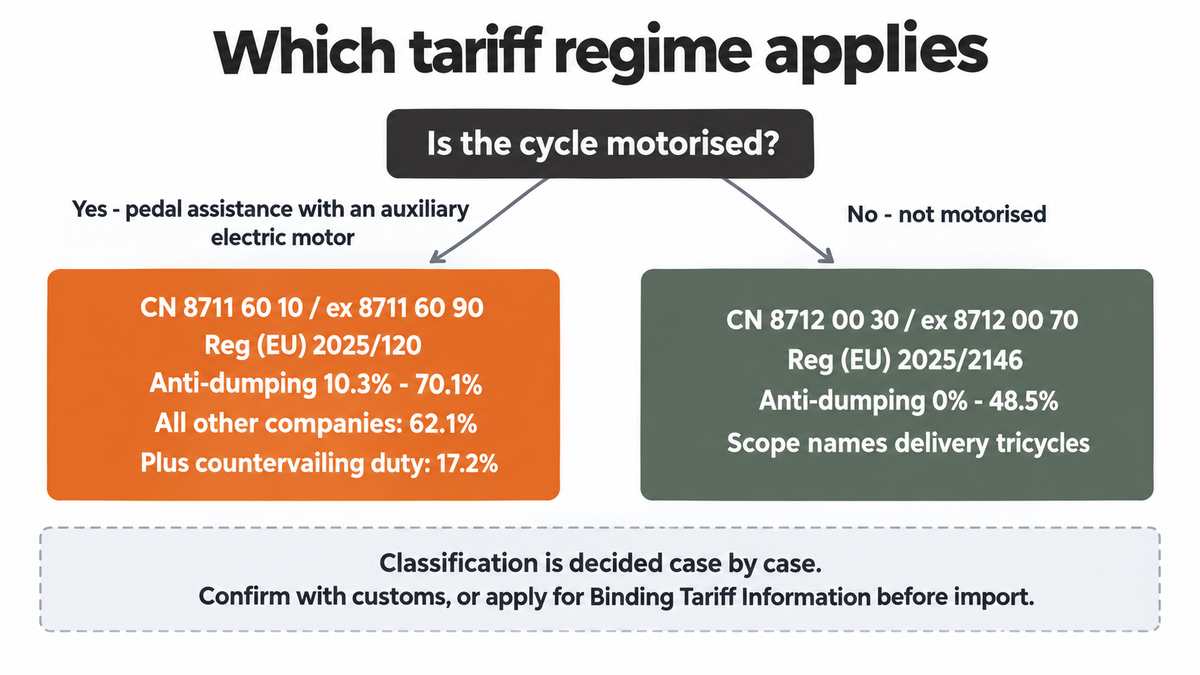
The first question is not “what is the duty”. It is “is this thing motorised”, because that decides which of two entirely separate sets of measures applies.
Pedal-assist e-bikes. Commission Implementing Regulation (EU) 2025/120 of 23 January 2025 re-imposed a definitive anti-dumping duty on “cycles, with pedal assistance, with an auxiliary electric motor” from China following an expiry review, under CN 8711 60 10 and ex 8711 60 90 — the CN 8711 60 heading is where anything with an auxiliary motor lands. It entered into force the day after publication, on 25 January 2025, and an expiry review extends measures for a further five years. The original duties ranged from 10.3% to 70.1%; the residual rate for “all other companies” is 62.1% under TARIC additional code C999. And there is a second measure stacked on top: the same regulation records a countervailing duty of 17.2% for that same “all other companies” group.
Read those two numbers together, because importers routinely find only the first. The anti-dumping duty ebike importers quote to each other is rarely the whole bill.
Non-motorised cycles. Commission Implementing Regulation (EU) 2025/2146 of 22 October 2025 covers “bicycles and other cycles (including delivery tricycles, but excluding unicycles), not motorised” under CN 8712 00 30 and ex 8712 00 70. Note what is inside that bracket: delivery tricycles are named in the scope. Duty rates under the preceding measures ran from 0% to 48.5%, and the measures have been extended to consignments from several other countries as well as China.
| Pedal-assist e-bikes | Non-motorised cycles | |
|---|---|---|
| Governing measure | Reg (EU) 2025/120 | Reg (EU) 2025/2146 |
| CN codes | 8711 60 10, ex 8711 60 90 | 8712 00 30, ex 8712 00 70 |
| Scope wording | “cycles, with pedal assistance, with an auxiliary electric motor” | “bicycles and other cycles (including delivery tricycles, but excluding unicycles), not motorised” |
| Rate range | 10.3%–70.1%; residual 62.1% | 0%–48.5% under preceding measures |
| Parallel countervailing duty | Yes — 17.2% residual | Confirm separately |
A non-motorised cargo trike and the same frame with a motor fitted are therefore in different legal universes. That is not a loophole; it is simply how the two regimes are drawn, and it is why the motorisation decision has a tariff consequence that belongs in the product brief rather than in the shipping conversation.
Classification is a case-by-case question — and BTI exists
Here is where honest advice stops short of a conclusion. We cannot tell you your commodity code, and neither can any supplier. Classification turns on the specific configuration, components and intended function of your product, and for cargo and three-wheeled vehicles the boundaries are genuinely contested. Every component specification differs by company, and the position has to be confirmed with customs — in practice your forwarder will run that confirmation for you.
What almost nobody in this industry uses is the instrument built for exactly this problem. European Binding Tariff Information is a formal classification decision you apply for before you import. A BTI is “binding on all EU customs administrations and the holder of the decision”, the holder “must declare their BTI decision and use it for customs procedures”, and it is generally valid for three years. You apply per product type through the EU Customs Trader Portal — some member states use their own portal — with a detailed description of the goods, and it cannot be issued retroactively, so it is a pre-import tool only.
In our experience no customer has ever raised BTI with us. That is remarkable for a decision worth tens of percentage points of landed cost, and it is the single highest-value thing most readers of this article will take from it. If your classification is uncertain and your volumes are meaningful, a BTI converts an unquantified tariff risk into a three-year known quantity before you commit the order.
Building a landed cost cargo bike importers can bank on
Landed cost is a stack, not a line. Build it in this order and nothing hides:
| Component | What it depends on |
|---|---|
| FOB price | Your specification and volume |
| Freight and insurance | FOB versus CIF — who books and who carries the risk |
| Conventional customs duty | Your commodity code |
| Anti-dumping duty | Origin, exporter, and TARIC additional code |
| Countervailing duty | Stacks on top of anti-dumping where it applies |
| Import VAT | Charged on the duty-inclusive value; recoverable, but it is cash out first |
| Clearance, port and handling charges | Port, forwarder and whether documents are clean |
| Inland transport to your warehouse | Distance and delivery terms |
| Compliance and registration costs | Market entry obligations — see EPR for e-bike importers |
Two things on that list are routinely mis-modelled.
Import VAT is a cash-flow event, not a cost. You will recover it, but you pay it at clearance on a value that already includes duty, which means the higher the tariff, the larger the VAT you temporarily fund.
The deposit arrives long before the stock does. Our terms are a 30% deposit by telegraphic transfer, which is normal in this industry. Model it honestly: 30% of the order value leaves your account at order placement, the balance before or at shipment, VAT and duty at clearance — and the first euro of revenue arrives after the goods are in the warehouse and listed. For a first order that sequence, not the unit margin, is what decides whether a new brand survives its own launch.
EU assembly CKD: parts are outside the measures, and where the legal line runs
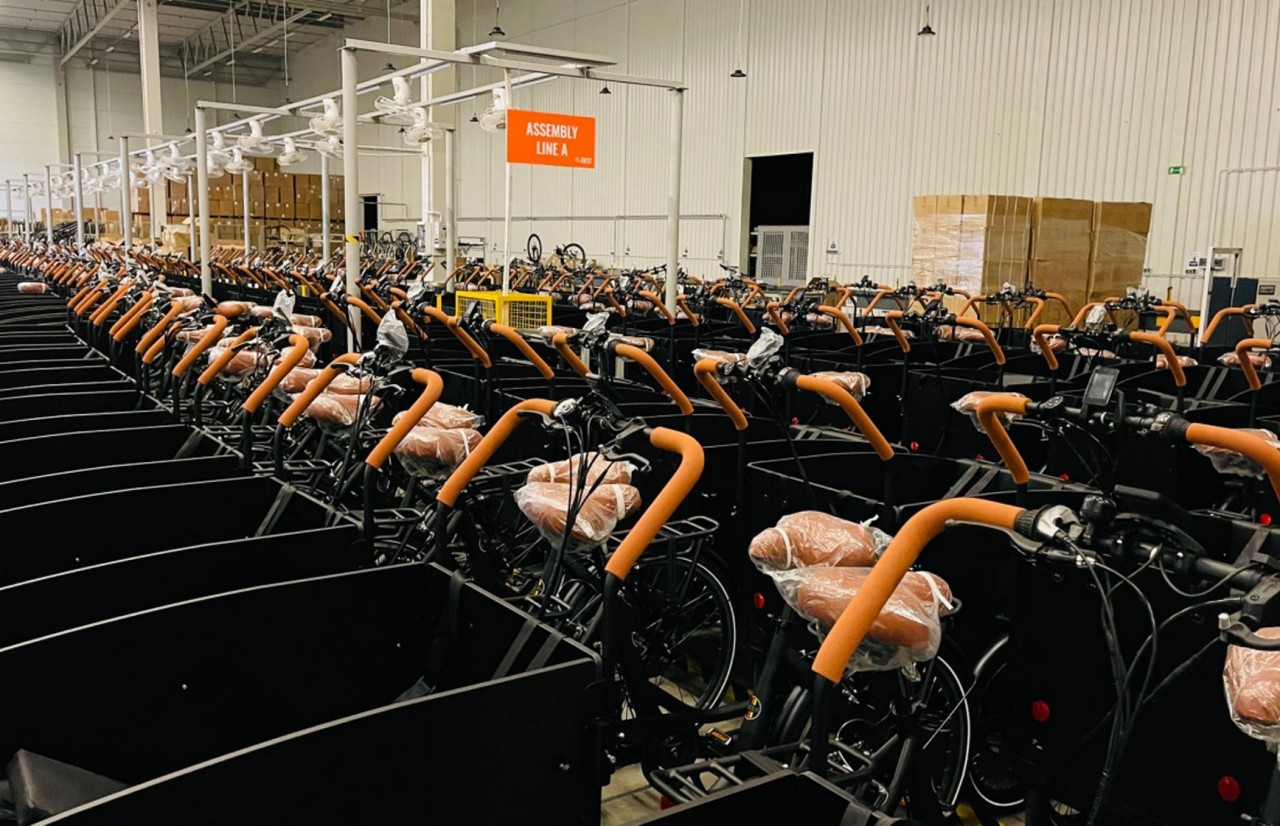
Let us be precise about the question this section answers, because a wrong version of it circulates. The question is this: under what conditions does assembly in the EU constitute genuine European manufacturing rather than a paper exercise — and where exactly does EU law draw that line? That line is written down, it is specific, and any serious buyer should know it before planning a supply chain around either option. It is also the line a national authority would measure your counterparty against, which is why it belongs in due diligence rather than in a sales pitch.
Start with a fact from the measures themselves. When a party asked the Commission to clarify that imported parts were excluded from the e-bike duties, Regulation (EU) 2025/120 recital 29 records that clarification “was not warranted since parts are not covered by the measures that are subject of this review.” Parts are simply not within scope. That is the structural basis on which CKD assembly operations exist at all, including the Polish lines UnitedMobility assembles on — and in our case all production for European customers runs CKD.
The line is drawn by the anti-circumvention provisions of Regulation (EU) 2016/1036. Two parts of Article 13 matter.
Article 13(1) defines circumvention as requiring, among other elements, a practice or process for which there is “insufficient due cause or economic justification other than the imposition of the duty”. An assembly operation with real commercial reasons — proximity to the market it serves, shorter lead times to European customers, lower inbound logistics cost, the ability to configure late — is not an operation whose only rationale is a duty. That is a question of fact about a business, and it is the first thing a well-run operation can evidence.
Article 13(2) then sets three cumulative conditions for treating an assembly operation as circumvention. The operation must have started or substantially increased around the initiation of the investigation with parts from the country under measures; the remedial effects of the duty must be undermined with evidence of dumping; and on the parts test, the parts must “constitute 60 % or more of the total value of the parts of the assembled product” — followed by the proviso that matters most:
“except that in no case shall circumvention be considered to be taking place where the value added to the parts brought in, during the assembly or completion operation, is greater than 25 % of the manufacturing cost”
So there is a defined safe harbour, expressed as value added against manufacturing cost, and it is absolute in its own terms. Whether a given assembly operation sits above it is a question of that operation’s real cost structure, verifiable from its accounts — which is precisely why it is a question to put to a manufacturer’s finance function with documentation, not a claim to accept in a sales meeting. We do not publish our own figure here; what you should take away is that the test exists, that it is the test your counterparty will be measured against, and that you are entitled to ask how they satisfy it.
Two practical consequences for a European buyer. First, if you are comparing a China-direct quotation with an EU-assembled one, you are comparing two different tariff positions, and the comparison is meaningless until both are expressed as landed cost. Second, EU assembly has operational consequences beyond duty — Herstellung von Lastenrädern Und frame manufacturing explain what is and is not done where, and for fleet-scale programmes the Nutzlastrad view sets out how configuration affects the build. If you want a landed-cost comparison run on your actual specification rather than on a generic rate, that is a conversation to have through our ODM-Service or directly with the UnitedMobility team.
Figures current as of October 2026; duty rates, TARIC codes and measures change — verify your position against EUR-Lex and TARIC and confirm classification with customs or through a BTI application before you commit to an order.
Häufig gestellte Fragen
Is the import duty electric bikes from China to EU face a single rate?
No. A conventional customs duty, an anti-dumping duty and, where it applies, a countervailing duty can all apply to the same consignment, and the anti-dumping rate depends on the specific exporter and its TARIC additional code. The residual rate for “all other companies” on pedal-assist e-bikes is 62.1%, with a further 17.2% countervailing duty recorded for that group.
Are cargo trikes treated as e-bikes?
It depends entirely on motorisation and configuration. Non-motorised cycles fall under a separate measure whose scope expressly includes delivery tricycles. A motorised version may fall under the e-bike measure instead. This is exactly the situation a BTI application exists for.
Does importing parts rather than complete bikes change the duty position?
Parts are not covered by the e-bike anti-dumping measures — recital 29 of Regulation (EU) 2025/120 says so directly. What that does not do is answer whether a given assembly operation is genuine EU manufacture; that is governed by Article 13 of Regulation (EU) 2016/1036, including a proviso that circumvention can in no case be found where value added during assembly exceeds 25% of manufacturing cost.
How long does a BTI take and how long does it last?
Apply before importing, per product type, through the EU Customs Trader Portal. A decision is generally valid for three years, binds all EU customs administrations and the holder, cannot be amended, and has no retroactive effect.
What cash do I need before the first container arrives?
At minimum a 30% deposit at order placement, the balance by shipment, then duty and import VAT at clearance, plus clearance and inland transport — all before any stock is sold. Model that sequence as a cash curve, not as a single landed-cost figure.
 German
 English
 Dutch
 Danish
 French
 Polish
 Portuguese
 Spanish