


Core takeaway (read this first): DJI’s 1,500W Avinox raises the ceiling on cargo bike motor power — but for commercial hauling, torque, heat control, and component matching matter far more than headline watts.
A 30-second primer on what a cargo bike motor actually does
An e-bike motor converts battery power into forward assistance. Two numbers describe it.
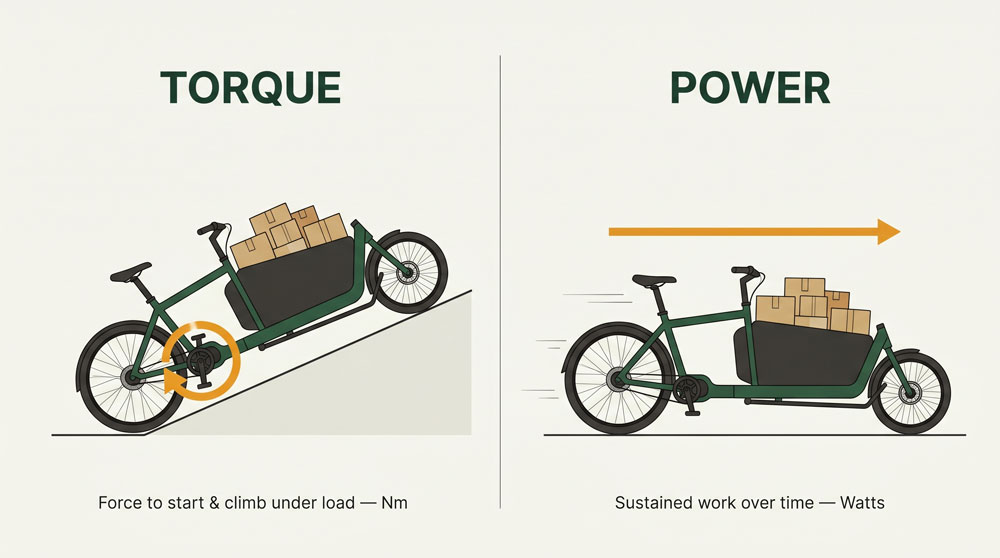
Power, measured in watts, is how much work it can do over time — roughly, sustained speed and the ability to keep moving under load.
Torque, measured in newton-metres (Nm), is rotational force — what you feel pulling away from a standstill and grinding up a hill with a loaded box.
For a cargo bike motor, torque is the number that decides whether the bike is usable. A fully loaded long john or front-trike carrying 150–250kg starts and stops constantly in city traffic. Each pull-away from rest demands force, not top speed. This is why the cargo segment has always cared more about Nm than about km/h.
Who is DJI, and why is the bike industry talking about Avinox?
DJI is the Chinese drone giant. In 2024 it brought its motor, battery and software expertise into e-bikes under the Avinox brand, which now operates as an independent name. The original M1 motor stunned the industry with 120Nm and 1,000W peak from a unit weighing just 2.5kg — the lightest full-power drive on the market at launch.
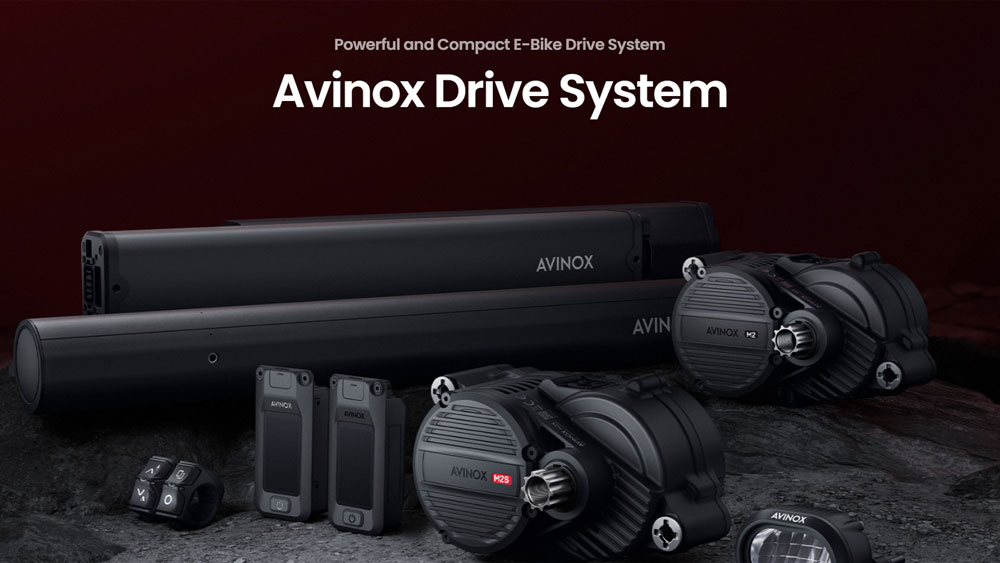
In April 2026, Avinox went further. The new lineup raised the bar to figures the mainstream had never targeted:
- Avinox M2S: up to 1,500W peak power and 150Nm torque
- Avinox M2: up to 1,100W peak power and 125Nm torque
- Weight: approximately 2.6kg — essentially unchanged from the M1
- Partner brands: around 60 manufacturers signed on
- New for 2026: removable battery options (RS600/RS800), OLED navigation display, and heart-rate-based assist
For context, premium mainstream mid-drives from Bosch, Shimano, Brose and Yamaha generally sit around 600–850W peak and 85–100Nm. Avinox roughly doubled the torque the industry had quietly agreed was “enough.” That is why it dominates conversation — and why competitors feel cornered.
Watts vs torque: which number matters for a cargo bike motor?
Here is the trap most spec sheets set. A big peak-watt figure looks impressive, but watts only translate into real-world hauling if the rest of the system can feed them. Battery voltage sag, controller current limits, and heat all cap what the motor actually delivers under sustained load.
What a cargo operation should weigh:
- Torque (Nm) decides start-from-stop and climbing ability under load — the daily reality of urban delivery
- Sustained power matters only if the controller and battery can supply current without overheating
- Heat management is the hidden killer: a motor pushed hard for hours, fully loaded, in summer, will throttle itself if it can’t shed heat
- Support ratio (how much the motor multiplies rider input) affects how natural the assistance feels at low speed
For most commercial cargo duty, 85–110Nm of well-managed torque beats 150Nm of poorly-cooled peak power. The Avinox figures are genuinely useful for steep-gradient cities and heavy payloads — but only inside a system built to sustain them.
Hub motor vs mid-drive: the cargo bike’s defining choice
Where the motor sits changes everything. This is the hub vs mid-drive cargo bike decision, and it has a clear consensus for heavy loads.
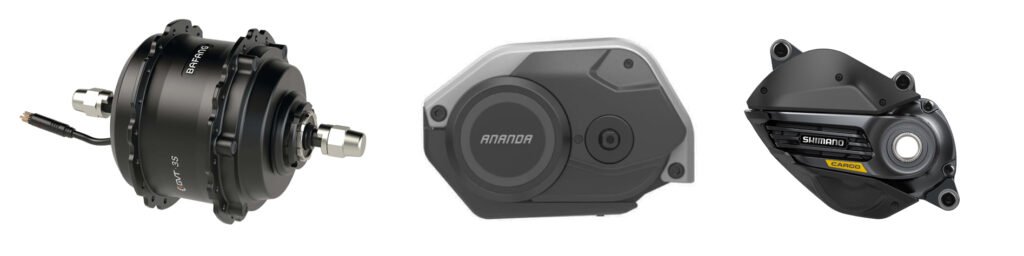
Mid-drive motors sit at the bottom bracket and drive through the bike’s gears. Because they multiply torque through the drivetrain, they climb steep hills with a full load far more efficiently. The ride feels natural. The trade-off: the motor’s force passes through the chain, cassette and derailleur, so those parts wear faster and need attention.
Hub motors sit inside the wheel and drive it directly, independent of the gears. They are simpler, more reliable, cheaper to maintain, and quieter — but they can’t use gearing to multiply torque, so they struggle on long or steep climbs under heavy load.
The practical verdict for cargo:
- Heavy loads + hills (most commercial cargo): mid-drive wins, clearly
- Flat-city light cargo + low maintenance priority: a strong geared hub with a torque sensor is viable and cheaper over the bike’s life
- High-power systems like Avinox are mid-drives — which is the correct architecture for the cargo job, even before the power debate
The Avinox is a mid-drive. That alone makes it relevant to cargo, regardless of the wattage headline.
Where the motor sits shapes the whole bike
Motor placement isn’t only about climbing. It drives the bike’s balance, and therefore its handling under load.
A rear-hub motor with a rack-mounted battery concentrates weight over the back wheel, which makes a loaded longtail feel sluggish and tail-heavy. A mid-drive keeps mass low and central, near the bottom bracket — exactly where a cargo bike wants it for stability when the box is full. This is one reason serious commercial platforms, including our own electric cargo bike range, are built around central mid-drives rather than hub motors. Load stability and predictable handling matter more to a fleet than the lower upfront cost of a hub.
What real riders and the industry are saying
The reaction to ultra-high-power motors has split the industry.
Supporters point to genuine benefits: steep climbs become trivial, and heavier riders, older riders, and cargo-hauling applications get assistance that lower-powered systems can’t match. In a May 2026 statement, Avinox defended its approach precisely on these grounds, arguing that a rigid one-size-fits-all power limit excludes the riders who benefit most from more assistance — and naming cargo as a key example.
Critics raise two concerns. First, regulation: 1,500W sits well outside the 250–750W limits that define a road-legal pedal-assist bicycle in most markets, so a bike using full Avinox power may not be street-legal as a bicycle. Second, category creep: increasingly powerful e-bikes blur the line between bicycle and light motorcycle, inviting regulatory pushback.
For a commercial buyer, the takeaway is nuanced. The power headroom is real and useful. But you’ll likely run it capped to your market’s legal limit — which means the quality of the motor’s torque delivery and heat management matters more than its peak figure.
The benefits and risks of an Avinox-class cargo bike motor
Benefits:
- Abundant torque for the heaviest payloads and steepest urban gradients
- Light weight (2.6kg) keeps the overall bike manageable
- Mature software ecosystem: GPS, anti-theft, app tuning, fast charging
- Removable battery options now suit the daily reality of cargo and commuter use
Risks:
- Peak power often exceeds local legal limits for bicycles; needs capping
- High output stresses the drivetrain — chains and cassettes wear faster
- Heat under sustained commercial load is a real constraint, not a spec-sheet footnote
- A premium, tightly integrated ecosystem can mean tighter dependence on one supplier
Component matching: the part buyers forget
A powerful cargo bike motor is only as good as the parts around it. Doubling torque means everything downstream must be rated for it:
- Drivetrain: chains, cassettes and derailleurs wear faster under high torque. Belt drives or internally geared/gearbox systems (e.g. enviolo, Pinion) reduce this and suit fleets
- Brakes: more power and speed demand hydraulic discs with larger rotors (180–203mm)
- Frame: the frame must be rated to handle both the payload and the motor’s force — EN 17860 compliance becomes essential
- Battery and controller: must supply sustained current without sag or overheating, or the headline watts never materialise
Bolting a 150Nm motor onto a frame and drivetrain specced for 85Nm is a warranty claim waiting to happen. Matching is not optional.
How long until high-power motors reach cargo bikes?
Today, the Avinox M2/M2S are overwhelmingly specced on electric mountain bikes, not cargo bikes. Direct cargo applications are not yet on the market in volume. But the trajectory is clear:
- High torque is exactly what heavy cargo needs
- Avinox has publicly named cargo as a target use case
- Removable batteries — newly added — are a cargo and commuter feature, not an eMTB one
- Around 60 partner brands give the platform fast reach across segments
A realistic estimate: expect credible high-power, cargo-specific drive options to appear within roughly 12–24 months, first on premium and commercial platforms where the payload justifies the cost and the operator can manage the regulatory framing.
The bottom line
DJI’s Avinox has genuinely moved the cargo bike motor conversation. The 1,500W headline matters less than what it signals: the old 85Nm ceiling is gone, and high-torque mid-drives are becoming the expected architecture for serious hauling. For commercial buyers, the smart position is to chase well-managed torque, robust heat handling, and a properly matched drivetrain — not the biggest number on the page. The brands that win the next cargo cycle will be the ones that pair appropriate power with frames, brakes and transmissions engineered to sustain it.
To see how mid-drive architecture and load-rated frames come together in a commercial platform, explore our modular cargo bike for commercial fleet >UM Frontier modular cargo bike or the full cargo bike lineup.
United Mobility (Wuxi United Mobility Technology Inc.) is a cargo bike ODM/OEM manufacturer with nearly two decades of experience supplying customized cargo bikes to operators, municipalities, and private-label brands across Europe and US.
 English
  German
  Dutch
Dutch  Danish
  French
  Polish
  Portuguese
  Spanish