

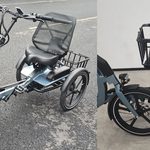

Someone asked us recently: “What’s the benefit of a recumbent over an upright? Reduces turning radius, right?”
It’s a fair assumption — and a common one. But the answer is actually the reverse, and unpacking why reveals something more interesting: the real advantages of a semi-recumbent trike have nothing to do with cornering geometry, and everything to do with what your body feels after an hour in the saddle.
Looking for senior-friendly electric trike options for your brand? Explore our ODM/OEM electric tricycle range →
The Turning Radius Question — Let’s Clear This Up First
A semi-recumbent trike is typically longer than an upright trike of equivalent wheel size. That longer wheelbase means a wider turning radius, not a tighter one. If you’re navigating a narrow bike lane junction or reversing out of a tight parking space, a compact upright trike actually has the maneuverability edge.
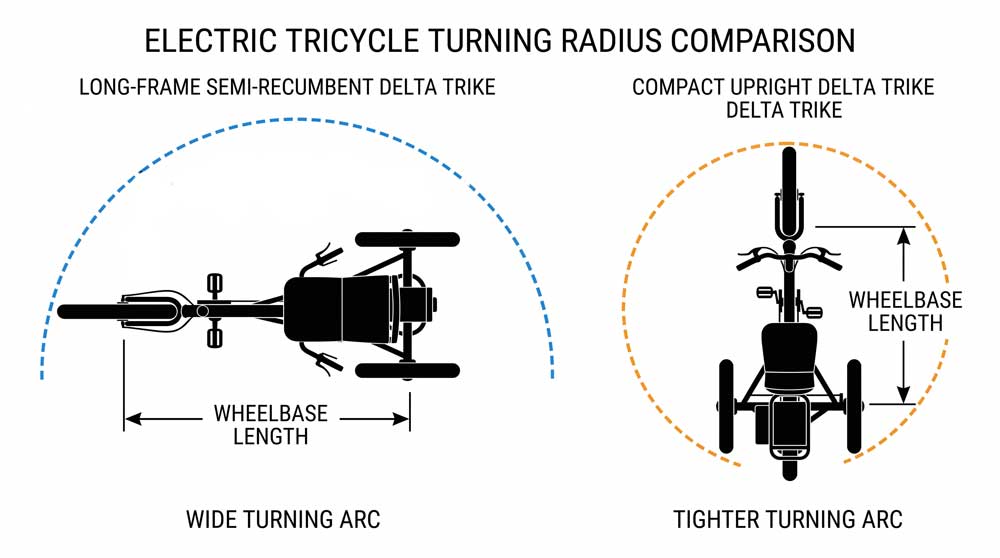
That said, turning radius is not fixed. It depends heavily on frame length, front wheel size, and steering geometry. A compact semi-recumbent model — one with a shorter frame and smaller front wheel — can close that gap considerably. We’ll come back to this when we compare two specific models below.
The point is: don’t choose between recumbent and upright based on a turning radius assumption. Choose based on what matters more to you — and for most riders, that turns out to be comfort, not cornering.
What a Semi-Recumbent Design Actually Changes
The defining feature of a semi-recumbent electric trike is not the wheel configuration — it’s the rider’s relationship to the machine. Here’s what shifts, systematically, compared to an upright:
1. Weight distribution across your whole body
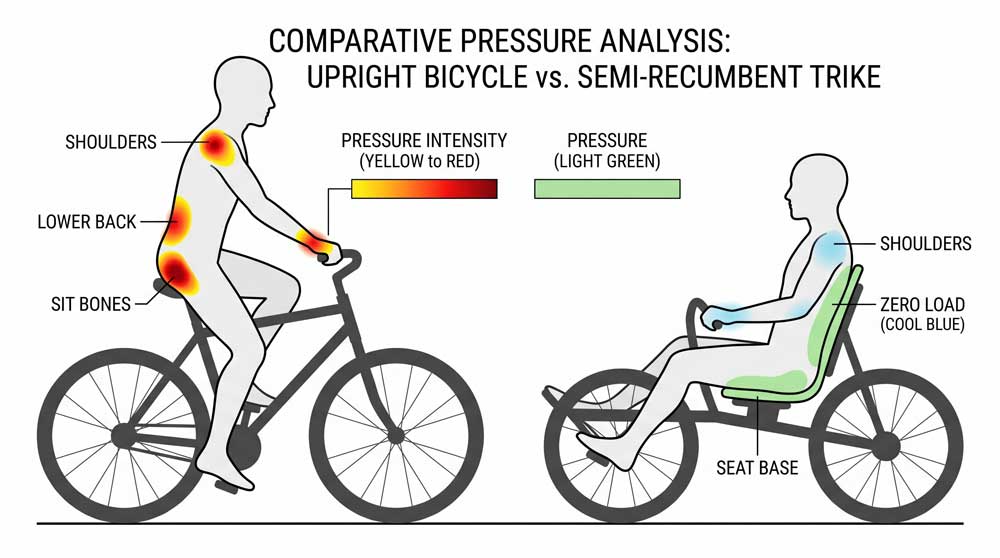
On an upright trike, your body weight is shared between your sit bones, your wrists (bearing down on the bars), your lower back (holding your torso upright), and your shoulders (absorbing road vibration). After 30 minutes, you feel all of those points. After 90 minutes, some of them ache.
On a semi-recumbent, you sit into a wide, chair-like seat with a full backrest. Your weight spreads across your back and seat base. Your wrists float — they steer, but they don’t support. Your shoulders are relaxed. The result isn’t just comfort in the abstract; it’s a fundamentally different fatigue curve that lets you ride longer without the compounding discomfort that makes most upright riders cut their rides short.
2. Handlebar reach — and this is where frame length matters
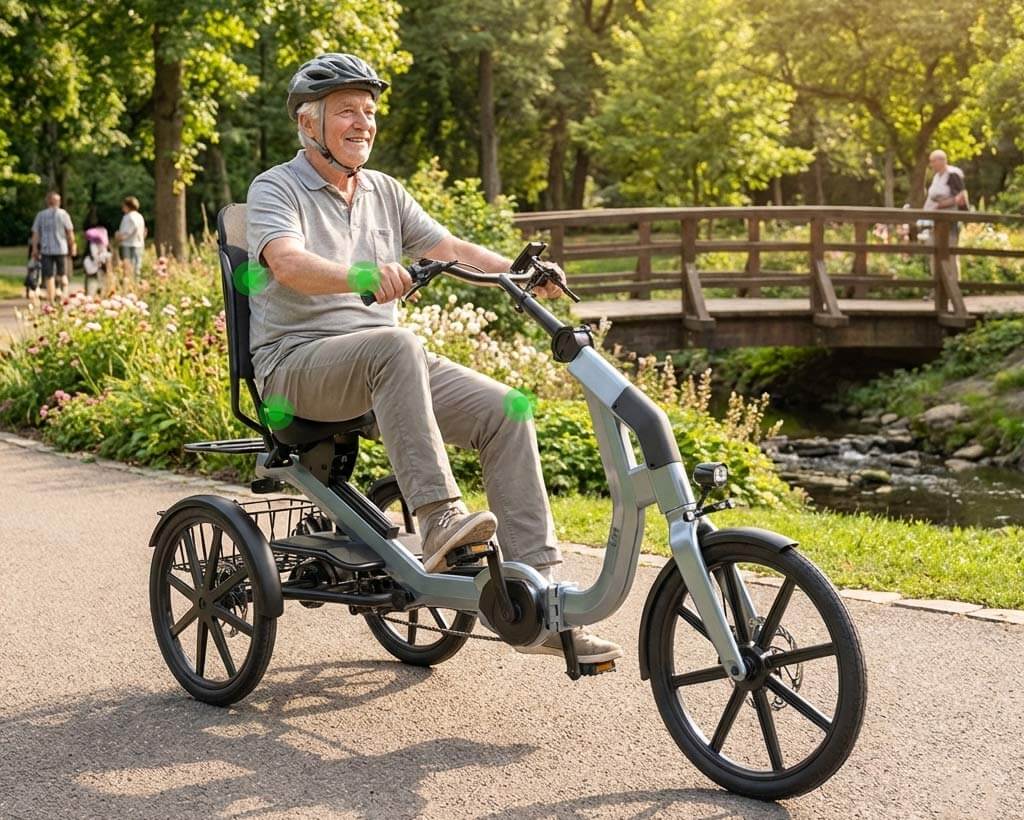
Here’s where the turning radius question connects to something genuinely important. Because semi-recumbent trikes vary in frame length, the distance from the seat to the handlebars varies too. On a longer-frame model, the bars sit further from the rider — arms are extended into a relaxed, nearly neutral position, with no forward lean. On a shorter-frame model, the bars are closer and slightly higher, giving a more upright feel within the recumbent format.
Either way, the critical difference from an upright is this: you are not reaching forward under tension. The bars come to you. That eliminates the shoulder compression and wrist load that make upright riding uncomfortable for anyone with joint sensitivity — which is most people over a certain riding age.
3. Core engagement — removed rather than recruited
Riding upright requires your core to work continuously to keep your torso stable. Most riders don’t notice this until they stop. On a recumbent, the seat does that work. Your core is disengaged from posture management and can simply rest. For riders with lower back issues, disc problems, or reduced core strength, this is often the decisive factor.
4. Stability at stops
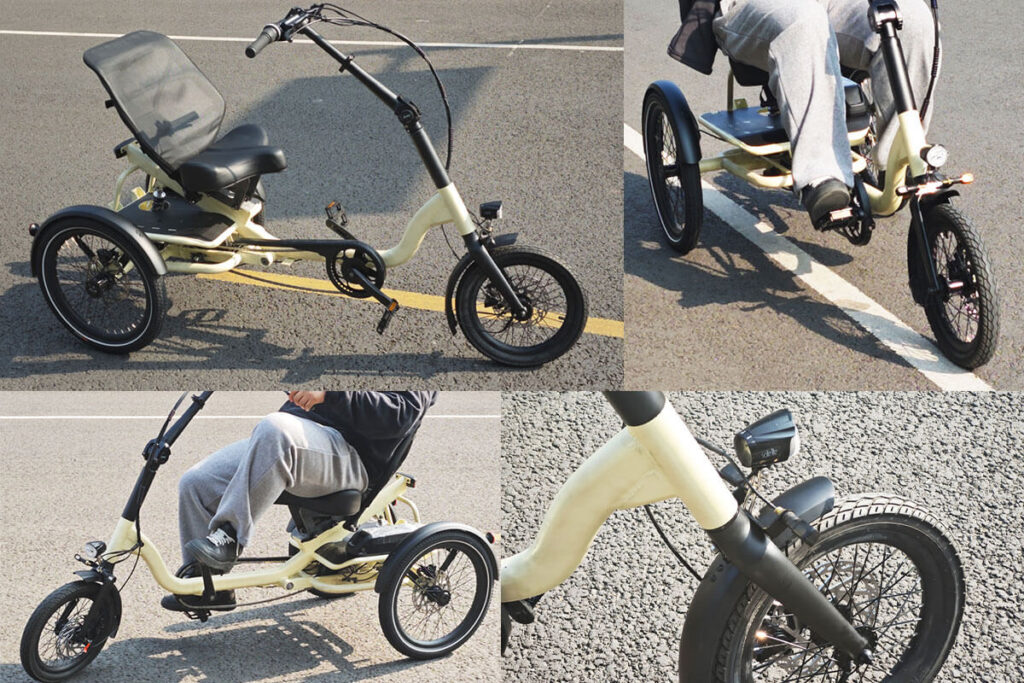
Three wheels mean no balancing at traffic lights. But the semi-recumbent goes further: the low centre of gravity — a direct result of the reclined seating position — makes the trike feel planted and predictable at low speeds and during tight turns. It’s a qualitative difference that affects rider confidence as much as safety.
5. Power transfer
With your back supported by the seat, you have a fixed point to push against with every pedal stroke. Upright riders rely entirely on leg strength, sometimes rocking the torso for extra power. Recumbent riders can sustain more consistent pedal pressure over distance, which matters on longer routes or gradual inclines.
Upright Trikes: Where They Still Have the Edge
Honesty matters here. Upright electric trikes have real advantages in specific scenarios:
- Tighter turning radius in compact models, better for very confined urban routes
- Immediate familiarity — the riding position is close to a standard bicycle, requiring no adaptation period
- Lower purchase price in many cases, since the frame design is simpler
- Better sightlines in traffic for riders accustomed to an upright posture
For riders who want a straightforward, familiar ride and don’t plan on long distances, an upright trike is a sensible and capable choice. For riders where comfort is the primary goal — daily errands, leisure riding, post-rehabilitation mobility, or any scenario where joint health matters — the semi-recumbent is in a different category.
Explore how both formats serve senior riders specifically here →
Chill vs Vita: Two Semi-Recumbent Trikes, Two Different Riders
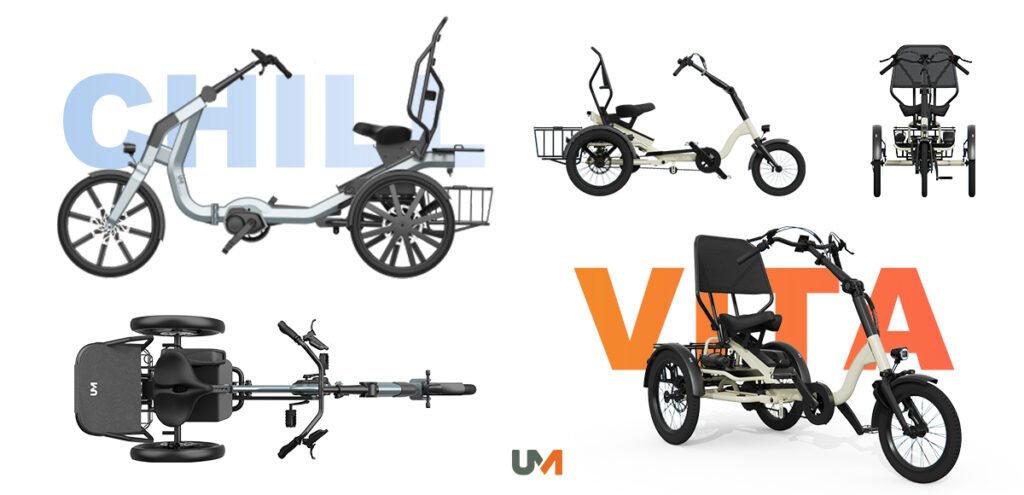
If you’ve decided that the semi-recumbent format fits your needs, the next question is which model. The UM Chill and UM Vita share the same ergonomic philosophy but are built for meaningfully different riders.
UM Chill — The Full-Featured Platform
The Chill is the larger of the two. Its longer frame positions the handlebars further from the rider, giving taller riders (up to around 1.95m / 6’4″) a genuinely comfortable reach without compression. The 42cm-wide seat mounts on an angled sliding rail, allowing both height and fore-aft adjustment — so the relationship between seat, pedals, and bars can be dialled in precisely.
Power comes from a 120N·m Ananda M100 mid-drive motor with internal shifting, delivering smooth and consistent output across terrain. The modular frame disassembles for transport or storage — a practical feature for riders who want to take it in a vehicle without a trailer. Maximum total load: 200kg.
The Chill is the right choice for riders who want maximum adjustability, who are taller or larger-framed, or who plan to ride frequently over longer distances where the premium component spec and extended ergonomic range earn their keep.
Explore more benefits of the semi-recumbent trike Chill >>
UM Vita — Compact, Agile, Built for Smaller Riders
The Vita takes the same semi-recumbent comfort principle and packages it in a lighter, more compact frame. The shorter overall length brings the bars closer to the rider — a natural fit for riders of smaller stature who would find the Chill’s longer reach too extended. The smaller front wheel(16″ front, 20″ rear) that comes with the more compact geometry has a direct effect on turning radius: the Vita is noticeably more agile in tight spaces than the Chill, partially closing the gap with upright trikes on maneuverability without giving up the recumbent’s comfort advantages.
That combination — compact frame, smaller front wheel, tighter arc — makes the Vita a particularly good fit for women and petite riders who want the full ergonomic benefit of the semi-recumbent position without a bike that feels oversized for their frame. The 42cm seat base is independently height-adjustable, puncture-resistant reflective tires are standard, and an optional dual-battery system extends range for riders who want more distance without anxiety.
The Vita is the right choice for daily urban use, riders transitioning away from two-wheel bikes, and anyone who prioritises lightness and maneuverability alongside comfort.
Explore more benefits of the semi-recumbent trike Vita >>
The Honest Summary
| Upright Trike | Semi-Recumbent (Chill) | Semi-Recumbent (Vita) | |
|---|---|---|---|
| Turning radius | Tighter | Wider | Moderate — most compact of the three |
| Wrist/shoulder load | High | None | None |
| Back support | None | Full backrest | Full backrest |
| Best for height | All | Taller riders | Smaller riders, women |
| Ride duration comfort | Short–medium | Long | Long |
| Urban agility | Best | Moderate | Good |
| Familiarity | Immediate | Small learning curve | Small learning curve |
If you’re comparing a recumbent to an upright and your first question is about turning radius, you’re probably asking the wrong question. Ask instead: how long do I plan to ride, and how does my body feel after an hour on a traditional saddle? The answer usually makes the decision for you.
Browse the full range of electric trike for seniors or contact the team to discuss which configuration fits your riding profile.
Recommended Reading:
 English
  German
  Dutch
Dutch  Danish
  French
  Polish
  Portuguese
  Spanish