

La certification UL 2849 pour les tricycles électriques est un point de départ crucial pour la plupart des projets d'entrée sur le marché américain : soit ils réussissent, soit ils échouent, entraînant des coûts importants. Cette norme n'est pas un document obtenu après la commercialisation du produit ; elle évalue l'ensemble du système électrique, ce qui signifie que les choix techniques – architecture de la batterie, appairage du chargeur, comportement du contrôleur, logique de coupure – sont figés bien avant la délivrance du certificat. L'ajout de variables spécifiques aux tricycles, comme les deux moteurs, la marche arrière et la transmission différentielle, complexifie encore le processus. Cet article détaille les exigences réelles d'un tricycle électrique destiné au marché américain, les différences entre les modèles à trois roues et semi-couchés et les modèles à deux roues, ainsi que les conséquences d'une éventuelle adoption de la réglementation fédérale proposée par la CPSC.
Les chiffres et le statut réglementaire sont à jour en juillet 2026. Les exigences de certification évoluent ; veuillez confirmer la portée auprès de votre organisme de certification et, pour les questions de droit étatique, auprès d’un avocat américain avant d’utiliser ces informations à des fins commerciales.
Les quatre couches, dans l'ordre où elles vous lient
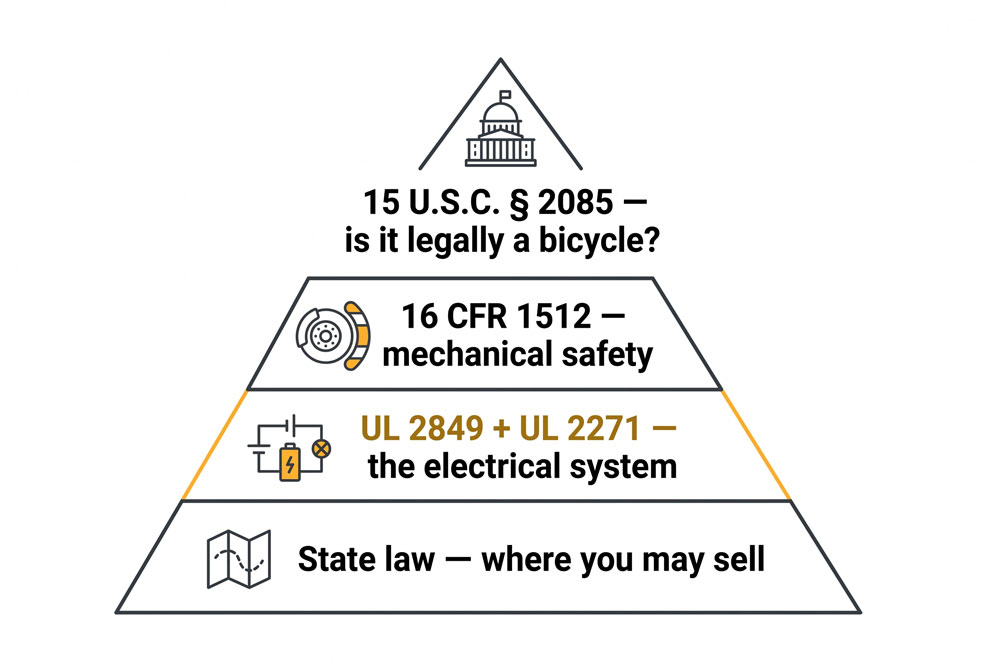
1. Classification fédérale des produits — 15 USC § 2085.
Un “ vélo électrique à basse vitesse ” est un à deux ou trois roues Véhicule doté de pédales entièrement fonctionnelles, d'un moteur de moins de 750 W et d'une vitesse maximale en mode tout électrique inférieure à 32 km/h. Seuls les véhicules à trois roues sont concernés. Si ces limites sont respectées, le produit est considéré comme un produit de consommation réglementé comme un vélo, et non comme un véhicule motorisé. Dans le cas contraire, il sort complètement du cadre réglementaire du vélo – un seuil bien plus important que ce que la plupart des discussions techniques laissent entendre.
2. Sécurité mécanique fédérale — 16 CFR 1512.
La réglementation de la CPSC relative aux vélos couvre les freins, les réflecteurs, les éléments saillants, les fixations, les instructions de montage et les essais de structure. Elle s'applique aux vélos électriques à basse vitesse en vertu de l'article 2085, ce qui inclut les tricycles. Cette réglementation ayant été rédigée pour les vélos à deux roues, plusieurs dispositions nécessitent une appréciation quant à leur application à un tricycle ou un vélo couché ; le positionnement des réflecteurs et la visibilité depuis une position assise plus basse en sont des exemples évidents. Il est donc essentiel de poser ce type de question par écrit à l'organisme de certification plutôt que de se fier à des suppositions.
3. Sécurité du système électrique — Certification des batteries UL 2849 et UL 2271.
La norme UL 2849 est une norme système : la batterie, le chargeur, le moteur, le contrôleur et le câblage sont évalués comme un tout, et non comme des composants homologués séparément. La norme UL 2271 couvre le bloc-batterie des véhicules électriques légers. C’est cette approche système qui pose problème aux nouveaux entrants : l’utilisation d’une batterie certifiée ne garantit pas la certification du véhicule, et le remplacement d’un chargeur ou d’un contrôleur après certification peut rendre le dossier non conforme.
4. Loi de l'État.
La loi locale 39 de la ville de New York et la loi de l'État de New York interdisent la vente et la distribution d'appareils de micromobilité au lithium non certifiés. En Californie, la loi SB 1271 s'applique aux systèmes électriques et aux batteries des vélos électriques vendus dans l'État à compter du 1er janvier 2026. Les exigences ne sont pas uniformes : certaines juridictions acceptent des solutions alternatives tandis que d'autres les refusent. Il est donc essentiel d'effectuer une vérification au cas par cas dans votre plan de lancement plutôt que de généraliser.
5. Déclaration d'importation — déjà en vigueur.
Depuis 8 juillet 2026, Les importateurs de produits de consommation réglementés doivent déposer électroniquement un certificat de conformité auprès de la CPSC avant l'entrée des marchandises sur le marché américain. Cette mesure est applicable dès maintenant. Cela signifie que votre documentation de conformité doit être disponible et prête à être déposée au moment de l'importation, et non pas être constituée ultérieurement à la demande d'un distributeur ou d'un responsable de programme.
Un certificat européen est-il valable aux États-Unis ?
C’est la question que se pose chaque usine fournissant l’UE, et la réponse est généralement non.
Les normes EN 15194 et UL 2849 ne sont pas interchangeables. Certains programmes et juridictions américains acceptent la norme EN 15194 comme alternative dans certains contextes, mais la CPSC a refusé de l'adopter dans sa proposition fédérale, invoquant des lacunes, notamment en matière d'inflammabilité. Un dossier de conformité européenne est donc utile comme preuve de maturité technique et permet de réduire certaines tâches internes, mais il ne saurait se substituer à la norme EN 15194. Un programme américain doit donc être conçu dès le départ comme un projet de certification distinct.
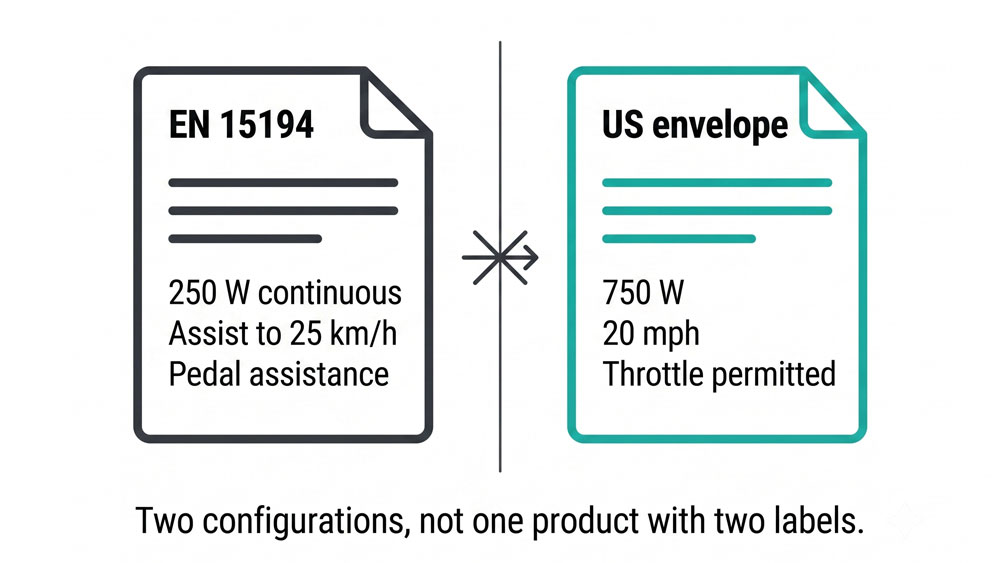
Il existe une seconde différence, plus subtile. La réglementation européenne sur les vélos électriques limite la puissance nominale continue à 250 W, l'assistance s'arrêtant à 25 km/h, et le pédalage est généralement obligatoire. Aux États-Unis, la puissance peut atteindre 750 W, la vitesse maximale 32 km/h (20 mph) et le fonctionnement se fait uniquement par l'accélérateur – une configuration particulièrement appréciée des seniors américains. Un produit conçu selon les normes européennes n'est pas simplement “ sous-dimensionné ” pour les États-Unis ; il repose sur une philosophie de contrôle différente. Le dimensionnement du moteur, la gestion thermique et la logique du contrôleur sont tous différents. Il faut donc prévoir deux configurations, et non un seul produit avec deux étiquettes.
Là où les tricycles semi-couchés diffèrent : le risque lié à la formulation, que personne ne prend en compte dans les prix.
Pour les normes UL 2849 et UL 2271, la géométrie du siège est largement sans importance : ces normes testent le système électrique, et un cadre semi-allongé ne modifie pas les contraintes auxquelles la batterie doit résister. Le périmètre des tests s'élargit uniquement lorsque le véhicule intègre des sous-systèmes électriques — un second moteur, une marche arrière électrique, un contrôleur différentiel —, chacun de ces éléments étant plus fréquent sur les tricycles que sur les deux-roues et augmentant la taille du système testé.
C’est au niveau des définitions des codes de la route des différents États que réside la véritable divergence, et il est important de le préciser car ce point est rarement abordé. Ces définitions sont rédigées indépendamment du droit fédéral, et leur formulation n’est pas uniforme :
- Certains États définissent un vélo à assistance électrique comme ayant “ deux ou trois roues, une selle, ” des pédales parfaitement fonctionnelles » et un moteur dont le fonctionnement est conforme aux limites spécifiées. Le code de l’État de Washington utilise cette formulation.
- D'autres utilisent “un siège” plutôt qu’une selle “ — la Caroline du Nord, le Kansas et la Caroline du Sud, entre autres.
- La Californie adopte une approche différente : son code de la route définit un vélo comme un engin doté de “ “une ou plusieurs roues” et précise qu’un vélo électrique est un vélo, sans mention de selle ou de siège dans la définition opérationnelle. ».
Un tricycle vertical classique est, de toute évidence, équipé d'une selle. Un tricycle semi-couché avec une large assise de type chaise et un dossier ne correspond pas manifestement à la définition légale de “ selle ”. À notre connaissance, aucune mesure d'application n'a été prise sur ce point, et il est possible qu'il ne soit jamais mis à l'épreuve ; toutefois, le risque est bien réel, il concerne précisément les États où les programmes de cyclisme adapté sont les plus actifs, et il devrait figurer dans un registre des risques liés à l'entrée sur le marché plutôt que d'être relégué au second plan. Réponse pratique : Lorsqu'une définition étatique est ambiguë, consultez un avocat américain avant de fonder vos arguments de conformité et vos supports marketing sur l'affirmation “ il s'agit légalement d'un vélo ” dans cet État. Poser la question au plus tôt est peu coûteux, mais y répondre tardivement peut s'avérer onéreux.
Qu’est-ce qui changera si la règle de la CPSC est finalisée ?
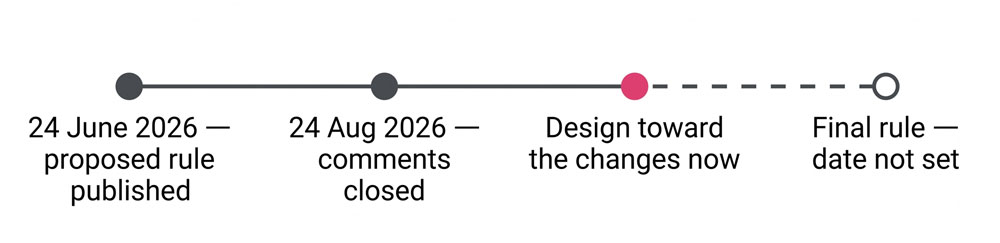
Le 24 juin 2026, la CPSC a publié un projet de règlement qui rendrait obligatoire une norme de sécurité des batteries au lithium pour les produits de micromobilité, la période de commentaires se terminant le 24 août 2026. La proposition incorpore par référence les normes UL 2849, UL 2271 et UL 2272, mais les modifie en ajoutant des exigences telles que des boîtiers de batterie inviolables, des tests de charge et de polarité inversée supplémentaires, ainsi que des avertissements et des instructions aux consommateurs élargis.
Pour toute personne procédant actuellement à une certification, il est essentiel de bien comprendre qu'un produit certifié selon les versions actuelles de ces normes nécessiterait probablement des modifications de conception, de nouveaux tests ou une mise à jour de son étiquetage pour être conforme à la réglementation fédérale finale. Si votre produit est en cours de développement, il est plus judicieux de concevoir en tenant compte des évolutions proposées plutôt que de se contenter d'une certification de base et d'éviter ainsi de payer deux fois pour le même travail. La conception et l'étiquetage du boîtier sont peu coûteux à réaliser correctement dès la phase de dessin, mais onéreux à modifier ultérieurement.
Deux mises en garde concernant le calendrier, qu'il convient d'intégrer à la planification plutôt que de les ignorer : une proposition de règlement n'est pas un règlement définitif, et le calendrier dépend des commentaires reçus et d'éventuels recours juridiques. Il est déconseillé d'établir un calendrier de lancement en présumant une date d'entrée en vigueur précise. De même, il est déconseillé de supposer un renversement de tendance : la tendance observée au niveau des États est la même depuis trois ans.
La séquence pratique d'un programme américain
L'ordre est important, car plusieurs de ces décisions contraignent celles qui suivront.
- Commencez par définir l'enveloppe de classification. Moteur de 750 W et 32 km/h (20 mph) uniquement, pédales entièrement fonctionnelles. Tout ce qui suit (éligibilité aux subventions, référencement sur les plateformes de vente, assurance, cadre réglementaire du vélo lui-même) dépend du respect de ce cadre.
- Définir le système certifié avant l'outillage. Batterie, chargeur, contrôleur, moteur(s) et tout système électronique de marche arrière ou différentielle sont considérés comme un seul élément. Le remplacement d'un composant ultérieurement peut nécessiter une nouvelle évaluation.
- Concevoir dès maintenant les deltas fédéraux proposés. Boîtier inviolable, étiquetage et avertissements, comportement de charge.
- Déterminez qui détient le certificat. Le fait que les produits soient détenus par l'usine ou par l'importateur a des conséquences sur l'ajout d'un deuxième distributeur, un changement de marque ou un changement de fournisseur. Il s'agit d'une décision commerciale déguisée en décision administrative, et c'est celle qui est le plus souvent prise par défaut.
- Vérifiez les définitions de l'état cible, en particulier pour les modèles semi-couchés. Voir le point de formulation ci-dessus.
- Conservez le dossier mécanique 16 CFR 1512 à côté du dossier électrique. Ce sont des obligations distinctes et les deux vous incombent.
- Créez le dossier documentaire dont votre chaîne a besoin. Il est à noter que, depuis juillet 2026, ce dossier doit être déposé électroniquement au moment de l'importation. Les gestionnaires des remises, les concessionnaires de solutions de mobilité et les équipes de conformité des plateformes de vente demandent tous des justificatifs sous différents formats. Le constituer correctement une seule fois permet d'éviter une source récurrente de retards.
Comment United Mobility gère cela
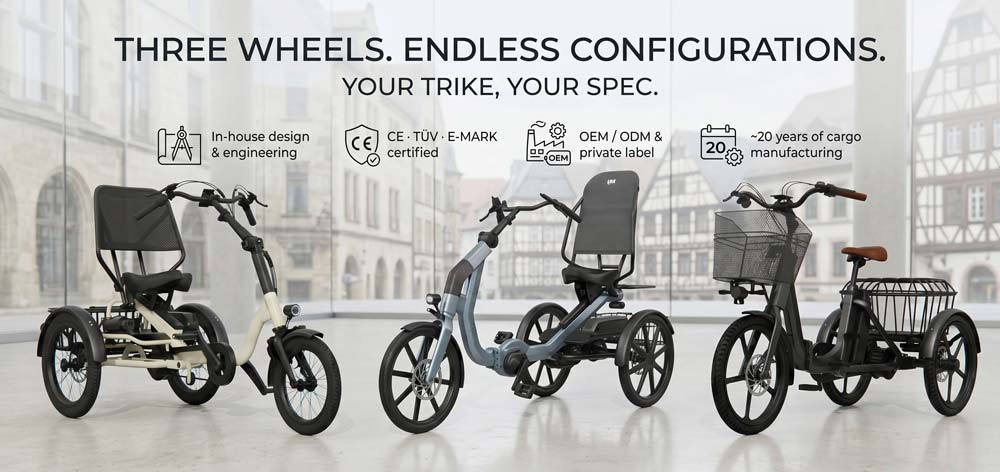
Nous considérons la certification comme une partie intégrante de la conception du produit, et non comme une étape ultérieure. Pour les programmes américains, cela signifie que le périmètre du système certifié est défini dès la conception, que la classification repose sur des spécifications précises et non sur des espoirs, et que le dossier est conçu pour accompagner votre réseau de distribution, incluant la documentation demandée par les gestionnaires de remises adaptatives et les distributeurs de solutions de mobilité. Nos deux plateformes semi-couchées, UM Vita et le UM Chill, sont configurés par marché plutôt que d'être expédiés selon une spécification mondiale unique, ce qui rend une enveloppe américaine séparée pratique plutôt qu'un compromis.
Si vous étudiez un programme américain, Contactez notre équipe d'ingénieurs Idéalement, il est préférable de procéder au plus tôt, avant même la conception des outils, car c'est à ce moment-là que le périmètre de certification est le plus facile et le moins coûteux à définir. Pour un aperçu plus large du marché, consultez notre Carte du marché américain des tricycles électriques pour seniors.
FAQ
Un tricycle électrique a-t-il besoin de la norme UL 2849, ou une batterie certifiée suffit-elle ?
Une batterie certifiée ne signifie pas un véhicule certifié. La norme UL 2849 évalue le système électrique dans son ensemble : batterie, chargeur, contrôleur, moteur et câblage. Les programmes et les juridictions exigeant la norme UL 2849 demandent spécifiquement la certification du système, tandis que la norme UL 2271 couvre la batterie séparément.
Les tricycles à trois roues et les tricycles semi-couchés nécessitent-ils une certification différente de celle des vélos électriques à deux roues ?
Il ne s'agit pas de normes différentes, mais souvent d'une portée plus large : double moteur, marche arrière électrique et contrôleurs à différentiel sont autant d'éléments qui enrichissent le système testé. La véritable divergence est d'ordre juridique plutôt que technique : certaines définitions des vélos électriques au niveau des États sont formulées autour de la notion de “ selle ”, ce qui ne convient pas à un siège semi-couché de type chaise et justifie une analyse juridique écrite dans ces États.
Notre certification EN 15194 sera-t-elle acceptée aux États-Unis ?
Parfois, dans le cadre de programmes spécifiques, mais jamais comme solution de remplacement générale ; la CPSC a d’ailleurs refusé d’adopter la norme EN 15194 dans sa proposition fédérale, invoquant des lacunes, notamment en matière d’inflammabilité. Il convient de considérer un programme américain comme un projet de certification à part entière.
Devons-nous obtenir la certification maintenant ou attendre la réglementation de la CPSC ?
Attendre n'est pas envisageable, car la loi de l'État exige déjà une certification. La meilleure solution consiste à certifier le système tout en intégrant les modifications prévues par la réglementation fédérale proposée, afin qu'une réglementation définitive implique une mise à jour de la documentation plutôt qu'une refonte complète.
Qui devrait détenir la certification : l’usine ou l’importateur ?
Les deux modèles sont utilisés et chacun a des conséquences sur le changement de marque, l'ajout de distributeurs et le changement de fournisseurs ultérieurs. Il est préférable de prendre une décision délibérée dès le début du programme plutôt que de laisser cette décision dépendre de la personne qui remplit les documents administratifs.
Référence:
15 USC § 2085 → https://www.law.cornell.edu/uscode/text/15/2085
Avis de proposition de réglementation de la CPSC, 91 Fed. Reg. 38 162 → https://www.federalregister.gov/documents/2026/06/24/2026-12749/safety-standard-for-lithium-ion-batteries-used-in-micromobility-products-and-electrical-systems-of
Washington RCW 46.04.169 (“ formulation de selle ”) → https://app.leg.wa.gov/rcw/default.aspx?cite=46.04.169
Code de la route californien § 231 → https://leginfo.legislature.ca.gov/faces/codes_displaySection.xhtml?lawCode=VEH§ionNum=231
 French
  English
  German
  Dutch
Dutch  Danish
  Polish
  Portuguese
  Spanish