

Explication de la première partie de cette série pourquoi l'importateur est le “ producteur ” légal” et les trois obligations qu'entraîne l'utilisation d'un vélo électrique. Cette section sert de guide : pour chaque grand marché du vélo, elle indique les registres existants, les organismes chargés de la collecte et les pays où la désignation d'un représentant local agréé est obligatoire. La réglementation évolue ; considérez les liens officiels ci-dessous comme la source de référence et cet article comme un point d'orientation.
Registres et autorités officiels cités dans cet article :
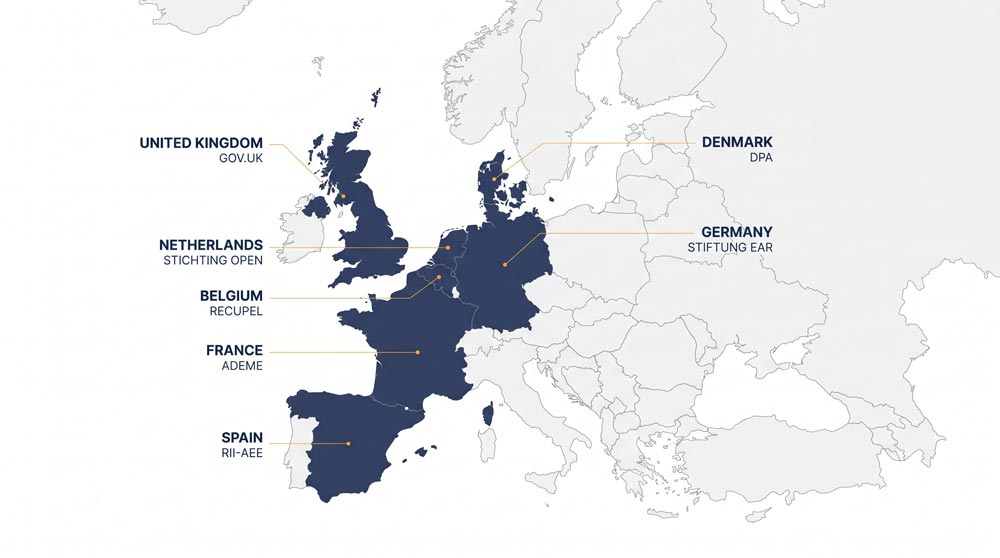
- Allemagne: Fondation EAR (Registres DEEE et de piles) · ZSVR — LUCI (conditionnement)
- France: ADEME filières REP · Écologique · Citeo
- Pays-Bas: Fondation OPEN · Stibat · Verpact
- Belgique: Récupérer · Bebat · Fost Plus / Valipac
- Danemark: Dansk Producentansvar (DPA)
- Espagne: MITECO (Registres RII-AEE et des producteurs d'emballages)
- Royaume-Uni: GOV.UK DEEE · Emballage GOV.UK EPR
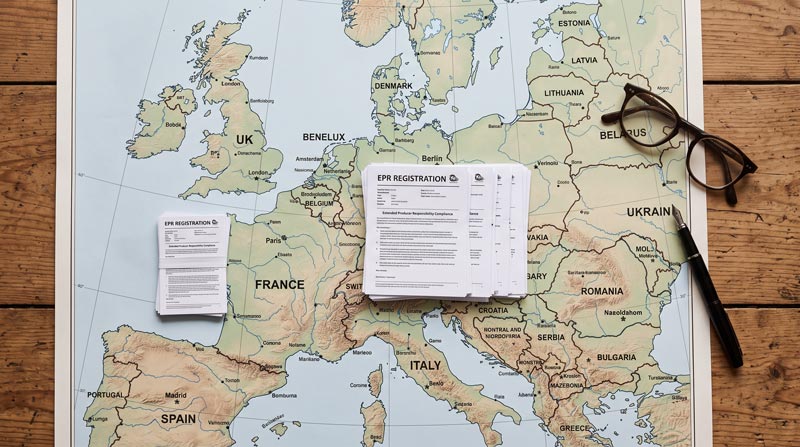
Comment lire cette carte
Chaque pays ci-dessous suit le même schéma : une inscription au registre qui attribue un numéro de producteur, l’adhésion à un système de collecte et de valorisation des déchets, et une déclaration annuelle (voire plus fréquente) des quantités. Ce qui diffère, c’est le nombre de registres, les organismes qui les gèrent, l’obligation pour les entreprises étrangères de désigner un représentant local et le niveau de contrôle exercé par les marchés et les autorités. Le tableau donne une vue d’ensemble ; les sections suivantes détaillent les difficultés rencontrées par les importateurs sur chaque marché.
| Pays | DEEE | Batteries | Conditionnement | Représentant local pour les vendeurs étrangers |
|---|---|---|---|---|
| Allemagne | Fondation EAR (numéro DEEE) | Registre des batteries à la Fondation EAR | Registre LUCID + contrat de système double | Obligatoire pour les entreprises sans filiale allemande (DEEE) |
| France | Adhésion éco-organisme, IDU via l'ADEME | Organisme écologique agréé pour les batteries, propriétaire d'un IDU | Citeo (ménage) / programme agréé, propre appareil urinaire | Mandat requis pour les entreprises non françaises |
| Pays-Bas | Fondation OPEN | Stibat | Verpact | Obligatoire pour les vendeurs à distance non néerlandais ; à vérifier pour chaque flux. |
| Belgique | Récupérer | Bebat | Fost Plus (ménages) / Valipac (commerces) | Vérifiez pour chaque flux; des variations régionales s'appliquent |
| Danemark | registre DPA | registre DPA | Registre DPA (EPR mis en place progressivement à partir de 2025) | Obligatoire pour les producteurs étrangers sans établissement DK |
| Espagne | Registre RII-AEE | registre des producteurs de batteries | Registre des producteurs d'emballages (RD 1055/2022) | Un représentant autorisé est requis pour les entreprises non espagnoles. |
| Royaume-Uni | Système de conformité des producteurs, inscription à l'agence environnementale | système de conformité des batteries | pEPR — déclaration des données + frais d'élimination pour les grands producteurs | Établissement ou représentation au Royaume-Uni nécessaire en pratique |
Allemagne : trois systèmes, tolérance zéro pour la vente en premier
En Allemagne, les trois filières fonctionnent comme trois systèmes véritablement distincts, et toutes trois suivent la même règle stricte : l’immatriculation avant la mise en vente de la première unité – la mise en vente, et non la simple vente, suffit à déclencher l’obligation.
Pour le véhicule, l'enregistrement auprès de la Stiftung EAR, conformément à la loi allemande sur les équipements électriques et électroniques (ElektroG), génère un numéro d'enregistrement DEEE (WEEE-Reg.-Nr.) qui doit figurer sur les factures et être vérifié par les plateformes de vente en ligne. Les entreprises étrangères sans établissement en Allemagne désignent un représentant agréé pour gérer cet enregistrement. Le registre des batteries, également géré par la Stiftung EAR en vertu de la législation relative aux batteries, est un enregistrement distinct qui couvre les batteries de vos vélos et les pièces détachées vendues séparément. Les emballages sont enregistrés dans le registre LUCID, géré par le ZSVR, et font l'objet d'un contrat avec un système de collecte mixte agréé. Les volumes déclarés dans LUCID et les volumes couverts par le système de collecte mixte doivent correspondre, ce qui explique pourquoi les poids d'emballage manquants par référence en usine entraînent des erreurs de déclaration.
Les plateformes de vente en ligne allemandes appliquent l'obligation d'un numéro EPR depuis 2022, et le mécanisme de contrôle est avant tout commercial : les annonces sont tout simplement désactivées. Pour une marque qui se lance via une plateforme de vente en ligne ou une distribution hybride, l'enregistrement en Allemagne est une étape cruciale du plan de lancement, à effectuer avant même la réception des stocks ; l'approbation auprès d'EAR peut prendre plusieurs semaines.
France : un identifiant par flux et un mandataire local obligatoire
En France, la REP est gérée par l'ADEME, qui attribue un identifiant unique (IDU) par entreprise et par flux. Ainsi, une marque de vélos électriques possède plusieurs IDU : un pour les équipements électriques, un pour les batteries et un pour les emballages. Chaque IDU est obtenu grâce à l'adhésion à un éco-organisme agréé pour le flux concerné : Ecologic est l'éco-organisme de référence pour les équipements électriques, Citeo pour les emballages ménagers et les batteries sont gérées par les organismes agréés de batteries. L'adhésion n'est pas une simple formalité : sans contrat signé avec un organisme agréé, les produits ne peuvent être commercialisés légalement en France.
Deux spécificités françaises sont importantes pour les entreprises du secteur du cycle. Premièrement, les entreprises non établies en France doivent désigner un mandataire français qui assume les obligations localement ; ceci s’applique aux entreprises de l’UE sans succursale française ainsi qu’aux vendeurs hors UE. Deuxièmement, la France dispose d’une procédure REP (Réputation Énergétique Française) dédiée aux articles de sport et de loisirs (ASL, gérée par Ecologic) qui couvre les cycles conventionnels non motorisés. Ainsi, une marque vendant à la fois des vélos électriques et non électriques enregistre les modèles électriques dans la procédure relative aux équipements électriques et les modèles non électriques dans la procédure ASL. Confondre ces procédures est l’une des erreurs de déclaration les plus fréquentes en France dans le secteur du cycle. La France exige également le logo Triman et les informations de tri sur les produits et les emballages ; un point d’étiquetage à régler avec votre fabricant dès la conception graphique, et non après l’impression.
Pays-Bas et Belgique : des dispositifs consolidés, moins de surprises
Le système néerlandais est relativement simplifié : Stichting OPEN gère la responsabilité du producteur pour les équipements électriques, Stibat s’occupe des batteries et Verpact (successeur d’Afvalfonds) gère les emballages, avec des seuils de volume faibles que de nombreux importateurs de vélos dépassent rapidement compte tenu du poids unitaire des emballages. La Belgique présente une structure similaire avec Recupel pour les équipements électriques, Bebat pour les batteries (l’un des plus anciens systèmes de gestion des batteries en Europe, avec un système de déclaration performant) et une répartition des emballages entre Fost Plus pour les emballages domestiques et Valipac pour les emballages commerciaux/industriels. Cette distinction entre emballages domestiques et commerciaux est importante pour les expéditions de vélos B2B : les palettes et les emballages de transport destinés aux revendeurs sont traités différemment des cartons destinés à la vente au détail au client final, et votre structure de déclaration doit refléter votre modèle de distribution réel.
Danemark : une porte d'entrée
Le Danemark est administrativement le plus favorable du groupe : la Dansk Producentansvar (DPA) centralise les registres des producteurs d’équipements électriques et de piles, et la REP (Responsabilité élargie du producteur) des emballages – introduite progressivement entre 2024 et 2025 conformément aux exigences de l’UE – est également gérée par la DPA. Les producteurs étrangers sans établissement au Danemark désignent un représentant local. Pour une marque souhaitant s’implanter dans les pays nordiques, le registre consolidé du Danemark en fait un premier marché stratégique, quelle que soit la stratégie commerciale adoptée.
Espagne : nouvelles règles d’emballage, obligation de représentation formelle
L'Espagne exige l'inscription au registre RII-AEE pour les équipements électriques et, depuis le décret royal 1055/2022, à un registre des producteurs d'emballages, en plus de l'inscription des producteurs de piles. Les entreprises non espagnoles doivent se faire représenter par un mandataire agréé. La réglementation espagnole en matière d'emballages étant plus récente que celles de l'Allemagne ou de la France et les exigences en matière de déclaration se durcissant d'année en année, il est conseillé de prévoir un délai plus long pour les premières déclarations que celui indiqué par le registre.
Royaume-Uni : même logique, univers séparé
Le Royaume-Uni, bien que n'appartenant pas au cadre de l'UE, applique des obligations directement comparables. Par conséquent, aucune transférabilité n'est possible : les enregistrements européens ne sont pas valables en Grande-Bretagne. Les producteurs d'équipements électriques s'enregistrent auprès des agences environnementales via un système de conformité des producteurs ; les fabricants de piles adhèrent à un système de conformité des piles ; et la REP réformée des emballages (pREP) exige la déclaration des données d'emballage via le service gouvernemental, les plus grands producteurs devant également s'acquitter de frais d'élimination à partir de 2025. Les seuils britanniques sont fonction de la taille des volumes – les petits producteurs sont soumis à des obligations réduites – il est donc important de déterminer rapidement de quel côté des seuils se situent vos volumes de la première année, et de noter que l'étiquetage des conteneurs à roulettes et les catégories de déclaration des données diffèrent de la pratique européenne, même si certaines similitudes peuvent paraître évidentes.
Séquençage d'un lancement multi-pays
L'enregistrement dans sept pays, réparti sur trois filières, implique une vingtaine de relations administratives distinctes. Les importateurs qui gèrent efficacement ces démarches adoptent trois stratégies : ils séquencent leur entrée sur le marché, en effectuant les enregistrements pour les un ou deux premiers marchés avant l'expédition des stocks, plutôt que de se conformer a posteriori aux réglementations ; ils centralisent les données produits – un fichier maître par référence contenant le poids unitaire, les données relatives à la batterie et la composition de l'emballage, à partir de la documentation du fabricant, afin que chaque déclaration nationale s'appuie sur les mêmes données ; et ils décident rapidement s'ils gèrent les enregistrements en interne ou par l'intermédiaire d'un prestataire de conformité paneuropéen. Ce dernier a un coût, mais permet de regrouper les vingt relations en une seule, ce qui est généralement rentable au-delà de deux ou trois marchés.
Ces trois habitudes dépendent toutes de la même donnée en amont : des données complètes du fabricant, par référence. La partie 3 détaille précisément ce qu'il faut demander, et comment prévenir les problèmes de déclaration qui surviennent généralement lors de la première déclaration annuelle. Pour une vue d'ensemble de la certification liée à l'accès au marché, voir le Guide de conformité des vélos cargo de l'UE.
Foire aux questions
Dans quel pays dois-je m'inscrire en premier ?
Le pays où vous proposerez vos produits à la vente pour la première fois est celui où l'obligation s'applique : elle concerne la commercialisation sur ce marché national, et non le lieu d'implantation de votre entrepôt. Si votre stock arrive en Allemagne mais que vos premières ventes ont lieu aux Pays-Bas, l'immatriculation aux Pays-Bas est prioritaire. Si vous vendez sur les plateformes allemandes dès le départ, un numéro d'immatriculation allemand est requis avant la mise en ligne de vos annonces. Ai-je besoin d'un représentant agréé dans chaque pays ?
Ai-je besoin d'un représentant autorisé dans chaque pays ?
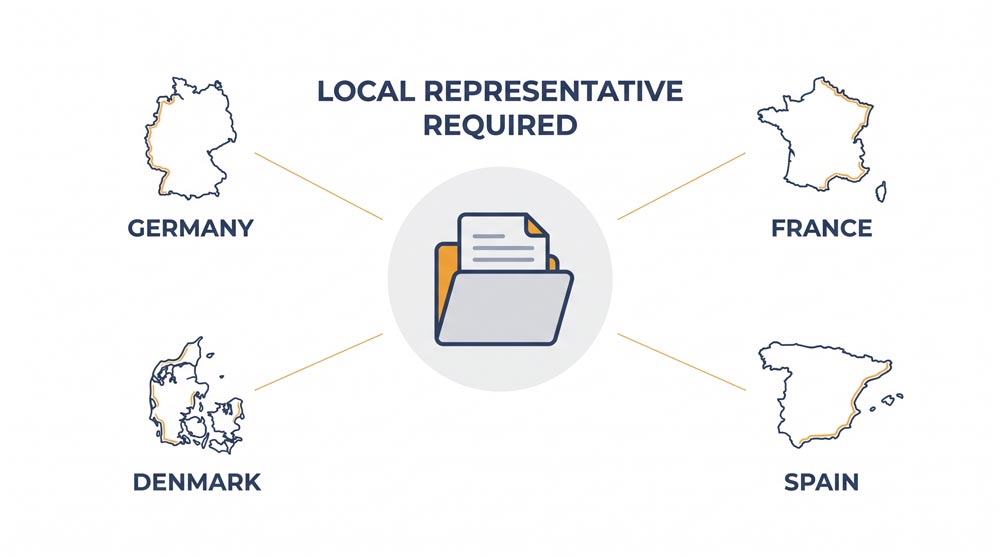
Pas dans tous les pays, mais dans plusieurs : la France exige un mandataire pour toute entreprise sans établissement français, l’Allemagne en exige un pour la DEEE si vous n’avez pas de succursale allemande, et l’Espagne et le Danemark ont des exigences similaires. En résumé : plus vous êtes éloigné de la création d’une entité locale, plus il est probable qu’un représentant soit obligatoire. Les frais sont-ils importants ?
Les frais sont-ils importants ?
Les redevances sont calculées en fonction du volume (par kilogramme ou par unité mise sur le marché), auxquelles s'ajoutent des frais fixes d'enregistrement et de gestion du système. Pour les vélos, l'emballage représente souvent le poste de dépense le plus important en raison du poids unitaire de l'emballage. Le coût économiquement risqué n'est pas le barème des redevances, mais l'enregistrement tardif, qui entraîne des arriérés de paiement et d'éventuelles amendes sur toutes les ventes déjà effectuées. L'assemblage au sein de l'UE modifie-t-il mes obligations en matière de REP ?
L'assemblée européenne modifie-t-elle mes obligations en matière de REP ?
Non — la REP s'applique à la mise sur le marché national des produits, quel que soit leur lieu d'assemblage. Le lieu d'assemblage influe sur le traitement douanier et les droits de douane, ce qui constitue un élément distinct à prendre en compte dans le calcul du coût rendu.
Vous prévoyez un lancement dans plusieurs pays ? United Mobility travaille avec des marques qui pénètrent successivement plusieurs marchés européens et fournit une documentation par modèle (poids unitaires, fiches techniques des batteries, spécifications d'emballage) structurée de manière à ce que le même fichier prenne en charge chaque déclaration nationale. Discutez de votre plan marketing avec nous..
 French
  English
  German
  Dutch
Dutch  Danish
  Polish
  Portuguese
  Spanish