

The target market for an electric trike for seniors is not one buyer — it is at least three. Each has a different body, budget, motivation and buying channel. Get the segmentation right and your assortment, fit range and marketing follow logically. Get it wrong and you carry the wrong SKUs for the wrong customer.
Here is who is actually riding, what the data says about them, and what each fact should change in how you sell.
Three Buyer Profiles in the Electric Trike for Seniors Target Market
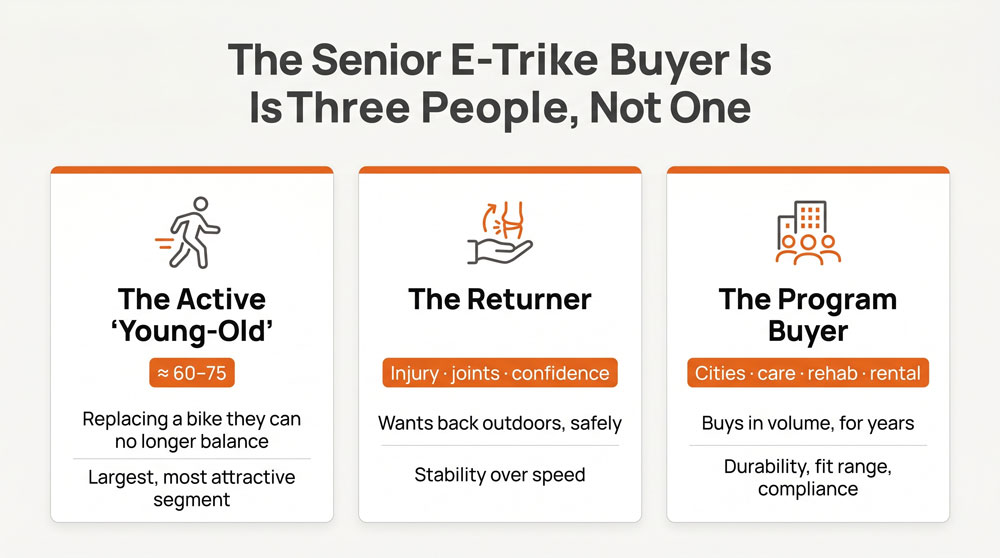
Most of the demand sorts into three profiles:
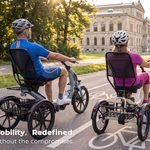
- The active “young-old” leisure rider (≈60–75). Still fit, still independent, but the two-wheeler has started to feel less reliable — balance takes conscious effort, junctions feel less predictable. Transport research describes this group precisely: older adults adopt e-bikes largely as a replacement for the conventional bike they can no longer comfortably ride, to keep cycling rather than to substitute car trips. This is the largest and most commercially attractive segment.
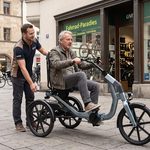
- The mobility-constrained returner. Recovering from injury, managing arthritic joints, or having lost confidence after a fall or near-miss. They want back outdoors. Stability, low step-through and reassuring brakes matter more than range or speed.
- The institutional / program buyer. A municipality, assisted-living operator, rehabilitation partner or tourism-rental fleet buying on behalf of riders. This buyer cares about durability, serviceability, fit adjustability across many users, and compliance — and buys in volume.
These three need different specifications and reach you through different channels. The rest of the demographic picture explains why.
Gender: Senior Cycling Demographics Skew Older and Female in Europe
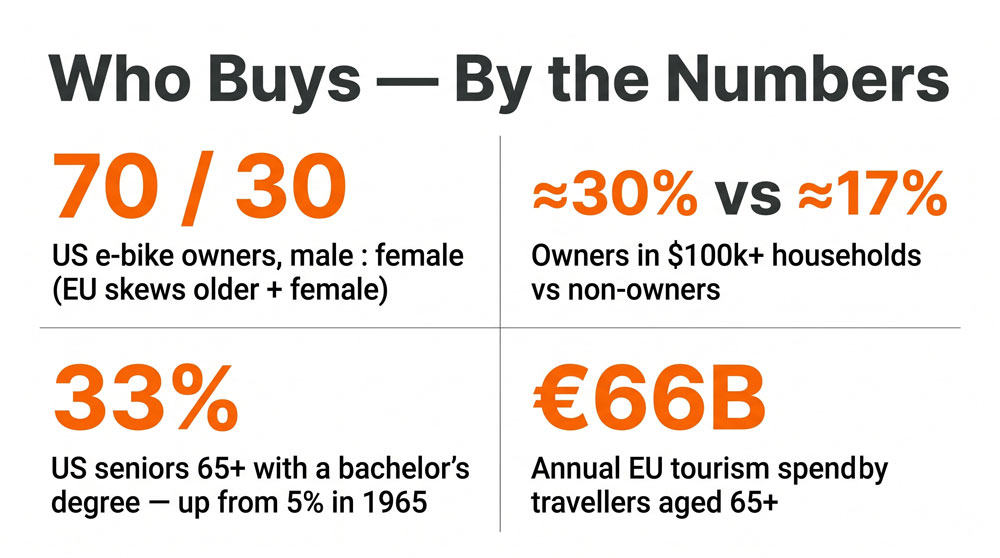
This is the most commonly missed point in senior cycling demographics across Europe. In North America, cycling is more male-dominated, and e-bike ownership reflects it — US owner surveys typically show roughly a 70% male / 30% female split. In Europe the picture inverts at older ages: transport research finds e-bikes have a notably higher adoption rate among older women in the European context.
Two further facts sharpen this. More older women live alone — in the US, 27% of women aged 65–74 live alone, rising to around half by age 85 (Census/PRB), and the European pattern is similar. For someone living alone, independent mobility is not a leisure nicety; it is autonomy. And women in this cohort are, on average, smaller-framed.
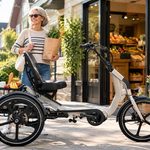
What it changes: a senior line built only around large, heavy frames quietly excludes a big share of European demand. You need a genuinely compact, lighter option a smaller rider can handle, mount and store alone — not a token “ladies’ colourway.” This is exactly the rider the compact UM Vita was shaped for, with its shorter frame, smaller front wheel and tighter turning circle.
Income: Who Buys Electric Trikes for Seniors Isn’t the Budget Buyer
The cheap-trike supply assumes seniors shop on price. The data on who buys electric trikes for seniors says otherwise. E-bike owners skew higher-income — US surveys indicate roughly 30% of owners live in households earning over $100,000, versus about 17% of non-owners. Meanwhile senior poverty has fallen sharply: the official US poverty rate for those 65+ is now around 10%, down from nearly 30% in the 1960s. In Europe, older households hold a disproportionate share of accumulated wealth.
Add education. Among Americans 65+, the share with a bachelor’s degree or higher has risen from 5% in 1965 to 33% by 2023 (PRB). This is a cohort that researches, reads spec sheets and is hard to impress with marketing language.
What it changes: you are selling to a discerning, quality-sensitive buyer with money — not a price-floor shopper. Product substance, honest specs and credible build quality convert this audience. Thin marketing on a thin product does not.
Culture and Geography: How Older Adult E-Bike Riders Differ by Market
Riding norms decide how the product lands, and older adult e-bike riders behave differently by market.
- Mature cycling cultures — the Netherlands, Germany, Denmark, Belgium — already normalise older-adult cycling. The trike is socially accepted everyday mobility, and these markets show the deepest older-rider adoption. A French government (Cerema) survey of more than 22,000 e-bike purchase-subsidy recipients found the over-55s made up 68% of beneficiaries, and retirees 46% — far above their share of the population. When the price barrier drops, older riders are who step forward.
- Car-dependent markets — much of the US — have lower everyday-cycling norms, so demand concentrates in pockets: active-ageing and wellness programs, warm-weather retiree regions, RV and leisure travellers, and trail or recreation use rather than utility commuting.
What it changes: format and positioning should follow the market. Northern-European buyers accept the trike as practical transport; many US buyers respond better to it as recreation and active-lifestyle equipment. Same vehicle, different story.
Leisure Habits: The Trike as Lifestyle Gear
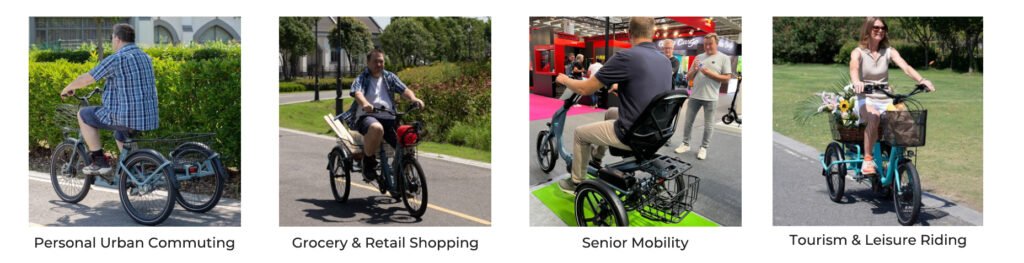
This cohort spends heavily on experiences. European travellers aged 65+ account for roughly €66 billion a year in tourism spending, and “active ageing” is core to how this generation sees itself. They are not buying a concession to decline; they are buying the means to keep doing what they enjoy — park rides, exploring on holiday, group outings, getting to a café under their own power.
What it changes: position the product against leisure and freedom, not infirmity. The same de-medicalised framing that decides whether a rider accepts the trike at all (covered in our look at the European senior trike trend) decides how it should be merchandised.
Senior Electric Trike Buyer Demographics: What Distributors Should Do
Pulling the senior electric trike buyer demographics together:
| The data point | The stocking / selling implication |
|---|---|
| Three distinct buyer profiles | Carry at least a compact and a larger platform; don’t treat “senior” as one SKU |
| EU adoption skews older + female | A genuinely compact, lighter, manageable model is essential, not optional |
| Higher-income, well-educated buyer | Lead with build quality and honest specs; this buyer researches |
| Market-dependent cycling norms | Position as transport in NL/DE, as active-leisure in much of the US |
| Strong leisure / tourism spending | Merchandise as lifestyle gear; build the accessory and rental story |
| Living-alone, autonomy-driven riders | Prioritise solo handling, low step-through, manageable weight |
The clearest mistake in this category is buying for an imagined frail, price-driven, single “senior.” The real buyer is more capable, more affluent, more discerning and more varied than that — and the supply that wins is the one built around who they actually are.
To match these profiles to concrete specifications, see what buyers really look for in an electric tricycle and the full senior e-trike platform range.
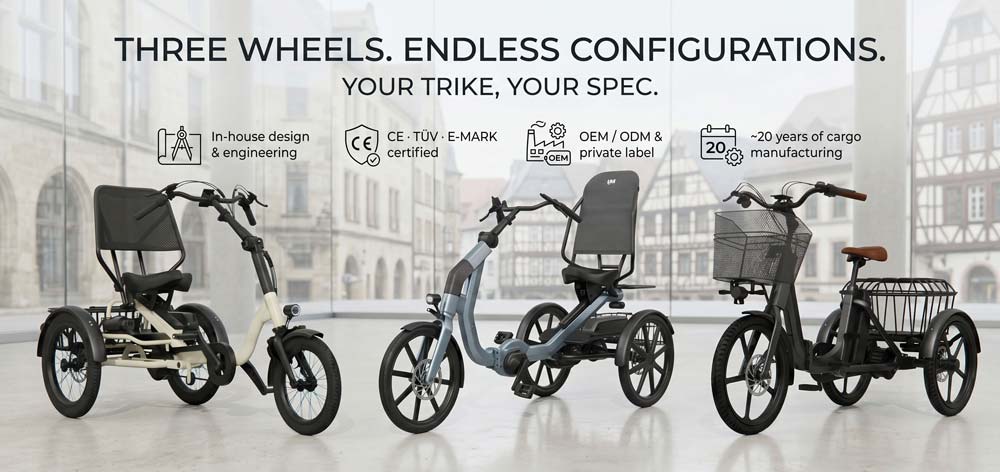
Building your assortment? The compact UM Vita and the larger UM Chill were designed to cover the different rider profiles above — a lighter, agile platform for smaller and solo riders, and a fuller-specified one for taller, road-confident users. Talk to United Mobility about an OEM/ODM senior line shaped to your market.
FAQ
Who is the target market for an electric trike for seniors?
There isn’t one. The market splits into active “young-old” leisure riders (around 60–75) replacing a bike they can no longer balance, mobility-constrained returners getting back to cycling, and institutional buyers — municipalities, assisted-living, rehab and tourism fleets — purchasing on riders’ behalf.
Are senior e-trike buyers mostly men or women?
It depends on the market. North American e-bike ownership skews male (roughly 70/30), while in Europe adoption among older women is notably higher. Many older women also live alone, which makes independent, easy-to-handle mobility especially important.
Do seniors buy on price?
Generally no. E-bike owners skew higher-income, senior poverty has fallen to around 10% in the US, and a third of US seniors now hold a bachelor’s degree or higher. This is a research-driven, quality-sensitive buyer rather than a price-floor shopper.
 English
  German
  Dutch
Dutch  Danish
  French
  Polish
  Portuguese
  Spanish