
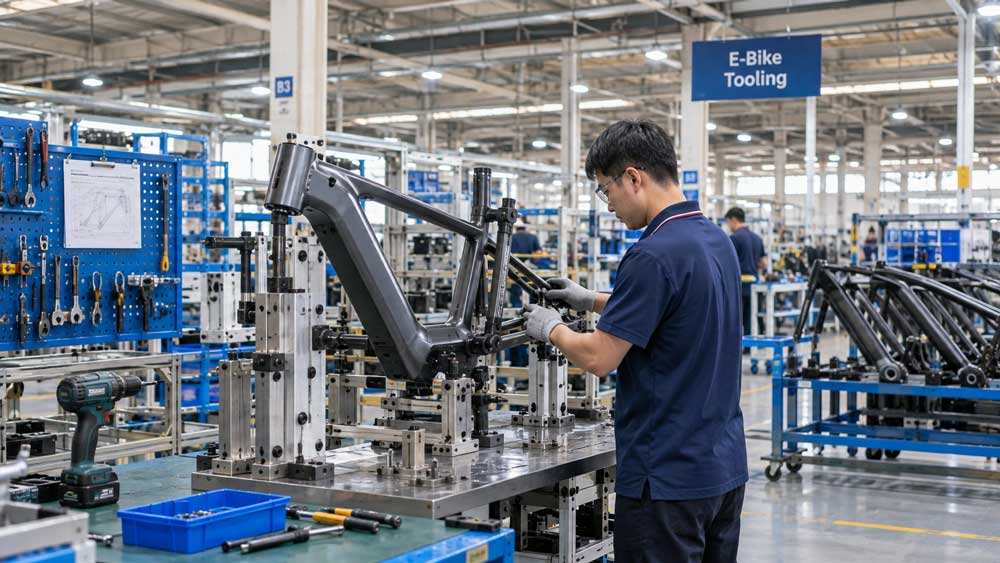





CKD vs SKD ebike assembly looks like a freight question. It is really a question about who finishes the vehicle, who tests it, and whose name goes on the declaration of conformity. The three modes differ by roughly a factor of three in what a container carries, and by more than that in what your workshop has to be able to do.
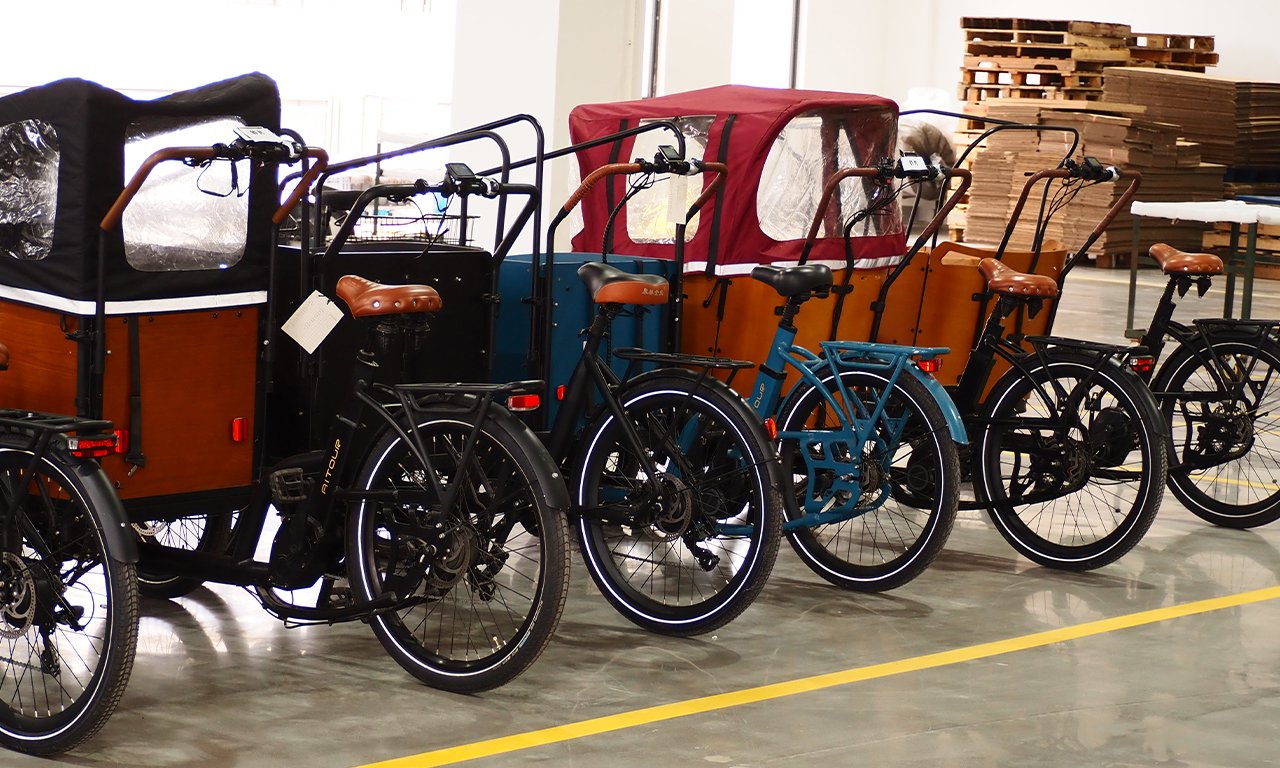
What each mode actually contains
The three abbreviations are used loosely, so start from what physically arrives on the dock.
- CBU (complete build unit). A rideable bike in a carton. The importer checks it over, adjusts brakes and tyre pressure, and it goes on the floor. Nothing is assembled.
- SKD assembly (semi knocked down). The frame arrives joined, painted and usually with the drivetrain fitted. The front end is off: fork and bars separate or loosely located, front wheel out, pedals and accessories boxed. The buyer finishes a vehicle that is already 80 per cent built.
- CKD (completely knocked down). Parts. Frame, fork, wheels, motor, controller, harness, battery, brakes, fasteners, decals, each in its own packaging, with a bill of materials and a build sheet — the processus ODM in its most literal form. The buyer builds the vehicle.
The distinction that matters commercially is not the box count, it is where the vehicle becomes a vehicle. Below that line the factory is shipping components; above it, someone is placing a finished product on a market and taking the conformity obligations that come with it.
Container loading plan: the arithmetic, not a ratio
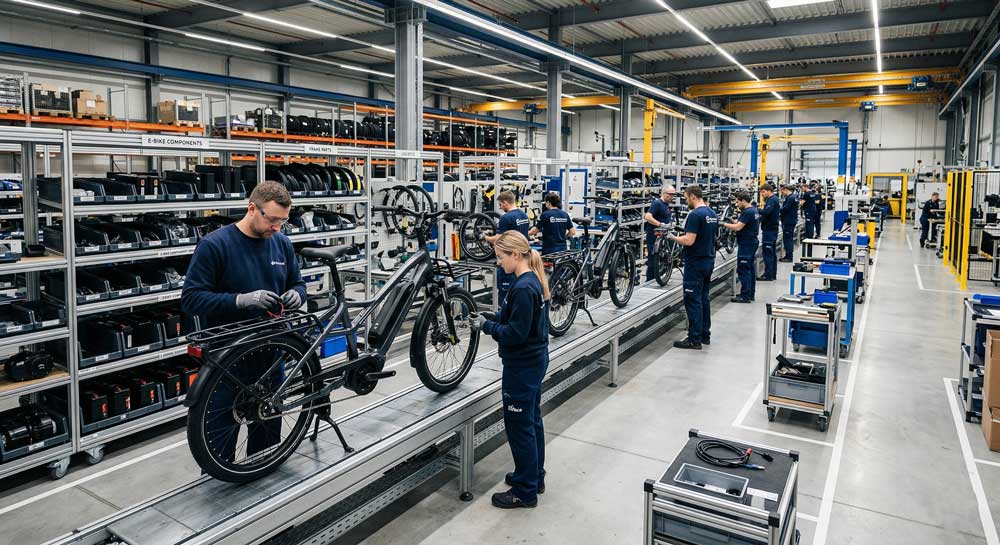
Suppliers quote a multiplier — “CKD carries three times as much” — and the multiplier is usually true and always useless, because it depends on your frame sizes and your carton design. Any CKD vs SKD ebike assembly decision starts here, because volume is the only input both modes share. Do the division instead. A 40-foot high cube has roughly 76 m³ of internal volume; allow about 68 m³ usable once pallets, bracing and the door end are accounted for. Then divide by the packed volume of one unit.
| Mode | What arrives | Packed volume per unit | Units per 40HQ at 68 m³ | Finishing work |
|---|---|---|---|---|
| CBU | Rideable bike in a carton | 1.3–1.5 m³ | 45–52 | PDI, minutes |
| SKD | Frame with drivetrain, front end off | 0.7–0.9 m³ | 75–97 | About an hour |
| CKD | Loose parts per bill of materials | 0.4–0.5 m³ | 136–170 | Half a day or more |
Read those volumes as planning figures to argue with, not as promises. Four things move them, and they are the four items to check in a container loading plan:
- Frame size mix. A compact 20-inch frame nests inside a larger one; a container of one size loads differently from a three-size mix.
- Wheel size. Twenty-inch wheels pack tighter than 26-inch or 700c, and pre-built wheels lose the nesting advantage that loose rims and spokes have.
- Whether the cargo box ships assembled. A welded box is the single largest volume item in a cargo bike, and the one most often forgotten in the arithmetic.
- The battery carton. Packs ship separately, at a state of charge capped for transport, with their own documentation, and they take volume that the bike cartons no longer do.
Ask for a loading diagram with dimensions, not a unit count. A diagram can be checked against a tape measure; a count cannot. For the same reason, two suppliers quoting an identical unit price rarely quote identical packing, which is where most cargo bike quote comparisons quietly diverge.
Assembly labour is the number that decides it
The freight saving from CKD is real and easy to calculate. The assembly cost is real and usually estimated badly, because buyers count the build time and forget the wheel building, the electrical test and the rework. This is also where a ckd vs skd ebike assembly decision stops being reversible: once a workshop is staffed and tooled for kits, going back to finished bikes leaves that capacity idle.
A trained mechanic finishing an SKD unit is doing an hour of work: fork and bars, front wheel, brake set-up, torque check, light and display test. The same mechanic building a CKD unit is doing a working half-day, and the bottleneck is almost never the frame. It is the wheels. Building and truing a wheel takes twenty to thirty minutes each, and a wheel that is out of tension will come back as a warranty claim two months later.
This is why most practical CKD programmes are CKD minus wheel building: the factory laces and trues the wheels, ships them built, and everything else stays loose. You keep most of the volume advantage and none of the skill dependency. If a supplier offers you a fully loose kit without asking whether you can build wheels, that is a question about their experience rather than your capability.
Multiply before you commit. One hundred and fifty CKD units at four hours each is six hundred labour hours, which is about fifteen working weeks for one person before holidays, rework and the first unit that takes twice as long as the hundredth. If that arithmetic does not fit your workshop, the mode is wrong regardless of the freight number — and if the volume is not there yet, the minimum order quantity arithmetic will usually say so first.
When the destination market decides for you
In Europe the buyer usually chooses the mode. In several other markets the buyer’s own import regime makes the choice for them: finished vehicles and kits are treated differently, and local assembly is a condition of the programme rather than an option. Pakistan and parts of the Middle East are the cases buyers raise most often, and in both the constraint comes from the destination, not from the factory.
Two consequences follow. First, ask the buyer for their intended customs treatment in writing, including the heading they expect to declare, before you design a kit — and budget the lead time for that answer, because it arrives from a broker rather than a factory. Second, do not let a supplier tell you what your own market requires — that is a question for your broker and, where classification is genuinely uncertain, for binding tariff information. We do not give classification opinions, here or anywhere else; a BTI binds every EU customs administration and the holder for three years, and it has to be applied for before the goods arrive.
If the assembly happens inside the EU rather than in the destination market, a different set of questions applies, and they are about origin and classification rather than about packing. Our note on droits d'importation sur les pièces de vélo cargo works through that side of the file; this article stays with the mode decision.
The 48V battery platform: one pack across three sizes
The most useful engineering decision in a multi-size range is not the frame. It is the voltage. Build the range on a single 48V battery platform and three frame sizes stop being three products.
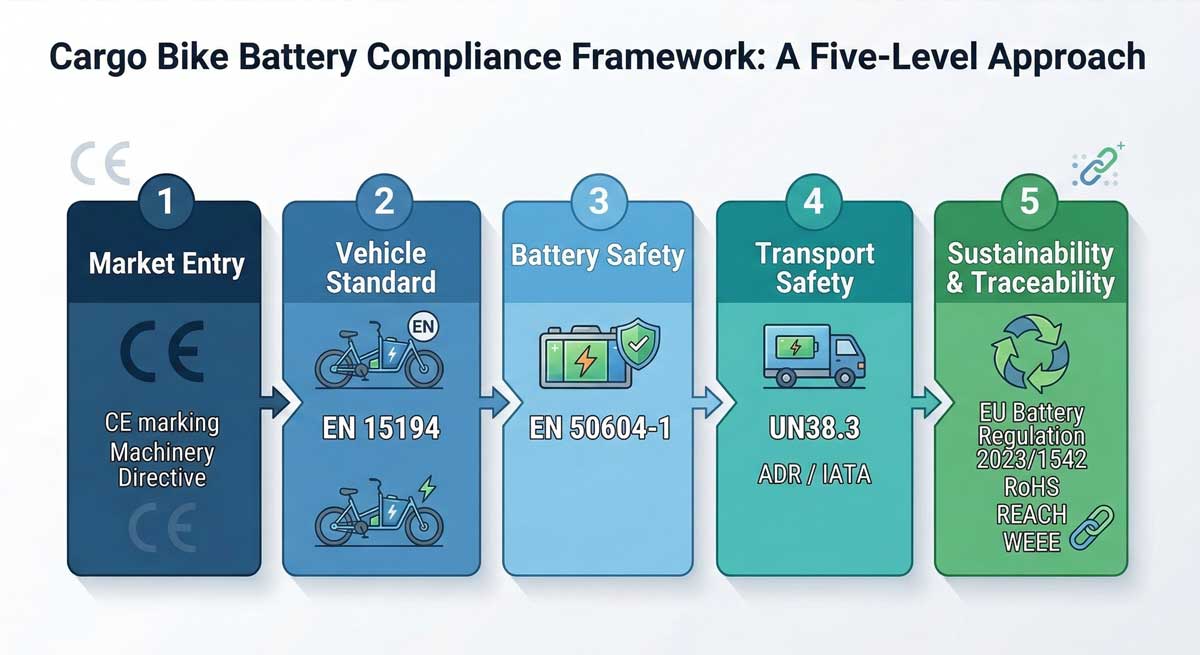
The first reason is regulatory rather than commercial. EN 15194 covers EPAC systems with a rated voltage up to and including 48 V d.c. Go to a 52V pack and the bike is outside the scope of the standard the whole European market tests against, which means the conformity route changes rather than the paperwork. Forty-eight volts is not a marketing preference; it is the ceiling of the test regime, and a supplier who offers “52V for more power” is offering you a different approval problem.
The second reason is that voltage is the wrong variable to differentiate on. Capacity is what riders feel, and capacity is varied in Wh by cell configuration inside the same pack envelope. Keep the envelope, the dock, the connector and the BMS family identical across sizes, and you get a range where one spare pack covers the fleet, one charger serves every model, and the dealer stocks one battery instead of three. Our guide des spécifications de la batterie sets out the parameters that belong on the sheet when you specify it.
The third reason is the kit itself. A shared dock and a shared harness mean a CKD kit for a large frame differs from a small one in the frame, fork and a handful of parts, not in the electrical architecture. One set of build instructions, one torque table, one electrical test, one training session for the workshop. That is what makes a three-size programme buildable outside a factory at all.
Who owns the warranty and the CE file after assembly
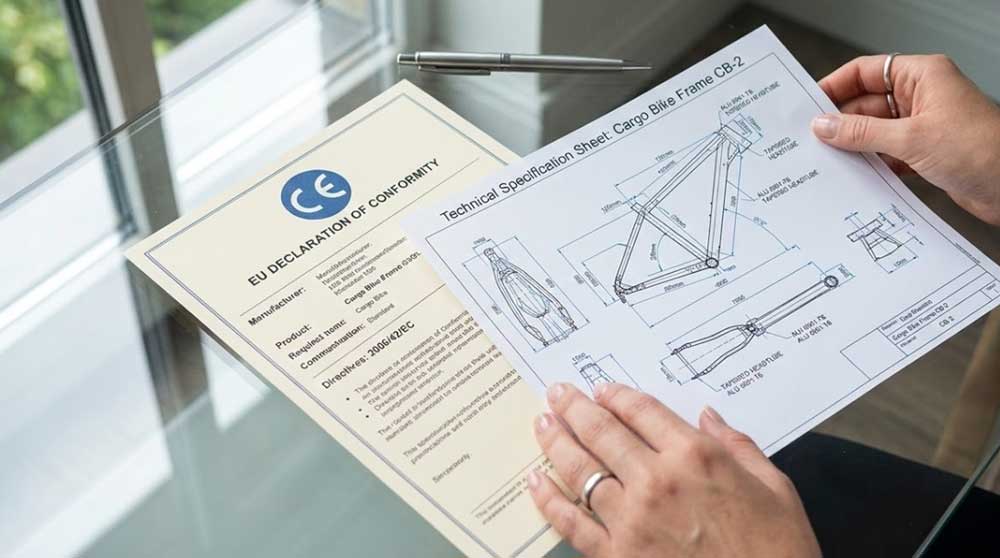
Assembly relocates obligation, and the contract should say so before the first kit ships.
If you build the bike into a rideable vehicle and sell it under your brand, you are the manufacturer for CE purposes: your declaration of conformity, your technical file, your liability. The factory’s EN 15194 report supports your file, but it does not replace it, and a report naming the factory’s platform rather than your model and configuration is not your evidence. Where the line sits between PDI and assembly is worth agreeing in writing at the start — a front wheel and handlebars is normally pre-delivery preparation, a bare frame is not — because the answer decides who signs.
Then fix the three defect classes in the contract, because the argument always arrives with the first claim:
- Part defect. Supplier pays the part and the labour at an agreed hourly rate. The rate is the clause people leave out, and it is the one that decides whether a claim is worth making.
- Assembly defect. Yours, and worth separating explicitly so that a stripped thread from an impact driver does not become a supplier dispute.
- Transit damage. Follows the Incoterm, and needs photographs at unpacking with the carton still present.
Add the evidence that makes the split workable: a torque log per unit, a pre-delivery checklist with photographs, and pack serial numbers recorded against frame numbers so a battery claim can be traced to a batch. Suppliers who build for assembly markets supply these as a matter of course; trading desks do not have them. UnitedMobility ships every kit with a build sheet and a torque table per frame size, and the quality regime that produces them is the same one that governs the finished-bike lines.
Where the legal line sits, in one paragraph
Assembly in Europe is ordinary trade, and two separate tests govern it. Tariff classification asks whether a set of parts presented across shipments is in fact the complete article, which is the General Interpretative Rule 2(a) question the General Court addressed in T-529/25. Anti-circumvention asks a different question under Article 13 of Regulation (EU) 2016/1036, where a value-added threshold operates as a safe harbour — the threshold exists, and any operation should be able to evidence where it sits rather than assume it. Both tests are answered with contemporaneous records, not with structure. The one thing a buyer should never accept is a supplier describing a mode as a way around a duty: that sentence is the beginning of an investigation, not the end of a cost problem.
UnitedMobility runs its European production as CKD assembly from the Wuxi plant into Poland, and has built city and commuter ebikes, longtail and long-john cargo bikes, and delta and tadpole trikes on one engineering base since 2009, with more than fifty registered patents behind the platforms. In practice that means a buyer can order the same programme in any of the three modes — a first container of CBU for a launch, SKD while the workshop is being set up, CKD once volume justifies local build — without changing supplier, battery platform or technical file. The 48V platform is shared across sizes, the kits ship with build sheets and torque tables, and the documentation pack includes the reports an assembly operation needs to defend its own file. If you are choosing a mode, send the destination market, the annual volume and the workshop’s capability, and the answer comes back as a loading plan and a labour estimate rather than a slogan.
FAQ
Is CKD always cheaper than SKD per unit?
Per unit of freight, usually yes, because you ship volume rather than air and packaging. Landed cost is a different sum: add assembly hours at your own labour rate, the tooling, the rework in the first batches and the spare-part float. Below roughly a hundred units a year, SKD frequently wins on total cost even though it loses on freight — the landed cost model is the one to run before you decide.
Can we mix modes in one container?
Yes, and it is common on a launch: mostly CKD with a handful of CBU for demonstration and press. The complication is documentation rather than packing, because the battery cartons and the DG declaration have to describe what is actually inside, and a mixed container is harder to describe than a uniform one.
Do we need our own CE file if we only fit the front wheel?
If the bike reaches your customer as a rideable vehicle under your brand, the declaration is yours either way. What changes is the evidence: with SKD, the factory’s report covers the assembled system and your file is thin; with CKD, you are assembling the system, so you need the test reports for the exact motor, controller and pack combination plus your own assembly records.
Which mode suits a first order of fifty units?
Usually SKD. Fifty CKD kits is two hundred hours of skilled work, a tooling outlay and a learning curve, for a volume that does not yet justify any of it. Start with SKD, learn what fails in your workshop, then move to CKD when the annual volume makes the labour line worth optimising.
 French
 English
 German
 Dutch
 Danish
 Polish
 Portuguese
 Spanish