


On 7 October 2026 the EU General Court held that components arriving in separate shipments can be classified as the complete vehicle they are destined to become. Presenting them to customs at the same time is no longer required — it is one indication among several. If you import components for assembly in Europe, the cargo bike parts import duty question is no longer answered one declaration at a time.
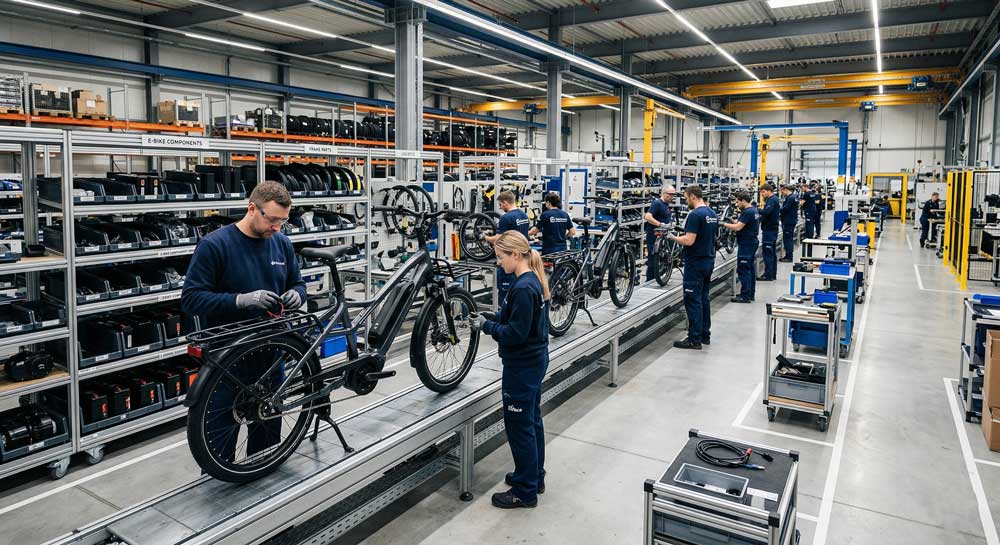
What changed for cargo bike parts import duty on 7 October 2026
The case is T-529/25, Prestige Rijwielen, decided by the General Court on a reference from the Antwerp Court of Appeal. The facts are ordinary enough to be uncomfortable. A Belgian importer bought complete e-bikes from China until the anti-dumping and countervailing measures of 2018–2019 made that expensive, then imported components — frames, forks, motors and the rest — across 27 separate customs declarations over more than two years, declared as parts. Belgian customs grouped those declarations into six clusters, each containing what was needed to build complete bicycles, and claimed over EUR 2.9 million in evaded duty.
The legal hook is General Interpretative Rule 2(a) of the Combined Nomenclature, which says an article presented unassembled or disassembled is classified as the complete article. Until now the working assumption across the trade was that this applied to goods presented to customs together. The Court disagreed: as Baker McKenzie’s note on the judgment records, GRI 2(a) “does not specify any time limits for presenting the components of a complete article to customs.” The decisive question is whether objective factors, assessed at the time of clearance, show that the parts form a whole, are intended to be assembled into a single article, and carry the essential character of that article.
Two things follow that are easy to miss.
The first is the size of the gap being bridged. Components declared as parts and a complete Chinese e-bike are not a few percentage points apart: the complete vehicle attracts anti-dumping duty up to 70.1% and a countervailing duty up to 17.2% under the measures re-imposed by Règlement (UE) 2025/120. A reclassification does not trim a margin. It removes one.
The second is that this is not the anti-circumvention regime. Anti-circumvention is an investigation the Commission opens, with written thresholds. This is tariff classification, applied by a customs officer to declarations already filed. The industry association LEVA-EU, which has been warning members about the consequences, notes that the Advocate General had reached the opposite conclusion four months earlier, and that the judgment itself sets no threshold for what counts as “essential”, no maximum interval between shipments, and no procedure for getting an answer in advance.
What customs is now entitled to look at in a split consignment
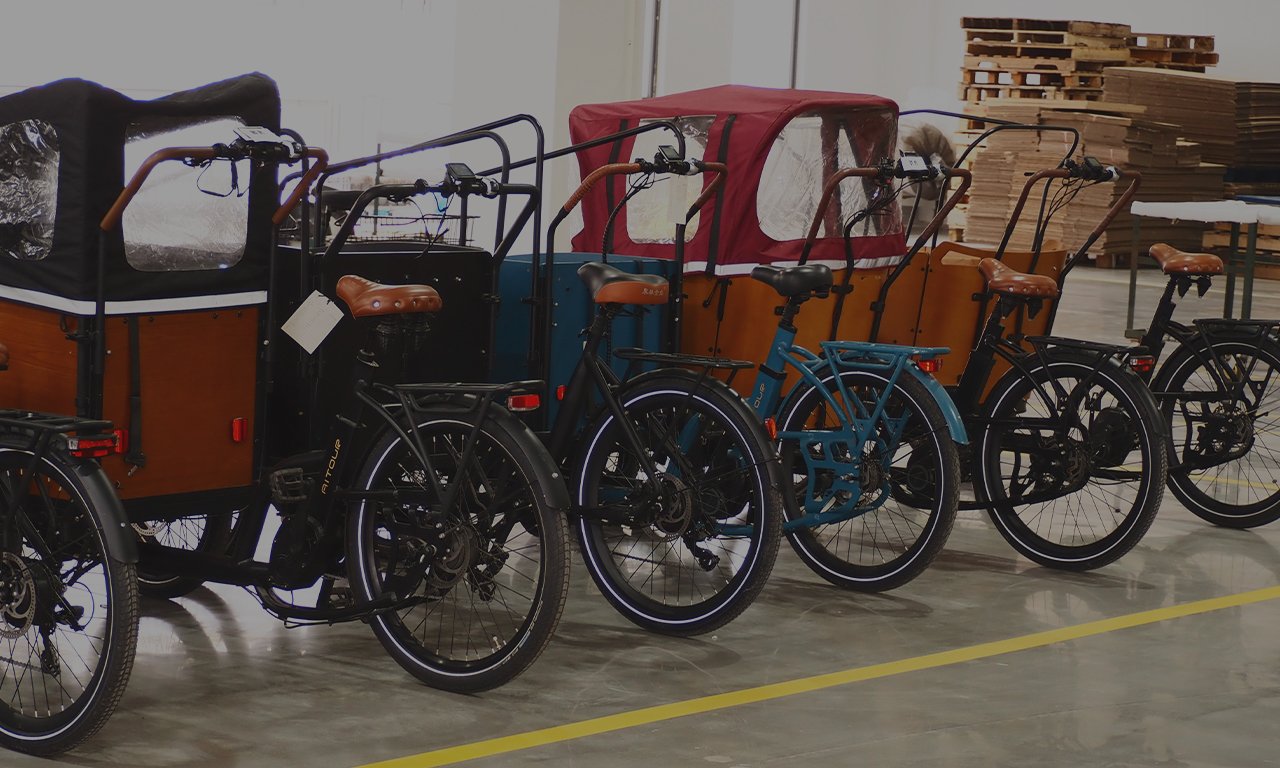
The useful part of the judgment, for anyone running an import programme, is the list of objective factors the Court treated as capable of showing that a split consignment forms one whole. They are all things a customs officer can reconstruct afterwards from paperwork you have already filed:
- the same consignee, intermediary, declarant and customs office appearing across the shipments;
- quantities of parts that correspond to a set number of complete articles;
- invoices carrying reference numbers that identify sets of parts making up that number of vehicles;
- the consignee having stopped importing complete vehicles around the time the parts imports started.
Read that list as a description of how a file gets reconstructed, not as a list of things to avoid doing. Three of the four are unavoidable features of a real assembly operation — you will have one consignee, one customs broker, and parts in sensible build quantities. The judgment does not make those facts illegal. It makes them evidence, and evidence is answered with a better record, not with a disguise.
It is worth knowing where the other end of this road leads. In a separate matter, the European Public Prosecutor’s Office reported in April 2024 that an Antwerp court convicted a manager and two companies over EUR 3.1 million in evaded anti-dumping and countervailing duties, on goods worth about EUR 4.4 million, where — in EPPO’s words — “whole e-bikes were deliberately imported in separate parts, to avoid the payment of anti-dumping duties.” The manager received a twelve-month suspended sentence. That case turned on deliberate misdeclaration rather than on classification theory, which is precisely why the distinction between a documented assembly operation and an undocumented one now matters so much.
The checklist for essential bicycle parts and complete-vehicle risk
Work through this against your own last three years, not against your intentions.
- Can a whole vehicle be reconstructed from your declarations? Take any rolling window and count essential components by model. If the numbers resolve to a round number of complete vehicles, assume customs can see the same thing.
- Do your invoices or packing lists carry references that tie shipments into sets? The shared reference number across invoices was what let Belgian customs group 27 declarations into six clusters. Reference numbers that correspond to build batches are a reasonable commercial practice and a reconstructable trail; know which of yours do that.
- Did your import pattern change from complete vehicles to components, and when? If it did, write down the commercial reason now, with the evidence that existed at the time — a customer requirement, a lead-time calculation, a freight quotation. A reason recorded three years later reads as a reconstruction.
- Are your parts genuinely bought as parts? Multiple models sharing a component, stock replenishment that does not track build batches, and service-part volumes all look different from a kit. If your purchasing is in fact kit-shaped, do not describe it as something else.
- Do you hold the right authorisation for essential bicycle parts? Chinese essential bicycle parts have been inside the extended anti-dumping measure since Regulation (EC) No 71/97, with exemption for authorised assemblers under Regulation (EC) No 88/97. Check that your authorisation or end-use permission is current, covers the parts you actually import, and matches the volumes you actually bring in. Confirm the thresholds against the regulations rather than from memory.
- Is the basis for each classification decision written down, at the time it was taken? This is the single cheapest item on the list and the one most often missing.
- Have you applied for binding tariff information where classification is genuinely uncertain? A BTI binds every EU customs administration and the holder, generally for three years. It must be applied for before importing and has no retroactive effect, so it protects the next order, never the last one.
- Can you evidence real value added in the EU? Assembly hours, test records, quality sign-off, serial allocation. You need this for a separate legal test in any case, and it is the same evidence.
UnitedMobility runs all European production as CKD assembly, and the lesson we take from this judgment is not that CKD is now unsafe — it is that the documentation standard for CKD has risen, and the burden sits with the importer rather than the factory. Of every customer who has asked us about duty positions, none has ever mentioned applying for a BTI. After 7 October that silence is expensive.
Two separate routes to the same bill
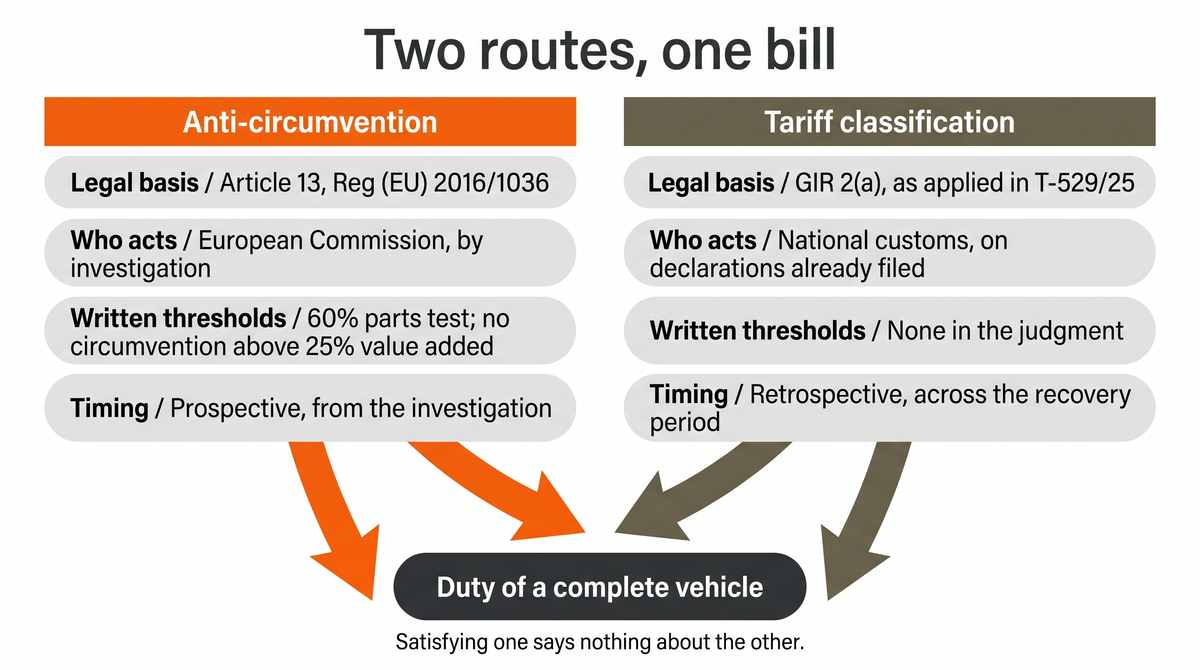
The reason this judgment surprised a lot of well-advised companies is that they were watching a different rule. Both routes end at the duty applicable to a complete vehicle; they get there by different means and are administered by different people.
| Anti-circumvention | Tariff classification | |
|---|---|---|
| Base juridique | Article 13, Regulation (EU) 2016/1036 | GIR 2(a), plus T-529/25 |
| Who acts | The Commission, by investigation | National customs, on declarations already filed |
| Written thresholds | Yes — a 60% parts test, and no circumvention where value added exceeds 25% of manufacturing cost | None in the judgment |
| Trigger | A finding covering a practice or a country | Objective factors in your own paperwork |
| Timing | Prospective from the investigation | Retrospective over the recovery period |
Our companion piece on import duty electric bikes from China to EU sets out the first column — the regimes, the rates, and the 25% value-added provision. This article is the second column. A European assembly operation has to satisfy both, and satisfying one says nothing about the other.
How far back this reaches
Customs authorities can normally reopen declarations for three years, and longer — up to ten in several member states — where criminal proceedings are possible. That is the practical content of this judgment for most readers: the cargo bike parts import duty you booked three years ago is reviewable, so it changes what is already on file more than it changes next quarter.
Two consequences are worth planning around. Each national customs authority will apply the test in its own way until the position is settled, so a group importing through more than one member state can get different answers for the same flow. And because the measure attaches to components from outside the EU generally, not only to China, the same reasoning can reach into preferential origin claims under free trade agreements.
None of this argues for stopping European assembly. It argues for treating the import file as a compliance deliverable with the same seriousness as the product file — which is the approach we take to fabrication de vélos cargo et fabrication de cadres documentation, and which belongs in the buying sequence set out in achat de vélos cargo.
What helps, and what does not
What helps is unglamorous: contemporaneous records of why each classification was chosen, purchase documentation that reflects how you actually buy, a current exemption authorisation, a BTI for anything genuinely unclear, and evidence of the assembly work itself. For fleet-scale programmes, where configuration drives the parts flow, the same records also answer the questions in our vélo cargo commercial guide.
What does not help is structural cleverness. Spreading one project across several companies addresses exactly one of the four factors the Court listed, and leaves the other three — the build-quantity arithmetic, the reference numbers, the switch away from complete vehicles — fully visible. Nor does declaring parts under a different heading help, since classification is the thing being assessed. If your assembly operation is real, the answer is to make it legible. If it is not real, no amount of documentation will survive the examination, and the EPPO case shows what that examination can escalate into.
If you want a landed-cost position worked out on your actual bill of materials and your actual flow rather than on a generic rate, that is the conversation to have through our Service ODM ou directement avec le Équipe UnitedMobility.
FAQ
Does this mean importing parts is now illegal?
No. Importing components for genuine assembly remains lawful and ordinary. What changed is that parts arriving as a split consignment may be classified as the complete article, so the duty outcome can differ from what each individual declaration suggested.
Do the shipments have to arrive together for this to apply?
No, and that is the change. Simultaneous presentation to customs is now one indication among others rather than a precondition. The Court found that GIR 2(a) sets no time limit for presenting components.
How many parts make a vehicle for this purpose?
The judgment gives no threshold. The test is whether the components carry the essential character of the complete article — judged on objective factors at clearance, not on a percentage. Where it is unclear for your bill of materials, that is exactly the case for binding tariff information.
Can we get an advance ruling on our specific flow?
You can apply for a BTI on a product, before import, and it binds all EU customs administrations and you for three years. It cannot be issued retroactively and it does not bless an import pattern, so treat it as certainty about classification rather than as clearance for a programme.
Does this affect parts from countries other than China?
The classification reasoning is not country-specific. It applies wherever components presented unassembled or disassembled would, as a whole, be classified differently from the sum of the parts — which can also touch preferential origin claims.
 French
 English
 German
 Dutch
 Danish
 Polish
 Portuguese
 Spanish