
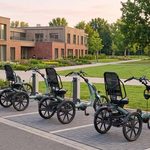
Le marché néerlandais du tricycle électrique pour seniors est en pleine mutation : du système de remboursement qui a donné naissance à cette catégorie au marché de détail qui assurera son développement. Les municipalités néerlandaises accordent chaque année de moins en moins de subventions pour les tricycles WMO, au moment même où les statistiques nationales de sécurité révèlent une augmentation record du nombre de chutes de deux-roues chez les seniors. Cet article analyse cette évolution comme un distributeur ou une marque devrait le faire : comme une cartographie des canaux de distribution. Les Pays-Bas constituent le premier chapitre de notre histoire. Analyse du marché européen des tricycles pour seniors couvrant cinq pays.
Les trois conclusions principales :
- La demande est en hausse et documentée. 2025 a été la pire année jamais enregistrée pour les cyclistes néerlandais âgés — et les mécanismes d'accident pointent directement vers le format à trois roues et siège.
- Le circuit de remboursement se réduit. Les municipalités sont restrictives quant aux subventions de l'OMM et les remplacent souvent par un scooter motorisé ; le segment en croissance finance désormais lui-même ces subventions.
- Les rayons des magasins n'appartiennent à personne. Certaines marques contrôlent le canal WMO ; l’acheteur qui paie lui-même, sensible au design et à des prix abordables, n’est pas représenté. C’est là que réside le point d’entrée.
Le reste de cet article développe chaque conclusion, en expliquant le mécanisme qui la sous-tend.
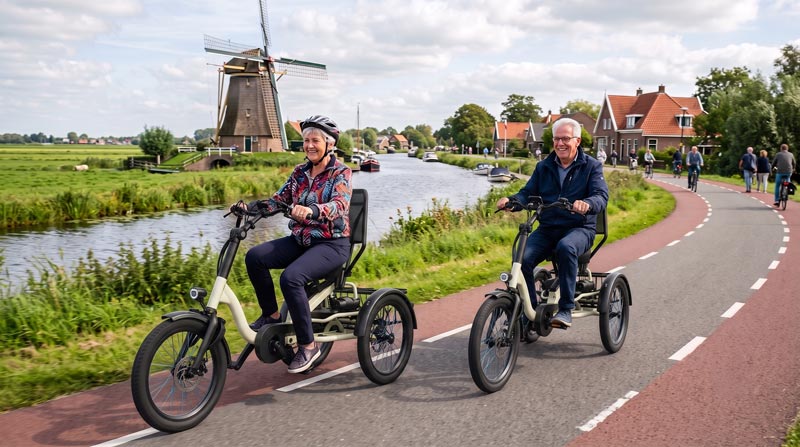
1. L'argumentaire de la demande : les données de sécurité de 2025 ont influencé le marketing
Statistiques nationales néerlandaises pour 2025 enregistrées 759 décès sur les routes, et la hausse la plus marquée est venue des hommes plus âgés à vélo : 118 décès de cyclistes parmi les hommes de plus de 70 ans, soit quarante de plus que l'année précédente. Au moins 411 000 des décès de cyclistes impliquaient un vélo électrique. Le SWOV, l’institut national de sécurité routière, ne considère plus ce chiffre comme un cas isolé : ses projections indiquent une augmentation des accidents graves à vélo jusqu’en 2040, principalement chez les personnes âgées.
Deux détails de la recherche sont plus importants pour cette catégorie que le titre :
- Environ un tiers des décès de cyclistes sont dus à des accidents impliquant un seul véhicule. Aucune voiture n'était impliquée. Il s'agissait simplement d'une chute.
- SWOV identifie la perte d'équilibre à basse vitesse — en particulier lors de la montée et de la descente — comme un mécanisme d'accident récurrent parmi les cyclistes plus âgés.
Aucun des deux n'est un problème d'infrastructure. Ce sont deux problèmes de conception de véhicule, et une plateforme à trois roues avec un siège et un accès facile y répond directement — l'argument structurel sous-jacent à ce format que nous avons analysé en détail dans la nouvelle tendance des tricycles semi-couchés en Europe.
Un détail souvent négligé : les chiffres de SWOV concernant le risque par kilomètre pour les cyclistes âgés sont stables, voire en légère amélioration. Le vélo n’est pas devenu plus dangereux. Les seniors néerlandais pratiquent simplement plus de vélo, plus tard dans leur vie, et de plus en plus souvent le vélo électrique. La courbe des pertes est une courbe de demande. Chaque année, le nombre de personnes qui devraient passer du vélo au tricycle augmente, et les Néerlandais ne renoncent pas pour autant à ce mouvement. Ils cherchent au contraire des solutions pour continuer à pédaler.
2. L'OMM se retire, ce qui modifie le profil de son client.
Comment fonctionne le processus de remboursement sur papier
Un résident dont le handicap physique rend la conduite d'un deux-roues dangereuse peut déposer une demande auprès de la mairie. L'OMM. Après une évaluation (généralement de 8 à 12 semaines, habituellement appuyée par un ergothérapeute et une déclaration du médecin généraliste — la municipalité peut fournir un driewielfiets, avec un revenu dépendant eigen bijdrage Les données sont collectées via le CAK. L'assistance électrique n'est prise en charge que sur justification médicale. PGB (persoonsgebonden budget) variante permet au demandeur de choisir lui-même le modèle et le fournisseur.
Que se passe-t-il en pratique ?
Le mouvement est à sens unique. ANBO-PCOB, la plus grande organisation néerlandaise de personnes âgées, affirme clairement que les municipalités sont devenues chevaux Terughoudender — de plus en plus réticente — à accorder un driewielfiets, et conseille ouvertement à ses membres d'envisager l'achat auprès d'un particulier. La logique d'éligibilité explique pourquoi : le déclin purement lié à l'âge ne constitue pas un motif valable, l'usage “ récréatif ” est exclu, et la gemeente ne doit au demandeur que le solution adéquate la moins chère.
La fourche Scootmobiel — le vrai concurrent
Dans la salle d'évaluation, la solution adéquate la moins coûteuse n'est souvent pas un tricycle du tout. C'est un scooter — la subvention municipale par défaut, moins coûteuse pour la commune, et le dispositif que les familles néerlandaises redoutent en silence car il marque le fin de l'enfournissement plutôt que de sa simple continuation. Même l'ANBO-PCOB avance explicitement l'argument de la santé : sur un vélo à pédales, on continue à solliciter les muscles des jambes ; un scooter électrique, lui, les en prive.
Toute marque entrant sur ce marché devrait axer sa communication néerlandaise précisément sur cette fourchette — blijven fietsen (continuer à faire du vélo) versus accepter le scootmobiel — parce qu’il s’agit du moment de décision que chaque acheteur potentiel vit réellement.
3. Ce que veut l'acheteur néerlandais au détail — trois conséquences sur le produit
Si l'on exclut tous ceux qui ont droit à une subvention, le marché restant — plus important — est celui des cyclistes actifs de 60 à 75 ans : toujours à vélo, de plus en plus mal à l'aise aux intersections et aux arrêts, payant de leur poche (les tricycles pour adultes aux Pays-Bas se vendent environ entre 1 500 et 5 000 €, les modèles électriques étant les plus chers), et ne voulant pas être vus sur un engin qui annonce le déclin.
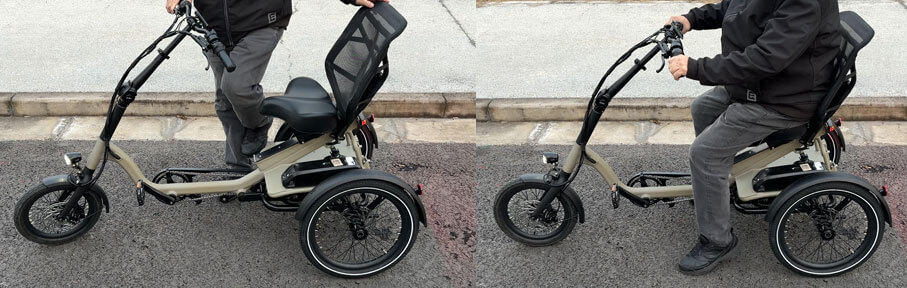
L'entrée assise est préférable à l'entrée basse.
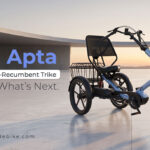
Les acheteurs néerlandais possèdent déjà des cadres à enjambement bas ; grande instap C'est la base. Ce qu'aucun deux-roues ne peut offrir — et que les données sur les accidents confirment — c'est la possibilité de s'asseoir. dans le véhicule plutôt que de se balancer par-dessus. C'est là que la géométrie semi-couchée du UM Chill Elle trouve naturellement sa place dans un showroom néerlandais : le pilote s’assoit comme sur une chaise, les deux pieds en avant, ce qui élimine complètement le moment de monter et de descendre de l’équation des risques.
La largeur et le volume de stockage sont les objections néerlandaises.
Les plaintes des cyclistes et des concessionnaires néerlandais se concentrent sur le rayon de braquage et la largeur des routes étroites. vélo, et où la machine est entreposée la nuit — les remises des maisons mitoyennes n'ont jamais été conçues pour un tricycle de taille normale. Un format compact et facile à transporter comme le UM Vita‘Elle répond à l'objection que les concessionnaires néerlandais entendent le plus souvent, avant même qu'elle ne soit soulevée.
Un design démédicalisé est le prix d'entrée.
L'acheteur particulier est, par définition, la personne que le système médical a rejetée – ou qui a refusé d'y entrer. C'est le langage du design des vélos urbains, et non l'esthétique des équipements de rééducation, qui permet à un vendeur de proposer ses services à une personne de 63 ans qui “ n'en a pas encore besoin ”. Un design démédicalisé, c'est précisément ce dont nous avons besoin. solution de tricycle électrique pour seniors est conçu autour de cela.
4. Stratégie de distribution : vendre à proximité de l'OMM, et non à l'intérieur.
Le marché néerlandais des vélos de cette catégorie ne se limite pas aux magasins de vélos classiques. Il s'agit d'un réseau de revendeurs spécialisés en mobilité et de distributeurs hybrides de vélos et de fauteuils roulants, étroitement liés au processus de certification WMO : essais, bilans d'ergothérapie, gestion des contrats municipaux. L'emprise de Van Raam sur ce réseau, fruit de plusieurs décennies de certification WMO, est bien réelle et ne justifie pas une attaque frontale.
La solution viable est indirecte. Ces mêmes revendeurs constatent une stagnation des volumes de vente de matériel de musculation tandis que la fréquentation des magasins privés augmente – et la plupart ne proposent aucun fauteuil semi-allongé de milieu de gamme crédible pour les clients payant eux-mêmes. Un distributeur offrant précisément cela – un produit grand public conforme à la norme EN 15194 (voir notre Guide de conformité de l'UE), une marge favorable au commerce de détail, une conception démédicalisée — est combler un manque en rayon, pas combattre un concurrent en place. Le mécanisme PGB constitue un levier secondaire utile : il offre à l’utilisateur final la liberté de choisir son fournisseur, permettant ainsi à un distributeur de servir un client disposant d’un budget sans que le produit ne soit jamais soumis à l’appel d’offres municipal.
5. Aux Pays-Bas, la fabrication d'un tricycle électrique pour seniors commence en usine.
Tout ce qui précède converge vers un cahier des charges produit auquel les tricycles disponibles sur catalogue ne répondent pas : une position assise semi-allongée, un encombrement adapté aux parkings à vélos et aux abris de jardin, la conformité à la norme EN 15194 à des prix accessibles au grand public, et un design qui a sa place dans un magasin de vélos, et non dans une maison de retraite.
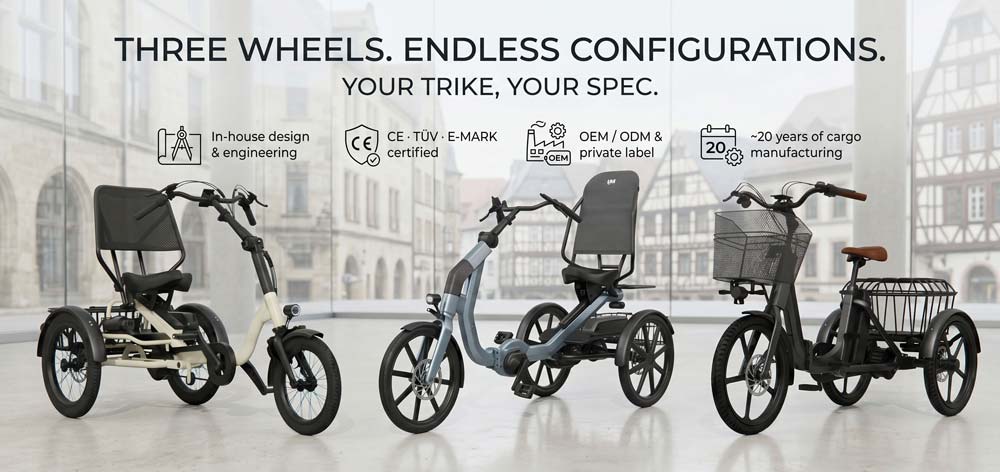
Ce cahier des charges concerne le travail d'ingénierie, et non le travail d'approvisionnement — et c'est le travail. Mobilité unie En tant que fabricant OEM/ODM spécialisé dans les tricycles électriques et semi-couchés, nous développons les plateformes Vita et Chill en fonction des exigences spécifiques de ce marché et nous les adaptons aux besoins de nos partenaires commerciaux : géométrie du cadre, hauteur et configuration du siège, empattement et rayon de braquage, options de transmission et composants spécifiques au marché néerlandais sont tous personnalisables selon les spécifications du commerce de détail néerlandais. Comparez modèles de tricycles électriques dans notre formation actuelle.
Si vous évaluez ce marché en tant que distributeur, importateur ou marque, Contactez notre équipe d'ingénieurs à propos d'une spécification adaptée aux Pays-Bas — ou commencez par notre liste de contrôle d'évaluation du fabricant pour connaître les questions qu'il vaut la peine de poser à n'importe quelle usine, y compris la nôtre.
FAQ
Un tricycle électrique pour seniors aux Pays-Bas peut-il être remboursé par l'OMM ?
Parfois, mais de moins en moins souvent. La municipalité n'accorde un vélo électrique que lorsqu'une limitation physique rend un deux-roues réellement dangereux, et l'assistance électrique doit être justifiée séparément. L'âge seul ne constitue pas un motif suffisant, et les municipalités proposent de plus en plus souvent un scooter électrique comme alternative moins coûteuse. La plupart des cyclistes actifs âgés de 60 à 75 ans finissent par acheter un vélo électrique à titre privé.
Quel est le prix d'un tricycle électrique pour seniors dans le commerce aux Pays-Bas ?
Entre 1 500 et 5 000 € environ. Les modèles non électriques se situent en bas de la fourchette, tandis que les modèles électriques semi-allongés sont en haut. Dans le cadre d'une subvention de l'OMM ou d'un PGB, l'utilisateur final paie rarement le prix de détail complet, ce qui explique la différence notable entre les segments du remboursement et de la vente au détail.
Pourquoi choisir un tricycle plutôt qu'un scooter électrique ?
Le tricycle permet de pédaler, préservant ainsi la force des jambes, l'activité cardiovasculaire et le sentiment d'appartenance à la communauté cycliste, éléments essentiels de la culture néerlandaise. Le scooter électrique, quant à lui, est un mode de transport passif. Les associations de seniors néerlandaises mettent d'ailleurs en avant cet argument santé dans leurs conseils à leurs membres.
Les tricycles semi-couchés sont-ils pratiques sur les pistes cyclables étroites des Pays-Bas ?
La largeur et le rayon de braquage sont les deux objections les plus fréquemment rencontrées par les concessionnaires néerlandais, et elles sont tout à fait justifiées. C'est pourquoi une géométrie compacte doit être un critère de sélection, et non une simple option. Les modèles conçus pour les largeurs de voies européennes, comme le UM Chill, sont pensés précisément en tenant compte de cette contrainte.
Nous sommes distributeurs — le produit peut-il être adapté spécifiquement au marché néerlandais ?
Oui. En tant que partenaire ODM, United Mobility adapte la hauteur d'assise, les options de dossier et d'appui-tête, l'empattement, le rayon de braquage, les systèmes de transmission et les finitions aux spécificités du marché, et assure la conformité à la norme EN 15194 pour l'importation dans l'UE. Les exigences propres aux Pays-Bas — encombrement réduit dans le coffre, style épuré, accès facilité — sont au cœur du développement du Vita/Chill.
 French
  English
  German
  Dutch
Dutch  Danish
  Polish
  Portuguese
  Spanish