




Freight transport has always been about scale. Bigger vehicles, longer routes, faster highways.
But in dense cities, scale is no longer the advantage it once was.
Across the US and Europe, last-mile delivery now accounts for the highest share of delivery cost, delay, and emissions. City logistics has become the weakest—and most expensive—link in the freight transport chain. This is where cargo bikes are no longer experimental. They are becoming operational tools.
This article looks at why major freight transport companies are integrating cargo bikes, also called freight bicycles, what conditions make them work, where they do not, and what kind of cargo bike solutions actually make sense for professional freight transport.
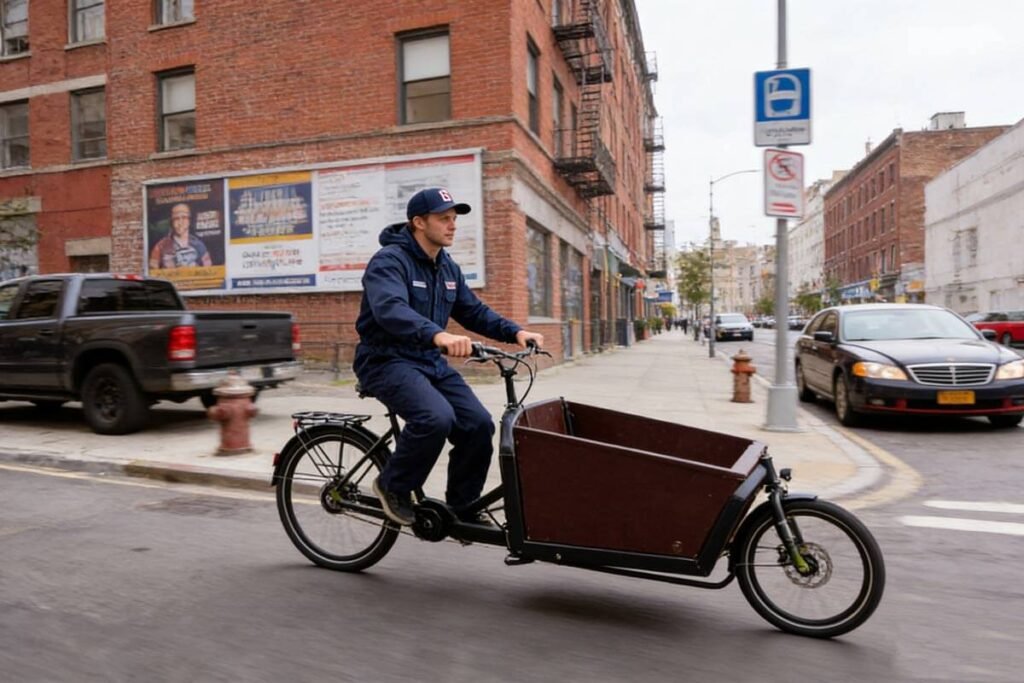
Freight Transport Meaning Today: Why the Last Mile Dominates Cost and Risk
Traditionally, freight transport by road focused on long haul and regional distribution.
Today, the economics have shifted.
Multiple industry studies show that the last mile represents 30–50% of total delivery costs, despite covering a fraction of the distance. In dense cities, congestion, parking restrictions, failed delivery attempts, and labor inefficiencies quickly erase the advantages of vans and trucks.
At the same time:
- Urban land is becoming more regulated and more expensive
- Cities are restricting freight access by time, zone, or vehicle size
- Consumers expect same-day or next-day delivery at low cost
This forces freight transport companies to rethink vehicle selection, routing, and fleet composition—not just speed.
How Major Freight Transport Companies Use Cargo Bikes in City Logistics
Cargo bikes are not replacing trucks.
They are restructuring freight logistics at the urban edge.
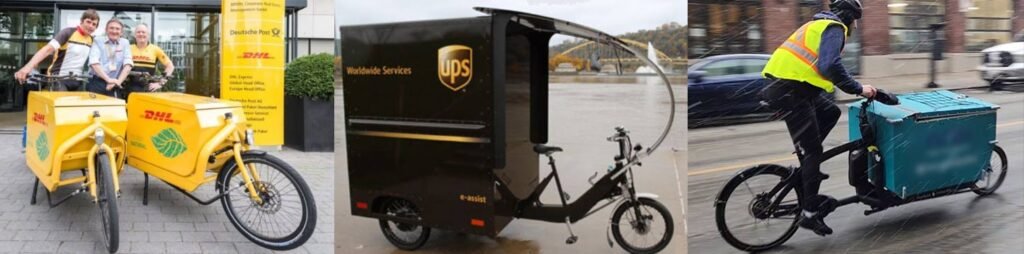
UPS, Amazon, DHL: Strategy Patterns That Matter
UPS
UPS has deployed electric cargo bikes in cities such as New York, Hamburg, Paris, and London through micro-depots. The pattern is clear: trucks handle bulk transport to the city edge; cargo bikes complete dense urban routes where parking and congestion slow vans.
DHL
DHL’s Cubicycle program uses purpose-built freight bikes with enclosed cargo boxes. Reported outcomes include shorter delivery times per stop and reduced failed deliveries in pedestrian-heavy zones.
Amazon
Amazon has piloted cargo bikes in European capitals and selected US cities, primarily for short-radius routes tied to urban fulfillment centers. The goal is not branding—it is route reliability under urban constraints.
The shared conclusion:
Cargo bikes are most effective when distance is short, stops are frequent, and traffic unpredictability is high.
Why Governments Are Accelerating Cargo Bike Freight Transport
City logistics is no longer only a business problem—it is a policy issue.
Across the US and Europe, public authorities are:
- Charging congestion fees or tolls for larger vehicles
- Limiting delivery windows in city centers
- Expanding bike lanes that are legally accessible to cargo bikes
- Offering local incentives or pilot funding for zero-emission freight
Policies vary by city and change frequently. If you operate across regions, you must monitor local transport authorities, DOT programs, municipal pilot tenders, and urban mobility plans rather than relying on national headlines.
The direction, however, is consistent: lighter, quieter, lower-impact vehicles gain access where trucks lose it.
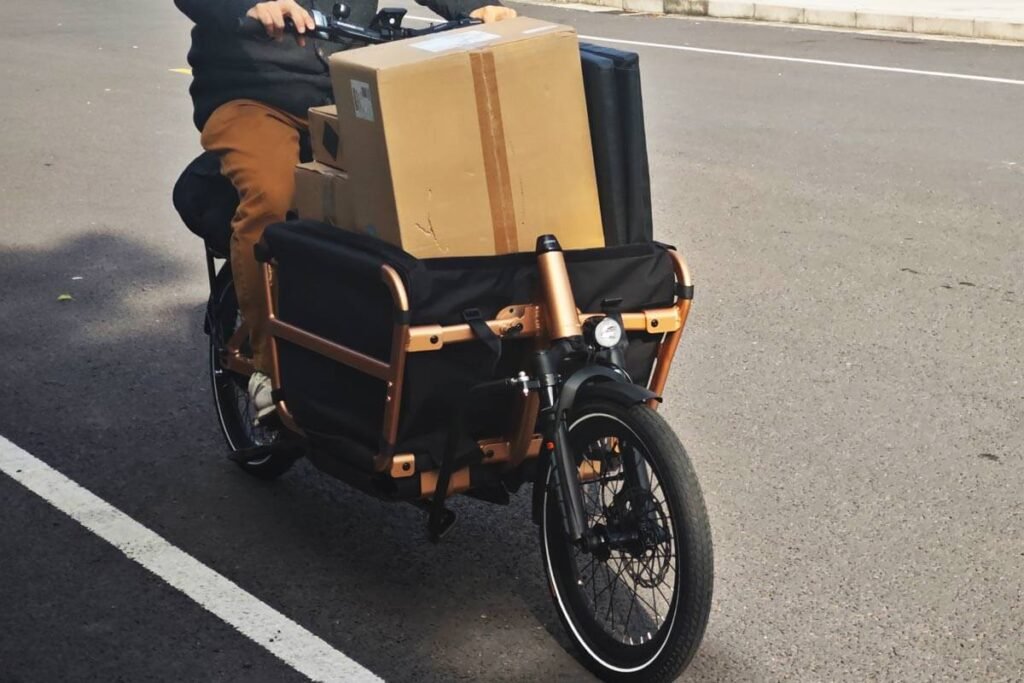
When Cargo Bikes Work—and When They Don’t
Cargo bikes are not universal freight transport solutions. Unlike usual family bike, they succeed under specific conditions.
1. Distance and Destinations
Cargo bikes excel within 2–8 km service radiuses, especially in high-density areas. They struggle with long suburban routes or dispersed rural deliveries.
2. Time Sensitivity
For routes with many short stops, cargo bikes often outperform vans. For single large or time-critical loads over distance, they do not.
3. Budget
Lower vehicle cost, minimal fuel expense, and simpler maintenance reduce total cost of ownership. However, payload and volume limitations remain real constraints.
4. Environmental and Public-Facing Roles
Many freight operators use cargo bikes not only operationally but also strategically—as visible proof of sustainable logistics.
What Freight Transport Really Needs from a Cargo Bike
Many cargo bikes on the market are built for families or lifestyle use.
Freight transport requires different priorities.
Frame Strength and Durability
A freight cargo bike must withstand daily loading cycles, curb impacts, and uneven surfaces. This requires reinforced frame design, verified fatigue testing, and strict quality control—not just higher payload numbers on paper.
Simple, Reliable Operation
Drivers should get on and ride with minimal training. Over-complex displays or unnecessary features reduce uptime.
Tailored but Practical Drivetrains
Drivetrain choices matter:
- Hub motors are simple and low-maintenance
- Mid-drive motors offer higher torque for loaded starts and gradients
The right choice depends on route profiles, not marketing claims.
“Ready-to-Deploy” and Customizable
Most operators need both:
- Standardized, quick-deployment models
- Tailor-made cargo bike solutions aligned with parcel size, load type, and branding
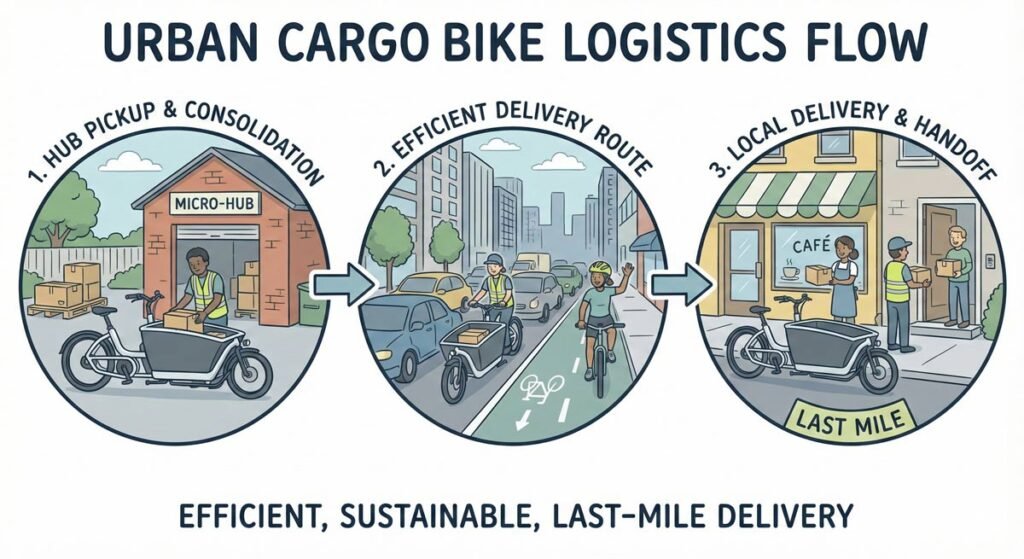
Cargo Bikes Inside Future Smart Mobility Systems
Cargo bikes do not operate alone.
They increasingly integrate with:
- Micro-hubs and urban consolidation centers
- Electric vans and intermodal freight transport
- Smart routing software and fleet management systems
In this system, cargo bikes function as precision delivery tools, not compromises.
A Practical Conclusion for Freight Transport Decision-Makers
If you manage freight logistics today, the question is no longer whether cargo bikes belong in city logistics.
The real questions are:
- Where do they reduce cost and delay today?
- Which routes benefit from lighter, more flexible vehicles?
- What specifications actually survive daily freight use?
Answering these questions requires more than buying bikes off a catalog. It requires understanding real delivery conditions and working with partners who can engineer around them.
How United Mobility (UM) Fits into Freight Transport Solutions
At UM, we focus on cargo bike ODM development for professional freight use.
We work with logistics operators, platforms, and public projects that need:
- Proven frame durability
- Application-specific configurations
- Both standardized and customized production options
If you are exploring cargo bikes as part of your freight transport strategy, we can help you assess feasibility, specifications, and cost structures—before you commit.
Talk to us for a professional evaluation or quotation based on your real delivery scenarios.
 English
  German
  Dutch
Dutch  Danish
  French
  Polish
  Portuguese
  Spanish