





In the cargo e-bike world, the choice of motor often makes or breaks the ride experience. Among all the electrical parts (battery, drivetrain, brakes), the motor is the heart. In cargo applications, a mid-drive motor usually offers better performance, flexibility, and efficiency than a hub motor—if you pick the right one.
If you’re exploring new opportunities in the cargo e-bike market — from expanding your existing e-bike range to sourcing tailor-made models for logistics or city mobility — understanding mid-drive motors is the first step toward building reliable, high-performance products. Below I break it down for you.
What Is a Motor — And Why Mid-Drive Matters More in Cargo Use
Motor Types: Hub Motor vs Mid-Drive
- Hub motors mount in the wheel hub (front or rear). Simpler design, less interference with chain, easier to install.
- Mid-drive motors sit at the crank area and drive through the bike’s gears. That gives you better torque distribution and more responsive control.
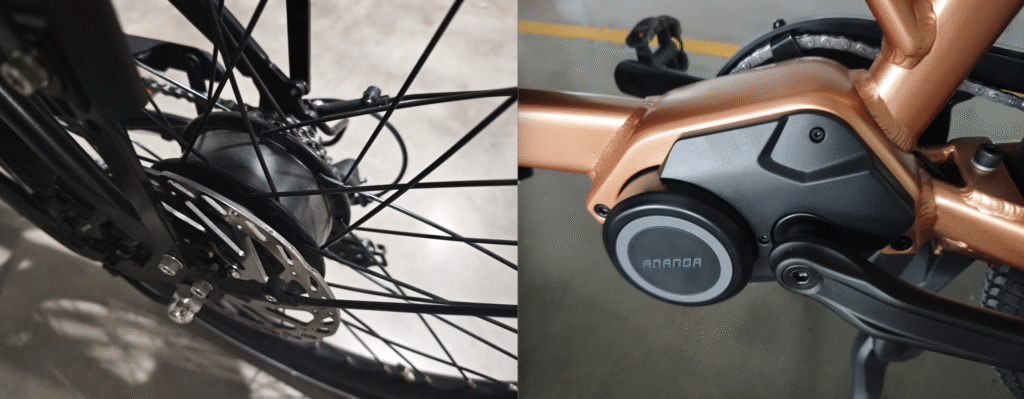
In a cargo bike, the motor influences how heavy loads feel, how well the bike handles hills, and how battery consumption behaves. A weak motor in a cargo bike will drain battery quickly or strain components. For example, pairing a 90 Nm mid-drive motor with a low-quality 36 V battery will cause overheating and early power loss — especially on long climbs with heavy loads. That’s why most premium cargo e-bikes in the EU now use 48 V systems with smart BMS and torque sensors, giving smoother power delivery and longer range.
Other components like battery, drivetrain, and sensors must be matched to the motor. A powerful mid-drive demands good battery capacity and robust gear systems.
Why Mid-Drive Motors Are Preferred in Cargo E-Bikes
Cargo vs Regular E-Bike Demands
Cargo e-bikes carry much heavier loads (often 300–550 lbs including rider + cargo). So torque, thermal management, and durability matter more than for a commuter e-bike. European regulations (EN 15194, EN 17860, local vehicle classes) often limit motor power to 250 W continuous, but torque and assist curve are key.
Performance Benefits
- Better climbing with heavy loads
- More efficient use of battery because the motor works in favorable gear ratios
- More control when starting/stopping under load
- Easier integration with multiple chainrings or gearboxes
If you want to understand how motors perform in real-world conditions — from power delivery to noise levels — you can also check our guide on How to Test an Electric Bike Motor. It explains practical methods for evaluating motor efficiency and reliability before placing bulk orders or integrating into your cargo bike design.
At Eurobike 2025, several brands announced new mid-drive motors with higher torque, better heat dissipation, and more integration.

Notable Mid-Drive Brands & Key Features
| Brand | Key Features |
|---|---|
| Bosch | Precision engineering with a closed ecosystem, offering unmatched reliability and wide service coverage across Europe. However, it limits custom integration for OEM/ODM projects. |
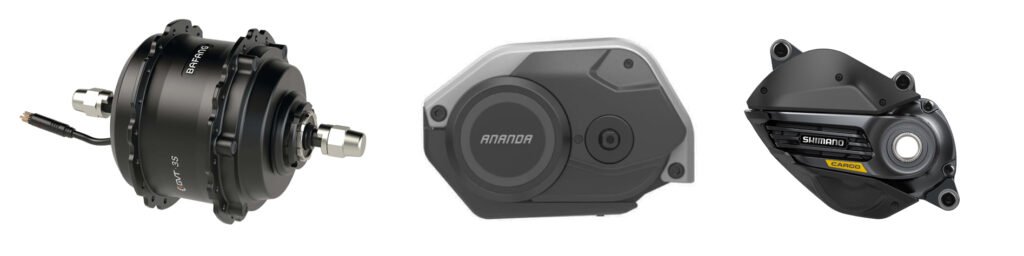
| Shimano | Delivers stable, quiet, and durable performance, though torque feedback and software adaptability are somewhat limited compared to premium systems. |
| Yamaha | A pioneer in e-bike drive systems, known for smooth and natural power delivery, low-noise operation, and PWseries motors with up to 85 Nm torque — perfect for longtail and front-loading cargo bikes. |
| BAFANG | Open architecture design with broad compatibility, ideal for manufacturers needing flexibility in tuning and design for various cargo e-bike models. |
| Ananda | Offers balanced torque performance and localized support centers in Europe, suitable for mid- to high-end cargo bike configurations. |
If you are building a cargo brand or distribution line, pick motor suppliers with deep experience in cargo or mid-drive applications, strong logistics support, and flexible customization capability.
Matching Motor to Cargo Bike Types
Different cargo bike geometries put different load and torque demands on the motor. Here’s how they map:
- Longtail (rear loading)
These often benefit from mid-drive because the motor can push through the gears for carrying kids or goods. - Front-loaders / Bakfiets
The front weight distribution means torque control and smooth response is key — mid-drive helps manage that. - Electric trikes / semi-recumbent trikes
For electric trikes and semi-recumbent trikes designed primarily for comfort, stability, and daily mobility—not heavy hauling—mid-drive motors are not always the most practical choice. - Compact cargo pedelecs or foldable cargo
Moderate loads, smaller frames — mid-drive motors with moderate torque are ideal to avoid overstrain and keep weight manageable.
In Europe many cargo models adopt 48 V systems and motor torque in the range 90–130 Nm for practical usage under regulation limits.
Key Technical Specs to Scrutinize
When you evaluate mid-drive motors for your cargo range, pay close attention to:
- Rated torque and peak torque
- Efficiency across RPM range
- Thermal management / cooling design
- Compatibility with multiple chainrings / gear sensors (can a mid drive motor support multiple chain rings?)
- Noise and vibration levels
- Weight and size (compact designs reduce frame constraints)
- Serviceability and spare parts availability
- Warranty, firmware upgrade support, diagnostics tools
Also evaluate how the supplier’s motor works with belt drive systems, with high-step loads, and under sustained heavy use.
Common Questions
- What is a mid drive motor? — It’s a motor located at the crank, using the drivetrain to multiply torque.
- How does a mid drive motor work? — It amplifies pedal force through gears before sending power to the wheel.
- Which is better: hub motor or mid drive motor? — For cargo, mid-drive typically offers better climbing, efficiency, and control.
- Are hub drive motors more durable than mid drive motors? — Hub motors are simpler and sealed, but mid-drives give better load versatility.
- Which is more efficient: hub motor or mid-drive? — In heavy-load scenarios, mid-drive is often more efficient due to gear advantage.
- How to install mid drive motor? — Requires a compatible bottom bracket shell, correct torque sensors, gear sensor, and controller integration.
- Can a mid drive motor support multiple chain rings? — Yes, if the motor and controller support gear sensors and crank interface.
- Which is quieter: geared hub motor or mid drive? — High-quality mid-drives can be very quiet; modern geared hub motors also improved.
Why You Want Us as a Partner
When you configure cargo e-bikes for your market, the choice of motor supplier defines your product’s performance, reliability, and after-sales trust. You need a supplier that:
- Has real experience in cargo and mid-drive systems
- Can customize firmware, torque curves, and interface
- Has spare parts and technical support across Europe
- Offers flexibility in pricing and configuration per model or region
We at United Mobility are more than just a bike manufacturer — we integrate motor, battery, drivetrain, and frame into one system. Our supply chain covers motors, controllers, sensors; we design with modularity to allow “mix & match” based on your fleet needs. With nearly two decades of experience, we help you avoid mismatches and deliver a cargo e-bike your market trusts. Feel free to contact us for a customized cargo bike solution.
 Spanish
  English
  German
  Dutch
Dutch  Danish
  French
  Polish
  Portuguese